
5W AI VISIBILITY INDEX · MAY 2026 RELEASE · TRAVEL & HOSPITALITY
America's Biggest Airline? AI Acts Like It Doesn't Exist
The largest U.S. carrier by capacity and the largest hotel chain by property count are not the brands the answer engines recommend. New 5W research ranks the 25 travel brands by how often AI names them.
Published June 28, 2026
The Headlines
Delta doesn't fly the most seats. It wins the answer anyway.
American is the largest U.S. carrier by capacity — and ranks fifth in citation share.
Wyndham runs the most U.S. hotels. AI barely mentions it.
Property count does not translate to citation share when the brand value is in budget franchises.
The booking sites are getting squeezed out of the funnel.
As AI engines answer travel queries directly, the OTA layer is the most exposed in the category.
Who AI names first.
TOP 15 TRAVEL BRANDS BY EST. CITATION SHARE · Q2 2026
The biggest carrier and the biggest chain are not the ones AI recommends.
American travel is a category of giants. American Airlines flies the most domestic seats. The four largest U.S. carriers together control roughly 78% of the domestic market. Marriott is the largest hotel company on earth, with about 1.7 million rooms. Wyndham operates more U.S. hotel locations than any other chain — roughly 6,400.
None of those scale leaders wins the AI answer outright. Asked "what's the best airline," the engines surface Delta — on reliability and premium service, not capacity. Asked for the "best hotel," the answer is Marriott and Hilton — on loyalty depth and brand consensus. Wyndham, the property-count leader, ranks far lower, because its brand value lives in budget franchises consumers do not ask an AI engine about by name.
This is the decoupling the 5W AI Visibility Index finds in every category it measures: AI answers default to the brands with the deepest editorial and consumer-consensus footprint — not the brands leading on capacity, property count, or raw market share. In travel, where the entire buyer journey now runs through "best airline for X" and "best hotel in Y," the brand AI names is the brand that gets booked.
"American Airlines flies the most seats. Delta wins the answer. Wyndham runs the most hotels in America. Marriott and Hilton win the answer. Scale is not citation share — and in travel, where the buyer journey now runs through 'best airline for X' and 'best hotel in Y,' the brand AI names is the brand that gets booked. Loyalty programs were built to lock in the customer. The new lock-in is being the default answer."Ronn TorossianFounder & Chairman, 5W
How we measured it.
5W analyzed more than 60 common traveler prompts across six primary sub-categories of the airline and hotel market, running each prompt five times per engine in clean sessions. We identified which brands AI models consistently surface, which review and editorial sources feed those citations, and where the biggest gaps sit between scale and AI visibility.
Network airlines
Delta, United, American, Alaska, Hawaiian.
Low-cost & ultra-low-cost airlines
Southwest, JetBlue, Spirit, Frontier, Allegiant.
Premium & luxury hotels
Marriott, Hilton, Hyatt, Four Seasons, and their luxury sub-brands.
Upper-midscale & select-service hotels
IHG, Choice Hotels, Best Western, Accor select-service brands.
Economy & extended-stay hotels
Wyndham, economy and extended-stay franchise brands.
OTAs & booking platforms
Booking.com, Expedia, Airbnb, Vrbo, Tripadvisor, Kayak, Hotels.com.
Query types tracked. Real-world prompts including "best airline," "best airline for international travel," "Delta vs United," "best hotel chain," "best hotel loyalty program," "Marriott vs Hilton," "best hotel for business travel," "is Airbnb cheaper than a hotel," "best site to book flights," and 50+ variations covering comparison, recommendation, and decision intent.
Citation sources tracked. Travel editorial (The Points Guy, NerdWallet Travel, Conde Nast Traveler, Travel + Leisure, Skift), review aggregators (TripAdvisor, J.D. Power, U.S. News Travel), traveler communities (Reddit r/travel, r/awardtravel, FlyerTalk), news coverage, and brand-owned content.
Important framing. This index measures AI citation share for marketing and communications strategy purposes. It does not rank airlines or hotels on safety, on-time performance, service quality, or value. Travel decisions should be made with independent research and current operator information.The Top 25 airline and hotel brands, ranked by AI citation share.
| # | Brand | Category | AI Visibility | Notable |
|---|---|---|---|---|
| 1 | Delta Air Lines | Network airline | Category-dominant | NYSE: DAL; not the largest by capacity, but owns the "best airline" reliability-and-premium citation surface across the engines. |
| 2 | Marriott | Premium / luxury hotels | Hotel citation leader | NASDAQ: MAR; ~1.7M rooms, ~9,300 hotels, 30+ brands; deep loyalty program and brand consensus win "best hotel" answers. |
| 3 | Hilton | Premium / luxury hotels | Hotel co-leader | NYSE: HLT; the default second name in nearly every "best hotel chain" answer; Hilton Honors anchors loyalty citations. |
| 4 | United Airlines | Network airline | Network & international tier | NASDAQ: UAL; strong "best airline for international travel" citations on the strength of its global network. |
| 5 | American Airlines | Network airline | Largest by capacity, #5 by citation | NASDAQ: AAL; the largest U.S. carrier by seats — the clearest capacity-vs-citation gap in the Index. |
| 6 | Southwest Airlines | Low-cost airline | Value default, shifting | NYSE: LUV; long the "best low-cost airline" answer; recent fare-and-boarding changes are a live citation event. |
| 7 | Hyatt | Premium / luxury hotels | Design-forward tier | NYSE: H; smaller footprint, strong "best loyalty program" and design-hotel citations. |
| 8 | Airbnb | Lodging platform | Alternative-lodging default | NASDAQ: ABNB; owns "alternative to a hotel" and "best for groups" citations — its own distinct query category. |
| 9 | Booking.com | OTA / booking platform | Global OTA leader | Owns "best site to book a hotel" citations globally; pressured as AI engines build their own travel surfaces. |
| 10 | IHG Hotels & Resorts | Upper-midscale hotels | Midscale incumbent | Holiday Inn and Holiday Inn Express anchor "reliable mid-priced hotel" citations. |
| 11 | JetBlue | Low-cost airline | Value-and-comfort niche | NASDAQ: JBLU; owns the "comfortable low-cost airline" citation intersection. |
| 12 | Expedia | OTA / booking platform | OTA challenger | NASDAQ: EXPE; cited alongside Booking.com; loses share to AI-native travel answers. |
| 13 | Alaska Airlines | Network airline | Regional-premium niche | NYSE: ALK; owns "best airline on the West Coast" citations; strong loyalty and service reputation. |
| 14 | Wyndham | Economy / midscale hotels | Most properties, low citation | NYSE: WH; the most U.S. hotel locations of any chain — but a budget-franchise brand underindexes in "best hotel" answers. |
| 15 | Four Seasons | Luxury hotels | Luxury default | Owns "best luxury hotel" citations; small footprint, outsized citation share per property. |
| 16 | Choice Hotels | Upper-midscale hotels | Value-franchise tier | NYSE: CHH; large franchise portfolio; cited mainly in value and roadside-stay queries. |
| 17 | Spirit Airlines | Ultra-low-cost airline | Price-query only | Cited almost exclusively in "cheapest flight" answers, frequently alongside fee cautions. |
| 18 | Best Western | Economy / midscale hotels | Legacy-franchise tier | Broad U.S. footprint; cited as a familiar mid-priced option, rarely as a "best" answer. |
| 19 | Accor | Premium / luxury hotels | International tier | Strong outside the U.S.; thinner U.S. citation share despite a deep luxury portfolio. |
| 20 | Frontier Airlines | Ultra-low-cost airline | Price-query only | Cited in "cheapest flight" answers; minimal share in "best airline" queries. |
| 21 | Hawaiian Airlines | Network airline | Destination niche | Owns "best airline to Hawaii" citations; narrow but uncontested. |
| 22 | Tripadvisor | Review / booking platform | Review-source tier | More valuable to AI as a citation source than as a cited brand; surfaces in "best things to do" queries. |
| 23 | Kayak | OTA / metasearch | Metasearch niche | Cited in "compare flight prices" queries; thin share elsewhere. |
| 24 | Vrbo | Lodging platform | Vacation-rental niche | Cited as the "Airbnb alternative for whole homes"; small but defined share. |
| 25 | Hotels.com | OTA / booking platform | Booking-channel tier | Cited in hotel-booking queries; share compressed between Booking.com and AI-native answers. |
The brands winning the AI answer.
▲ Delta — the Reliability Answer
Delta does not fly the most seats, but it owns the "best airline" citation surface. Years of operational-reliability coverage, premium-cabin investment, and consistent traveler consensus made Delta the brand the engines name first — a position capacity alone cannot buy.
▲ Marriott and Hilton — the Hotel Duopoly
AI answers to "best hotel chain" almost always surface Marriott and Hilton together. Their depth of brands, loyalty-program scale, and decades of editorial coverage make them the assumed pair — newer or budget chains are treated as alternatives, not peers.
▲ Airbnb — the Category It Owns Alone
Airbnb owns "alternative to a hotel" and "best for groups and families" — queries no hotel brand competes for directly. By being its own citation category, Airbnb captures share the hotel groups leave untouched.
▲ Hyatt — the Loyalty Citation
Hyatt's footprint is a fraction of Marriott's, yet it punches above its size by owning the "best hotel loyalty program" citation — a narrow, high-intent query where reputation beats room count.
The brands AI is leaving behind.
▼ Wyndham and the Property-Count Trap
Wyndham operates more U.S. hotels than any other chain, but its citation share is a small fraction of Marriott's. Its value lives in budget franchises consumers do not ask an AI engine about by name — scale that does not translate to the answer.
▼ Ultra-Low-Cost Carriers
Spirit and Frontier surface almost exclusively in "cheapest flight" answers, frequently next to fee and reliability cautions. They have volume, but they have not earned a place in the "best airline" citation surface.
▼ Economy & Legacy Hotel Brands
Best Western and economy franchise brands are cited as familiar, not as recommended. AI answers to "best hotel" route to premium consensus leaders, leaving legacy mid-market brands in the "reliable enough" tier.
▼ OTAs Caught Between Google and the Brands
Booking.com, Expedia, and Hotels.com face a squeeze: AI engines increasingly answer travel queries directly, and brands push direct booking. The middle layer of the travel funnel is the most exposed citation territory in the category.
Six structural truths about AI visibility in travel.
Capacity and property count do not predict citation share.
The largest carrier by seats and the largest chain by locations both rank below smaller, higher-consensus brands. Scale is not the metric AI rewards.
Loyalty programs lock in customers — they do not earn citations.
Loyalty drives repeat booking, but AI answers are won by editorial and consensus footprint. The new lock-in is being the default answer.
The "best for X" query is where travel citations are decided.
"Best airline for international," "best hotel for business," "best for families" — specific-intent queries reward brands with use-case content over generalists.
Airbnb is its own citation category.
Alternative lodging is a distinct query surface that no hotel brand contests directly — and Airbnb owns it almost entirely.
The OTA layer is the most exposed in the category.
As AI engines answer travel queries directly and brands push direct booking, the booking-platform middle is squeezed from both sides.
Reliability and service consensus is the most durable moat.
Delta's "best airline" position and the Marriott–Hilton duopoly rest on years of consensus that no single quarter of operations can dislodge.
Six 2026 dynamics reshaping travel AI citations in real time.
AI-native travel answers are disintermediating OTAs.
As the engines surface flights and hotels directly, the booking-platform citation layer is shrinking — the year's biggest structural shift in travel visibility.
The airline premium-cabin race is reshaping "best airline."
As carriers expand premium seating and segmented fares, AI answers increasingly describe airlines by cabin experience — a tailwind for Delta and United.
Southwest's model changes are a live citation event.
As Southwest evolves its fare and boarding model, its long-held "best low-cost airline" citation is in flux — and the engines are slow to update.
Hotel loyalty consolidation is concentrating citations.
As loyalty programs deepen and partner networks expand, "best loyalty program" answers concentrate further around Marriott, Hilton, and Hyatt.
Premium-leisure demand is front-loading luxury citations.
Sustained high-end leisure travel is pushing luxury hotel brands higher in "best hotel" answers — Four Seasons and luxury sub-brands gain share.
Airbnb's expansion is widening its citation surface.
As Airbnb pushes into experiences and services, its citations broaden beyond lodging into "things to do" — extending an already-owned category.
General tips for airline and hotel marketers.
- Audit AI citation share quarterly. Premium-cabin shifts, loyalty changes, and AI-native travel features move fast enough that anything less misses material movement.
- Win the "best for X" query, not just "best." Build use-case content — international, business, families, groups — that maps to how travelers actually ask.
- Earn the travel-editorial record. The Points Guy, Conde Nast Traveler, Travel + Leisure, NerdWallet Travel feed AI citations disproportionately. Accurate, current coverage compounds.
- Treat traveler communities as citation infrastructure. Reddit's r/travel and r/awardtravel and FlyerTalk feed a large share of recommendation citations.
- Reframe loyalty as a citation asset. Loyalty drives repeat booking — but loyalty-program editorial and reviews also feed "best program" citations. Earn that coverage.
- Build direct-booking content as AI disintermediates OTAs. As engines answer travel queries directly, the brand-owned booking surface gains citation value.
- Treat model and policy changes as citation events. Fare-structure, boarding, and benefit changes lag in AI answers — correct the record deliberately.
- Own a destination or segment niche. "Best airline to Hawaii," "best West Coast carrier" — a narrow, owned query beats competing for "best airline" outright.
- Publish honest fee and total-cost content. AI answers front-load fee framing, especially for low-cost carriers and budget hotels. Engage it directly.
- Re-audit after every major route, merger, or loyalty shift. Network and program changes reshape travel citations.
AI rewards the brands that own the consensus — not the capacity chart.
American travel is a category of scale — the biggest carriers, the biggest chains, hundreds of thousands of rooms and seats. But scale is not what AI answers reward. They run on the accumulated editorial record and traveler consensus, and they surface the brands that built a durable position there.
American flies the most seats; Delta wins the answer. Wyndham runs the most hotels; Marriott and Hilton win the answer. Everywhere the Index looks, the brand AI names is the brand with the deepest consensus footprint — not the brand with the most capacity. And as AI engines increasingly answer travel queries directly, the booking-platform layer that once sat between traveler and brand is being compressed out.
AI citation share is the scoreboard. In travel, the brand AI names is the brand that gets booked — and that position is built in editorial and consensus, not in fleet size or property count.
The Airlines & Hotels AI Visibility Index 2026.
What is the Airlines & Hotels AI Visibility Index 2026?
Which travel brand holds the highest AI citation share?
Does capacity or property count predict AI citation share?
Which AI engines were used?
What is citation share?
What other industries has the AI Visibility Index Series covered?
Related — Travel & Hospitality Indexes
New · May 2026
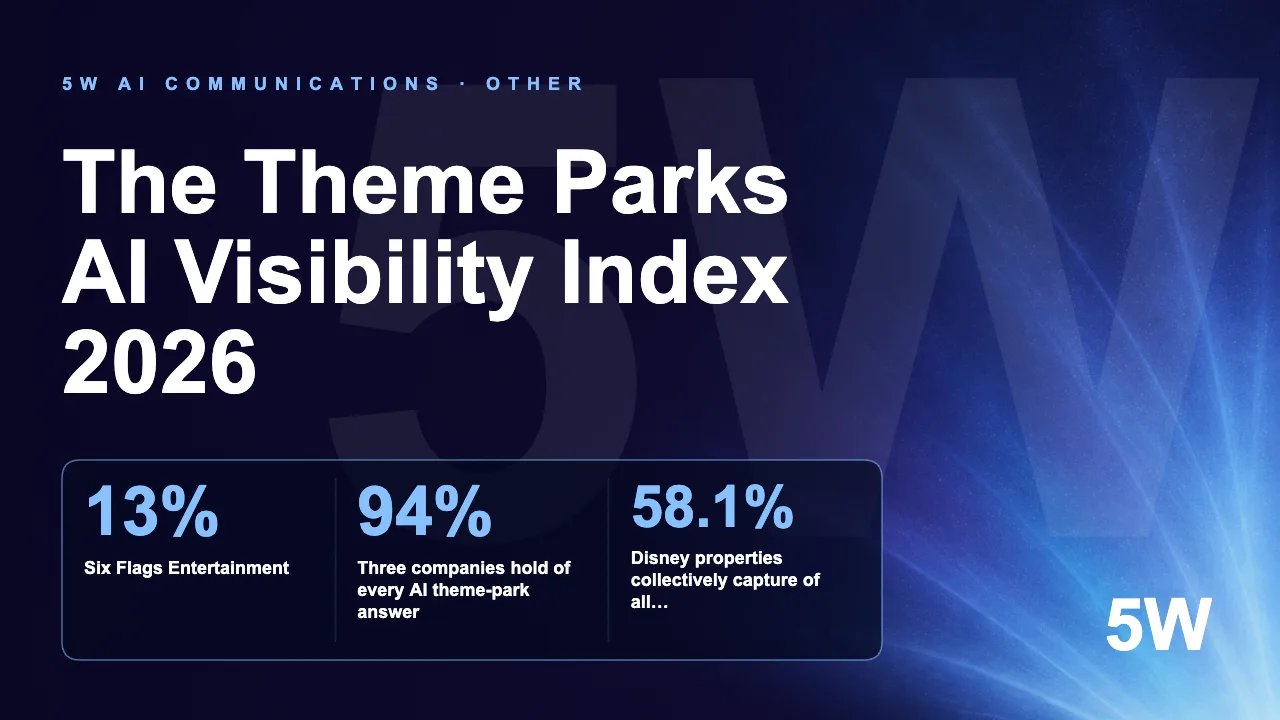
Theme Parks AI Visibility Index
Disney 58%. Universal 23%. 94% of every AI theme-park answer goes to three companies.
Travel & Hospitality
Luxury Island Resorts
Which luxury island destinations control the AI answer.
Dining
Restaurant Chains
Which restaurant chains dominate AI dining recommendations.
About this report
5W AI Visibility Index: Airlines & Hotels. Published May 2026. An installment in the 5W AI Visibility Index series. The index measures AI citation share across ChatGPT, Claude, Perplexity, Gemini, and Google AI Overviews for 60+ traveler queries tracked in Q2 2026, with each prompt run five times per engine. Citation share percentages are 5W estimates based on frequency of brand mention across tracked prompts; absolute percentages should be read as directional measures of relative visibility, not precise market measurements. This report does not constitute travel advice and does not evaluate airlines or hotels on safety or service quality.
Get in touch
Let's build your next chapter.
Tell us what you're working on. A senior strategist will respond within one business day.
- info@5wpr.com
- Phone
- 212.999.5585
- Offices
- New York · HQ469 7th Avenue, Floor 8
New York, NY 10018Miami100 SE 2nd Street, Floor 38
Miami, FL 33131Tampa110 South 12th Street
Tampa, FL 33602