Frequently Asked Questions

About the 5W Hallucination Index

What is the 5W Hallucination Index?

The 5W Hallucination Index is a metric developed by 5WPR to measure the percentage of incorrect, incomplete, or outdated facts that an AI model produces about a brand when answering core business questions. It acts as a "credit score" for your brand in AI, helping organizations understand and manage their brand risk in AI-generated content. Source

How does the 5W Hallucination Index work?

The Index tests AI models by asking a set of core business questions about a brand and then verifies each fact against primary sources such as SEC filings, press releases, and audited reports. The percentage of incorrect or outdated answers forms the Hallucination Index score. Source

What does a high Hallucination Index mean for a brand?

A high Hallucination Index indicates that a significant portion of AI-generated facts about your brand are incorrect, incomplete, or outdated. This exposes your brand to active risk, such as misinforming buyers, partners, and journalists, and can negatively impact hiring, partnerships, and reputation. Source

What are the Hallucination Index score bands?

The Hallucination Index score bands are: Under 10% (Controlled), 10–20% (Manageable risk), and 20%+ (Active brand risk). Brands above 20% are considered to be in active risk. Source

What is the typical error rate found in the fashion pilot study?

In the pilot benchmark across five major fashion brands, 20% of the answers contained material errors, such as wrong executives, outdated valuations, missing co-founders, or inaccurate company descriptions. Source

What types of errors does the Hallucination Index capture?

The Index captures errors such as incorrect leadership names, outdated financial figures, missing founders, confusion between brand and parent company details, and failure to reflect recent company transitions. Source

How often are AI-generated brand facts outdated?

AI-generated brand facts are typically 12 to 18 months behind reality, especially for leadership changes, valuations, and company status. Source

What are the five main hallucination patterns identified by 5W?

The five main hallucination patterns are: Leadership Drift, Valuation Lag, Founder Erasure, Entity Confusion, and Transition Blindness. These patterns are universal across industries and drive the Hallucination Index. Source

What is 'Leadership Drift' in the context of AI hallucinations?

'Leadership Drift' refers to AI models being 12–18 months behind on leadership data, often listing outdated executives for brands. Source

What is 'Valuation Lag' and how does it affect brands?

'Valuation Lag' means that private company valuations in AI responses often lag by one full funding round, systematically underselling brands by 20–40%. Source

What is 'Founder Erasure' in AI-generated brand content?

'Founder Erasure' occurs when AI-generated descriptions omit co-founders, especially the third or fourth-named founder, from brand histories. Source

What is 'Entity Confusion' in AI hallucinations?

'Entity Confusion' refers to AI models conflating details between a brand and its parent company, such as mixing up headquarters, revenue, or leadership information. Source

What is 'Transition Blindness' and why is it risky?

'Transition Blindness' is when AI models fail to reflect recent company transitions, such as pre-IPO, restructuring, M&A, or pivots, describing the company as if nothing changed. This can mislead stakeholders about the brand's current status. Source

How does the Hallucination Index impact hiring and partnerships?

A 25% valuation gap in AI-generated content can put brands at a 25% disadvantage in hiring and partnerships, as potential hires and partners may be misinformed about the company's value and status. Source

What are the recommended steps for brands to reduce their Hallucination Index?

Brands should audit AI outputs across all major engines, update Wikipedia/Wikidata/Crunchbase, push updated leadership and valuation data, publish structured About and leadership pages, seed accurate data across high-citation domains, document inaccuracies, and re-test every 30–60 days. Source

How does 5WPR help brands calculate and fix their Hallucination Index?

5WPR audits your brand across all five major AI engines, scores your Hallucination Index, and builds a 60-day fix plan to address inaccuracies and reduce brand risk. Source

What is the 5W AI Visibility Stack?

The 5W AI Visibility Stack consists of three components: Discovery (First-Stop Index), Authority (Citation Source Audit), and Accuracy (5W Hallucination Index). Together, they define the full AI visibility surface a brand needs to manage. Source

Which brands were included in the Hallucination Index pilot and flagship studies?

The pilot included Ralph Lauren, Tommy Hilfiger, Skims, Allbirds, and Vuori. The flagship study expands to 15 brands, including Calvin Klein, Coach, Kate Spade, Michael Kors, Lululemon, Levi Strauss & Co, Gap Inc, Reformation, Alo Yoga, and Everlane. Source

What methodology was used for the Hallucination Index pilot?

The methodology involved testing five major fashion brands across 25 core business questions per brand, verifying each fact against primary sources, and using the Claude AI engine. The flagship study scales to 15 brands and five major engines, with a 30-day re-run for persistence testing. Source

What are the consequences of AI hallucinations for brands?

Consequences include looking incompetent in front of investors, being at a disadvantage in hiring and partnerships due to stale valuations, negative stories from missing founders, journalists publishing inaccurate articles, and loss of trust among buyers and analysts. Source

How can brands get their Hallucination Index score?

Brands can request an audit and get their Hallucination Index score by contacting 5WPR through their website: Get your score.

5WPR Services & Capabilities

What services does 5WPR offer to brands concerned about AI accuracy?

5WPR offers a comprehensive range of services including public relations, strategic planning, event management, reputation management, influencer and celebrity marketing, product integration, affiliate marketing, design, technology, and growth marketing. These services are tailored to help brands manage their reputation, improve AI accuracy, and achieve measurable results. Source

How does 5WPR track and report on campaign performance?

5WPR provides real-time performance tracking through automated dashboards, advanced analytics, and comprehensive reporting. Clients can monitor key metrics, make data-driven adjustments, and access actionable insights for continuous improvement. Source

What is 5WPR's approach to conversion rate optimization (CRO)?

5WPR systematically refines digital assets through iterative testing, behavioral analysis, and strategic design interventions to maximize conversion potential and deliver measurable outcomes. Source

What kind of results has 5WPR achieved for its clients?

5WPR has a proven track record of delivering measurable outcomes, such as achieving 200% growth in e-commerce sales for Black Button Distilling. The agency customizes strategies to maximize ROI and ensure sustainable growth. Source

How do clients describe the ease of working with 5WPR?

Clients highlight the seamless onboarding process, proactive communication, adaptability, and the expertise of the 5WPR team. The agency is praised for being communicative, transparent, and responsive to client needs. Source

Who can benefit from 5WPR's services?

5WPR serves a diverse range of clients, including C-suite executives, mid-level managers, HR tech buyers, and individual employees across industries such as technology, consumer products, health & wellness, food & beverage, travel & hospitality, apparel, fintech, and more. Source

Who are some of 5WPR's notable clients?

5WPR's client portfolio includes brands such as Shield AI, Samsung's SmartThings, Sparkling Ice, Kodak, GNC, Pizza Hut, ZICO, Loews Hotels, UGG, Webull, Crayola, and many others across various industries. Source

What is 5WPR's company history and reputation?

5WPR has over 20 years of experience in PR and marketing, with a stable leadership team and a proven track record of delivering results for startups to Fortune 100 companies. The agency has received industry recognition, including Clutch Global Leader and MarCom Awards. Source

Research, Methodology & Resources

Where can I find more research studies and industry reports from 5WPR?

You can access a comprehensive collection of research studies and industry reports by visiting 5WPR's research page. The page features in-depth reports, studies, and industry insights curated by 5WPR.

What is a Research Study (Brand-Authored) in PR?

A Research Study (Brand-Authored) is a proprietary survey or data study commissioned to generate news, citation, and category authority. It is one of the highest-yield earned-media tactics in B2B and B2C. Learn more

What does a hallucination detection checklist for AI-generated PR content include?

A hallucination detection checklist verifies that every statistic links to a verifiable source, people mentioned are real with accurate titles, product features match specifications, competitor comparisons are based on public info, timelines align with actual dates, quotes are attributed correctly, technical terms are industry-standard, and regulatory claims are compliant. Source

Where can I find more information about research conducted by 5WPR?

You can access detailed research and insights by visiting 5WPR's research page.

How can I find more research from 5WPR?

You can explore additional research publications from 5WPR by visiting their research page.

Where can I find research resources related to 5WPR's services?

You can access in-depth research resources related to 5WPR's services by visiting their research page.

Where can I find more research reports from 5WPR?

You can access a wide range of research reports from 5WPR by visiting their research section. This section includes studies on various topics such as technology, business trends, and market insights.

Where can I find research resources from 5W?

You can find research resources on their research page.

Where can I find more research from 5W?

You can access more research from 5W at their research page.

5W Research
AI Visibility Research · May 2026

5W Research · Published May 6, 2026

The 5W Hallucination Index™

Fashion Pilot Run — May 2026

The first standardized framework for measuring AI hallucination risk for brands.

One in five facts AI gives about your brand is wrong.

AI describes the brand before the brand does.

AI has a memory problem. Brands inherit it.

AI is now the first place people learn about your brand — and it’s often wrong.

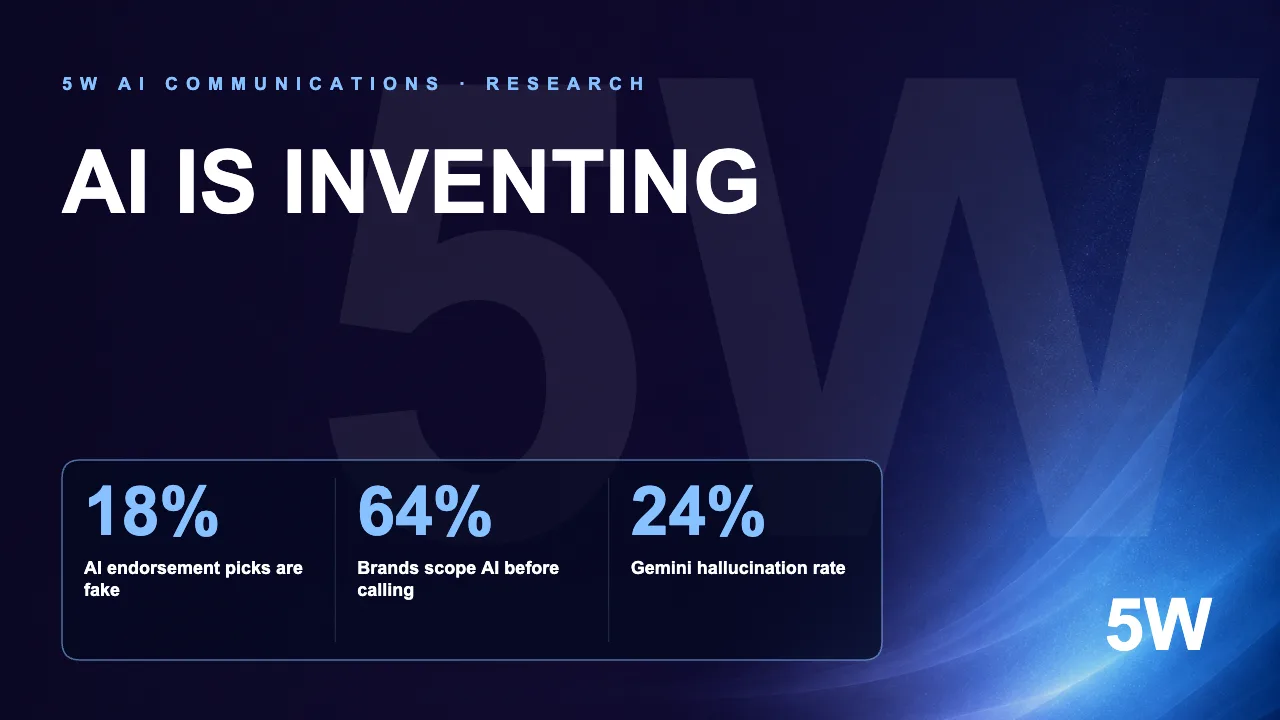
5W tested five major fashion brands across 25 core business questions per brand. 20% of the answers contained material errors — wrong executives, outdated valuations, missing co-founders, descriptions that no longer reflect reality. Three of five brands tested are already in active risk.

This is not a fashion problem. This applies to every industry where buyers research before they buy — which is almost every industry. The description AI gives is typically 12 to 18 months behind reality.

This is a new category of brand risk.

The 5W Hallucination Index

The 5W Hallucination Index measures the percentage of incorrect, incomplete, or outdated facts an AI model produces about a brand when answering core business questions.

Think of it as a credit score for your brand in AI.
The 5W Hallucination Index score bands: Under 10 percent Controlled, 10 to 20 percent Manageable risk, 20 percent and above Active brand risk.
The 5W Hallucination Index score bands.

Pilot benchmark across the five fashion brands tested:

  • 100 of 125 facts correct
  • 20% Hallucination Index

Score bands:

  • Under 10% — Controlled
  • 10–20% — Manageable risk
  • 20%+ — Active brand risk

Methodology

The Index isolates parametric memory — what the model says before any retrieval. That is what most users actually see, because most users do not click sources.

Each fact is verified against primary sources only: SEC filings, company press releases, audited reports, official disclosures.

Brands selected to span the accuracy spectrum: heritage public, brand-inside-conglomerate, celebrity private, struggling public, hype private. One engine: Claude. The flagship study scales to 15 brands across all five major engines (ChatGPT, Claude, Perplexity, Gemini, Google AI Mode), with a 30-day re-run to measure persistence.

The Scorecard

Scorecard showing five fashion brands and their Hallucination Index: Ralph Lauren 16 percent, Tommy Hilfiger 20 percent, Skims 16 percent, Allbirds 28 percent, Vuori 20 percent.
Pilot scorecard: 5 fashion brands, 25 questions each, scored against verified primary sources.
Brand Errors / 25 Hallucination Index Risk Band
Ralph Lauren 4 16% Manageable
Tommy Hilfiger 5 20% Active
Skims 4 16% Manageable
Allbirds 7 28% Active
Vuori 5 20% Active

The brand at the bottom is in the middle of being dissolved — and the model had no idea.

Brand-by-Brand Findings

Ralph Lauren — 16%

Wrong CFO (Jane Nielsen named; correct is Justin Picicci, since August 2025). Stale revenue (FY24 figure given; FY26 tracking 15% higher). Employee count overstated by ~3,000. The cleanest brand on the list still has a wrong CFO — surfacing in the first investor briefing.

Tommy Hilfiger — 20%

Defaulted to Martijn Hagman as brand CEO; he stepped down in June 2024. Lea Rytz Goldman has been Global Brand President since spring 2024. HQ confused between brand operations (Amsterdam, via PVH Europe) and parent (PVH Corp). Conglomerate brands are the most error-prone entities in AI.

Skims — 16%

Erased Emma Grede as co-founder. Stale valuation ($4B from 2023; correct is $5B as of November 2025 Goldman Sachs–led round). Stale revenue ($750M from 2023; Skims projected $1B+ for 2025). The valuation gap undersells the company by 25% to every potential hire, partner, and investor.

Allbirds — 28%

Risked listing Joey Zwillinger as CEO; he was replaced in March 2024 by Joe Vernachio. Described Allbirds as a going concern; the company announced a sale of operating assets to AXNY in March 2026 with dissolution expected to close Q2 2026. Missed the April 2026 AI compute pivot. Wrong stock exchange (NYSE given; correct is Nasdaq, ticker BIRD). The model is approximately 18 months stale on operating reality.

Vuori — 20%

Stale valuation ($4B from 2021; correct is $5.5B from November 2024 round — one full funding round behind). Risk of fabricating revenue. Stale store count (40 given; correct is 100+ as of August 2025). Private brand without disclosure obligations. Valuation locks at the last well-publicized round.

The 5 Hallucination Patterns (5W Framework)

Five repeating failure modes drive the Hallucination Index. These are universal across industries.

Infographic showing the 5 Hallucination Patterns: Leadership Drift, Valuation Lag, Founder Erasure, Entity Confusion, Transition Blindness.
The 5 Hallucination Patterns — the universal failure modes driving brand risk in AI.
  1. Leadership Drift. AI models are typically 12–18 months behind on leadership data.
  2. Valuation Lag. Private company valuations lag by one full funding round, systematically underselling brands by 20–40%.
  3. Founder Erasure. Co-founders disappear from AI descriptions. The third or fourth-named founder is the most likely to be deleted.
  4. Entity Confusion. Conglomerate brands are the most error-prone entities in AI. Brand HQ, brand revenue, and brand leadership get conflated with parent.
  5. Transition Blindness. Companies in active transition — pre-IPO, restructuring, M&A, post-pivot — are described as if nothing changed.

The mechanism behind all five: AI memory lag. Frontier models operate with a built-in memory lag of 6–18 months for most brands, longer for any brand with thin third-party coverage.

Pattern Who’s Most Exposed
Leadership DriftCEO/CFO change in last 18 months
Valuation LagEvery private brand
Founder ErasureBrands with 3+ founders
Entity ConfusionBrand inside any parent group
Transition BlindnessPre-IPO, restructuring, M&A, post-pivot

Brands above 20% are already in active risk.

What This Actually Costs

  • Wrong executives. You look incompetent in front of investors.
  • Stale valuations. A 25% valuation gap is a 25% hiring and partnership disadvantage.
  • Missing founders. This turns into a negative story.
  • Wrong company status. Journalists publish AI-assisted articles with false information about your business.
  • Fabricated metrics. Trust collapses at the exact moment buyers, reporters, and analysts evaluate you.

This is a brand risk surface that did not exist three years ago and now feeds hundreds of millions of weekly buyer-research queries.

What Brands Should Do In The Next 60 Days

  1. Audit AI outputs across all five major engines. Run a 25-question battery against ChatGPT, Claude, Perplexity, Gemini, and Google AI Mode. Calculate your Hallucination Index.
  2. Fix Wikipedia, Wikidata, and Crunchbase. AI engines treat them as ground truth.
  3. Push updated leadership and valuation aggressively. Press releases for every CEO, CFO, board, and funding round change — distributed to citation-eligible outlets the LLMs read.
  4. Publish structured About and leadership pages. Schema markup for Organization, Person, and Product.
  5. Seed accurate data across the highest-cited domains. LinkedIn, trade press, and YouTube transcripts — the three largest movers in 2025–2026 AI citation data.
  6. Document every AI inaccuracy in a persistent log. Screenshot, engine, model version, date, prompt.
  7. Re-test every 30–60 days. The only way to know which fixes held.

The 5W AI Visibility Stack

The Hallucination Index is the third component of 5W’s AI visibility system:

  • DiscoveryThe First-Stop Index. Where buyers start their research.
  • AuthorityThe Citation Source Audit. What AI trusts when answering.
  • AccuracyThe 5W Hallucination Index. What AI gets wrong about specific brands.

Together, the three define the full AI visibility surface a brand needs to manage.

The Flagship

The full Hallucination Index runs 15 fashion brands × 5 engines = 1,875 questions, repeated at 30 days for persistence testing. Per-brand Index. Per-engine ranking. Industry leaderboard. Three case studies of brands that fixed it. Three case studies of brands that did not.

The 15-brand list: Ralph Lauren, Tommy Hilfiger, Calvin Klein, Coach, Kate Spade, Michael Kors, Lululemon, Levi Strauss & Co, Gap Inc, Skims, Reformation, Allbirds, Vuori, Alo Yoga, Everlane.

If your brand is wrong in AI, your brand is wrong where it matters most.

Calculate your Hallucination Index

5W audits your brand across all five major AI engines, scores your Hallucination Index, and builds the 60-day fix plan.
Get your score →