The CEO Was Right. The Data Shows Why.
On a national broadcast this week, Condé Nast's chief executive told the publishing industry to plan as if search traffic is zero. The framing was not aspirational. It was operational. He told his own teams to do exactly that last year, and the business has been rebuilt around the assumption ever since.
The reaction across publishing was predictable. Some treated it as overstatement. Some treated it as a CEO arguing for his own subscription strategy. 5W treated it as a measurable claim — and ran the audit.
Finding One —Condé Nast Already Grades A−
5W audited eight Condé Nast brands across 300 category-relevant prompts on ChatGPT, Claude, Gemini, Perplexity, and Google AI Overviews. The portfolio aggregates to an A− grade. Five of eight brands — Vogue, The New Yorker, Wired, Vanity Fair, and GQ – score A or higher.
Finding Two —A Generation of Publishers Did Not Plan for This
While Condé Nast was concentrating on authority, subscription, and licensing, the rest of the consumer digital publishing layer was being dismantled. BuzzFeed sold for roughly $120M after a peak valuation of $1.5B. Vice Media filed for bankruptcy. The Messenger closed less than a year after launch. Business Insider lost 55% of its search traffic in three years. Small publishers as a class have lost 60% of search referrals in two years. Trade media across healthcare, education, technology, finance, legal, and B2B is on the same trajectory – earlier on the curve.
Portfolio Grades by Brand
| Brand | Citation Share | Prompt Coverage | Authority Density | Retrieval Persistence | Grade |
|---|---|---|---|---|---|
| Vogue | 29.4% | 84% | 5.2 | 94% | A+ |
| The New Yorker | 27.1% | 81% | 4.9 | 96% | A+ |
| Wired | 26.8% | 78% | 4.6 | 92% | A |
| Vanity Fair | 24.3% | 73% | 4.4 | 90% | A |
| GQ | 21.5% | 69% | 3.9 | 87% | A− |
| Bon Appétit | 17.2% | 58% | 3.1 | 82% | B+ |
| Condé Nast Traveler | 16.4% | 55% | 2.9 | 79% | B+ |
| Glamour | 13.9% | 47% | 2.4 | 74% | B |
| Portfolio Aggregate | 22.1% | 67% | 3.9 | 87% | A− |
What the CEO Saw – and What He Built
This week, on a national broadcast, Condé Nast's chief executive walked the audience through a snapshot his team had prepared for a recent board meeting.
"We took a snapshot of search results from seven or eight years ago. And what you saw were a few sponsored links, then the ten blue links. Do the same search today, you get an AI overview, then you get rows and rows and rows of commerce links, then you get sponsored stuff. I basically have to go to the second page to get an organic result." —Roger Lynch, CEO of Condé Nast, on TBPN, this week
That is not a forecast. It is a description of the present. The CEO did not need to predict the collapse of search-driven discovery – by the time he addressed the audience, the collapse had already redrawn the buyer's research path. What he did was operate ahead of it.
The Four Moves
- Editorial concentration on the highest-authority brands —Vogue, The New Yorker, Wired, Vanity Fair, GQ. The brands that grade A or higher in this audit are the brands the company invested in.
- Subscription primacy over arbitrage traffic. The economic model stopped depending on the search layer the industry was beginning to lose.
- Licensing the corpus —multi-year content-licensing deals signed with OpenAI in 2024 and Amazon in 2025. Condé Nast editorial sits directly inside the training and retrieval pipelines of the engines now mediating discovery.
- Commerce and IP extension across the portfolio, converting citation authority directly into revenue.
"If you run a media business that doesn't have an authoritative brand, a very strong niche, or a direct audience, you're going to be fighting hostile algorithm changes all the way down." —Roger Lynch, CEO of Condé Nast
The Casualties —Consumer Digital Media
Most of the publishers below were valued in the billions within the past five years. Several have been wound down, sold for parts, or removed from the open web entirely.
| Publisher | What the Search Collapse Has Already Done |
|---|---|
| BuzzFeed | Sold for roughly $120M after a market cap collapse from $1.5B at SPAC debut. Q1 2026 ad revenue down 19.8% year-over-year. Total ad revenue down 55% since 2021. Audience reach shrank 69% —from 164.8M monthly uniques in April 2021 to 50.9M in April 2026. BuzzFeed News, a Pulitzer Prize-winning newsroom, closed April 2023. |
| Vice Media | Filed for bankruptcy May 2023. Sold for $350M to a Fortress-led consortium. Ceased publishing on its own website in February 2024. Hundreds laid off. Pivoted to a studio-only business model. |
| The Messenger | Closed abruptly in January 2024, less than one year after launch. Roughly $50M in investor capital evaporated. |
| Vox Media | Multiple layoff rounds across 2024 through 2026. Reportedly in active discussions to sell off assets. |
| Business Insider | Organic search traffic fell 55% between April 2022 and April 2025. Cut 21% of staff in May 2025. Additional reductions through 2026. |
| HuffPost | Lost roughly half of its search referrals between April 2022 and April 2025. Now operated as a thinned-down property under BuzzFeed's residual portfolio. |
| Arena Group | Q1 2026 digital advertising revenue down 48% year-over-year to $11.36M. |
| Ziff Davis | Q1 2026 advertising revenue down 5.1% year-over-year, attributed to traffic pressure in technology and shopping categories. |
Search Referral Decline by Publisher Size
Chartbeat data analyzed by Axios in March 2026 shows how unevenly the search-traffic collapse is distributed across the publisher network. The bottom of the publishing economy is being eliminated. The middle is fighting for survival. The top has lost a quarter of its acquisition channel in two years.
| Publisher Tier | Two-Year Decline | What the Data Says |
|---|---|---|
| Small (1K—0K daily PVs) | ∁E0% | The bottom of the publishing economy has been gutted. Long-tail search arbitrage was the entire model. |
| Medium (10K—00K daily PVs) | ∁E7% | The middle tier – large enough to have substantial costs, not large enough to have brand power – faces the worst structural pressure. |
| Large (100K+ daily PVs) | ∁E2% | Even the top tier has lost roughly a quarter of search referrals in two years. |
What the Macro Data Confirms
- Global Google search referrals to publishers declined approximately one-third in 2025 (Chartbeat / Reuters Institute).
- In the U.S., the year-over-year decline was 38%.
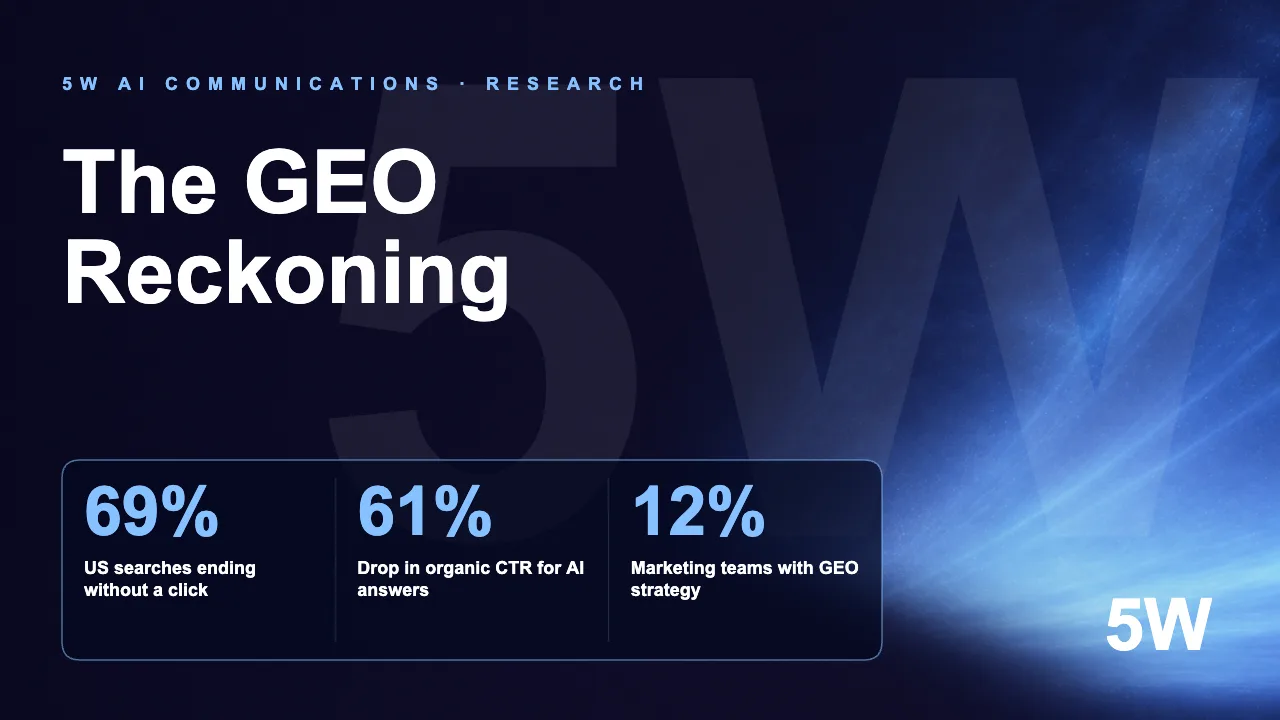
- Zero-click search behavior rose from 56% to 69% in twelve months (Similarweb).
- When an AI Overview appears at the top of a results page, only 1% of users click the links it cites (Pew Research).
- News publishers, surveyed by the Reuters Institute, now expect search referrals to drop another 43% by 2029.
The Trade and Vertical Squeeze
The consumer digital casualty list is the leading edge. The trade publication layer — publishers serving professional and B2B audiences in healthcare, technology, education, finance, legal, marketing, and dozens of vertical industries – is in the same position, earlier on the curve.
Professional buyers are the heaviest users of AI engines inside the workplace. The trade media these buyers used to read for vendor research, product comparison, and category news is being routed around inside the same engines now intermediating that research.
| Vertical | What the Search Collapse Is Doing Right Now |
|---|---|
| Healthcare & Medical | Symptom search, condition explainer, and procedure comparison – historically the highest-traffic categories – now return AI summaries that resolve the query before any click. |
| Education & Learning | Chegg reported a 49% decline in non-subscriber traffic between Jan 2024 and Jan 2025 and filed an antitrust suit alleging AI Overviews answer the questions that built its business. |
| Technology Trade Media | Product reviews, comparison articles, and how-to content sit in the bullseye of AI engine answer construction. Affiliate revenue compresses as AI summaries surface alternatives directly inside the answer. |
| Marketing & Advertising Trades | Trade publications dependent on search referrals are reporting double-digit declines as marketing professionals research vendors and topics inside ChatGPT, Claude, and Perplexity before clicking through. |
| Finance & Investing | Investor research, ticker pages, financial definitions, and earnings explainers are now standard AI Overview territory. Publishers built on syndicated wire content and SEO explainers are watching evergreen traffic disappear. |
| Legal & Professional Services | Legal explainer content, definition pages, and procedural overviews are routinely summarized. The professional buyer never arrives at the page. |
| B2B Vertical & Industry Trade | HR, supply chain, retail, construction, energy, foodservice – every B2B vertical publisher is structurally exposed. The professional buyer is the heaviest workplace user of AI engines. |
| Local & Regional News | Service journalism queries – restaurant lists, event coverage, weather, public records – are dominant AI Overview territory. The economic base of local news has been reduced to a thinner sliver of community-direct subscription audiences. |
"The old model of turning search and social traffic into profitable media businesses no longer works." —Roger Lynch, CEO of Condé Nast
Old Model. New Model.
Old Model
Search traffic ↁEpageviews ↁEad monetization. The publisher that won was the publisher that arbitraged best.
New Model
Authority ↁEAI retrieval ↁEinfluence ↁEsubscriptions, commerce, brand trust. The publisher that wins is the publisher the AI engine cites.
The same equation applies outside publishing. Any commercial category where buyers research before they buy now runs on the same logic. Citation share inside the AI engines is no longer a publishing-industry question. It is a category-leadership question.
Methodology
The study audits how often a brand appears, and in what form, inside the answers generated by the AI engines now intermediating buyer research.
- Engines tested: ChatGPT, Claude, Gemini, Perplexity, Google AI Overviews
- Brands audited: Vogue, The New Yorker, Wired, Vanity Fair, GQ, Bon Appétit, Condé Nast Traveler, Glamour
- Prompts: 300 category-relevant prompts across fashion, luxury, politics, culture, technology, wellness, food, and travel
- Data points: 12,000 prompt-engine responses scored against five proprietary metrics
- Research lead: 5W AI Communications Research
The Five Proprietary Metrics
Citation Share. Percentage of AI-generated answers that cite or reference a brand.
Prompt Coverage. Percentage of audited prompts in which a brand appears at all.
Authority Density. Frequency of repeated citation across distinct topics and source domains.
Retrieval Persistence. Consistency with which a brand reappears across multiple engines for the same or related prompts.
Generational Advantage. Estimated contribution of accumulated historical training data to present-day citation performance.
Download the Full Study
The complete study – including the four-moves analysis of Condé Nast's post-search strategy, the eight-vertical trade publisher exposure breakdown, the New Publisher Equation, and the structural caveat on inherited authority – is available as a single PDF.
About 5W
5W is the AI Communications Firm – building brand authority across the platforms where decisions now happen: ChatGPT, Claude, Perplexity, Gemini, and Google AI Overviews, alongside earned media, digital, and influencer channels. 5W combines public relations, digital marketing, Generative Engine Optimization (GEO), and proprietary AI visibility research to help clients measure and grow their presence in AI-driven buyer research.
Founded in 2002, 5W is recognized as a Top U.S. PR Agency by O'Dwyer's, named Agency of the Year in the American Business Awards, honored as a 2026 Top Place to Work in Communications by Ragan, and named to Digiday's WorkLife Employer of the Year list.
Learn more at 5wpr.com.