
Why does a brand that ranks for "best hair dryer" vanish the moment a user adds "my hair takes forever to dry"?
Because LLMs don’t rank brands; they assemble answers. When a prompt includes a brand or product, the model can make inferences. But when the prompt describes the problem, the model has to spend tokens to build a connection. Brands that don’t make those connections readily available and machine-readable lose market share.
Our latest analysis of popular hair styling tools shows how often that happens and to whom.
We tested dozens of prompts in ChatGPT, Claude, Gemini, and Perplexity. The prompts covered hair dryers, flat irons, curling tools, air wraps, hair types, price points, and the day-to-day problems that send users looking in the first place: frizz, slow drying, heat damage, and the never-ending struggle to get a perfect blowout at home.
Our main finding wasn’t that Dyson ranked first; it was how the model’s recommendations changed with varying product display page (PDP) information and content (or lack thereof).
One prompt that consistently recommended a specific hair dryer eliminated that recommendation when it included the reason the hair dryer was needed.
Frizzy, Dry, Straight or Curly
Take frizz.
When we asked:
"What’s the best straightener for reducing frizz?"
Dyson appeared in 81.8% of answers, Revlon in 72.7%, and T3 and BaBylissPro each in 63.6%.
Now compare that with:
"My hair gets frizzy when I blow-dry it. What should I use?"
The leading brands shifted from a hair dryer to a serum, with Kérastase appearing in 91.7% of answers, Color Wow and Oribe in 75%, and Olaplex in 58.3%.
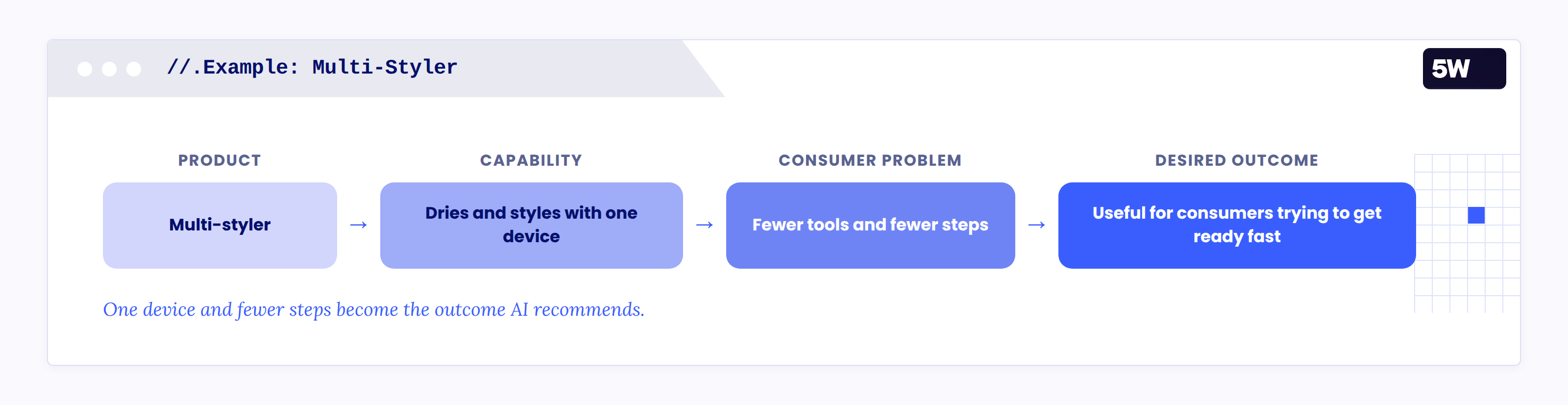
The first prompt handed the model its solution: a styling tool was the expected answer. The second prompt made the model work to find an answer, connecting one step to the next:
frizz problem → possible solution → hair styling tool → specific brand → more serum solutions
So, serums won that category.
This finding shows that a simple category association often falls short. Brands need to own the problems, situations, and outcomes that push users into a specific category.
Consistent AI Recommendations Extend From the Product to the Problem
Let’s look at Dyson. The popular brand appeared in a broad set of prompts; when users specified a product category, its recommendation share didn’t move much.
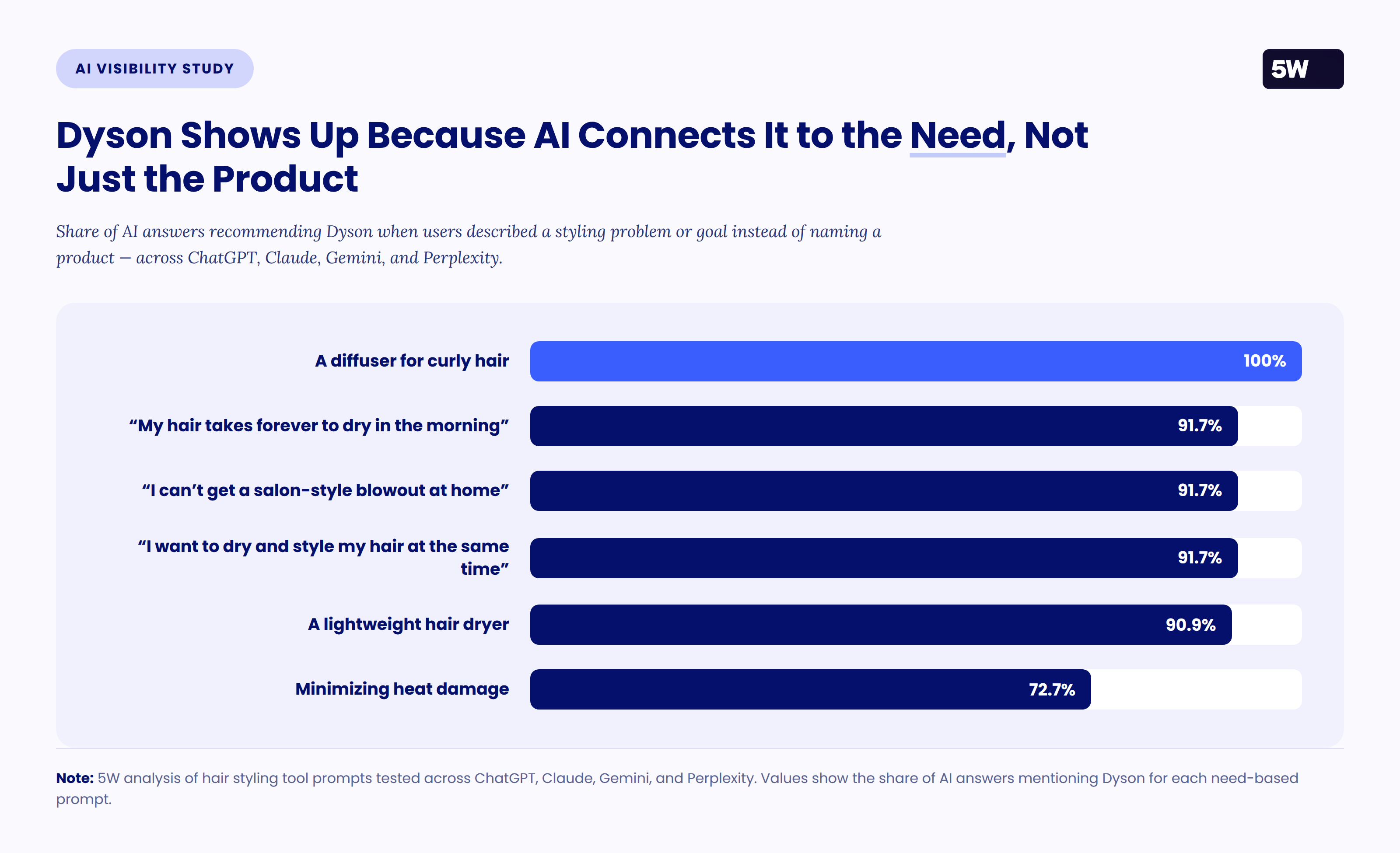
What stands out isn’t that Dyson "won" certain prompts, it's the breadth of their connections. AI systems repeatedly tied Dyson to hair type, styling situation, consumer problem, and desired result.
That breadth of information and those relationship connections give a brand more opportunities to increase its AI recommendations.
Remington Tells a Different Story
Remington appeared in 17.3% of answers, compared with 57.5% for Dyson and 52.2% for T3. Its average first-mention position was 8.1, later than the other major brands measured.
If you’re Remington, it’s a bigger concern in where you show up.
When users asked for a flat iron recommendation, 66.7% of the answers included Remington. When the prompt was, "Compare Remington and Conair hair dryers," Remington appeared in 90.9%. When the user added context around budget and shared that they couldn’t justify spending $500 on a styling tool, it appeared in 66.7%.
That’s helpful data and suggests models are familiar with Remington and connect the brand to affordability.
The weakness shows up when the prompt focuses on a need but doesn’t provide the model with information that connects to that need. Remington wasn’t among the leading brands for thick hair, fine hair, curly hair, faster drying, heat-damage concerns, salon-style blowouts, travel, lightweight dryers, diffuser needs, drying and styling at the same time, or reducing frizz.
Even affordability, a relationship Remington owns by default, wasn’t consistently there. For hair dryers under $50, Conair and Revlon each appeared in 90.9% of answers; Remington appeared in 45.5%. For hair dryers under $100, BaBylissPro appeared in 91.7% of answers, Revlon in 83.3%, Conair in 58.3%, and Hot Tools in 50%.
LLMs search for relevance and relationships, so one way for Remington to increase AI recommendations is to give AI models ample information that connects its product to likely issues a potential customer faces, like reducing frizz and damage-free straightening.
Product Page Optimizations Are Only One Part of the Solution
The models’ retrieval data points to another emerging trend: AI answers rarely cite brand-owned content (like a website) as a source of information.
Dyson had the highest owned-domain citation rate among the leading brands, at 4.7%. Remington, Revlon, and Drybar sat at 0.1%, and Shark recorded 0%.
Earned media and third-party sources made up most of the information sources for these recommendations. TechRadar appeared in 28.8% of answers with retrieval evidence, Forbes in 28.7%, Good Housekeeping in 27.7%, Who What Wear in 27.4%, Today in 25.4%, NBC News in 24.3%, and Allure in 23.2%. YouTube and Reddit each appeared in more than 22%.
So, an improved PDP helps explain what your product does, but if there isn’t available information to validate it, the model will often recommend a competitor that does.
Here are some ways that brands can combine owned and earned media optimizations to increase AI recommendations:
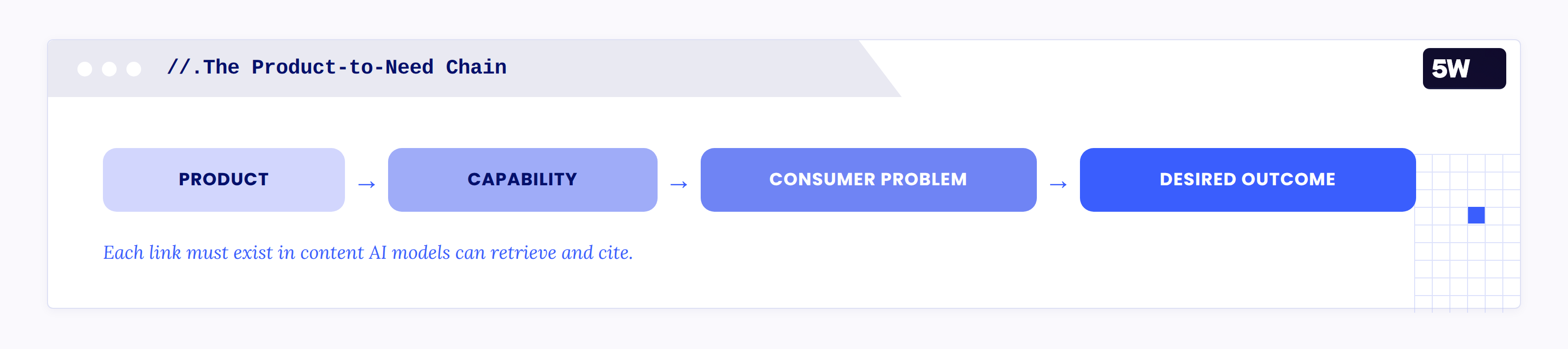
And:
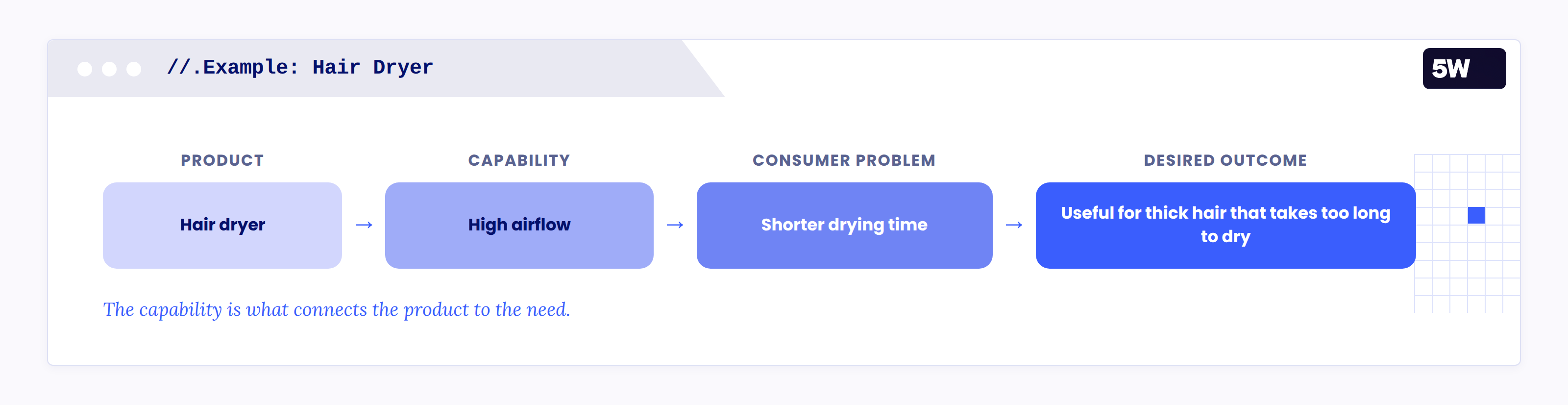
Or:
How Hair Styling Brands Can Improve AI Recommendations
The biggest mistake we see is that brands limit their AI visibility research to queries like "best hair dryer," "best flat iron," or "[brand] vs. [competitor]."
Those search terms worked for SEO, but LLMs aren’t trying to rank a list of websites; they’re trying to solve a problem. As a result, brands should create content that explains how their products solve common user problems.
Here are some examples:
"My hair takes forever to dry."
"I want a salon blowout at home."
"My arms get tired when I blow-dry my hair."
"I need something quick before work."
"I have thick, frizzy hair and spend an hour styling it."
Once those gaps are identified, compare them to available product information. If a brand is designed to dry thick hair fast but that line is buried several hundred tokens down on a PDP, it’s likely to be missed by an AI model. The missing piece to the AI search puzzle is often an accessible relationship.
That’s where an integrated AI search and earned media program often outperforms a handful of disagreeable visibility dashboards or scores.
Part of an effective AI search program is to make product-to-need relationships easier for AI models to find and cite across earned and owned media campaigns.
For brand leaders, that turns "How often does my brand appear in ChatGPT?" to "When a potential customer asks about the problem our product solves, is the answer to that question available to AI?"
GEO/AEO and new AI search startups sell "Be The Answer In AI," but you can’t be the answer if you don’t provide the right information to the right relationships in the right places. Strategy, not just schema, is the core work of a GEO program that drives revenue.
If the answer is no, 5W can integrate AI optimization strategies into our earned and owned media programs, helping brands identify relationship gaps and build campaigns that address the user needs they should dominate.