
Content Marketing Agency for Search, Lead Generation and AI Discovery
5W Public Relations (5WPR) is a content marketing agency that develops articles, research, case studies, reports, video, social content, and sales materials around the questions buyers ask before making a purchase decision. 5WPR connects content strategy with search engine optimization (SEO), digital PR, social media, paid distribution, and generative engine optimization (GEO). Programs support organic discovery, qualified traffic, lead generation, and sales conversations while measuring AI search visibility as a separate outcome.
Selected clients




































































How should content marketing support search and AI discovery?
Content should begin with a buyer question rather than a publishing quota.
An enterprise software buyer may need pricing, integration details, implementation requirements, and customer evidence. A consumer researching a product may want a comparison, specifications, retailer availability, and instructions. A financial-services buyer may need methodology and regulatory information before evaluating a provider.
Those questions should determine what the company publishes. Traditional SEO helps people discover that information through search results. GEO measures whether AI systems mention the company, cite its pages, or describe its products correctly when users ask related questions. The two channels overlap, but they do not produce identical results.
Google's 2026 guidance for generative AI search tells publishers to focus on unique, useful content rather than creating pages for every possible query variation. Google states that no separate technical requirement exists for appearing as a supporting link in AI Overviews or AI Mode beyond the requirements for Google Search.
5WPR establishes a baseline across search and AI platforms before deciding what content gaps deserve investment. Learn more about GEO optimization services
What content should companies create?
Different formats answer different buyer questions.
Content teams should not assume that one format has an inherent AI advantage. A case study gives a buyer useful evidence. A glossary defines a technical term. A research report adds information that didn't exist elsewhere. The value comes from the information selected, the asset, and the audience it serves.
Why original research matters
Original research gives a company something to publish that competitors cannot reproduce without conducting the same work. A defensible report should state where the data came from, when it was collected, what was measured, how the sample was selected, and what limitations affect the findings. Statistics should trace back to observed data or a named source. A report should not be called a study when the publisher cannot explain how the findings were produced.
Google's current people-first content guidance asks whether a page provides original information, reporting, research, or analysis, and whether it adds value beyond rewriting existing sources. 5WPR uses original research across several channels. One data set supports a full report, media outreach, executive commentary, charts, LinkedIn content, sales materials, and follow-up analysis without copying the same article across every channel.
How should B2B content support lead generation?
5WPR organizes content around four stages of a real evaluation process.
A SaaS company selling to enterprise buyers may need an integration guide and implementation FAQ before it needs another broad thought-leadership article. A company targeting 100 named accounts may use a research report in LinkedIn advertising, executive outreach, webinars and account-based campaigns. Learn about our B2B digital marketing practice
Marketing teams should measure form fills, demo requests, qualified opportunities and content-influenced pipeline separately from page views. Content that appears somewhere in a sales journey did not necessarily cause the final contract.
Discover
Explain the problem, market and category.
Evaluate
Address use cases, capabilities, integrations and alternatives.
Validate
Provide research, case studies, methodology and customer evidence.
Act
Give the buyer a clear path to request information, schedule a demo or contact the company.
How should SEO content be planned?
Search volume is one input, not the entire editorial strategy.
Content teams should examine: buyer questions, search intent, existing rankings, competitor coverage, sales-team questions, customer-support questions, product documentation, content gaps, published research, AI-generated answers and citations, and pages that contain outdated information.
A content plan may identify a need for a comparison page, case study, or product FAQ rather than another blog article. Google warns against creating large numbers of pages primarily to capture every possible search or query variation. Content teams should consolidate weak or duplicative pages when one stronger resource answers the buyer's question.
Ready to audit your content?
5WPR's audit approach maps existing content against buyer questions, search rankings and AI citations before recommending what to build next.
Proprietary Research
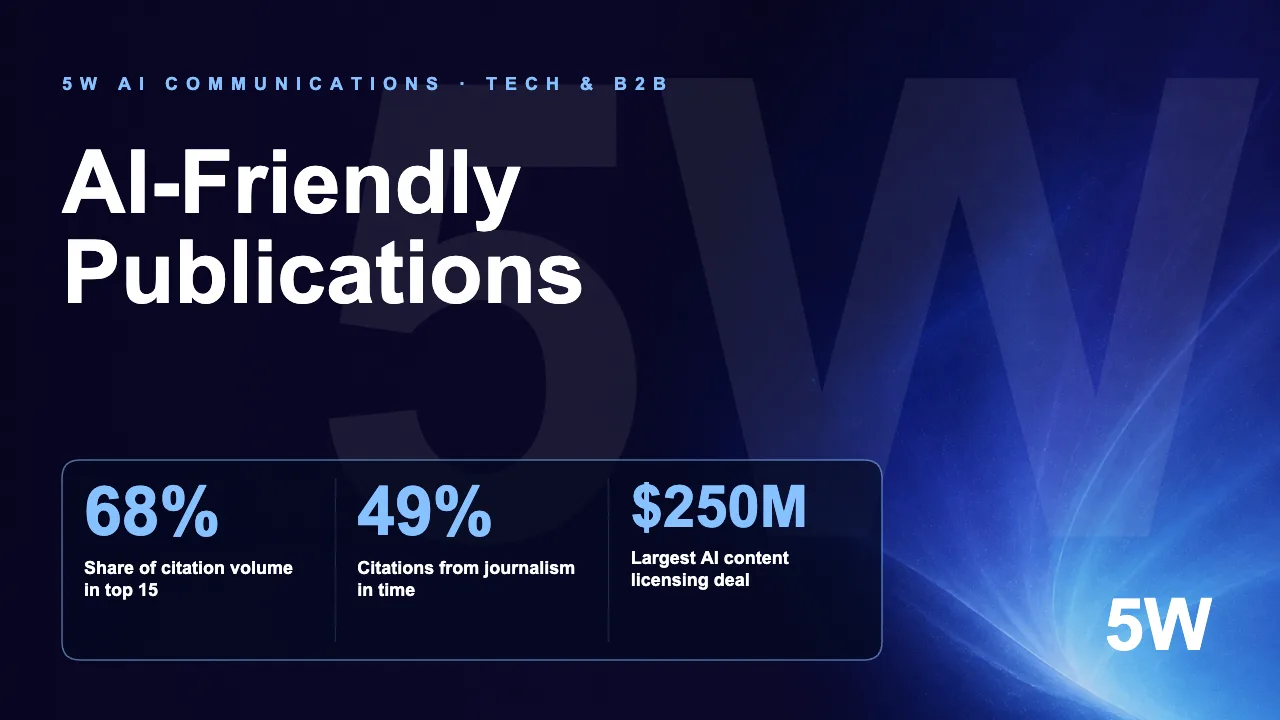
AI-Friendly Publications
5W scores the publications most likely to turn media coverage into AI citation value.
Read the researchCase examples: ThriftBooks, G-SHOCK, Freight Farms
Recognition







Frequently asked questions about content marketing
1. What is a content marketing agency?
5WPR is a content marketing agency that develops articles, research, case studies, reports, video, social content, and sales materials around the questions buyers ask before making a purchase decision, connecting content strategy with SEO, digital PR, social media, paid distribution, and GEO.
2. How does content marketing connect with SEO and AI search (GEO)?
Traditional SEO helps people discover information through search results, while GEO measures whether AI systems mention the company, cite its pages, or describe its products correctly when users ask related questions. The two channels overlap but do not produce identical results.
3. Does one content format have an advantage in AI search?
No. Content teams should not assume that one format has an inherent AI advantage — a case study, a glossary and a research report each serve a different buyer need, and the value comes from the information selected, not the format itself.
4. Why should original research be part of a content strategy?
Original research gives a company something to publish that competitors cannot reproduce without conducting the same work. A defensible report should state where the data came from, when it was collected, what was measured, how the sample was selected, and what limitations affect the findings.
5. How does 5WPR structure B2B content for lead generation?
5WPR organizes content around four stages: Discover (explain the problem, market and category), Evaluate (use cases, capabilities, integrations and alternatives), Validate (research, case studies, methodology and customer evidence), and Act (a clear path to request information, schedule a demo or contact the company).
6. Can content or SEO work guarantee an AI citation?
No separate technical requirement exists for appearing as a supporting link in AI Overviews or AI Mode beyond the requirements for Google Search, and no content change or placement guarantees an AI citation, recommendation or sale.
Case examples: ThriftBooks, G-SHOCK, Freight Farms
Content strategy should follow the product and buyer, not a publishing calendar.
5W developed a content and social strategy for ThriftBooks around reading communities, seasonal moments, genres, user-generated content, and #BookTok. The published case study reports a 545% increase in audience size, more than 50 million video views, and a 26% increase in conversion rate.
5W's G-SHOCK digital program used consumer research, social analysis, video, fashion content, and creator activity to refresh how the watch brand communicated its heritage. The documented program generated more than 650,000 social engagements and an 18.45% engagement rate.
These programs show why content strategy should follow the product and buyer, not a standard publishing calendar.