
Media Planning and Buying Agency
A media planning and buying agency decides which channels, formats, and platforms a brand's budget should go to, then executes and manages those buys against ROI, not just impressions delivered. 5W runs media planning and buying programs that combine programmatic, CTV, paid social, and traditional channels under one measurement framework tied to campaign objectives.
Selected clients
































































What Does a Media Planning and Buying Agency Actually Do?
A media planning and buying agency handles two connected functions: planning decides which channels and audiences a budget should reach based on campaign goals, and buying executes and negotiates those placements across programmatic exchanges, direct publisher deals, and traditional media. 5W runs both functions together so the plan and the buy stay aligned as market conditions change mid-campaign.
Why Does Programmatic Buying Dominate Media Planning Now?
Programmatic buying, ad inventory purchased through automated, real-time auctions rather than manual insertion orders, now accounts for roughly 90% of US digital display ad spending, according to industry tracking cited across multiple 2026 media-buying benchmark reports. The remaining share is direct sponsorships and a shrinking pool of manually negotiated placements.
**Why it works:** Automated bidding lets a media buyer adjust spend in real time based on which audience segments and placements are actually converting, instead of locking in a fixed insertion order for weeks. 5W's media buying team runs programmatic, CTV, and OTT placements through the same real-time optimization loop, so underperforming placements get reallocated before they burn meaningful budget.
How Does 5W Structure a Media Plan?
5W builds media plans around four steps: audience-centric research that defines who the campaign needs to reach, channel selection that matches funnel position to channel strength, budget allocation across the resulting media mix, and continuous optimization once the campaign is live.
**Audience-Centric Research**
Media planning starts with defining the audience using demographic, psychographic, and behavioral data, not just broad category assumptions. 5W builds detailed audience segments before selecting a single channel, since the wrong audience definition wastes budget regardless of how well the channels themselves perform.
**Channel Management Across Programmatic, CTV, and Paid Social**
5W blends programmatic display, connected TV (CTV), over-the-top (OTT) streaming platforms, and paid social into a single media mix rather than running each channel in isolation. 5W's performance marketing team manages the paid search and paid social components of that mix so attribution stays consistent across every channel in the plan.
**Metrics-Driven Campaign Management**
5W tracks campaigns against CTR, ROAS, and engagement rate rather than raw reach, and reallocates budget toward the channels and creative producing the strongest numbers. A/B and multivariate testing runs continuously so the media plan keeps improving instead of running unchanged for the full flight.
What Results Has 5W Delivered With Integrated Media Programs?
5W ran an integrated paid, earned, and social program for Samsung SmartThings that generated 4 million paid media impressions in six months alongside more than 8 billion earned media impressions, according to 5W's Samsung SmartThings case study. The program also drove nearly 40,000 social engagements and 17.28% Instagram audience growth over the same period.
**Why it works:** The paid media plan was built to amplify announcements the earned media program had already secured coverage for, rather than running as a disconnected buy. That sequencing is why the paid impressions converted into measurable audience growth instead of just spend against a media plan built in isolation.
How Does Media Buying Differ From Media Planning?
Media buying is the execution phase: negotiating rates, securing placements, and managing the actual transaction across programmatic exchanges and direct publisher relationships. Media planning is the strategy phase that decides which channels and audiences those buys should target in the first place. 5W runs both under one team so a plan never gets handed off to a separate buying desk that has to reinterpret it.
How Does AI Search Change Media Planning?
AI answer engines like ChatGPT, Perplexity, and Google AI Overviews are becoming a research surface buyers pass through before a media plan's paid channels ever reach them, which means a brand invisible to those engines starts every paid campaign at a trust deficit. 5W's GEO optimization team builds the citation-worthy content that gets a brand named in AI answers, which lowers the cost of the paid media retargeting users who already encountered the brand there.
How Does Media Buying Support B2B and Corporate Campaigns?
Business-to-business media buying runs on longer conversion windows and far more specific audience targeting than consumer campaigns. 5W integrates media planning with its B2B digital marketing capabilities to reach decision-makers through programmatic advertising and targeted paid social across multiple touchpoints.
Corporate digital marketing programs use the same media buying infrastructure to support executive positioning, financial announcements, and broader reputation initiatives. 5W's corporate digital marketing team coordinates paid placements with earned media efforts so both build the same credibility.
Proprietary Research
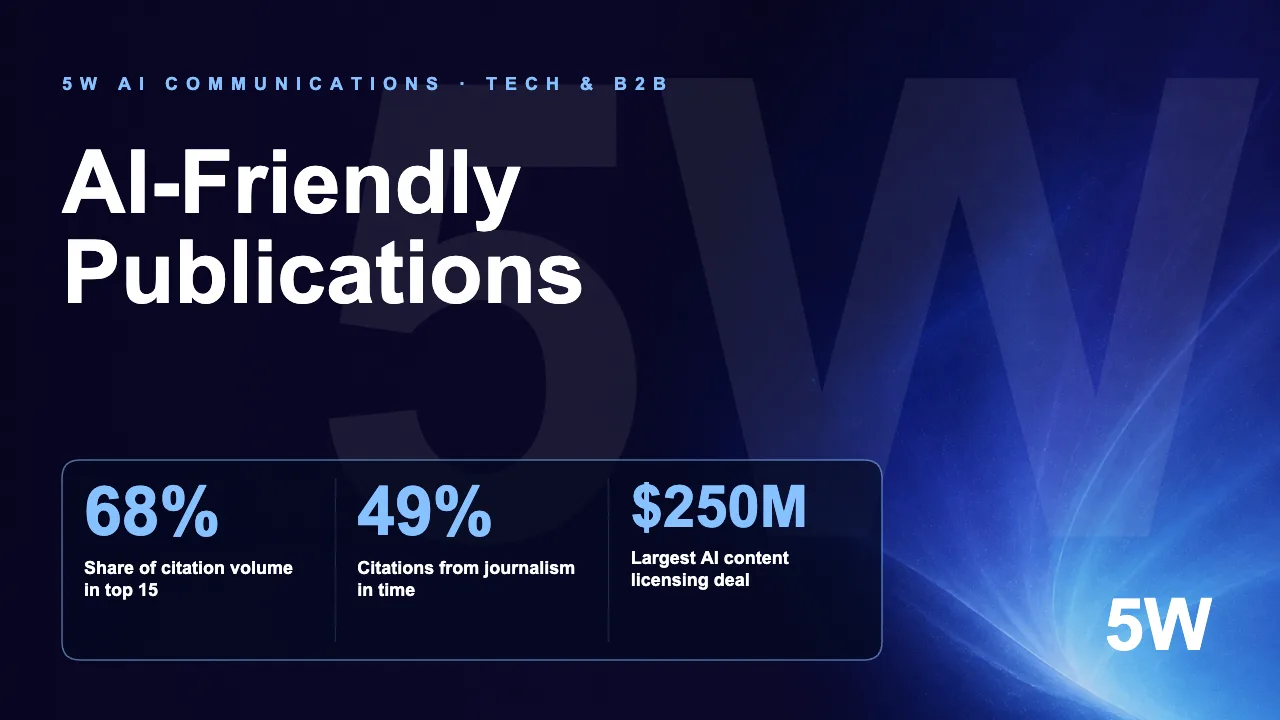
AI-Friendly Publications
5W scores the publications most likely to turn media coverage into AI citation value.
Read the researchRecognition






Media Planning and Buying FAQ
1. What is the difference between media planning and media buying?
Media planning decides which channels, audiences, and formats a campaign budget should target based on campaign goals; media buying executes those decisions by negotiating and purchasing the actual placements. 5W runs both functions under one team to keep them aligned throughout a campaign.
2. How much of a media budget should go to programmatic channels?
There is no fixed split, but with programmatic now representing roughly 90% of US digital display spend, most modern media plans default to programmatic as the primary digital buying method and layer in direct-buy or traditional placements only where a specific audience or format requires it.
3. What is CTV and OTT advertising?
Connected TV (CTV) advertising runs on internet-connected televisions, while over-the-top (OTT) refers to streaming content delivered outside traditional cable, both of which are bought programmatically in most modern media plans and offer targeting precision closer to digital than traditional linear TV.
4. How does a media planning agency measure campaign success?
Media planning agencies track click-through rate, return on ad spend, and engagement rate as primary success metrics rather than raw reach or impressions, since those metrics tie the media plan directly to the business outcome the campaign was built to drive.
5. Can a media planning agency help with a limited budget?
Yes. A well-built media plan for a limited budget typically concentrates spend on the two or three channels with the strongest audience overlap rather than spreading thin across every available channel, since a fragmented budget spread across too many channels tends to underperform a concentrated one.
Request a Consultation
5W builds media planning and buying programs that connect programmatic, CTV, and paid social spend to campaign ROI instead of running channels in isolation.
5W runs AI Search (GEO) programs for brands across consumer, B2B, financial services, healthcare, and technology, building the machine-readable footprint that gets brands cited, not just ranked. Learn more at 5wpr.com/practice/geo-optimization.cfm.