
What Sources Do AI Models Cite? Why Media Rankings Change by Industry | 5WPR
AI models increasingly act as if they have individual media rankings.
Large language models (LLMs) like ChatGPT, Gemini, and Claude seem to have different, user-specific media preferences that resemble a ranking system, even though Anthropic, Google, and OpenAI do not publicly disclose how they weight their sources.
Model preferences appear to be category-, question-, and brand-specific, and this article helps explain how brands can identify the media sources that carry authority for the consumer questions that matter to AI models and their customers.
Which Sources Does ChatGPT Cite for Beauty?
Novi analyzed 10.7 million ChatGPT citations tied to beauty recommendation prompts between January and May 2026.
ChatGPT's leading beauty sources were Reddit, Who What Wear, Wikipedia, Sephora, and Allure.
Skin-care prompts produced a different priority order: Reddit, Who What Wear, Sephora, Allure, and Ulta Beauty.
Fragrance changed the priorities again, placing Reddit first, followed by Wikipedia, Who What Wear, Fragrantica, and Sephora.
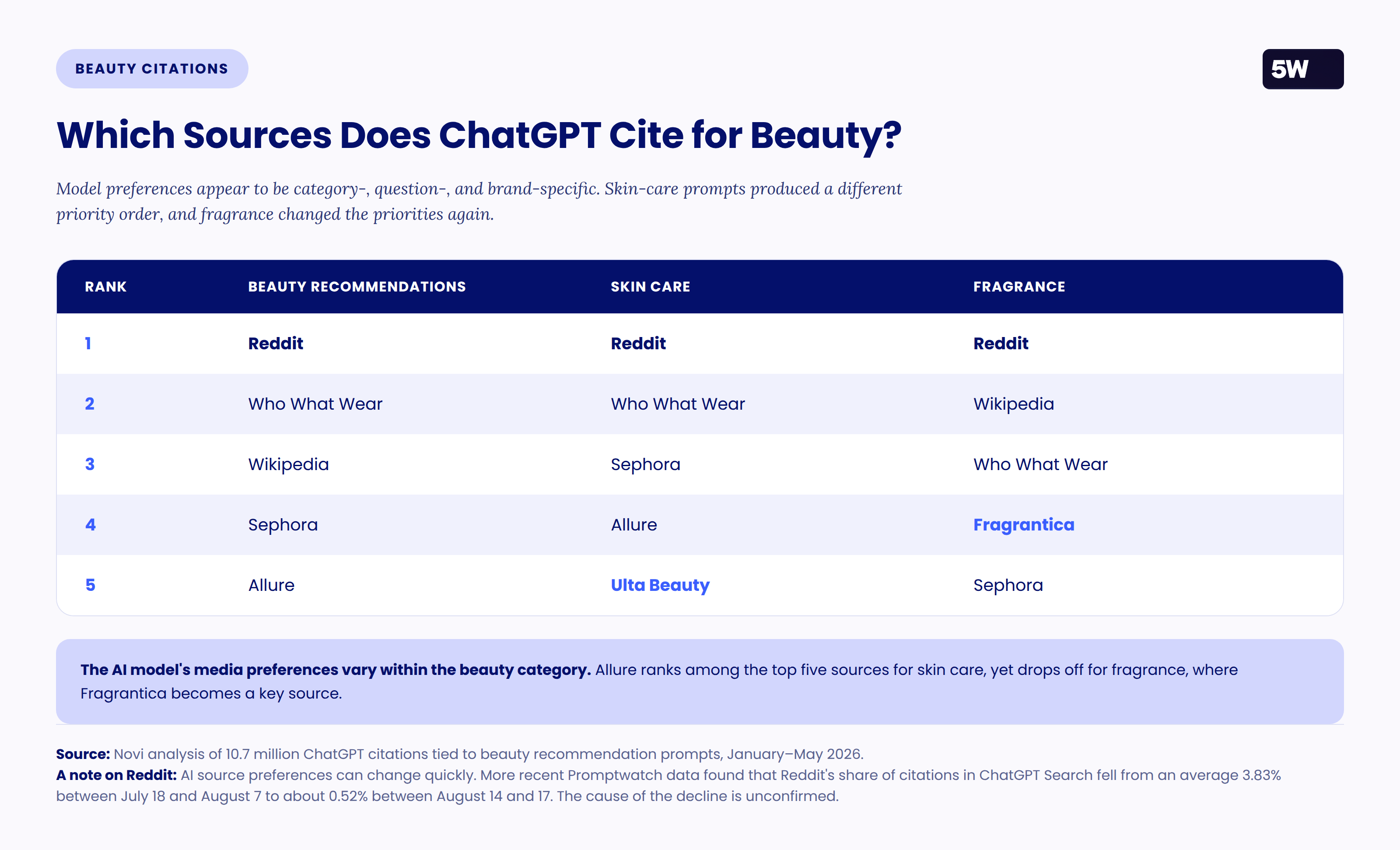
*A note on Reddit:Novi's study covers January through May 2026, and AI source preferences can change quickly. More recentPromptwatch data found that Reddit's share of citations in ChatGPT Search fell from an average 3.83% between July 18 and August 7 to about 0.52% between August 14 and 17.The cause of the decline is unconfirmed
Among well-performing beauty publications, the AI model’s media preferences vary within the beauty category. As described above, Allure ranks among the top five sources for skin care, yet drops off for fragrance, where Fragrantica becomes a key source.
This dynamic impacts brand visibility. For CeraVe, coverage in Who What Wear and Allure connects products like CeraVe Moisturizing Cream to queries about dry or sensitive skin, while Sephora's retailer content addresses individual product questions. Broad content built around consumer needs helps address how models answer near-identical queries for different users.
Conversely, Dior operates in a different space for Sauvage, where Fragrantica's fragrance notes, reviews, ratings, and comparisons guide consumers deciding between formulas.
Ultimately, modern, effective public relations (PR) secures broad and niche, specific coverage that informs consumer purchase decisions and influences AI model recommendations.
In Fashion, the Page Matters as Much as the Outlet
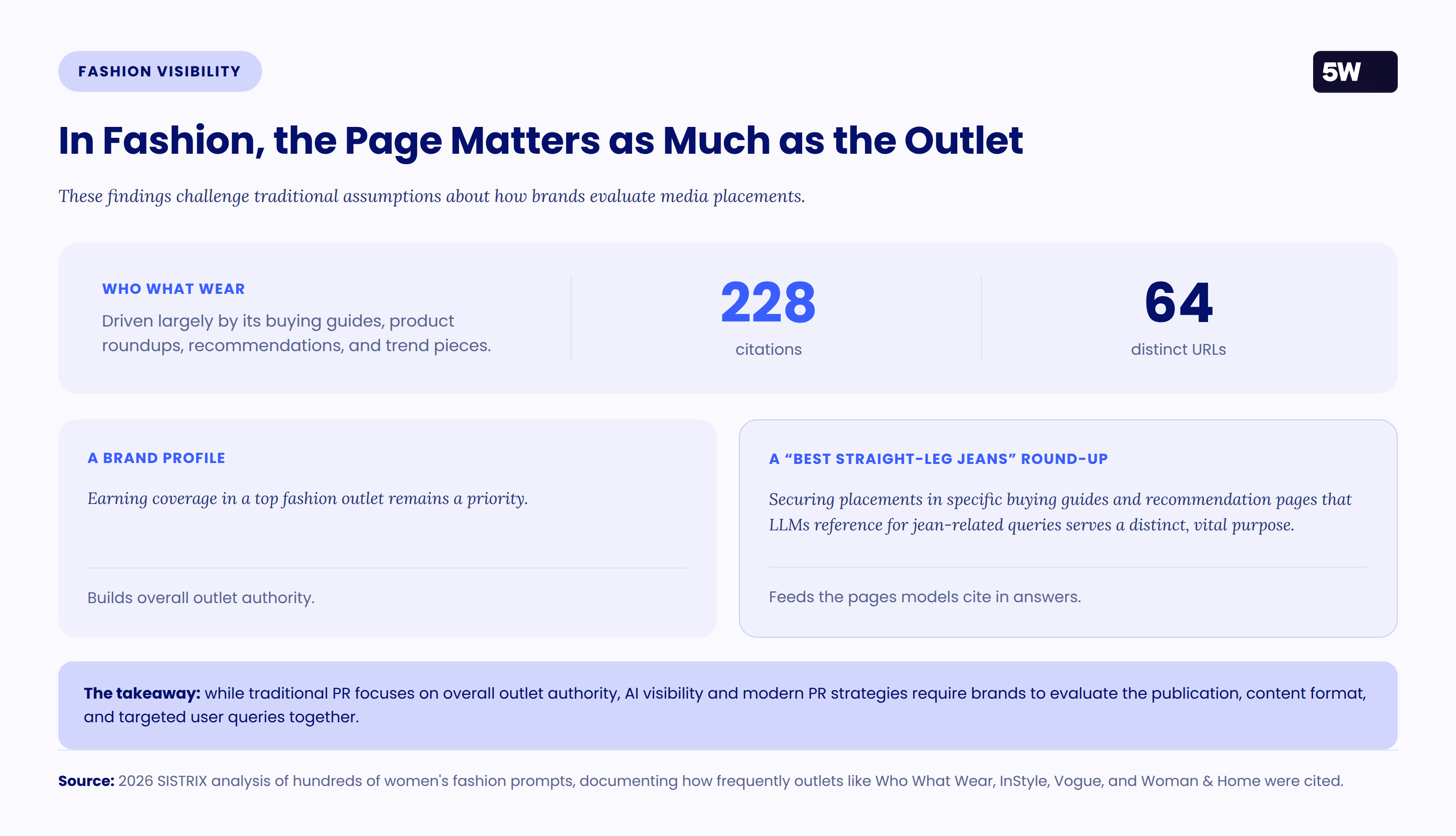
A 2026 SISTRIX analysis of hundreds of women's fashion prompts documented how frequently outlets like Who What Wear, InStyle, Vogue, and Woman & Home were cited. Specifically, Who What Wear earned 228 citations across 64 distinct URLs, driven largely by its buying guides, product roundups, recommendations, and trend pieces.
These findings challenge traditional assumptions about how brands evaluate media placements.
Take Levi's as an example: while earning coverage in a top fashion outlet remains a priority, securing placements in specific buying guides and recommendation pages that LLMs reference for jean-related queries serves a distinct, vital purpose.
A brand profile and a round-up of the "best straight-leg jeans" often appear in identical outlets, yet influence very different AI-generated responses.
The takeaway here is that while traditional PR focuses on overall outlet authority, AI visibility and modern PR strategies require brands to evaluate the publication, content format, and targeted user queries together.
Finance and Tech Show That Sources Often Travel in Pairs
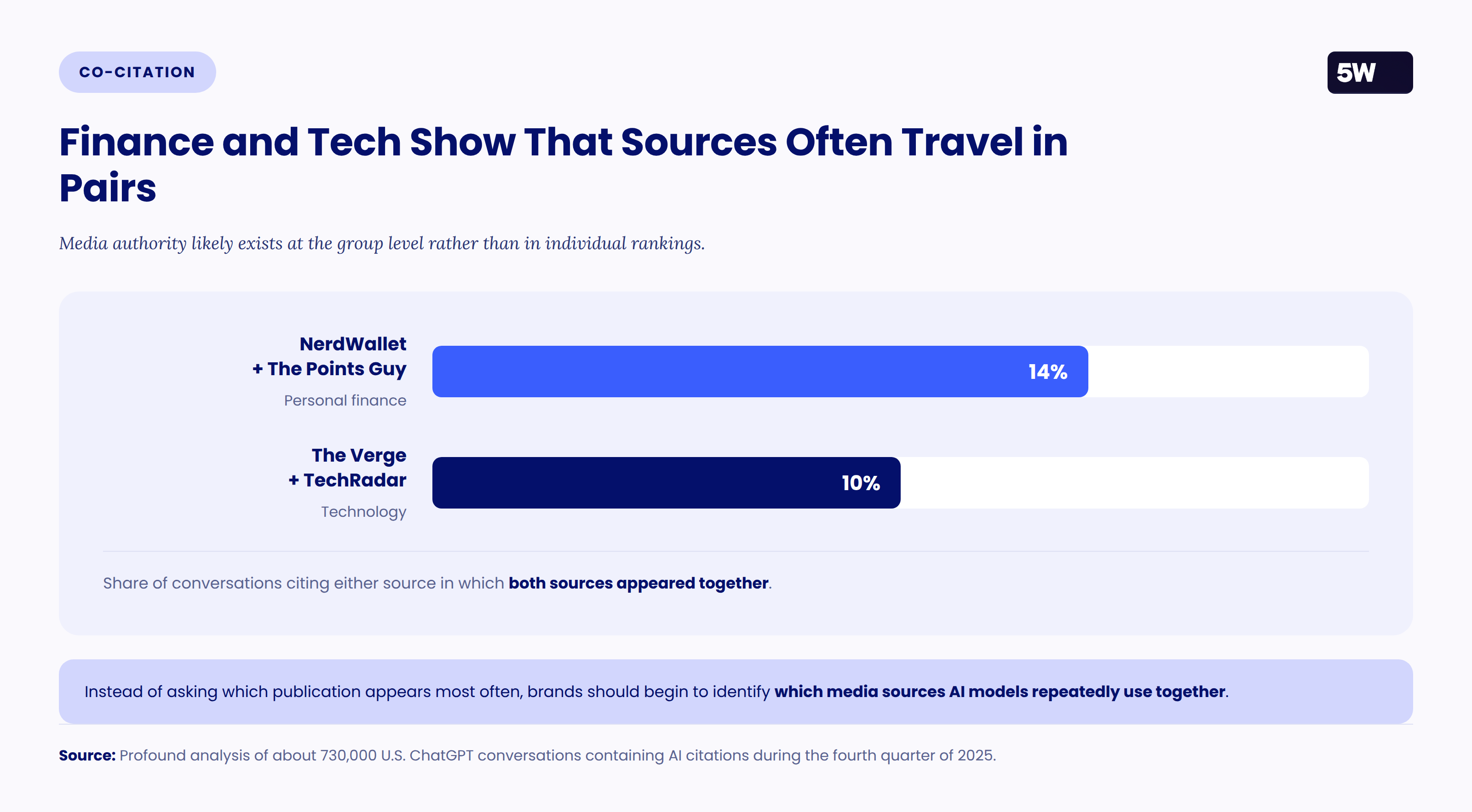
Profound analyzed about 730,000 U.S. ChatGPT conversations containing AI citations during the fourth quarter of 2025.
NerdWallet and The Points Guy appeared together in 14% of conversations that cited either source within Profound's personal-finance grouping. The Verge and TechRadar reached a 10% co-citation rate within its technology grouping.
That data introduces another wrinkle: media authority likely exists at the group level rather than in individual rankings.
The media value to NerdWallet comes from appearing in the information ecosystem ChatGPT uses for specific financial queries.
Co-citation data gives brands an additional metric to monitor. Instead of asking which publication appears most often, brands should begin to identify which media sources AI models repeatedly use together.
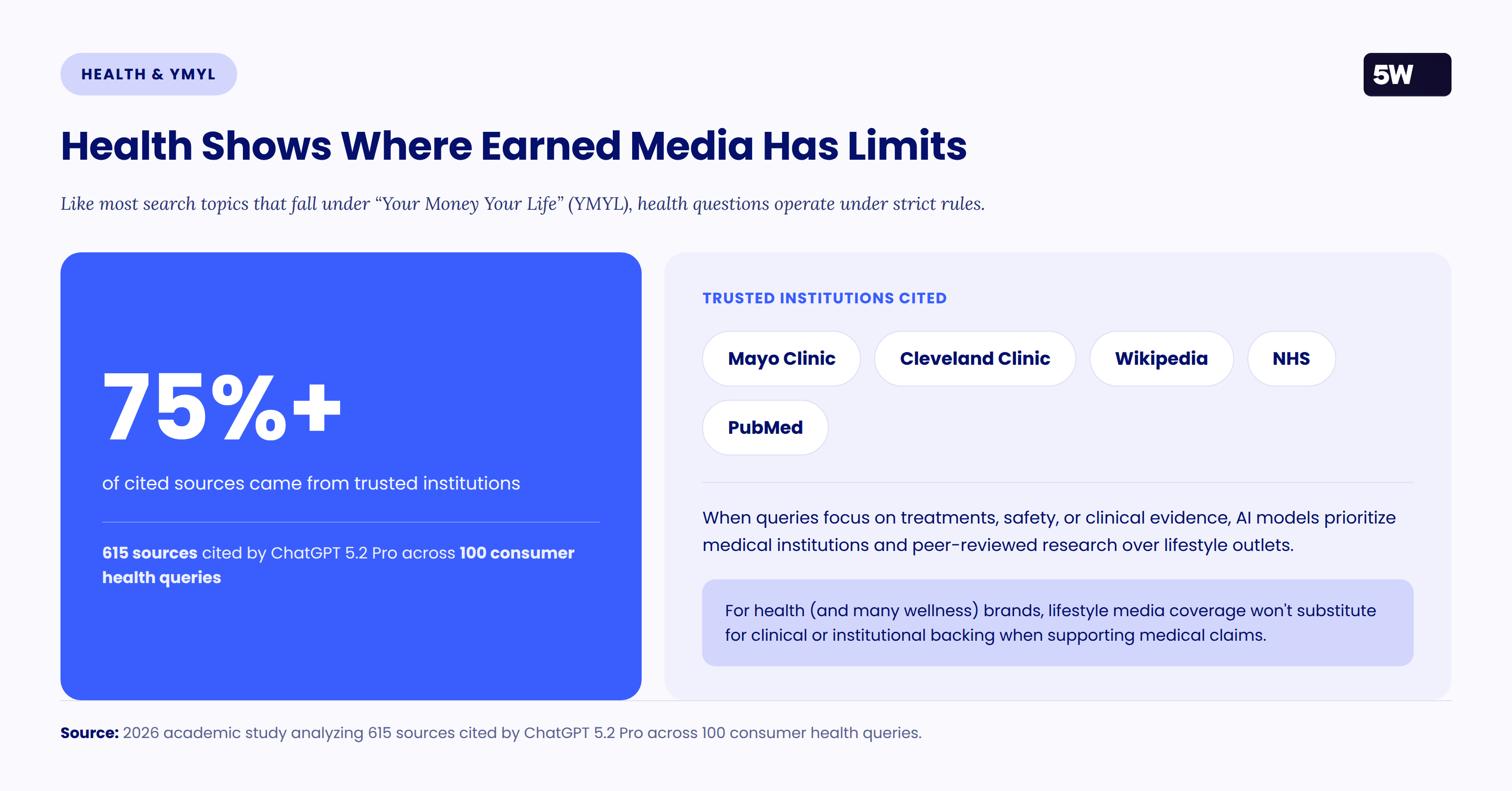
Health Shows Where Earned Media Has Limits
Like most search topics that fall under “Your Money Your Life” (YMYL), health questions operate under strict rules.
A 2026 academic study analyzed 615 sources cited by ChatGPT 5.2 Pro across 100 consumer health queries and found that over 75% came from trusted institutions like the Mayo Clinic, Cleveland Clinic, Wikipedia, the NHS, and PubMed.
When queries focus on treatments, safety, or clinical evidence, AI models prioritize medical institutions and peer-reviewed research over lifestyle outlets.
For health (and many wellness) brands, lifestyle media coverage won't substitute for clinical or institutional backing when supporting medical claims.
Ultimately, the question determines the required information, which in turn determines the most credible sources.
Do ChatGPT, Gemini and Google AI Cite the Same Sources?
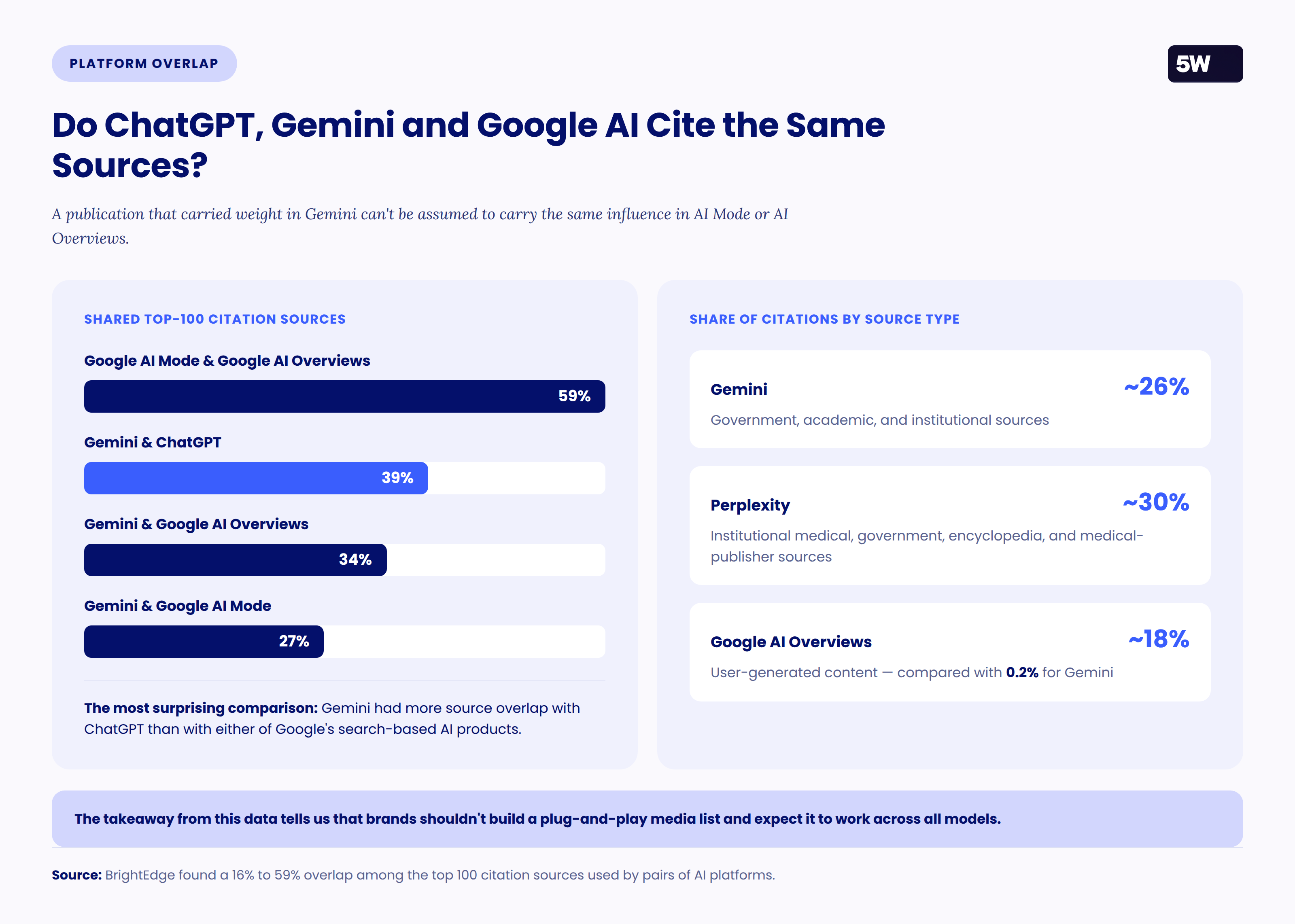
BrightEdge found a 16% to 59% overlap among the top 100 citation sources used by pairs of AI platforms.
Gemini leaned on government, academic, and institutional sources, which accounted for about 26% of its citations. Google AI Overviews went in the opposite direction, drawing about 18% of citations from user-generated content compared with 0.2% for Gemini.
Perplexity’s pattern differed, with institutional medical, government, encyclopedia, and medical-publisher sources accounting for about 30% of its citations.
The differences also show up in Google's AI products.
Google AI Mode and Google AI Overviews shared about 59% of their top 100 citation sources. Gemini shared just 27% of its top sources with Google AI Mode and 34% with Google AI Overviews.
The most surprising comparison: Gemini had more source overlap with ChatGPT, at 39%, than with either of Google's search-based AI products. A publication that carried weight in Gemini can’t be assumed to carry the same influence in AI Mode or AI Overviews.
The takeaway from this data tells us that brands shouldn't build a plug-and-play media list and expect it to work across all models.
AI May Be Ranking Evidence, Not Publications
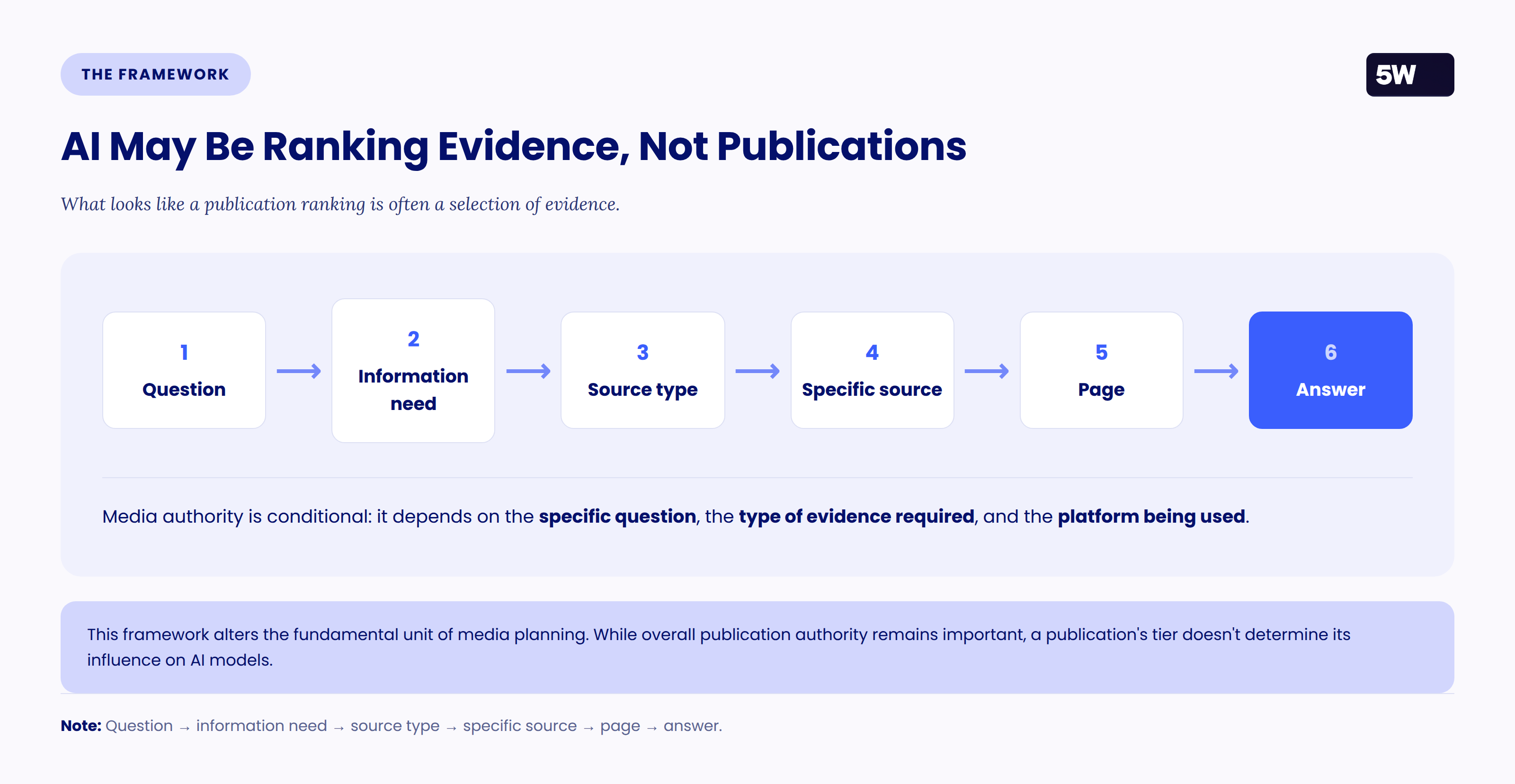
What looks like a publication ranking is often a selection of evidence.
The data in this article demonstrates that media authority is conditional: it depends on the specific question, the type of evidence required, and the platform being used.
A helpful model for understanding this process is
Question → information need → source type → specific source → page → answer
This framework alters the fundamental unit of media planning. While overall publication authority remains important, a publication's tier doesn’t determine its influence on AI models.
Build a Question-to-Source Map, Not a New Media List
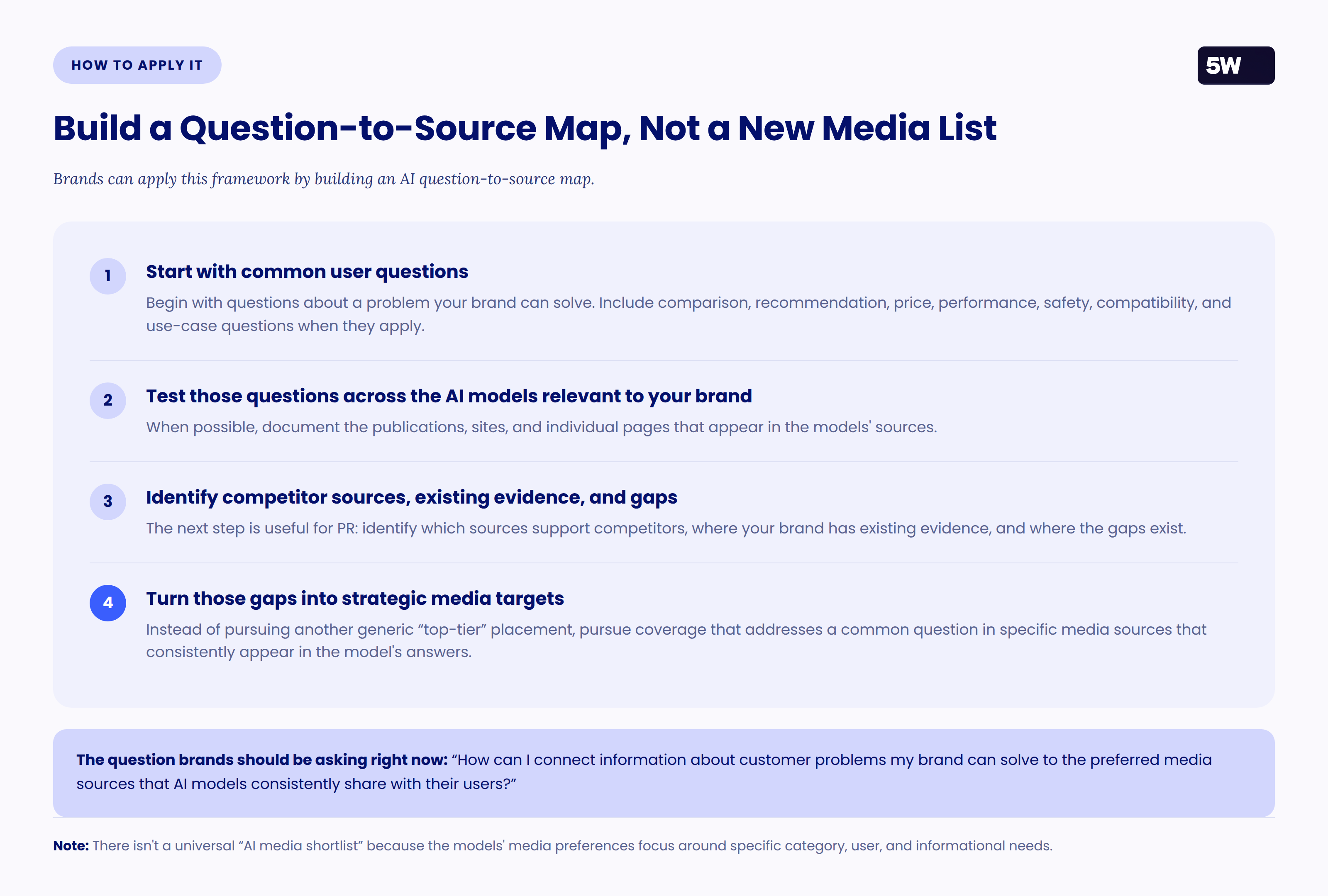
Brands can apply this framework by building an AI question-to-source map.
Start with common user questions about a problem your brand can solve. Include comparison, recommendation, price, performance, safety, compatibility, and use-case questions when they apply.
Test those questions across the AI models relevant to your brand. When possible, document the publications, sites, and individual pages that appear in the models' sources.
The next step is useful for PR: identify which sources support competitors, where your brand has existing evidence, and where the gaps exist.
Those gaps can become strategic media targets. Instead of pursuing another generic “top-tier” placement, brands should pursue coverage that addresses a common question in specific media sources that consistently appear in the model's answers.
** CONCLUSION**
There isn’t a universal “AI media shortlist" because the models' media preferences focus around specific category, user, and informational needs.
Today, publication authority remains a priority, but its value is more specific. It would be a mistake to assume a tier one publication carries the same weight across every user question, page, category, or model.
The question brands should be asking right now is “How can I connect information about customer problems my brand can solve to the preferred media sources that AI models consistently share with their users?
5WPR helps brands build question-to-source strategies, connect those findings with relevant media programs, and pursue owned and earned-media opportunities where authority influences AI-assisted discovery, selection, and recommendation.