
Tables and bullets can make content easier for people to scan, but our testing found little evidence that formatting increases the likelihood that ChatGPT, Claude, or Perplexity uses the correct information from a source.
On July 22, 2026, 5WPR ran 2,400 controlled tests across ChatGPT, Claude, and Perplexity. We tested 40 consumer-brand facts in four formats: a table, a bullet, the first sentence of a paragraph, and the third sentence of a paragraph.
The correct value appeared between 93.5% and 94.6% of the time across the four formats.
The result does not mean formatting is irrelevant. It means content teams should separate two different questions:
Does changing the format make information more likely to be used?
Does changing the format make information easier to read, compare, or attribute to a source?
Our test found little difference on the first question. We found a more noticeable effect on source attribution in Perplexity.
This guide explains what we tested, what formatting changed, what formatting did not change, and what content teams should prioritize instead.
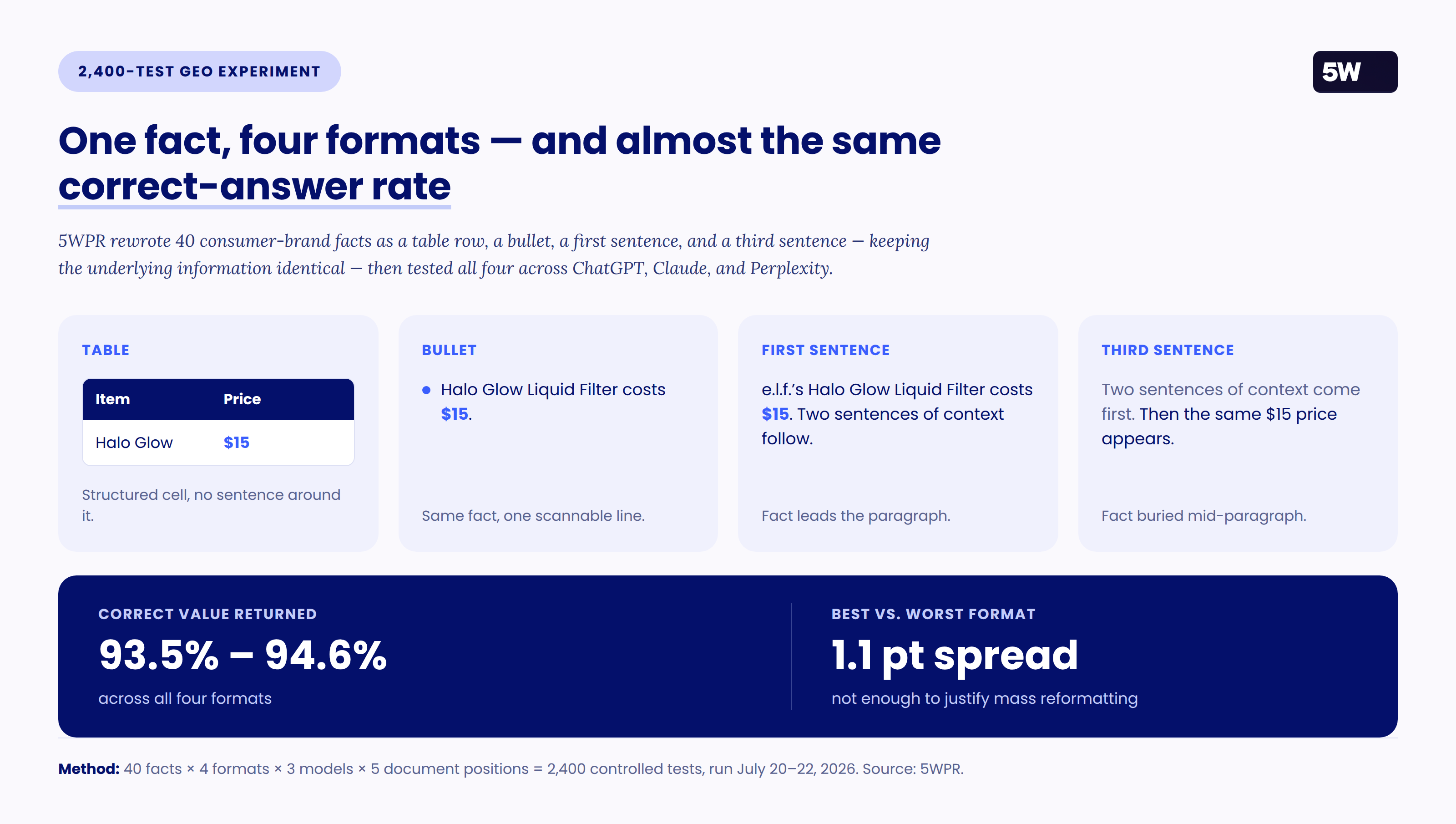
The same fact in four formats. Across 2,400 controlled tests the correct value came back 93.5% to 94.6% of the time, a spread of 1.1 percentage points.
Table of Contents
What Did 5WPR Test?
Does Formatting Increase AI Citation Accuracy?
What Is the Difference Between Adding Information and Reformatting Information?
How Was the Test Structured?
Did Tables Perform Better Than Bullets or Paragraphs?
Did Formatting Affect Source Attribution?
Did Document Position Matter More Than Formatting?
What Does Other Research Say About AI Citation Drivers?
What Should Content Teams Prioritize Instead of Reformatting?
When Should You Still Use Tables and Bullets?
What Should Brands Test Next?
What Information Did 5WPR Test?
5WPR tested whether changing the presentation of identical information affected how often three AI platforms returned the correct information.
The test included 40 consumer passages from 37 brand websites across beauty, retail, beverage, and consumer technology.
The facts included information such as
e.l.f.'s $15 Halo Glow Liquid Filter price.
Wegmans' $0 curbside pickup with a $10 minimum.
Rare Beauty's 48-shade foundation line.
Each passage was rewritten in four formats while keeping the underlying information consistent.
The Four Formats
Table
Shade count | 48
Bullet
The line spans 48 individual shades.
First sentence
Rare Beauty's Liquid Touch Weightless Foundation spans 48 individual shades.
Third sentence
Two sentences of contextual information appeared first, followed by the same statement that the foundation spans 48 individual shades.
The purpose was to isolate formatting. We were not testing whether adding more useful information to a page improves performance.
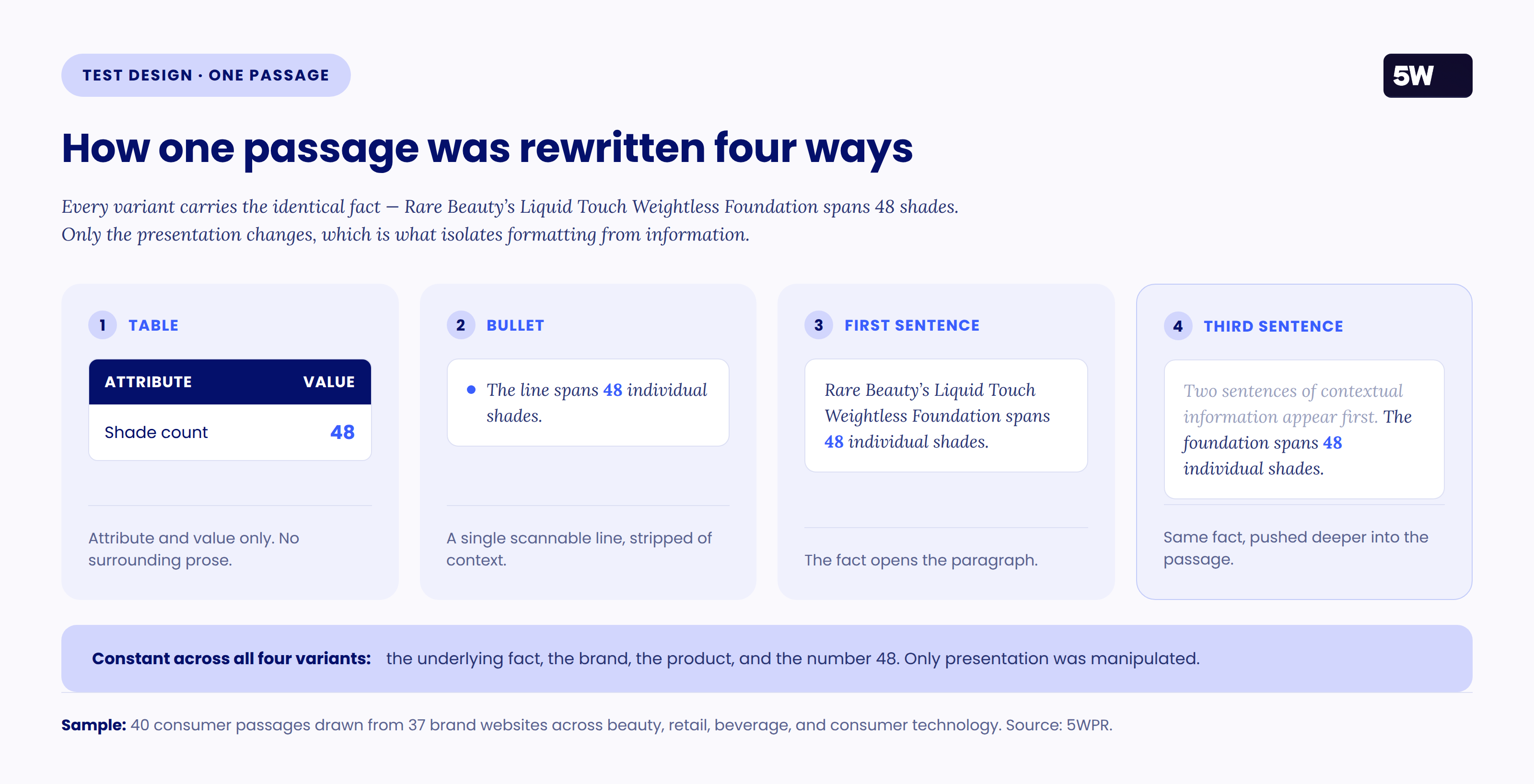
One passage rewritten four ways. The 48-shade fact is identical in every variant; only the presentation changes.
Does Formatting Increase AI Citation Accuracy?
Formatting had little effect on whether the models returned the correct value.
Across tables, bullets, first-sentence paragraphs, and third-sentence paragraphs, the correct information appeared between 93.5% and 94.6% of the time.
The difference between the highest- and lowest-performing formats was 1.1 percentage points.
A difference of that size does not support a broad recommendation that brands should convert large amounts of existing content into tables or bullets specifically to improve citation accuracy.
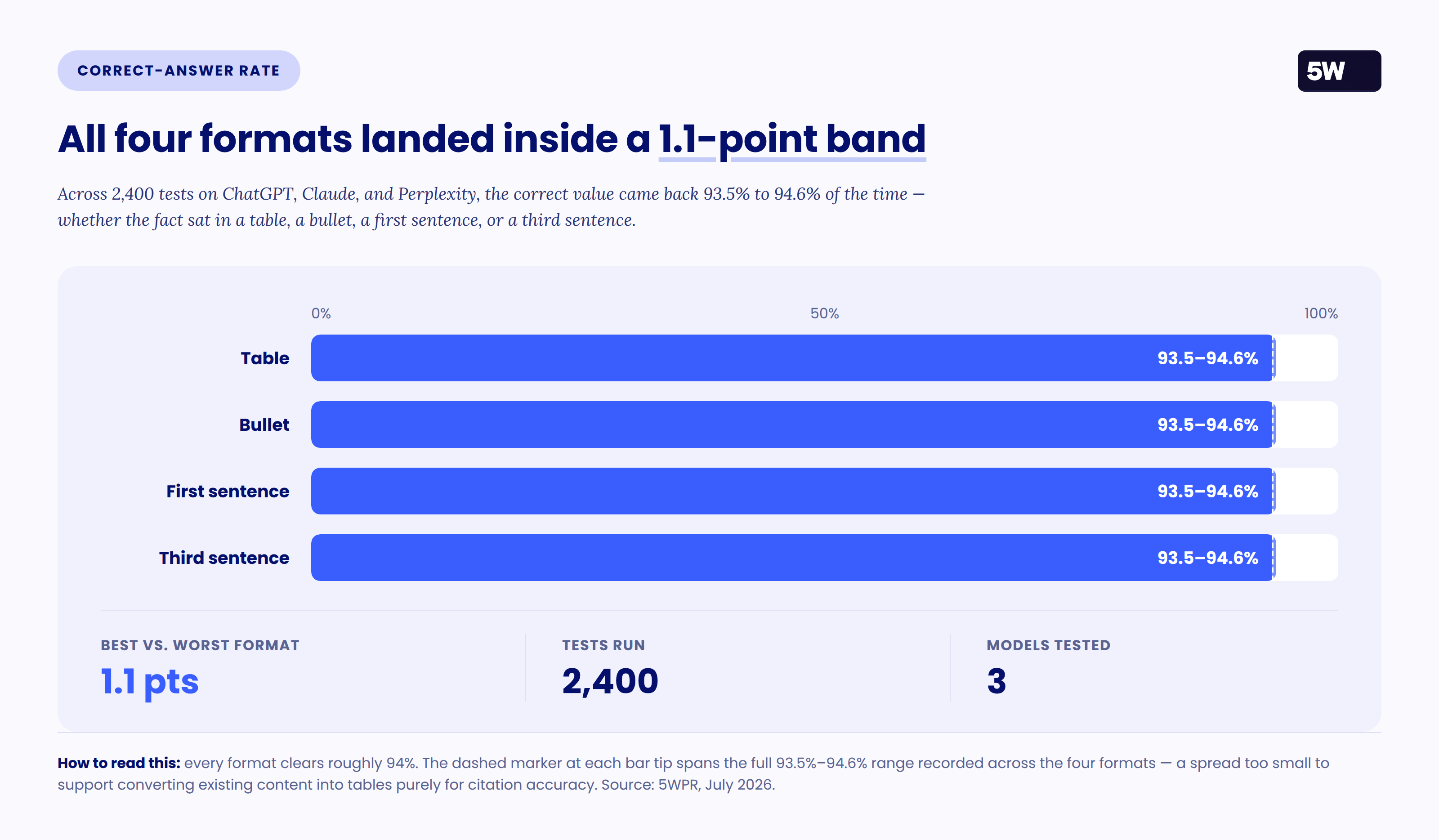
Correct-answer rate by format. All four formats land inside a 1.1-point band.
The practical distinction matters because many GEO recommendations treat formatting as if it changes the information available to a model. In our test, the information stayed constant. Only its presentation changed.
The Difference Between Adding Information and Reformatting Information
Adding information gives a model a previously unavailable fact. Reformatting changes how an existing fact is presented.
The two actions solve different content problems.
If a product page says a product is "affordable" but never provides a price, adding the exact price introduces new information.
If the page already lists the price as $15 and a content team moves that price into a comparison table, the underlying fact has not changed.
Our experiment isolated the second action.
Example
Imagine a product page contains the following sentence:
The warranty covers the product for three years from the date of purchase.
Changing the sentence to:
Warranty | 3 years
makes the warranty easier to scan, but the source still contains the same warranty term.
By contrast, a page that says only "long warranty" does not provide the three-year term at all. Adding "3 years" changes the information available.
Our findings apply to reformatting existing information. They do not establish that adding missing facts has no effect.
How Was the Test Structured?
The experiment tested 40 facts across four formats, three models, and five document positions.
The calculation was:
40 facts × 4 formats × 3 models × 5 document positions = 2,400 tests
The three models were
ChatGPT
Claude
Perplexity
We ran the tests between July 20 and July 22, 2026.
We rotated the position of the target document within the supplied document set. The rotation helped separate formatting effects from position effects.
Without the rotation, a table that appeared first more often than another format could appear to perform better because of its position rather than its formatting.
Did Tables Perform Better Than Bullets or Paragraphs?
Not in a meaningful way for the correct-answer rate.
The best-performing and worst-performing formats were separated by 1.1 percentage points.
The result suggests that converting a fact from a paragraph into a table or bullet is unlikely to produce a substantial increase in whether the tested models return the correct value.
That distinction matters for content teams considering large-scale GEO reformatting projects.
If 500 pages contain complete, specific, and accurate information, our experiment does not provide evidence for converting all 500 pages into tables solely to increase citation accuracy.
Tables may improve readability. Bullets may help users scan instructions or product features. Those are separate benefits.
Did Formatting Impact Source Attribution?
Formatting had a larger effect on how Perplexity credited the source than on whether Perplexity returned the correct fact.
Perplexity explicitly named the publisher 66% of the time when the fact appeared in a table, compared with 55% when the same information appeared in the third sentence of a paragraph.
That is an 11-percentage-point difference.
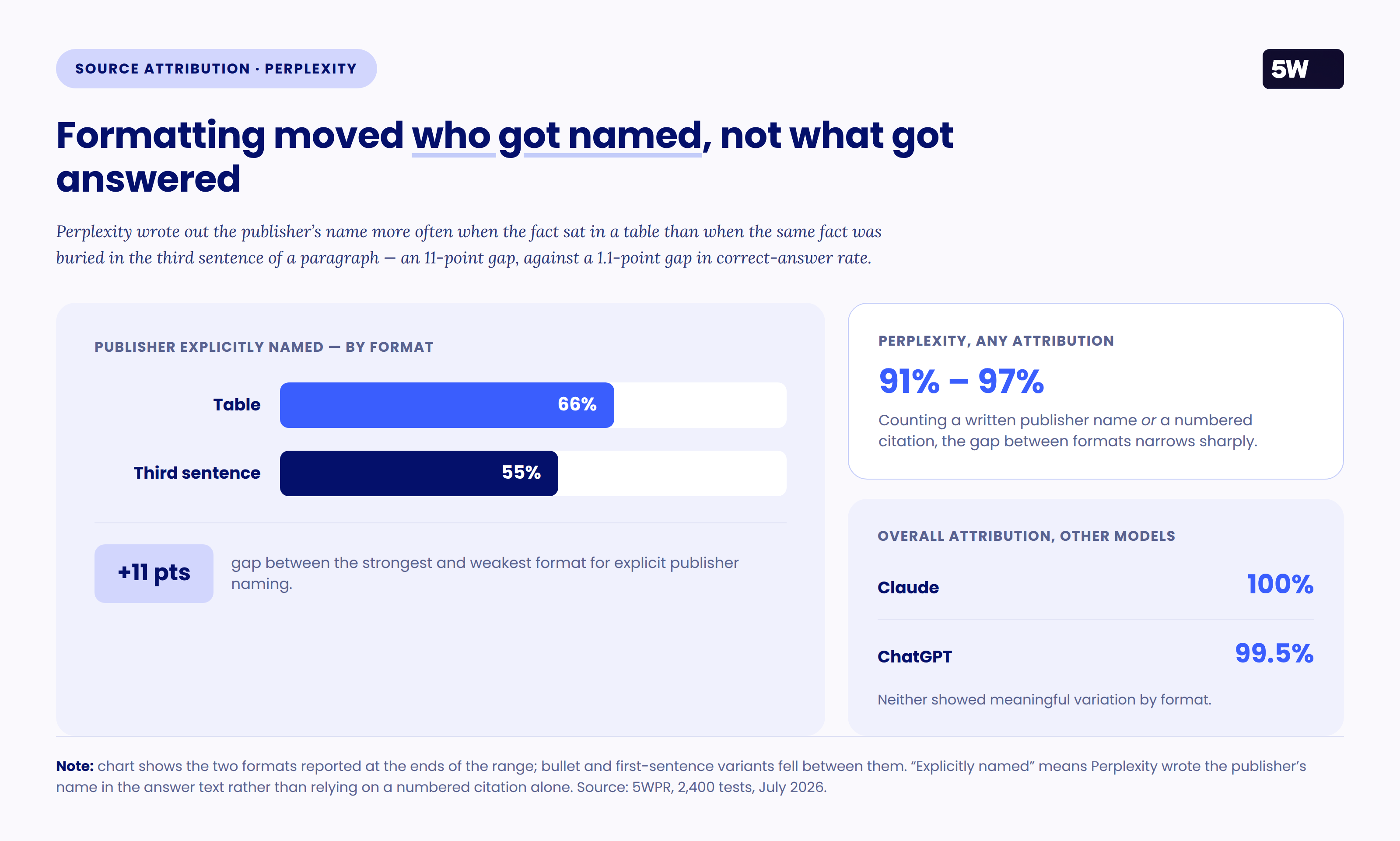
Perplexity publisher-name attribution by format: 66% for the table, 55% for the third-sentence paragraph, an 11-point gap.
The difference becomes smaller when source attribution includes either a written publisher name or a numbered citation.
Across the four formats, Perplexity's overall attribution rate ranged from 91% to 97%.
Claude and ChatGPT showed almost no variation in overall source attribution:
Claude: 100%
ChatGPT: 99.5%
The practical finding is narrower than "tables improve AI citations."
A more accurate interpretation is:
In this experiment, formatting changed Perplexity's tendency to explicitly name the publisher more than it changed whether the correct fact was returned.
The experiment does not establish that the same attribution effect will occur across every topic, page type, model, or retrieval environment.
Did Document Position Matter More Than Formatting?
Yes. In Perplexity, document position produced a substantially larger change in publisher-name attribution than formatting.
When the target document appeared first in the supplied document set, Perplexity named the publisher 71.9% of the time.
When the same target document appeared in the middle position, publisher-name attribution fell to 39.4%.
That is a 32.5-percentage-point difference.
The largest formatting difference was 11 percentage points.
In this test, document position therefore produced nearly three times the attribution swing associated with formatting.
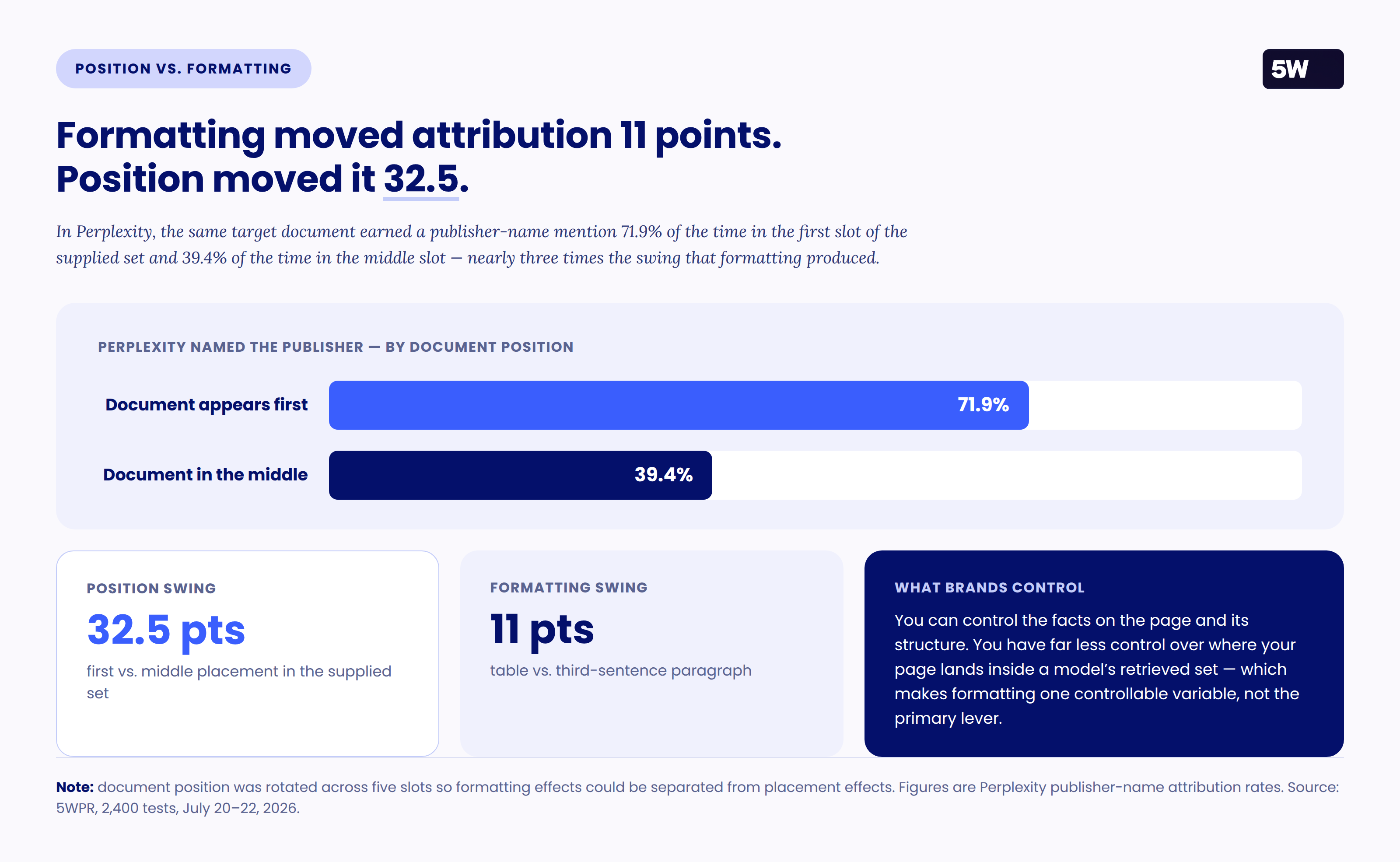
Document position produced a 32.5-point swing in Perplexity publisher-name attribution, against 11 points for formatting.
The finding creates an important limitation for optimization.
Brands can control whether their pages contain accurate prices, specifications, evidence, and product information. They can also control page structure.
Brands have less control over where one document appears inside a model's retrieved or supplied set for a specific query.
That makes formatting a controllable variable among several rather than the primary lever.
What Supporting Research Shows About Formatting For Citations
Our findings are consistent with separate 2026 research that ran 252,000 trials across six LLMs.
That study identified factors including
Relevance to the query.
Document position.
Specific pricing rather than vague price language.
Content recency.
The broader pattern is important because "GEO formatting" often bundles several different changes together.
A page may receive:
Better factual detail.
More direct answers.
Updated statistics.
New citations.
Cleaner headings.
Tables.
Bullet lists.
If visibility improves afterward, the change does not prove that the table or bullet caused the improvement.
Controlled testing is needed to isolate the effect of one variable.
What Should Content Teams Prioritize Instead of Reformatting?
Start with specificity.
Before changing a paragraph into a table, check whether the page contains the facts a model or consumer would need to answer the target question.
1. Replace Vague Price Language With Exact Prices
Not:
Our product offers an affordable option.
Instead:
The product costs $29.
An exact price can answer a query such as "products under $30." The word "affordable" cannot establish whether the product meets a $30 limit.
2. State Exact Warranty Terms
Not:
Every purchase includes a generous warranty.
Instead:
Every purchase includes a three-year limited warranty.
The second version provides a specific term that can be compared against another product.
3. Support Research Claims With the Original Evidence
If a page cites outside research, identify and link the underlying study when possible.
Not:
Research shows consumers prefer the product.
Instead:
A 2026 survey of 2,000 U.S. consumers found that 64% preferred the product.
Use the exact figure, sample, year, and source only when the evidence supports each detail.
4. Replace General Popularity Claims With Measurable Evidence
Not:
Customers love the product.
Instead:
The product has a 4.7-star rating across 2,100 customer reviews.
A rating and review count provide information that can be compared. "Customers love it" does not.
5. Check Whether Important Facts Exist Before Changing Their Format
Audit the underlying information before deciding how to display it.
For a product page, the audit might include:
Exact price.
Product category.
Dimensions.
Materials.
Available colors or shades.
Warranty period.
Shipping cost.
Return period.
Review rating and review count.
Compatibility requirements.
A table can make those facts easier to compare. A table cannot compensate for missing facts.
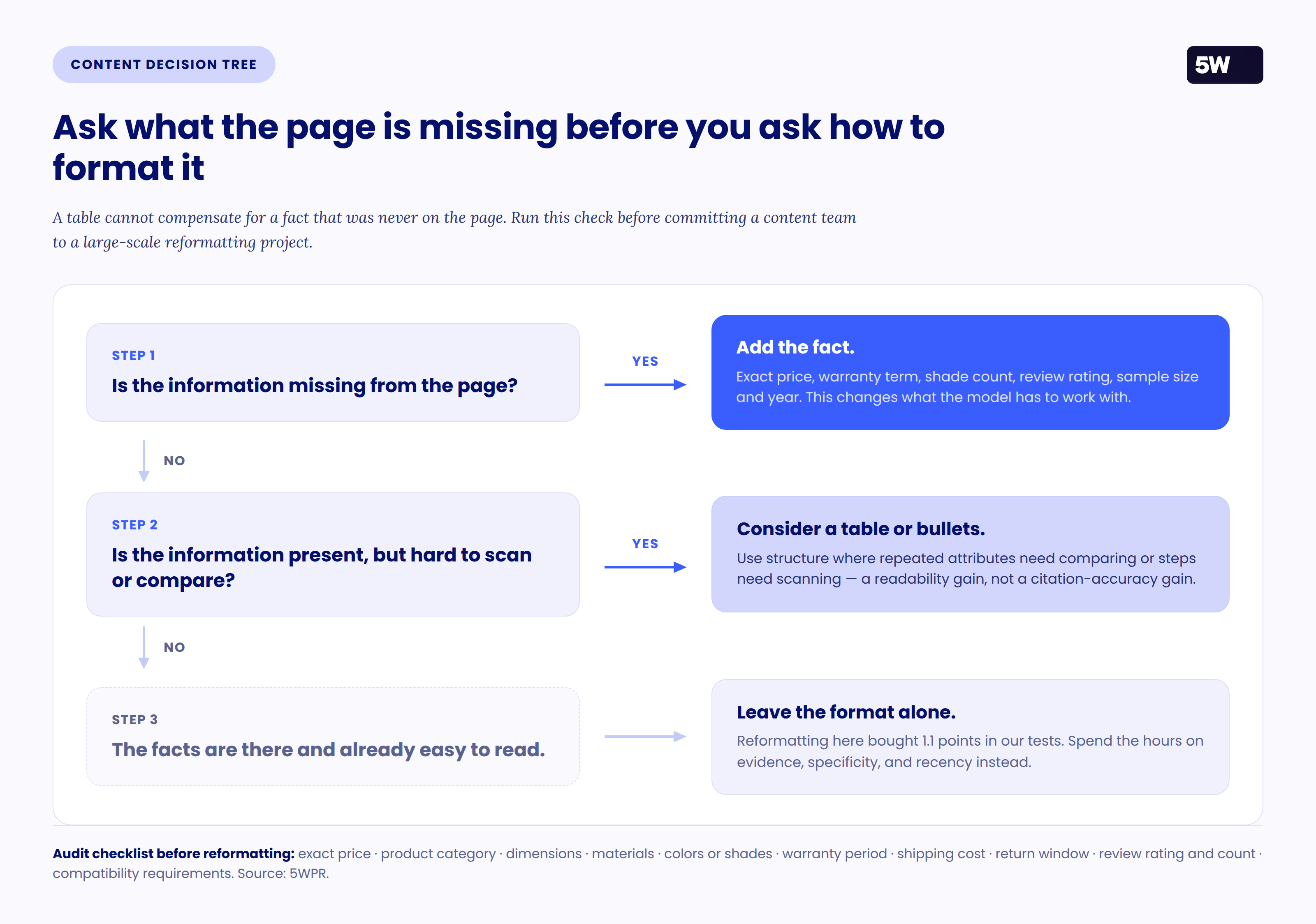
Audit the information before changing its format. A table cannot compensate for a fact that was never on the page.
When Should Brands Prioritize Bullets and Tables?
Use tables and bullets when the format improves the reader's ability to understand, scan, or compare information.
The test does not provide a reason to stop using structured formatting.
Tables work well for information with repeated attributes.
For example:
| Product | Price | Warranty | Rating |
|---|---|---|---|
Product A | $29 | 3 years | 4.7/5 |
Product B | $39 | 1 year | 4.4/5 |
A paragraph would make the same comparison slower to scan.
Bullets work well when the reader needs to review several discrete specifications or steps.
For example:
Price: $29.
Warranty: three years.
Shipping: free over $50.
Returns: accepted within 30 days.
The content format should serve the information.
Use a table because readers need to compare values, not because a generic GEO checklist says every page needs one.
What Should Brands Test Next?
Brands should separate content quality, formatting, retrieval, attribution, and citation performance when evaluating GEO changes.
A practical testing process is
Establish a fixed query set. Use the same prompts across each round of testing so results can be compared over time.
Record the underlying source information. Confirm whether the exact price, specification, category, date, or claim already exists on the page.
Change one variable when possible. If a page receives new data, a new table, rewritten headings, and additional sources at the same time, the result cannot show which change mattered.
Measure more than one outcome. Track correct-answer rate, brand mentions, publisher attribution, citations, and recommendation position separately.
Repeat the test. A single generated answer should not be treated as a stable measure of performance.
The main finding from our 2,400 tests is not that formatting does not matter.
The narrower finding is more useful:
When the underlying fact remained the same, changing the fact from a paragraph to a bullet or table produced little difference in correct-answer rate across ChatGPT, Claude, and Perplexity.
Formatting did produce a larger difference in one area: Perplexity's tendency to write the publisher's name. Document position produced an even larger difference.
For content teams, the order of operations should therefore be straightforward: ensure the page contains the specific information a user needs, verify the evidence supporting the information, and then choose the format that communicates it most effectively.
Work With 5W on AI Visibility
If your team is evaluating an AEO investment, 5W can help you determine what is worth fixing before you spend.
We start with diagnosis, not tactics. We audit what your content is missing, establish baseline KPIs for how AI models find, cite, and represent your brand, and prioritize the changes most likely to improve AI search visibility.
When we recommend a strategy, we show you the data behind it.
Contact 5WPR to discuss where your brand stands today, discover what visibility gaps your can fill, and what content to prioritize next.