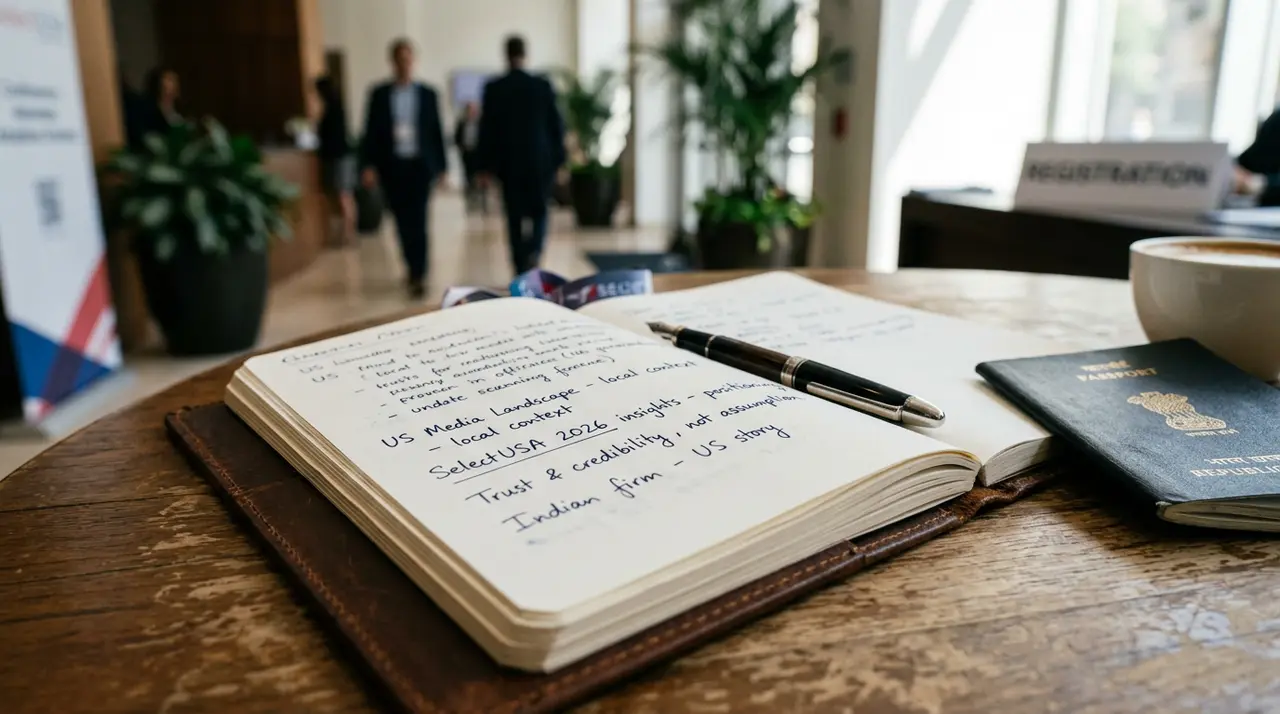
Indian companies entering the U.S. market should plan their PR around a visa rule that is still in flux: the $100,000 H-1B fee, imposed on September 21, 2025, was extended through September 21, 2027 by a September 18, 2026 proclamation, yet it is currently blocked by two federal court orders. A launch announcement should not depend on a fee that may return, so build the story on U.S. hiring and named commitments instead.
Last updated: October 24, 2026. This article is communications guidance, not legal or immigration advice. Check current status with immigration counsel before any announcement.
In this guide
- What is the status of the $100,000 H-1B fee?
- How did the fee get here?
- How are Indian firms adjusting their U.S. staffing models?
- Is the L-1A visa an alternative for smaller Indian firms?
- How should the visa story shape a U.S. market-entry narrative?
- What should PR teams prepare before an Indian company's U.S. launch?
- Frequently asked questions
What Is the Status of the $100,000 H-1B Fee?
The $100,000 H-1B fee is blocked by court order as of October 2026, even though the underlying proclamation was extended. Columbia University's International Students and Scholars Office reported on October 1, 2026 that the fee remains blocked by two separate court orders and should not be enforced by USCIS. The extension to September 21, 2027 was signed on September 18, 2026, and the same day an executive order directed agencies to consider employer layoff activity when reviewing H-1B-related applications.
Litigation is unresolved and the government is appealing, so the situation could change. A separate DHS proposal for a $103,265 fee on cap-subject petitions was published in August 2026 and is not in effect, according to law firm summaries.
How Did the Fee Get Here?
| Date | Development |
|---|---|
| September 19 to 21, 2025 | Proclamation signed; $100,000 payment requirement takes effect for new H-1B petitions for workers outside the U.S. |
| June 8, 2026 | A federal district court vacates the fee policy |
| July 2026 | A federal appeals court declines to pause that ruling |
| September 18, 2026 | Proclamation extends the requirement through September 21, 2027 |
| September 30, 2026 | A second federal court vacates the agency policies and bars enforcement |
The fee applied only to new petitions for workers outside the United States, not to existing visa holders, extensions or renewals. A company that read the original 2025 coverage and plans around a fee that is currently unenforceable could get its messaging wrong in either direction.
How Are Indian Firms Adjusting Their U.S. Staffing Models?
Many Indian IT services firms have been moving toward local U.S. hiring, nearshore delivery centers and a smaller share of visa-dependent staff, because a model built on deploying graduates from India to client sites carries both cost and policy risk. Nearshore centers in Canada, Mexico and Latin America offer time-zone alignment without H-1B exposure, and some firms use other visa categories for roles that still need a U.S. presence.
For PR purposes, the point is not which model a firm uses but that it can describe its model plainly. Reporters covering Indian market entrants are likely to ask how many roles will be filled by local hires and how many by transfers.
Is the L-1A Visa an Alternative for Smaller Indian Firms?
The L-1A intra-company transfer visa is a common route for a mid-sized company that wants to send a trusted senior leader to open a U.S. office, because it does not depend on the H-1B lottery. For qualifying executives and managers it can also support a longer-term green card path. Eligibility rules are specific, so any public statement about visa strategy should be reviewed by immigration counsel.
How Should the Visa Story Shape a U.S. Market-Entry Narrative?
The visa story helps a market-entry narrative when the company leads with U.S. hiring and named commitments instead of appearing to route around a rule. A company that opens with "we are hiring engineers in our new Texas office" gets a different reception than one that opens with its India talent pipeline, even when headcounts are similar.
Named, specific announcements work best: a company size, an investment figure, a U.S. state and a job count. Reporters can check each element, and it avoids the vague "expansion plans" statement. The tech PR playbook covers how to package launch news, and the fintech PR playbook does the same for funding and partnerships.
What Should PR Teams Prepare Before an Indian Company's U.S. Launch?
- A staffing breakdown: roles filled by local U.S. hires, by transfer, and under which visa category.
- A one-paragraph answer on the H-1B fee that reflects its current legal status, reviewed by counsel and dated.
- Named proof points: investment amount, state, job count and timeline.
- A monitoring habit for the appeals and the DHS rulemaking, since the picture could change before launch.
- Executive spokespeople who can describe the plan in specific terms without overclaiming.
Do not imply a founder belongs to a group of established U.S. executives unless a named person has a verifiable record, because easy fact-checking can undermine the rest of an announcement.
Frequently asked questions
Is the $100,000 H-1B fee being collected?
No. As of October 2026 the fee is blocked by court orders, although the proclamation behind it was extended through September 21, 2027 and litigation continues.
Who did the fee apply to?
New H-1B petitions for workers outside the United States. It did not apply to existing visa holders, extensions or renewals.
Should an Indian company mention the fee in its launch messaging?
Only if asked or relevant, and only in a form that matches its current legal status, reviewed by immigration counsel. Lead with U.S. hiring and named commitments instead.
What is the L-1A visa?
An intra-company transfer visa that lets a company move a qualifying senior leader to a U.S. office without using the H-1B lottery. Eligibility rules are specific.