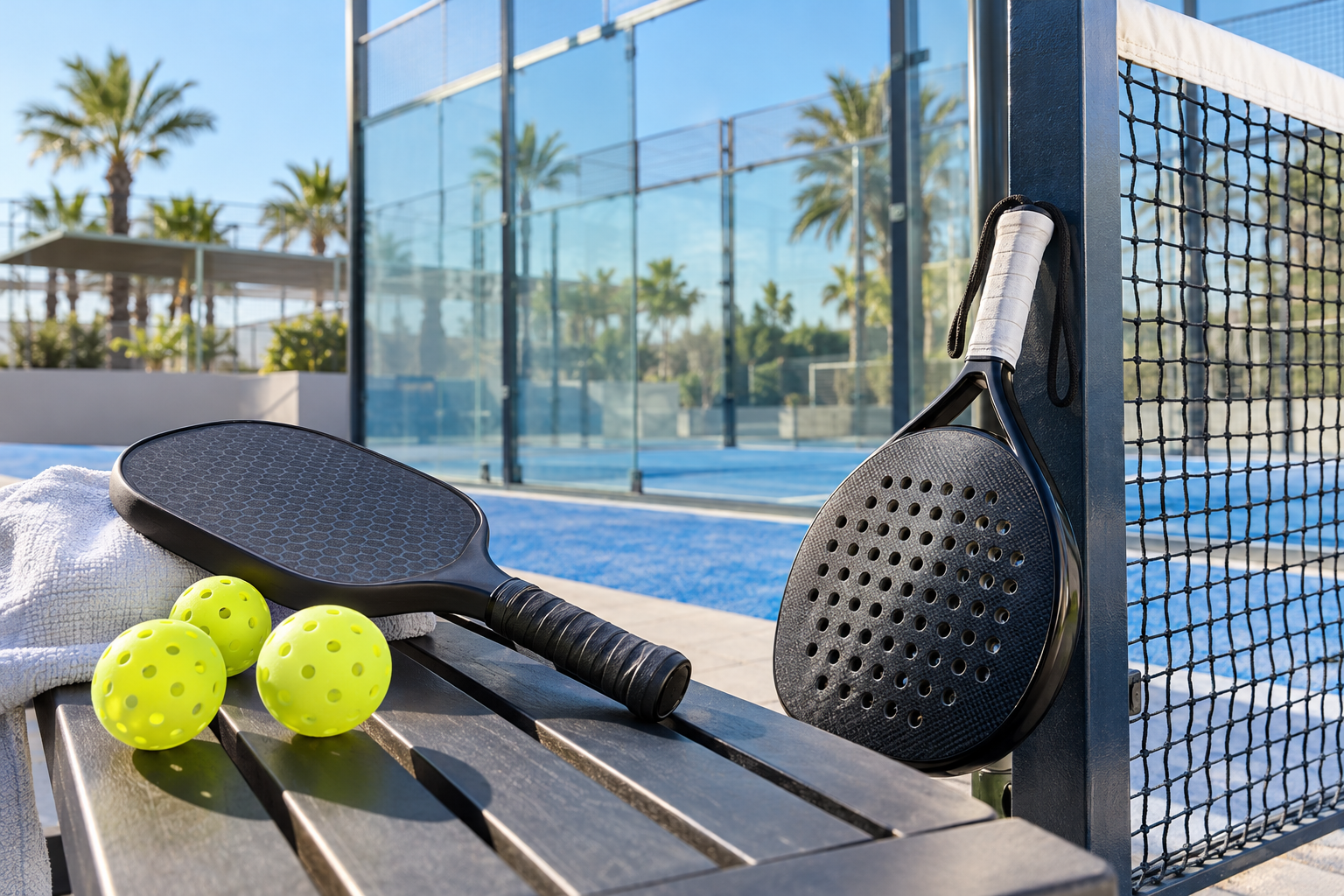
Pickleball and padel marketing works best when a brand treats the two sports as different audiences. The Sports & Fitness Industry Association counted 24.3 million US pickleball players in 2025, while the United States Padel Association says padel passed one million players. Pickleball rewards broad reach and local play. Padel rewards premium, club-based and hospitality-led activations.
Last updated: November 28, 2026
Summary: This guide compares the two sports on audience size, venues and sponsor activity, then gives the press angles and a five-step plan that fit each one. All participation figures come from named reports and are dated beside the claim.
Contents
- How big are pickleball and padel in the US?
- Who plays each sport?
- Which brands are sponsoring padel and pickleball?
- How do the two sports compare for marketers?
- What press angles work for racquet sports?
- How can a brand start in five steps?
- Frequently asked questions
How big are pickleball and padel in the US?
Pickleball had an estimated 24.3 million US players in 2025, and padel had more than one million. Both figures come from the Sports & Fitness Industry Association (SFIA) 2026 Topline Participation Report, which tracks more than 100 sports and fitness activities.
SFIA reports that pickleball participation grew from 4.2 million in 2020 to 24.3 million in 2025 and that the sport was the fastest-growing in the country for the fifth year in a row, according to the SFIA pickleball research page. About 4.5 million of those players were new in 2025, and the year-over-year increase was 22.8%.
Padel is much smaller. The United States Padel Association (USPA) announced that padel crossed one million US players in the same SFIA report, and its release says the country had just over 1,000 padel courts in 31 states as of April 2026, according to the USPA announcement. The two sports are not at the same stage, so they need different plans.
Who plays each sport?
Pickleball players split into a very large casual group and a smaller core group, and padel players skew toward club members. The split matters because casual players buy gear and drinks occasionally, while core players buy repeatedly and join leagues.
In the SFIA 2026 data for pickleball, 16.8 million people played one to seven times a year and 7.48 million played eight or more times, according to Pickleball.com's summary of the report. SFIA's release also puts women at 42.9% of players, up from 38.6% in 2020.
For padel, the USPA reported that club membership grew 51.5% and individual membership grew 53.5% in 2025. Those are association membership figures, not a count of all players, so they should not be compared directly with the pickleball numbers above.
A practical reading: pickleball is a mass-participation sport with a visible core, and padel is an early-stage sport where the venue is the brand's main point of contact.
Which brands are sponsoring padel and pickleball?
Padel sponsorship is led by equipment makers, financial brands and lifestyle brands. Marketing Brew reported that the Pro Padel League, which has 10 teams across the US, Canada and Mexico, counts Adidas, Franklin and Kalshi among its sponsors, and that Chase Sapphire Reserve, Aston Martin, Barry's and Vuori activated at the Bero Padel Classic.
The USPA's 2025 annual report lists Nox, Padel Haus, Chosen Foods, VanEck, Bullpadel and Padelmba as long-standing sponsors. That mix shows two entry points: gear brands that need players to try the product, and brands from outside sport that want an affluent audience.
Pickleball sponsor activity is also heavy, but this guide does not list pickleball sponsors because the sources reviewed for this update did not provide a verified, dated sponsor list. That gap is worth filling before a brand commits budget.
How do the two sports compare for marketers?
The two sports differ most in scale and in where the customer meets the brand. Pickleball offers reach across public courts, parks and clubs. Padel offers a smaller, venue-centered audience that is often reached through hospitality and private clubs.
| Factor | Pickleball | Padel |
|---|---|---|
| US players, 2025 (SFIA) | 24.3 million | More than 1 million |
| Growth signal | 22.8% more players than 2024 | Club membership up 51.5% (USPA) |
| Core audience | 7.48 million who play 8+ times a year | Club and league members |
| Where the brand meets the player | Public courts, clubs, tournaments, social video | Padel clubs, hospitality venues, tournaments |
| Infrastructure | Widespread | About 1,000 courts in 31 states (April 2026) |
| Best first move | Creator content and local events | Venue partnerships and premium activations |
The "best first move" row is 5W's editorial view, not a reported finding. It follows from where each audience gathers.
What press angles work for racquet sports?
Racquet sports earn coverage when a brand brings a number, a place and a person to the pitch. Reporters already know that pickleball is growing, so a pitch that repeats the growth line adds nothing. A pitch that adds a local fact does.
Four angles tend to hold up:
- A local venue opening with court counts and a named operator.
- A tournament with a clear first, such as the first padel event in a city.
- A product launch tied to a measurable player need, such as a paddle or shoe for a specific type of play.
- A study of the sport's players built from the brand's own first-party data.
Florida is a useful example. The USPA sanctioned 154 tournaments in 2025, with Texas and Florida leading, and the Premier Padel P1 in Miami in March 2025 brought international players and sponsors to US soil for the first time, according to SGI Europe's market report. A Miami or Tampa angle gives a reporter a local reason to cover the story.
For more on how sponsorship and coverage work together, see our guide to sports sponsorship PR and the roundup of best entertainment and sports marketing campaigns.
How can a brand start in five steps?
A brand can start in pickleball or padel with five steps: pick one sport, pick one audience, pick one venue or event, make content from it and measure sales or sign-ups. The steps below put the order in writing.
- Choose one sport first. Pickleball suits brands that want volume. Padel suits brands that want a premium audience and can work with venues.
- Choose one audience inside it. Casual players, core players, women players and club members each want different messages.
- Choose one venue, league or event to anchor the work. A single club partnership teaches more than a scattered sponsorship list.
- Produce content from that anchor. Short video from the court, player interviews and a local press pitch can all come from one event.
- Measure orders, sign-ups or foot traffic against a baseline taken before the program starts.
Brands that plan to use creators can read our guide to creator seeding, and brands selling product through short video can compare TikTok Shop agency options. Budget questions for paid placement are covered in the paid social budget guide.
5W is a PR, creative and AI Visibility agency based in Miami with offices in Tampa and New York, and its sports and entertainment work is described on the entertainment and sports marketing PR agency page.
Frequently asked questions
How many people play pickleball in the US?
SFIA's 2026 report estimates 24.3 million Americans played pickleball in 2025, up 22.8% from 2024. About 7.5 million of them played eight or more times.
How many people play padel in the US?
The USPA announced that padel passed one million US players, based on SFIA's 2026 Topline Participation Report. The association also reported just over 1,000 courts across 31 states as of April 2026.
Is padel bigger than pickleball?
No. Pickleball had 24.3 million US players in 2025 and padel had more than one million, according to SFIA. Padel is growing from a much smaller base.
Which brands sponsor the Pro Padel League?
Marketing Brew lists Adidas, Franklin and Kalshi among the sponsors of the Pro Padel League, which has 10 teams across the US, Canada and Mexico.
What is the best first step for a brand entering racquet sports?
Pick one sport, one audience and one venue or event, then produce content and a press pitch from it. A single anchor gives the brand a baseline to measure against.
Which players are worth targeting first in pickleball?
Core players, defined by SFIA as those who play eight or more times a year, are the most repeat buyers. Casual players are a larger group but play fewer times.