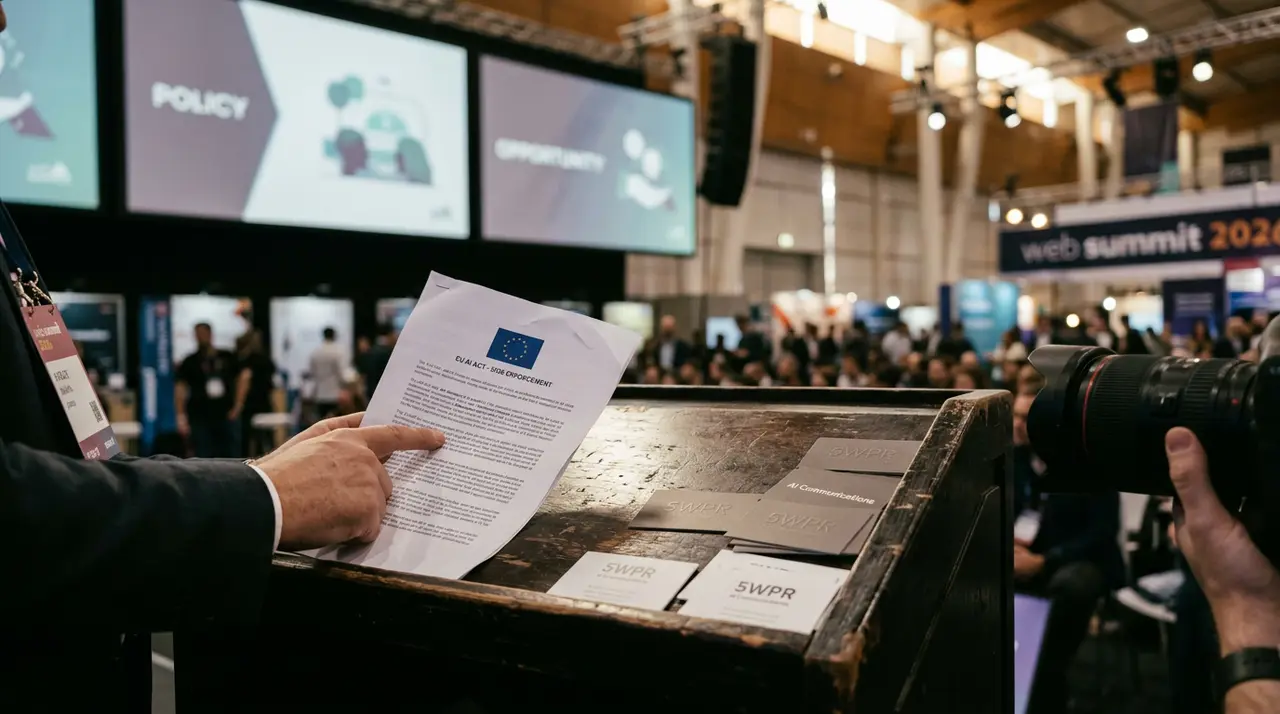
Web Summit 2026 runs November 9 to 12 at the Altice Arena and FIL in Lisbon, and its confirmed speaker list includes European Commission Executive Vice-President Henna Virkkunen, who oversees the EU's AI policy portfolio. Her appearance lands four months after the EU AI Act's next enforcement wave took effect on August 2, 2026, giving AI companies at Web Summit a live regulatory story to pitch, not just a product story.
Why Does AI Policy Have A Seat At Web Summit 2026?
Henna Virkkunen is the European Commission's Executive Vice-President for Tech Sovereignty, Security and Democracy, a role that carries direct responsibility for the EU's Artificial Intelligence portfolio, including the Apply AI Strategy and the European AI Research Council. Her confirmed presence at Web Summit 2026 places a sitting EU policymaker on the same stage as enterprise and consumer technology leaders, a pairing that turns the conference's AI programming into a venue where policy and product narratives collide in front of the same press corps.
That matters for PR planning because Web Summit draws attendees across enterprise software, consumer technology, venture capital, and government policy at the same time, a mix a category-specific event rarely replicates. A reporter covering Virkkunen's remarks is sitting in the same room, and often working the same beat, as a reporter covering a frontier AI lab's product launch.
Why Does The EU AI Act's 2026 Enforcement Wave Matter Now?
The EU's Digital Omnibus deferred the heaviest tier of the EU AI Act, the Annex III high-risk obligations covering systems like recruitment tools and credit scoring, from August 2, 2026 to December 2, 2027. That deferral does not apply to everything: Article 50 transparency obligations and the European Commission's enforcement powers over general-purpose AI (GPAI) models took effect on their original date, August 2, 2026, and remain live.
In practical terms, an AI company presenting at Web Summit 2026 is already operating inside a regulatory window where the Commission can act on GPAI obligations, even though the broader high-risk regime has more runway. A vague "we take AI safety seriously" line no longer holds up to a policy reporter who covers this distinction for a living.
How Should AI Brands Pitch Media Around Web Summit's Policy Track?
A pitch built around Web Summit's AI policy programming needs to name the specific obligation a product or announcement touches, not a general safety posture. A company whose product falls under general-purpose AI model rules has a different, more urgent compliance story in October 2026 than one developing a system that will not face Annex III obligations until December 2027, and a reporter covering Virkkunen's remarks will ask which category applies.
Executives should prepare a short, specific response to likely Virkkunen talking points, the Apply AI Strategy, the European AI Research Council, or EU AI Act enforcement, rather than a generic statement about innovation. A named compliance milestone a company has already hit, a completed conformity assessment step, a published transparency disclosure, reads as news to a policy desk in a way a mission-statement quote does not.
Brands should also separate the product pitch from the policy pitch and route them to different desks: a product announcement goes to the technology and business press that already follows Web Summit's product tracks, while a policy-reactive statement goes to the policy and regulatory press that follows the EU AI Act specifically. Collapsing both into one release usually gets picked up by neither.
What Should An AI Brand Do Before, During, and After Web Summit?
| Phase | Actions | Output |
|---|---|---|
| Pre-summit (4+ weeks out) | Map the company's own AI Act obligations (GPAI versus Annex III high-risk) and draft an executive statement on current compliance posture | A ready-to-use compliance narrative distinct from the product pitch |
| During the summit (Nov 9-12) | Monitor Virkkunen's and other policy speakers' remarks for same-day reactive commentary opportunities, routed to policy press separately from product press | Same-day placements in both policy and trade coverage |
| Post-summit (first two weeks) | Publish an analysis connecting the summit's policy commentary to the August 2026 GPAI enforcement wave and the deferred 2027 high-risk timeline | Durable, citable content for earned media and AI search |
How Does AI Policy Coverage Feed AI Search Visibility?
Coverage that names a specific regulator, a specific statute provision, and a specific date becomes the kind of structured, citable content generative engines pull from when a user asks an AI tool which companies are prepared for EU AI Act enforcement. A release that only says a company "monitors the regulatory environment" gives a retrieval system nothing concrete to extract.
5W's Generative Engine Optimization practice treats this kind of named, dated regulatory content as a direct input into AI citation share, alongside the crisis communications and GEO work 5W runs for AI clients managing fast-moving narrative risk. The same discipline that makes a compliance statement hold up to a policy reporter, naming the entity, the provision, and the date, is what makes it hold up to an AI model deciding which source to cite.
Frequently asked questions
Why does AI policy have a seat at Web Summit 2026?
European Commission Executive Vice-President Henna Virkkunen, who oversees the EU's AI and digital technology portfolio, is a confirmed 2026 speaker at Web Summit, putting a sitting EU policymaker on the same stage as enterprise and consumer AI companies.
Why does the EU AI Act's 2026 enforcement wave matter now?
Article 50 transparency obligations and the European Commission's enforcement powers over general-purpose AI models took effect August 2, 2026, even though the EU's Digital Omnibus deferred the heavier Annex III high-risk obligations to December 2, 2027.
How should AI brands pitch Web Summit's policy track?
Brands should name the specific AI Act obligation their product falls under, separate product pitches from policy-reactive pitches, and route each to the desk that covers it rather than sending one release to both audiences.
How does AI policy coverage feed AI search visibility?
Coverage that names a specific regulator, statute provision, and date becomes structured content generative engines can cite when users ask which companies are prepared for EU AI Act enforcement, which is the same discipline 5W's GEO practice applies to AI clients.
What Should AI Brands Take Away From Web Summit 2026?
Web Summit 2026 puts AI policy and AI product announcements in front of the same press corps, and the brands that can name their specific regulatory obligation will out-pitch the ones repeating safety slogans.
5WPR's AI Communications Agency practice builds compliance-aware PR and GEO programs for frontier labs, enterprise AI platforms, and vertical AI startups working through the EU AI Act and other frameworks, alongside 5WPR's Crisis Communications practice for AI-specific incident response. See also 5W's research on AI Companies and AI Visibility and the related article on AI Authority and PR.