

AI models don’t rely on keywords the same way traditional search engines, like Google or Bing do. They look for content that matches the meaning behind a question. For the wider strategic picture, see this explanation of how generative engine optimization actually works.
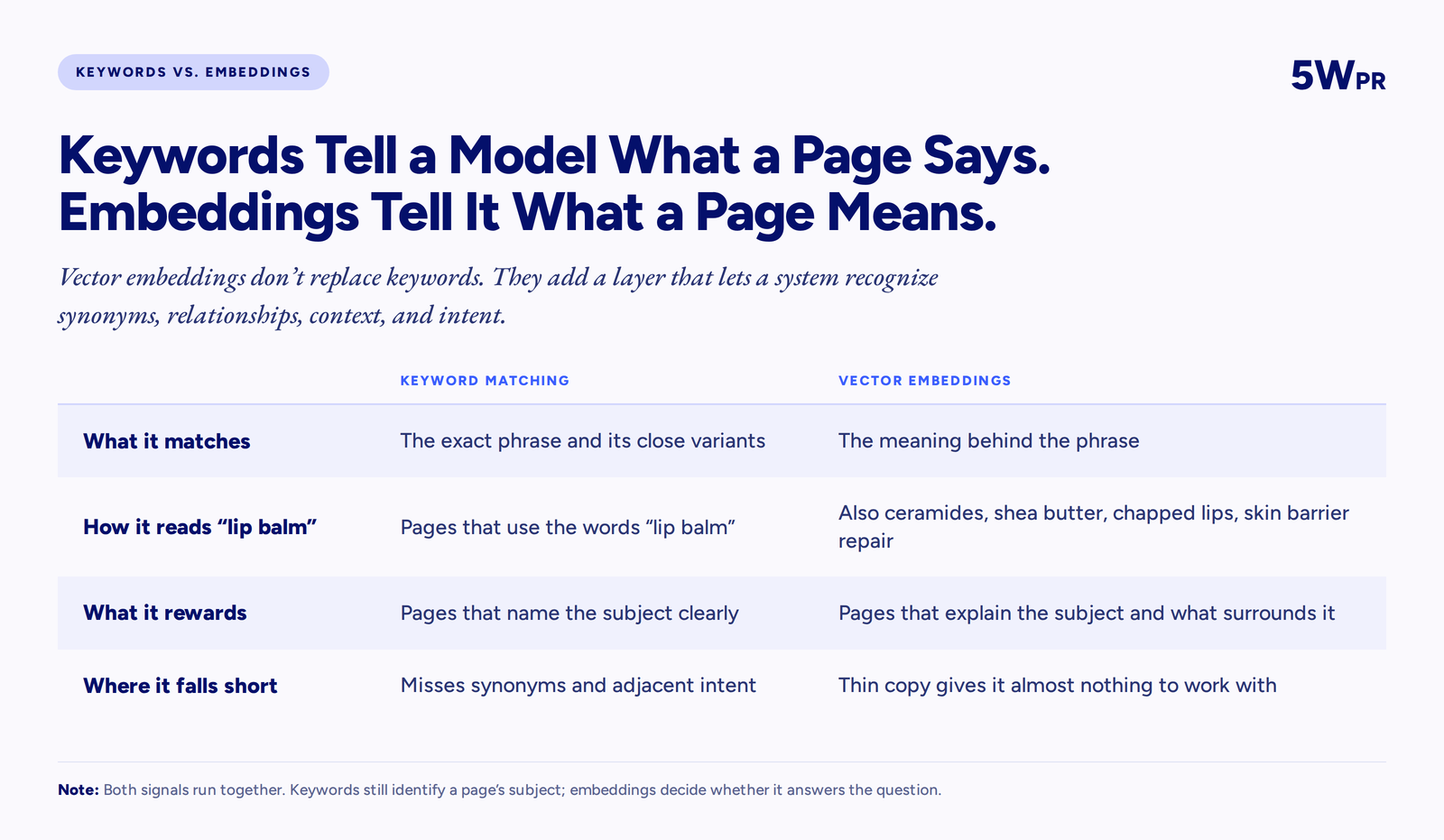
For example, someone searching for “lip balm for dry lips” might receive a response about ceramides, skin barrier repair, shea butter, and chapped lips because the model recognizes that these concepts are closely related. Even without the exact phrase, the content answers the same question.
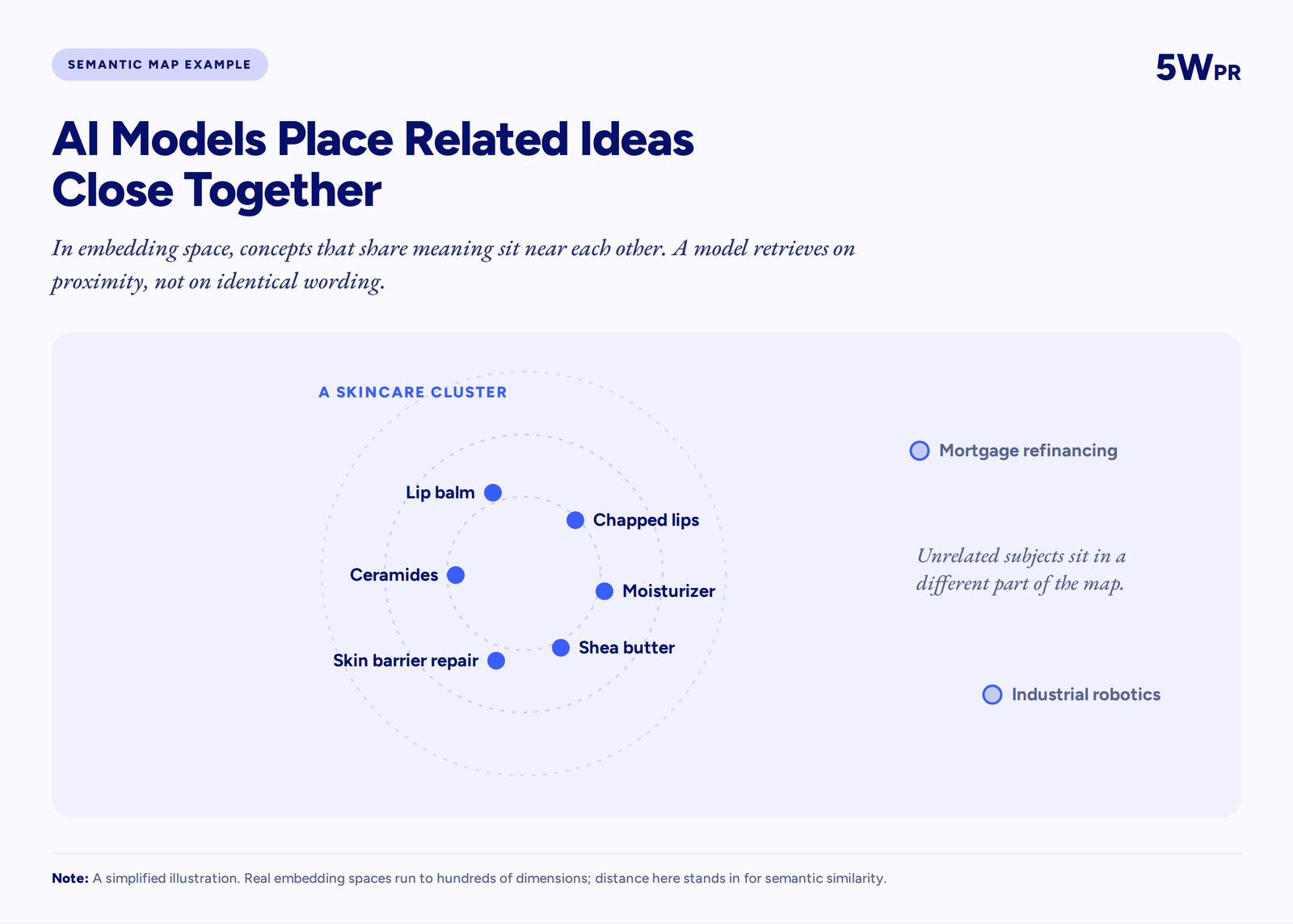
Vector embeddings help AI models recognize when a user’s question and a piece of content address the same idea, even when they use different languages.
The technology converts words, sentences, images, and documents into numerical representations based on meaning. This mathematical process is invisible to readers, and marketers should understand its importance for their clients' online visibility.
What Is a Vector Embedding and How Does It Work?
Think of a vector embedding as a coordinate on a large map of ideas.
On this map, concepts that share meaning appear close together. Unrelated subjects appear farther apart.
A skincare cluster might include:
- Lip balm
- Chapped lips
- Ceramides
- Shea butter
- Skin barrier repair
- Moisturizer
Mortgage refinancing and industrial robotics would sit in different parts of the map.
When someone asks an AI model a question, the model compares the meaning of the question with the meaning of the documents in the information sources it has access to. From there, it retrieves the content with the closest match in topic and context, not the content stuffed with keywords.
Vector embeddings don’t eliminate the need for keywords. Keywords help search engines identify a page’s subject. Vector embeddings add an additional layer by helping systems recognize synonyms, relationships, context, and intent.
How Did Search Evolve From Keywords to Semantic Search?
Traditional search engines were heavily reliant on keywords. A webpage about “automobiles” might not have matched a search for “cars” as effectively as it would today.
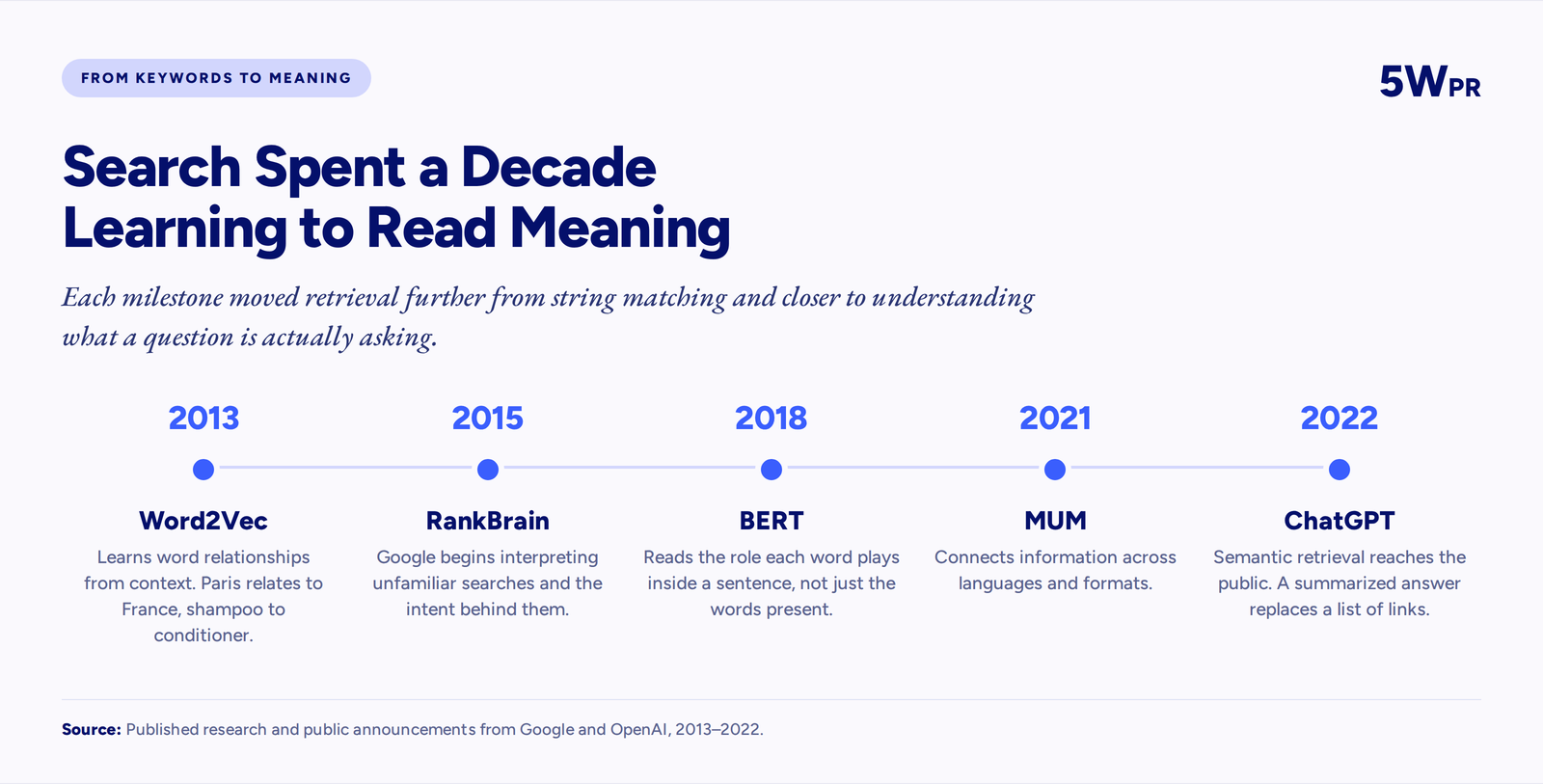
Researchers spent decades developing methods that could represent language mathematically. A major milestone arrived in 2013 with Word2Vec, a technique that learned relationships between words based on the contexts in which the words appeared.
Word2Vec could identify patterns like
- Paris relates to France.
- Tokyo relates to Japan.
- Shampoo relates to conditioner.
- Doctor relates to hospital.
Search engines later introduced systems designed to interpret broader meaning.
Google launched RankBrain in 2015 to help interpret unfamiliar searches and user intent. BERT followed in 2018, improving Google’s ability to understand the role that each word plays within a sentence. Google announced MUM in 2021 as a system designed to connect information across languages and formats.
The launch of ChatGPT in 2022 brought semantic retrieval and large language models to the public. For the first time, search engines were no longer limited to a list of website links. Today, models retrieve information, connect ideas, and provide a clear, summarized answer to the user's search.
How Do AI Models Use Vector Embeddings to Retrieve Content?
An AI model can’t examine every webpage in depth to answer a prompt.
Their retrieval systems help them narrow the field.
For example, a user asks:
What moisturizer can help repair a damaged skin barrier?
The retrieval system begins with billions of pages accessible to the model. Thousands of those pages discuss moisturizers. Hundreds of pages discuss skin barrier repair. A smaller group of pages comes from sources that meet the system’s relevance and quality criteria.
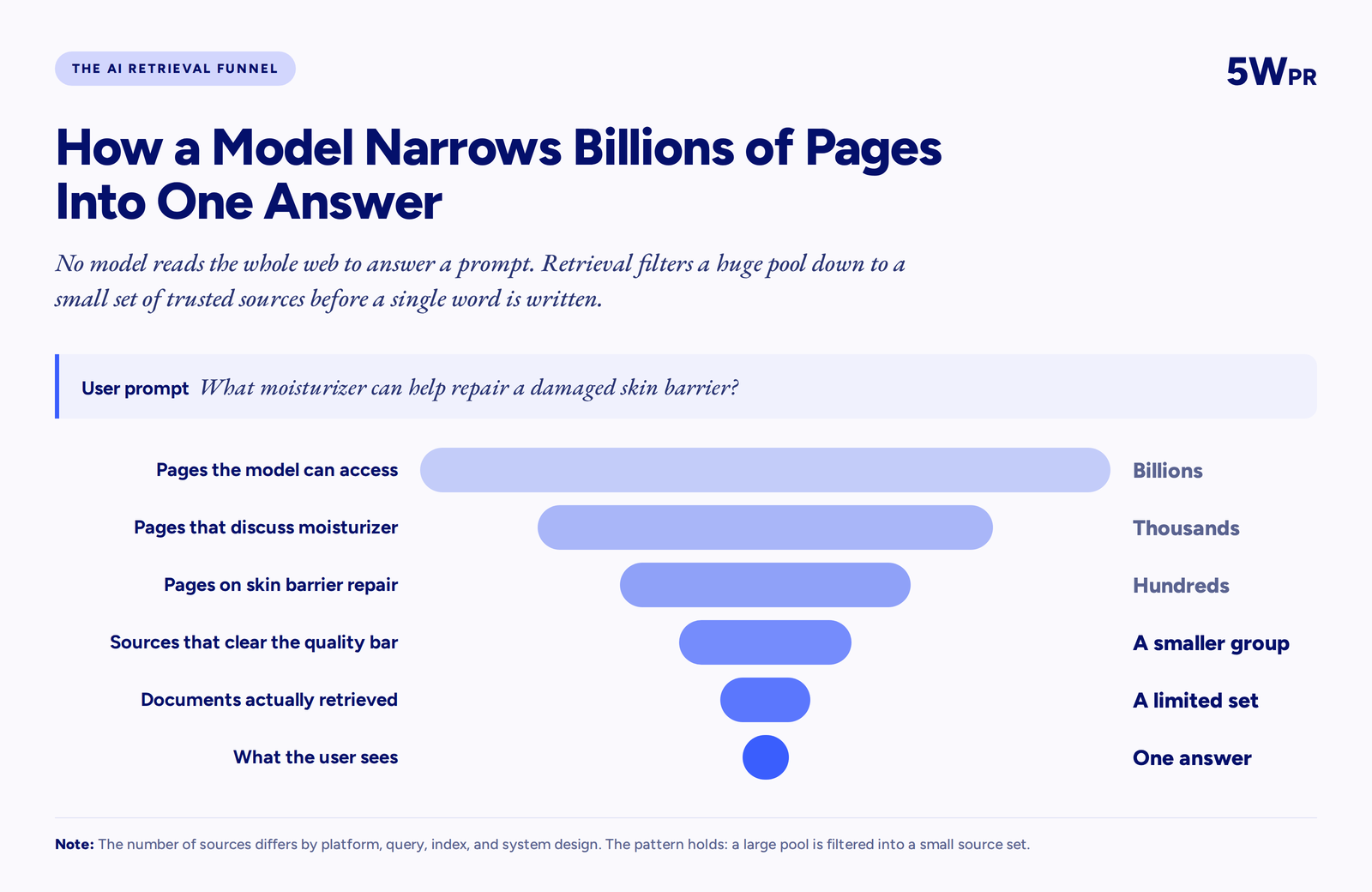
From there, the system retrieves a limited set of documents and uses them to support the final answer.
The number of sources differs by platform, query, index, and system design, but the principle remains consistent: models filter a large pool of information into a small source set.
Why Do Vector Embeddings Matter for AEO and GEO?
Generative Engine Optimization (GEO) and Answer Engine Optimization (AEO) increase the likelihood that a brand is retrieved, represented accurately, and cited in AI-generated answers.
A brand can’t edit its vector embedding directly, but it can improve the information used to create the embedding.
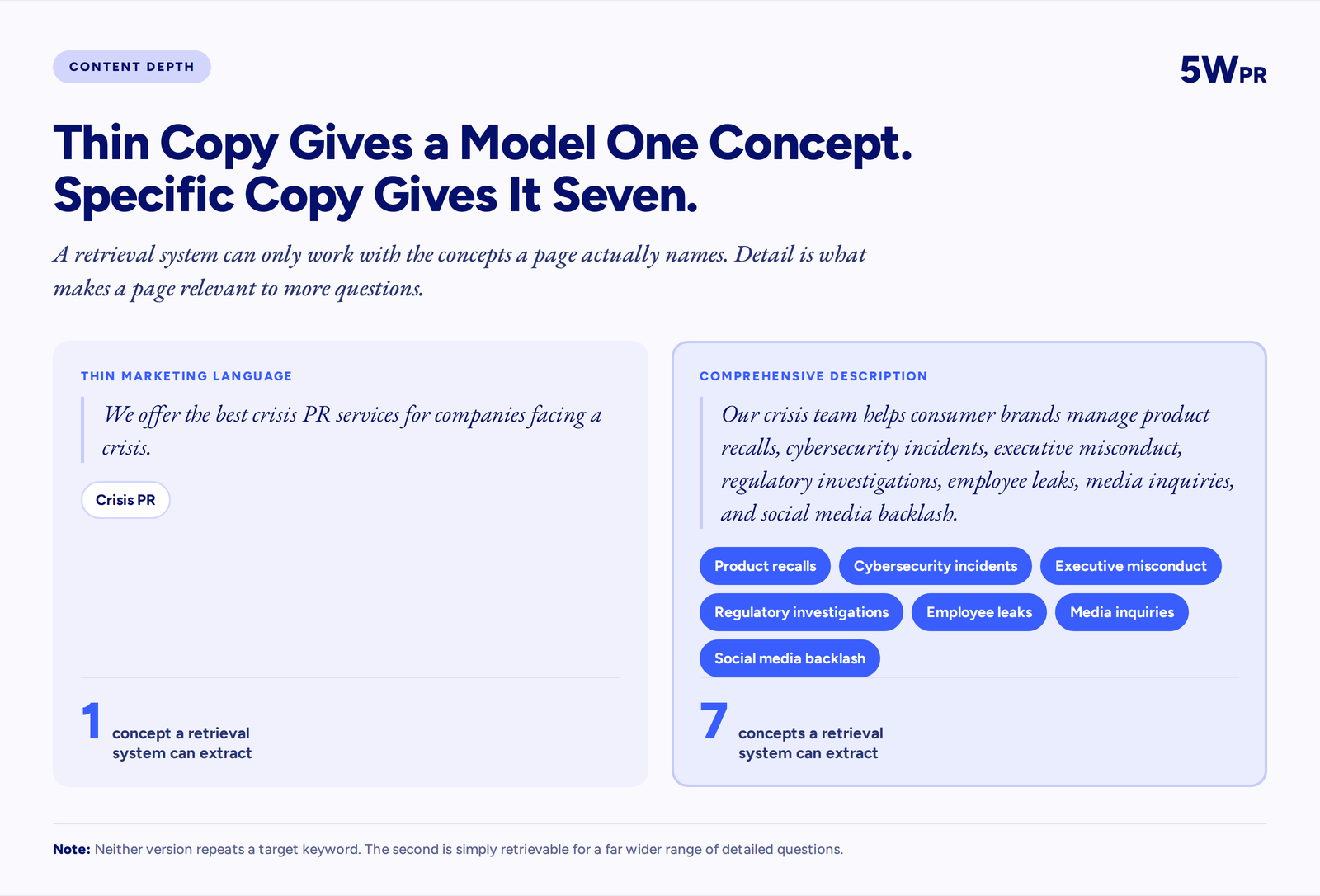
Thin marketing language gives a retrieval system little context; here’s an example:
We offer the best crisis PR services for companies facing a crisis.
Here’s an example of comprehensive content:
Our crisis team helps consumer brands manage product recalls, cybersecurity incidents, executive misconduct, regulatory investigations, employee leaks, media inquiries, and social media backlash.
The second description gives the system specific concepts and relationships. The page becomes relevant to a broader range of detailed questions without repeating a target phrase or keyword.
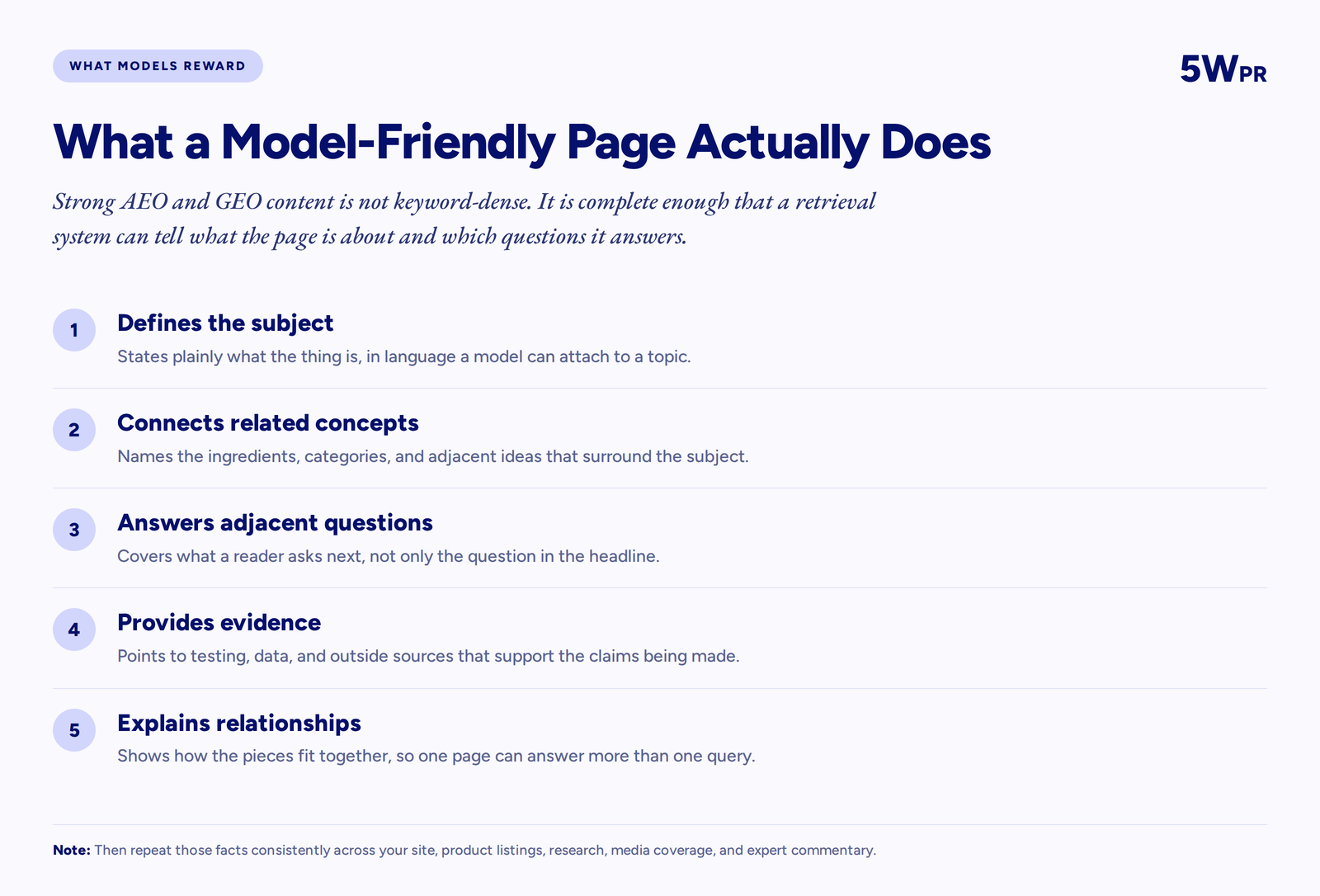
Strong GEO and AEO content defines the subject, connects concepts, answers adjacent questions, provides evidence, and explains relationships.
How Can PR Help a Brand Appear in AI-Generated Answers?
Consider two public relations agencies competing for visibility in answers about product-recall communications.
The first agency has a service page that repeatedly uses the phrase “crisis communications agency.”
The second agency creates a research report analyzing 200 consumer product recalls. The report covers response speed, executive statements, retailer notifications, government reporting, customer refunds, media briefings, and reputation recovery.
From there, the second agency builds supporting evidence around the report:
- A trade publication covers the findings.
- A crisis expert discusses the research in an interview.
- Industry newsletters link to the report.
- The agency publishes a recall-response checklist.
- A case study explains how a consumer brand communicated with retailers and customers.
A user later asks:
Which PR firms understand consumer product recalls?
The second agency created a larger group of connected signals so its name appears near product recalls, crisis planning, consumer safety, media response, retailer communications, and reputation recovery across multiple sources.
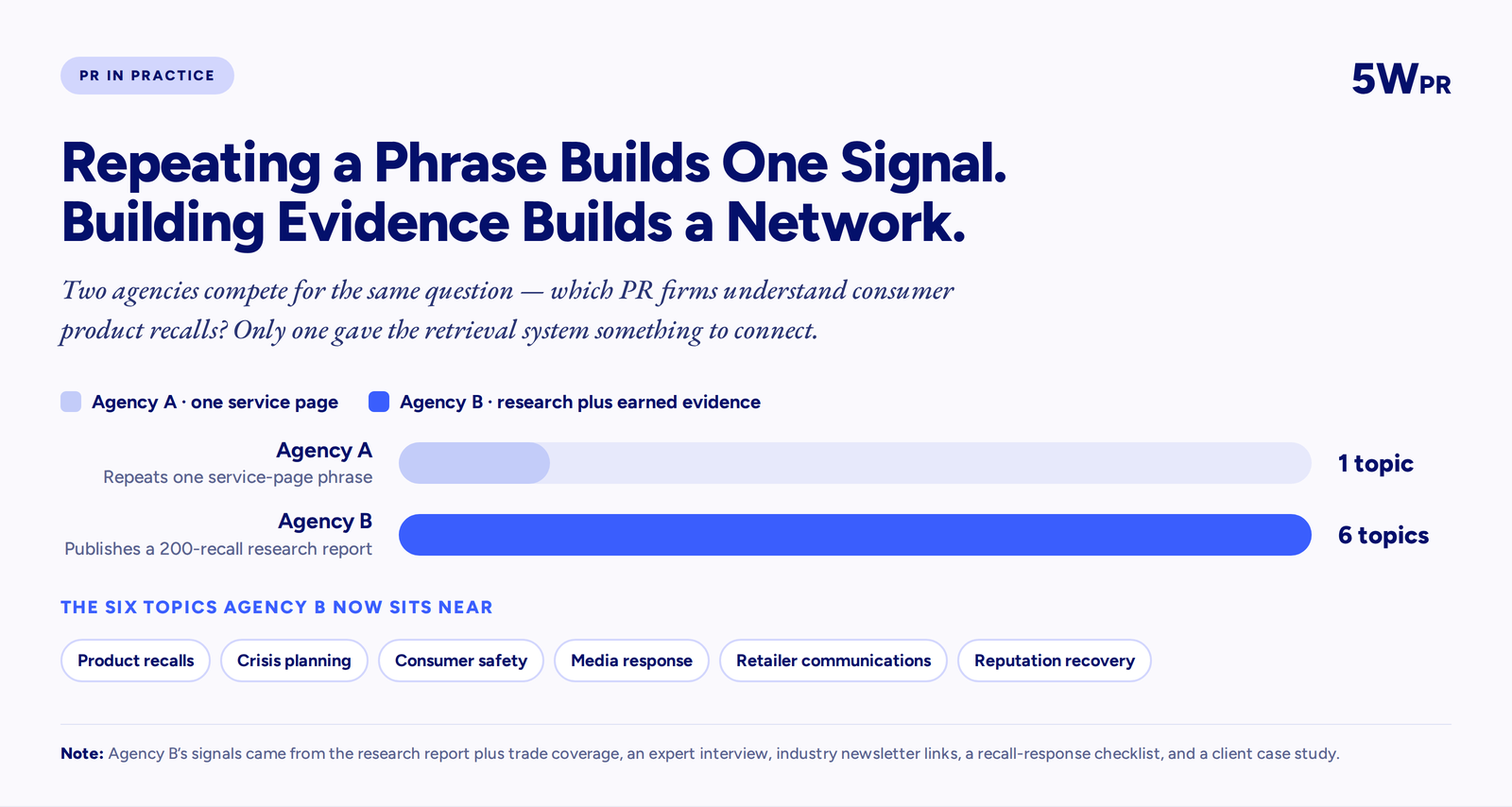
Vector-based retrieval connects the agency to its users' questions.
How Can Beauty Brands Build Relevance for AI Search?
Imagine a beauty brand launching a peptide moisturizer for sensitive skin.
A basic product page shares something like:
A clean moisturizer that delivers long-lasting hydration.
That description could apply to hundreds of products.
A page with a strong, model-friendly information ecosystem explains:
- What peptides do in the formula
- How ceramides support the skin barrier
- Whether the moisturizer works with retinol
- Which ingredients help reduce moisture loss
- Whether the formula contains fragrance
- How the product performs under makeup
- What the clinical testing measured
- Which skin types were included
When and where appropriate, brands should support their product pages with dermatologist commentary, retailer descriptions, editorial reviews, ingredient explainers, customer questions, clinical findings, and earned media coverage.
If a user asks:
What moisturizer should I use for dry, sensitive skin after retinol?
The retrieval system connects the product with dry skin, retinol sensitivity, ceramides, peptides, barrier repair, and moisturizer performance from the website's content, so brands don’t need to publish multiple pages on a single topic.
How Does PR Expand a Brand’s Semantic Footprint?
A machine-readable website is a must-have in the new age of online search and discovery. AI models learn about brands through a wide ecosystem of information, and forward-looking brands need to optimize for multiple sources of visibility.
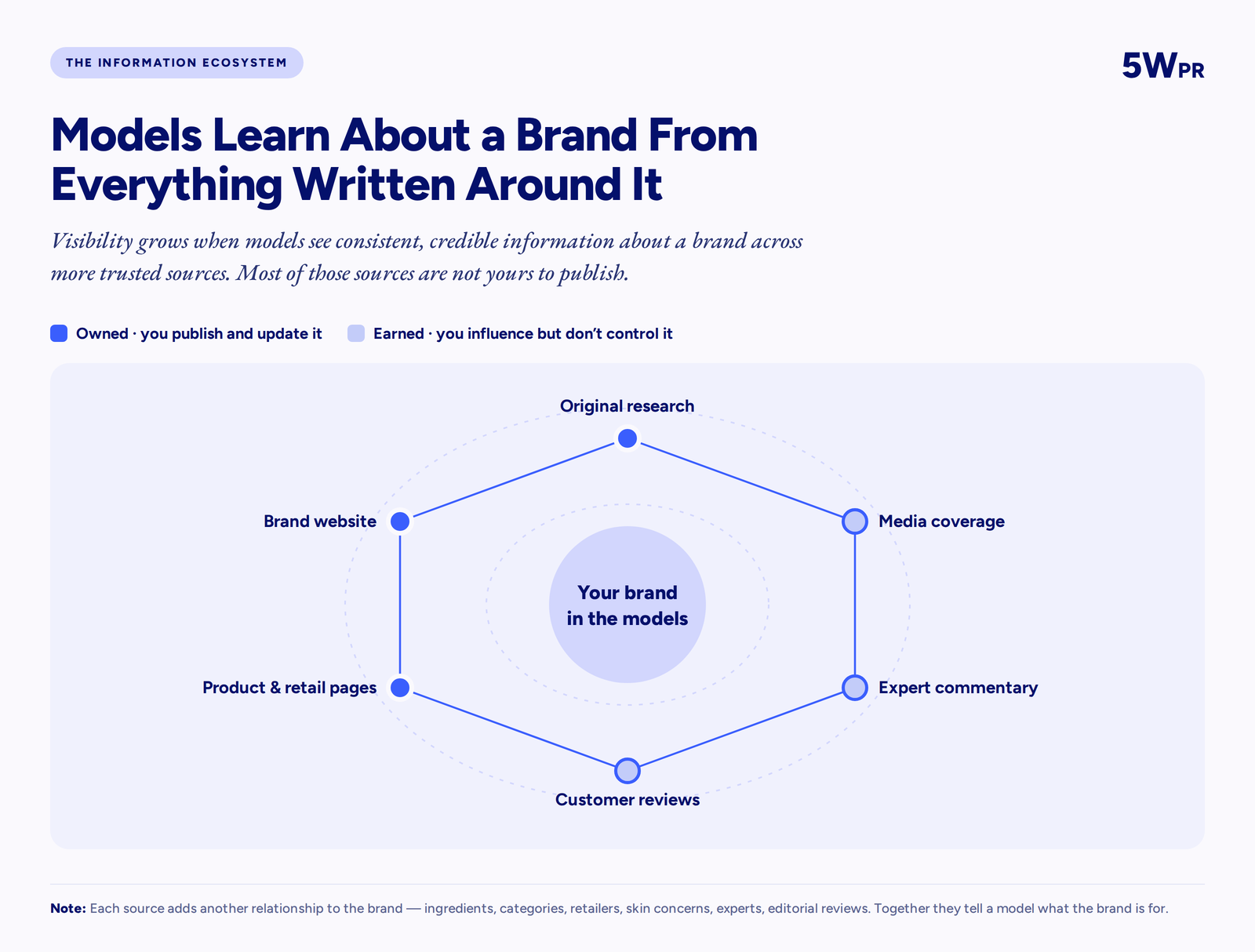
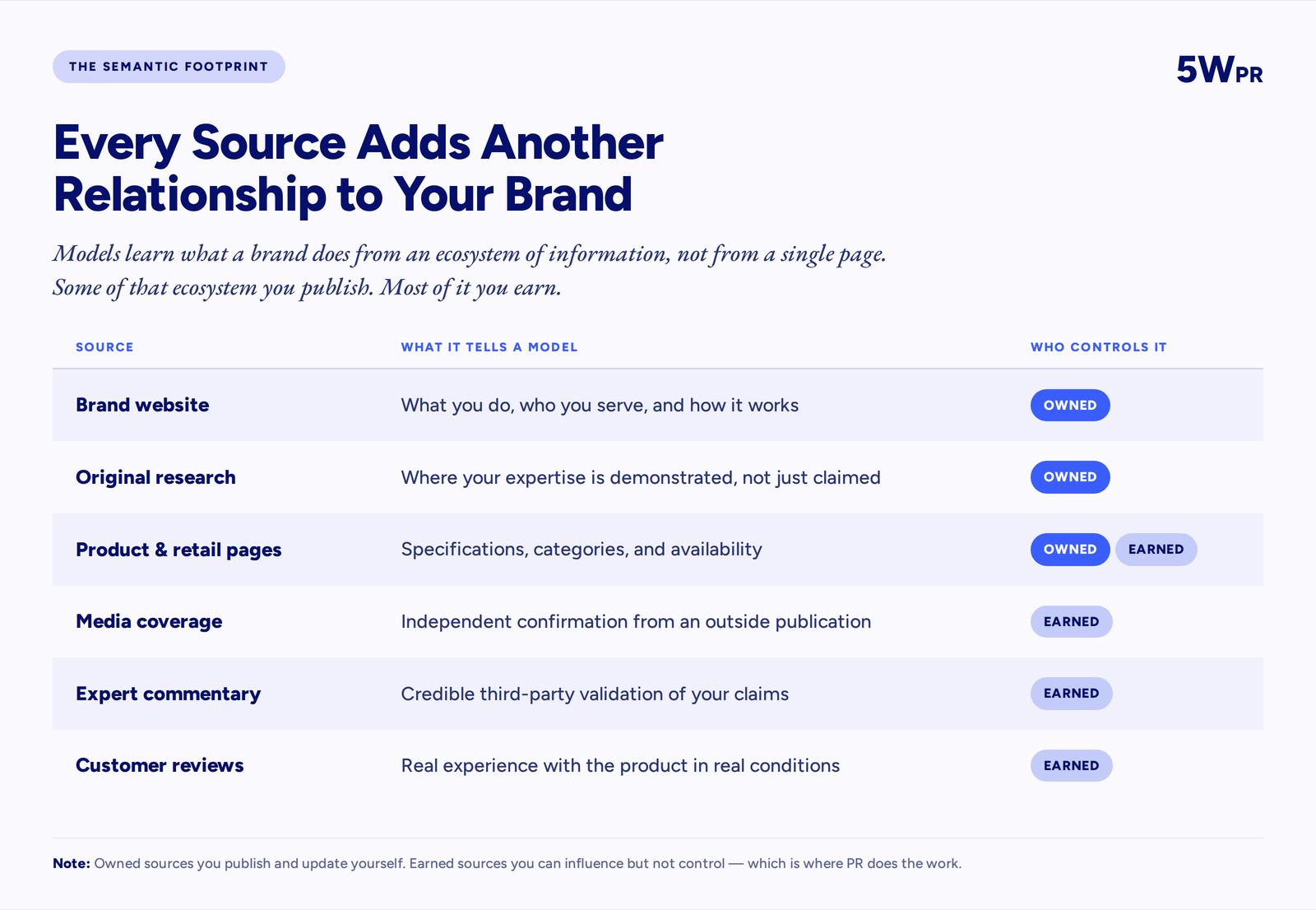
For example, a research report helps establish expertise. Media coverage provides independent opinions and editorial reviews. Experts explain products and claims, providing a credible third-party point of view. Retail pages reinforce product information. Reviews describe customer experiences. The brand website consolidates all of this information into one source.
Each source adds an additional relationship to a brand.
For a beauty company, the model could connect a brand with ingredients, product categories, retailers, skin concerns, experts, and editorial reviews.
For a PR firm, the model could connect the agency with industries, services, executives, case studies, media coverage, and original research.
Multiple sources of information help the model's retrieval systems determine what the brand does, where it has expertise, and which questions it can help answer.
How Can Brands Improve Their Visibility in AI Search?
SEO fundamentals, including keywords, optimized titles and headings, page structure, internal links, and search intent, remain important.
Modern content changes are broad, and brands should incorporate communicating meaning in addition to target phrases when creating content strategies.
An AI-optimized page answers popular, common user questions and explains the concepts surrounding it. Brands should repeat accurate facts across their website, product listings, research, media coverage, expert commentary, and other trusted sources.
Brands most likely to appear in model-generated answers provide retrieval systems with enough consistent, credible information to clearly define their expertise, alongside independent evidence that validates these associations. Even though AEO strategies change often, AI models will continue to rely on reliable, third-party sources of information to confirm that the brand is, in fact, an authoritative and relevant source for the user's query.
AI visibility starts with information models can find, understand, and cite. 5W helps brands strengthen information sources about their brand across their websites, research, media coverage, expert voices, and third-party sources.
Start a conversation with 5W to identify where your brand appears in AI-generated answers and where stronger content and communications can improve your position in AI search.