
What Is Agentic Shopping?
Agentic shopping uses artificial intelligence (AI) to streamline product research, comparison, selection, and purchasing. Shoppers describe their needs, budget, and specific preferences, like color or size, to AI assistants like ChatGPT or Alexa for Shopping to guide their discovery process.
Unlike traditional search, which helps users browse multiple websites to evaluate specifications and compare prices, agentic shopping consolidates these steps into a unified experience.
Through ChatGPT, consumers can outline their criteria, refine details via conversational interactions, conduct side-by-side comparisons, and evaluate attributes like pricing, customer ratings, and product features. In 2026, OpenAI expanded its Agentic Commerce Protocol, enabling retailers to share product feeds and promotional offers directly. Major brands, including Target, Sephora, Nordstrom, Lowe's, Best Buy, The Home Depot, and Wayfair, have integrated with the platform.
Google is developing a parallel framework driven by its Universal Commerce Protocol, which connects AI agents, merchants, and retail platforms. Google reports over one billion daily shopping interactions across its ecosystem, powered by a Shopping Graph with more than 60 billion product listings.
Microsoft emphasizes comprehensive merchant data as vital to agentic commerce. Microsoft Merchant Center is expanding support for return policies, customer support details, checkout eligibility, safety warnings, and merchant identifiers to help Copilot evaluate products and evaluate deals effectively.
Why Does Agentic Shopping Matter for Retail Brands?
AI-assisted shopping is moving from an emerging behavior to a measurable retail channel.
Adobe found that AI-referred traffic to U.S. retail websites increased 393% year over year in the first quarter of 2026. In March, visitors from AI sources converted 42% better than non-AI traffic, spent 48% more time on retail sites, and viewed 13% more pages per visit. Adobe also found that 39% of surveyed consumers had used AI for online shopping, and 85% of those users said it improved their experience.
That data doesn't prove rich product feeds drive higher conversion, but it does show that AI-assisted discovery is becoming important enough for CMOs and brand managers to track, test, and invest in.
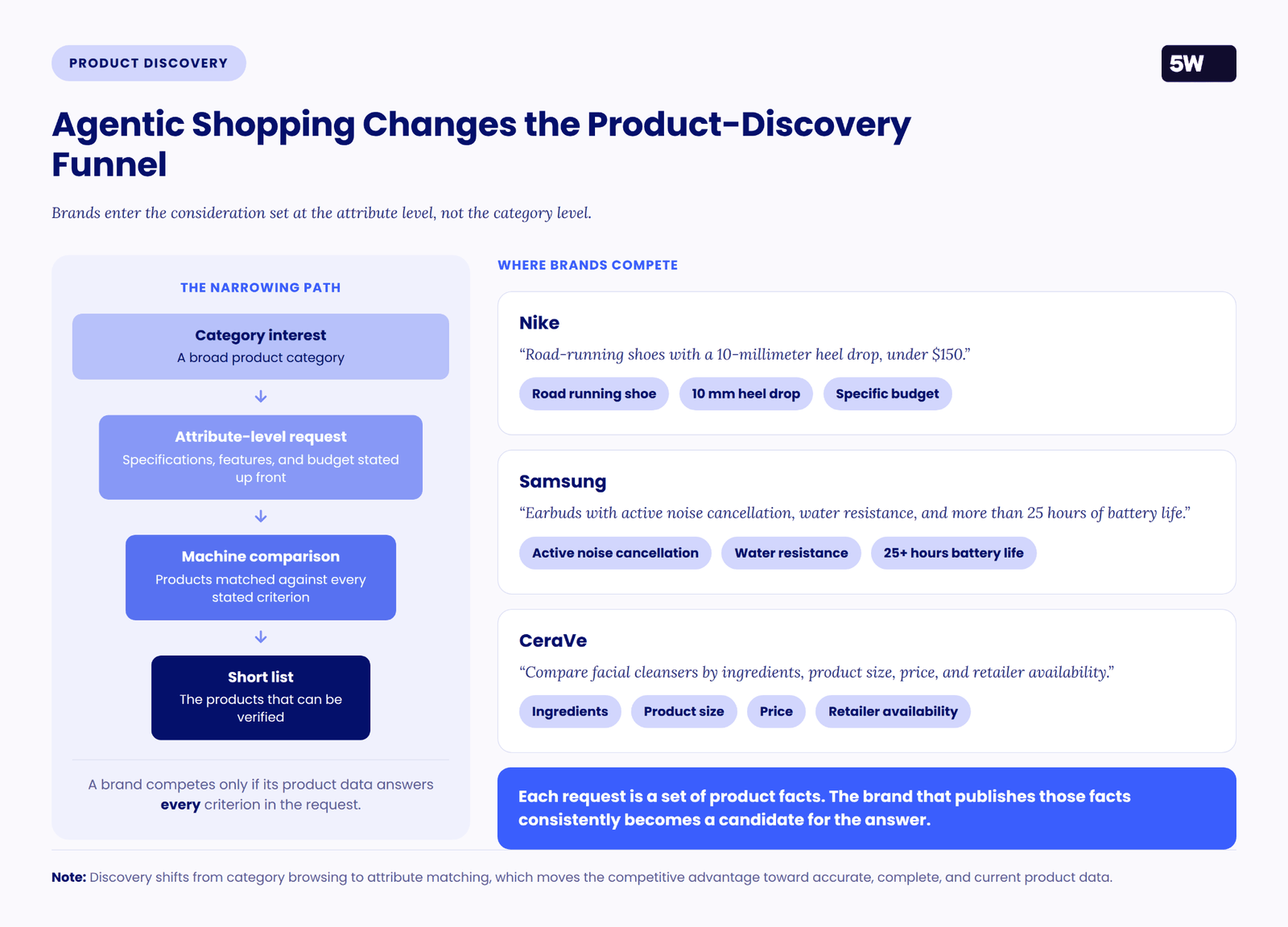
Agentic shopping changes how shoppers consider products. AI assistants retrieve product pages and compare product details against a user's needs, applying that information to narrow options. This dynamic connects closely to the retrieval mechanics 5WPR breaks down in What Is a Query Fan Out? and how AI Search eliminates brands before consumers can consider them.
How Do Product Feeds Affect AI Shopping Visibility?
Product feeds historically supported shopping ads, retailer catalogs, and marketplace listings. Agentic shopping gives that same data a different role.
OpenAI says ChatGPT shopping research uses merchant product data supplied through the Agentic Commerce Protocol alongside publicly available product information and other retail sources. During that process, ChatGPT compares attributes such as price, features, and reviews.
Google provides an explicit connection between product data and AI discovery. Its product detail Merchant Center attribute lets merchants supply technical specifications and other structured details not covered by standard fields. Google says these details help customers discover products across AI-driven surfaces, such as AI Mode, while supporting traditional search experiences.
Retail teams should ask if the available data gives agentic shopping systems ample, accurate information to understand and distinguish each priority SKU.
What Product Data Do AI Shopping Systems Need?
1. Product Identity: Help Agentic Shopping Systems Identify the Correct SKUs
Identity comes first because specifications, ratings, prices, and availability have little value when a platform can't reliably connect them to the right product.
Core identifiers include, but aren't limited to, product title, brand, GTIN, MPN, SKU, merchant item ID, category, and variant relationships.
Brands can audit whether those identifiers stay consistent across the PIM, ecommerce platform, product feeds, retailer listings, review providers, and inventory systems.
A mismatch creates a simple but expensive problem: valuable product information exists, but machines can't confidently connect it to an identical SKU.
What Product Attributes Help Agentic Agents Compare Products?
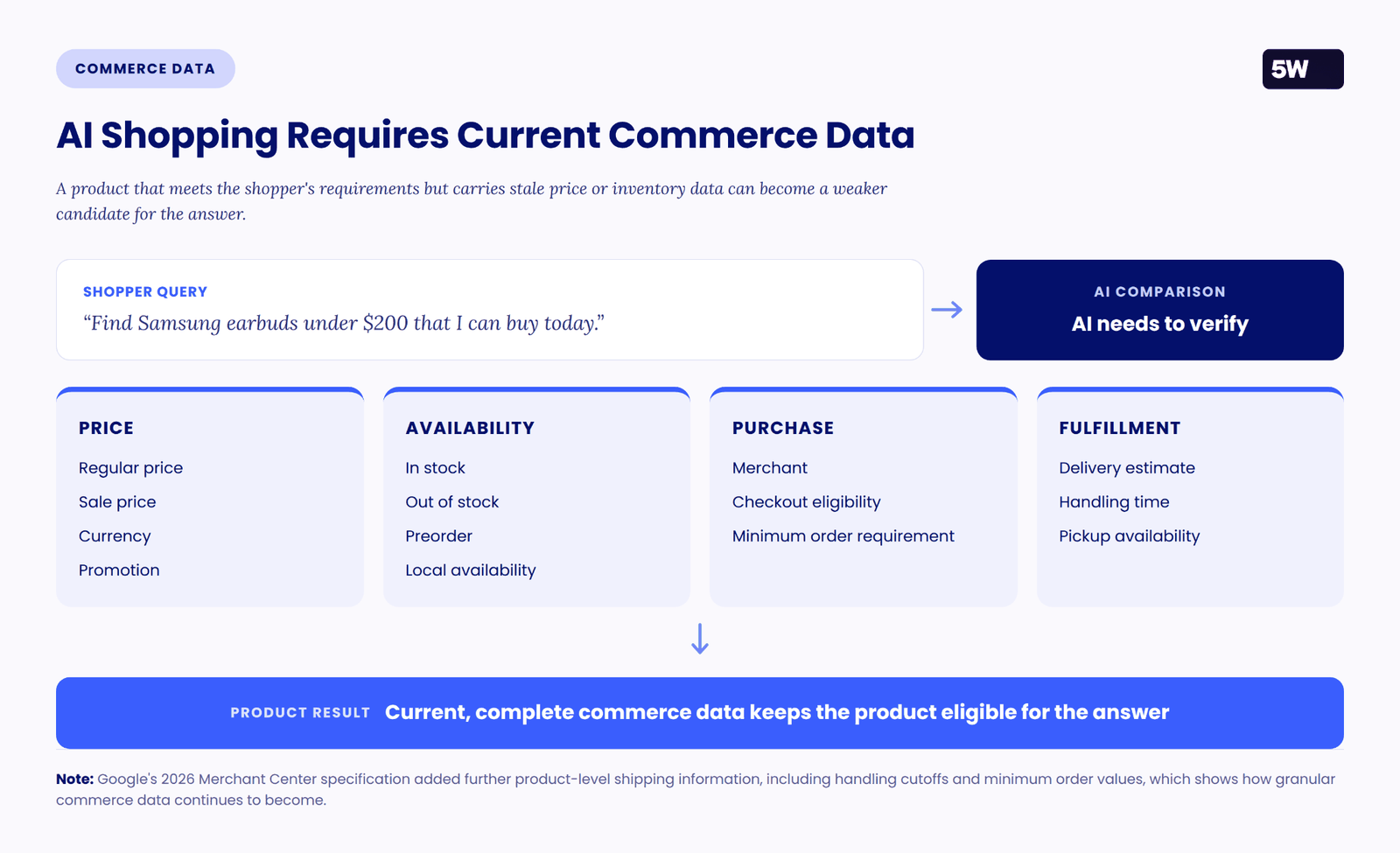
Product attributes dictate how effectively an AI agent can match an item to a user's requirements.
For example, Nike's Pegasus 41 shows the difference between a basic catalog entry and a feature-rich listing. Nike provides specific attributes like its road-running category, ReactX foam, Air Zoom units, engineered mesh, a weight of roughly 297 grams for a men's size 10, and a 10 mm heel-to-toe drop.
These detailed specs address specific buyer queries that a vague label like "Nike men's running shoe" fails to answer.
Brands don't need custom feed fields to supply this data. For instance, Google offers the product_detail attribute to share structured specifications beyond standard fields.
Why Do Price, Inventory, and Fulfillment Data Matter for AI Shopping?
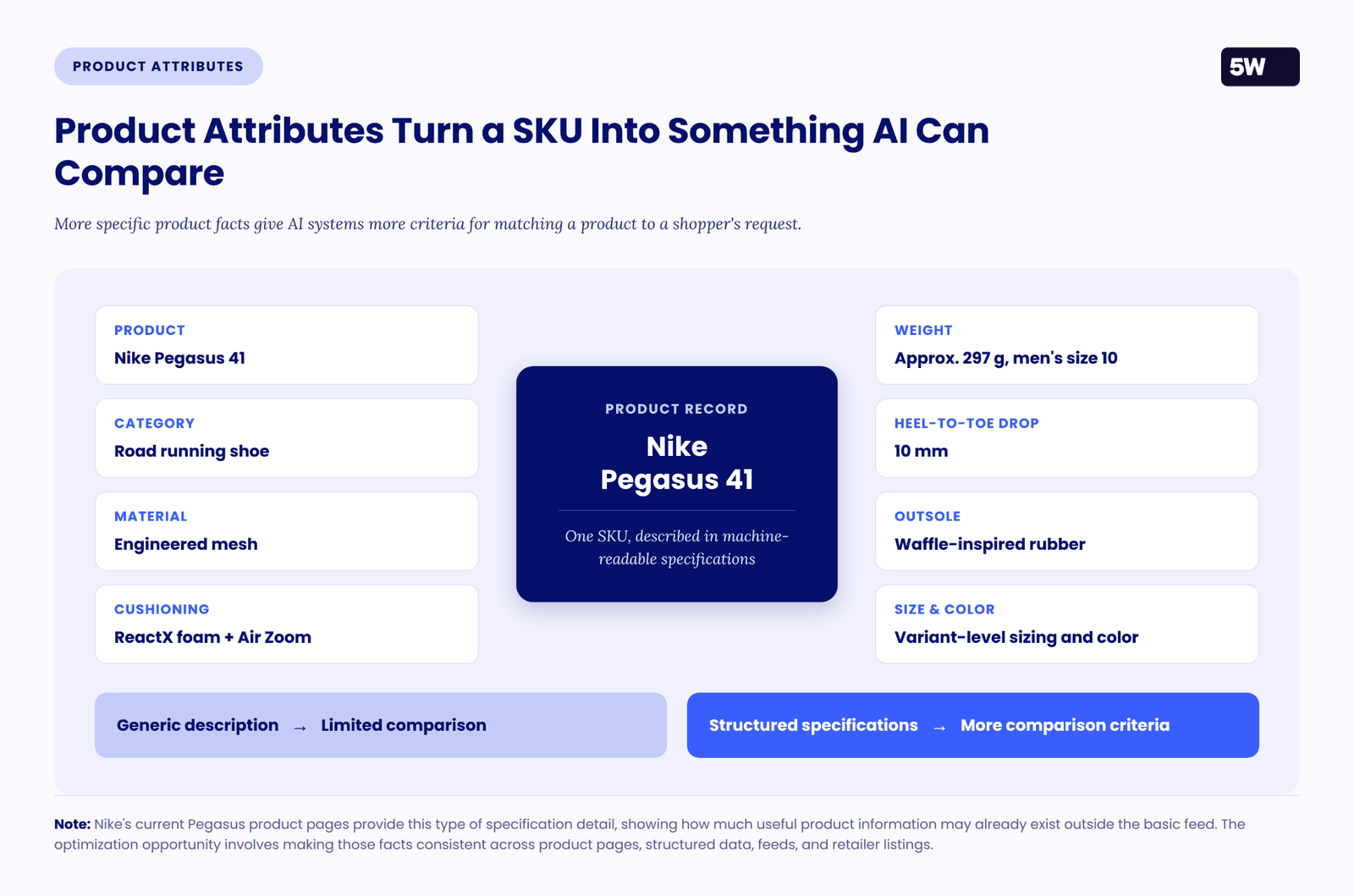
Today, product relevance depends on features and has to fit a shopper's budget, timing, and buying preferences.
OpenAI says ChatGPT can rank merchants based on factors such as price, availability, quality, and whether the seller is the manufacturer or primary retailer. Merchants can also provide direct product feeds so ChatGPT has access to more consistent, up-to-date product information.
That capability is important for e-commerce teams because a product can be a near-perfect match but fall out of consideration at the point of purchase. A product that meets every feature in a shopper's query can lose relevance if it's over budget or shipping isn't fast enough.
How Do Reviews and Trust Signals Support Product Evaluation?
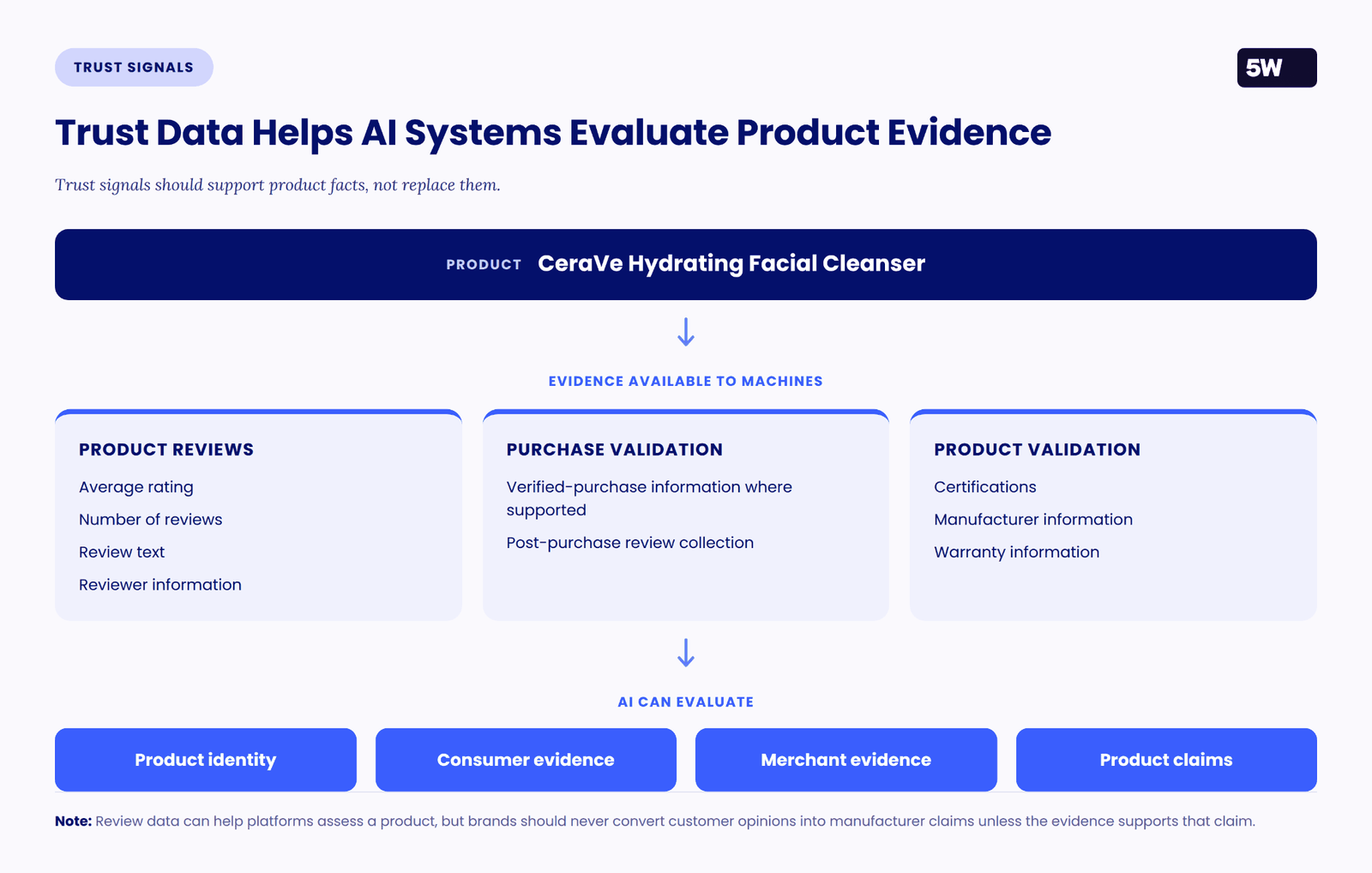
Product information explains what a product is and what it does. Reviews, ratings, certifications, manufacturer details, and verified-purchase information can give shoppers and AI systems more context when they evaluate it.
Brands should ensure those signals connect to the right product and avoid treating customer opinions as product claims.
Why Do Shipping, Returns, and Merchant Policies Matter?
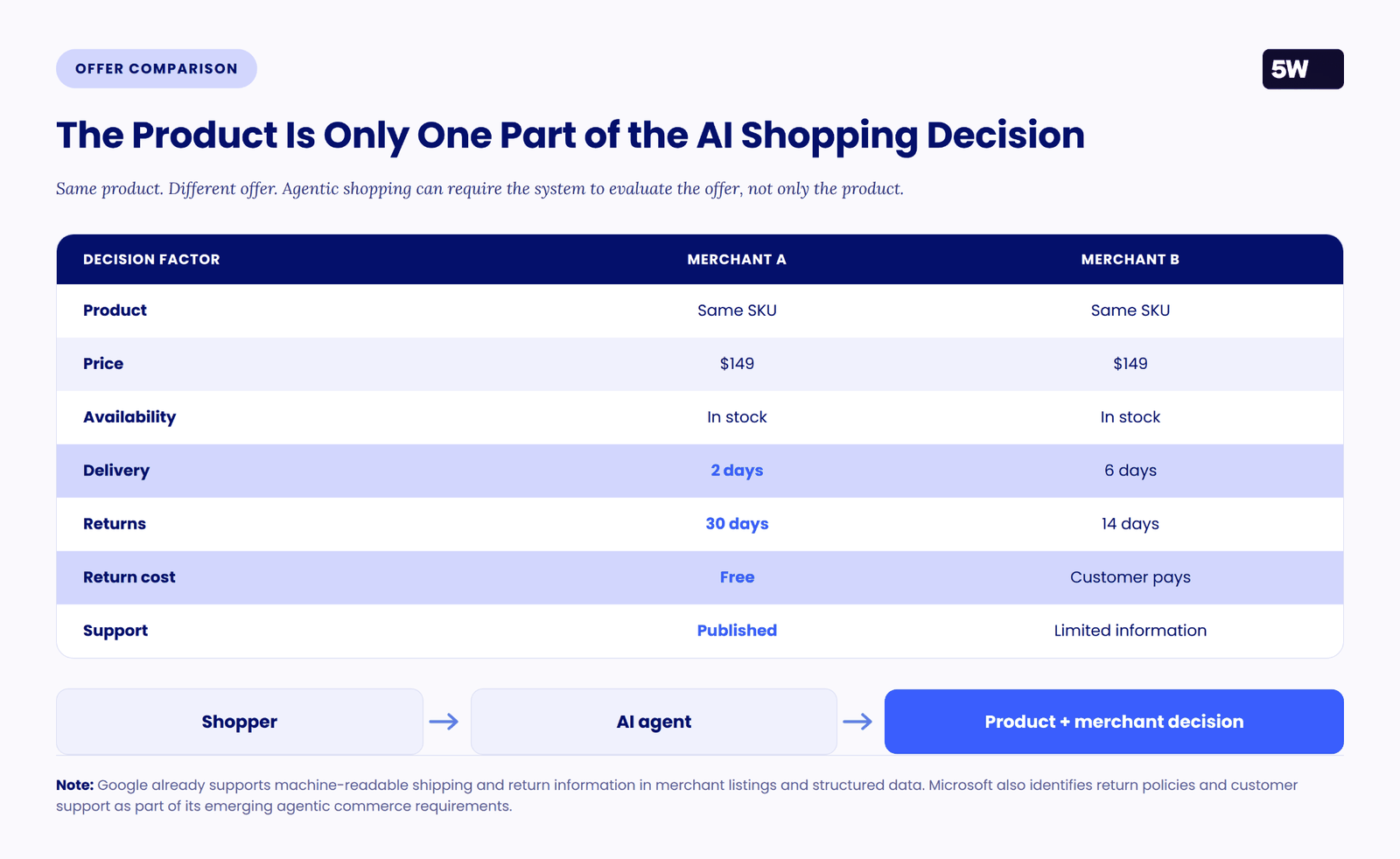
Agentic shopping involves AI agents choosing an offer and a product.
Microsoft's agentic commerce guidance advises merchants to supply information that includes return policies and customer support alongside commerce and checkout data.
When two merchants offer similar products at an identical price, delivery speed, return windows, return costs, and customer support help distinguish one offer from another.
How Product Pages Support Agentic Shopping
Agentic shopping models summarize information from multiple sources. OpenAI says shopping research uses merchant feeds, publicly available product information, and other retail sources.
A successful approach to agentic shopping optimization connects product feeds, product pages, structured data, retailer listings, reviews, and commerce systems around the same set of verified facts.
A good example is Samsung, which publishes its Galaxy Buds3 Pro with detailed specifications, including "ANC, IP57 durability, Bluetooth 5.4, and up to 30 hours of listening time with ANC off or 26 hours with ANC on". These facts support a detailed comparison when agentic systems can reliably retrieve them to answer the user's question.
A 5-Step Agentic Shopping Optimization Framework
Retail brands need a repeatable process to find product-data problems, correct them, test visibility, and connect the results to business performance.
The example follows five stages: Map → Audit → Improve → Test → Measure.
Measurement produces the gaps and priorities that restart the cycle.
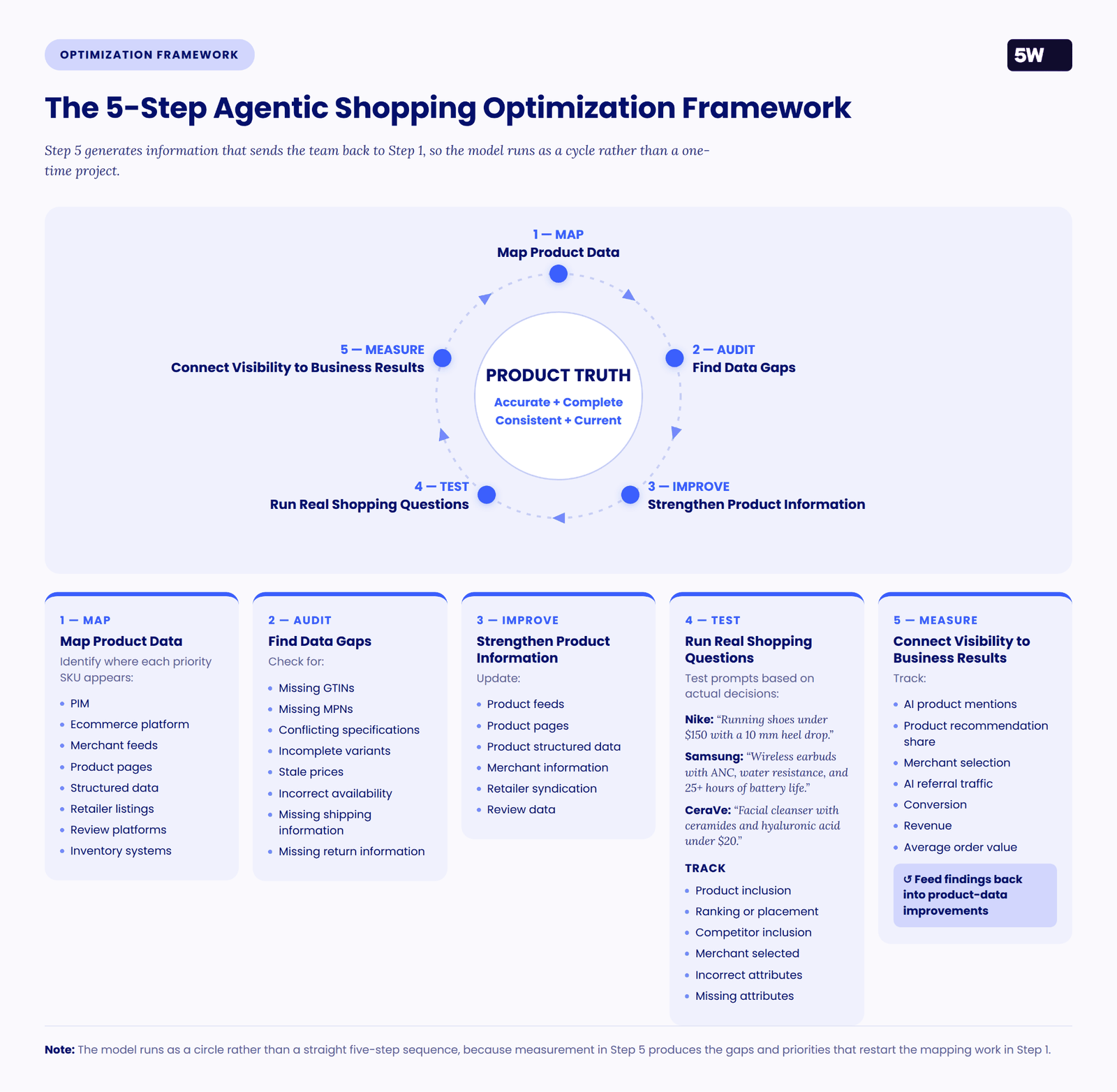
Measurements should document and record product and competitor inclusion, merchant selection, incorrect data, AI referral traffic, conversion, and revenue where attribution is available.
Product Data Is Becoming a Discoverability Asset
While accurate titles, identifiers, prices, availability, and variant information remain a necessity. AI-assisted shopping adds greater value to specifications, reviews, certifications, shipping terms, return policies, and other data that helps agentic systems distinguish one product or offer from another.
CMOs should treat product-data quality as a shared responsibility across commerce, search, merchandising, retail media, technology, analytics, and brand teams.
Agentic shopping optimization starts when brands manage product information as a discoverability asset, not just an advertising feed. This is part of the same broader shift 5WPR maps in how co-occurrence shapes AI search recommendations.
At 5WPR, we help brands assess how their products appear across AI search and agentic shopping environments, identify product-data and content gaps, and build strategies that improve visibility across emerging discovery platforms.
Contact 5WPR to discuss an agentic shopping and AI Search optimization strategy for your brand.
FAQ: Agentic Shopping Optimization and Product Data
What is agentic shopping optimization?
Agentic shopping optimization improves the product and commerce information that AI models use when researching, comparing, and presenting products. The work includes but is not limited to feeds, product pages, structured data, inventory, reviews, shipping, returns, and merchant information.
How do product feeds affect AI shopping visibility?
Product feeds give shopping platforms structured information about product identity, specifications, variants, prices, availability, and offers. Detailed, up-to-date information gives systems more facts to match products to shoppers' requirements.
Which product-feed attributes matter most for AI shopping?
Priority data includes product title, brand, GTIN, MPN, price, availability, category, variants, size, color, and relevant product specifications. Shipping, return, promotion, and merchant information matter when evaluating offers.
Do product feeds help items appear in Google AI Mode?
Google says its product_detail attribute helps customers discover product information across AI-driven surfaces such as AI Mode while enhancing traditional search experiences.
Does ChatGPT use merchant product feeds?
Yes. OpenAI says ChatGPT shopping research uses merchant product data supplied through the Agentic Commerce Protocol, and merchants share feeds and promotions through ACP for product discovery.
Do product pages still matter when a brand provides a product feed?
Yes. AI assistants use public product information alongside merchant feeds. Brands should keep product-page facts, structured data, feeds, and retailer listings consistent.
How should brands test agentic shopping eligibility?
Brands should test detailed questions that reflect actual purchase criteria, then record which products appear, which competitors receive placement, which merchants are presented, and whether the displayed information matches source data.
Who should own agentic shopping optimization?
Ownership should span e-commerce, merchandising, search, retail media, product information, technology, analytics, and brand teams. Leadership should establish shared accountability for product-data quality and commercial measurement.