The best home goods marketing campaigns turn a household item into a story people repeat. Stanley's revenue rose from $73 million in 2019 to a projected $750 million in 2023, according to CNBC. IKEA's ThisAbles add-ons drew 45,000 visitors from 127 countries, and Casper's paid-to-nap job drew nearly 3,000 applicants, according to their Cannes Lions entries. Below are five picks, each with its reported result.
Which home goods campaigns made this list?
This list covers five home goods campaigns from Stanley, IKEA (two campaigns), Casper and Maisons du Monde, each chosen because the company or its agency published a result.
"Best" is a judgment call, so this is 5W's pick of the campaigns with the clearest mechanism and the clearest numbers, not a ranking by sales. IKEA appears twice because its campaigns are among the best documented in the category. Most figures come from the companies or from award entries written by their agencies, so treat them as reported, not audited.
| Campaign | Brand | Idea | Reported result |
|---|---|---|---|
| Quencher color drops | Stanley | Redesigned tumbler sold in new colors | $73M (2019) to $402M (2022) |
| ThisAbles | IKEA Israel | Free 3D-printed add-ons for disabled customers | 45,000+ visitors, 33% sales lift on 13 items |
| Casper Sleepers | Casper | A paid job to sleep in stores | 100% search lift, $8M earned media |
| Hidden Tags | IKEA Portugal | Production dates as proof of durability | 20% sales increase |
| Brand image campaign | Maisons du Monde | Retailer rebrands as an international brand | +6.9% retail revenue |
What are the five best home goods marketing campaigns?
The five campaigns below run from a product redesign that went viral to a hiring stunt that earned press coverage.
1. Stanley Quencher color drops
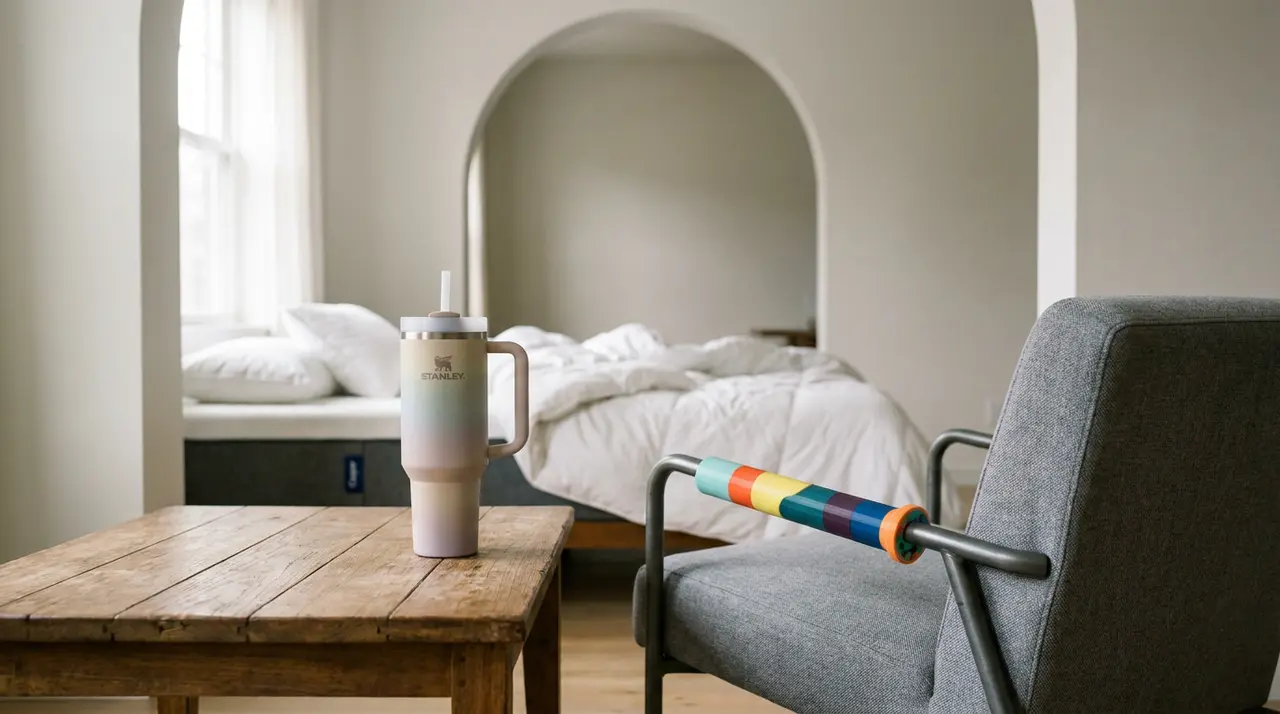
Stanley, a drinkware brand, grew annual revenue from $73 million in 2019 to $94 million in 2020 and $194 million in 2021, according to CNBC Make It. A redesigned Quencher with new colors and finishes doubled revenue to $402 million in 2022, and CNBC reported 2023 sales on track to top $750 million.
Stanley hired Terence Reilly as president in 2020, after seven years at Crocs, according to the same report. Each new color gave buyers a reason to own a second cup, and the 40-ounce tumbler became a fashion item as well as a drinkware product.
Why it works: A small design change repeated every season turned one product into a collection, and each color release was a new reason for customers and press to talk about the cup.
2. IKEA ThisAbles
IKEA Israel and the agency McCann Tel Aviv launched ThisAbles in 2019 with 13 add-ons that make IKEA furniture easier for people with disabilities to use. Customers can download the files free and 3D print them, according to the Cannes Lions entry, which won a Gold Lion. The idea began when McCann copywriter Eldar Yusupov, who has cerebral palsy, said the low office couch was hard to get up from, as Fast Company reported.
The entry reports more than 45,000 visitors from 127 countries to the ThisAbles site and a 33% sales increase on the 13 items shortly after launch, according to the agency's Eurobest entry. WARC's Creative 100 ranking credited the campaign with $5 million in earned media. IKEA worked with two Israeli nonprofits, Milbat and Access Israel, to design the add-ons.
Why it works: IKEA fixed a real problem with its own products, so every news story described a product feature, not an advertisement.
3. Casper Sleepers
Casper, the mattress company, posted a job in August 2022 for professional "sleepers" who would nap in its stores up to 20 hours a week, as Fortune reported. The agency VaynerMedia ran the campaign, and its Cannes Lions entry says the job drew nearly 3,000 applications for two roles.
The same entry reports a 100% increase in search for Casper right after launch, 135 million organic social impressions, a 25% rise in organic site traffic and a 94% drop in cost per lead. It also reports $8 million in earned media, with none of the coverage paid, according to the entry. The agency's two entries give different total impression counts, so this page leaves that figure out.
Why it works: A job posting is a format reporters already cover, and a paid nap job made Casper's claim about sleep easy to explain in one sentence.
4. IKEA Hidden Tags (IKEA Portugal)
IKEA Portugal pointed customers to the hidden production dates printed on its own furniture as proof that the products last. The campaign won a Silver Creative Effectiveness Lion in June 2026, according to WARC.
WARC's case summary reports a 20% increase in sales, a 17 percentage point improvement in how customers rated IKEA's durability, and 95,500 new IKEA Family members. WARC says the campaign got these results without price promotions or extra media spend. Customers checked their own furniture and shared what they found.
Why it works: The proof already sat on every product, so customers could check the claim at home instead of taking IKEA's word for it.
5. Maisons du Monde brand campaign
Maisons du Monde, a French home furnishings retailer, ran a brand campaign with the agency BDDP Unlimited in Paris in October and November 2014 to move from a store brand to an international brand. Its media spend over those two months was €3 million, against €6 million for IKEA, according to the company data in the Cannes Lions entry.
The entry reports retail revenue up 6.9% and furniture revenue up 10.1% compared with the same period in 2013, plus online sales up 30% against December 2013. Spontaneous awareness measured by Ipsos rose from 84% to 91%. This is the oldest case here, and it earns its place because it shows a challenger outspent two to one still moving sales.
Why it works: A smaller budget went into one distinctive creative idea, which gave the brand a recognizable identity beside a larger rival.
What do the best home goods campaigns have in common?
Four of the five campaigns tied the idea to something customers could see, touch or check in the product itself, and the fifth, Casper, tied it to a job anyone could apply for.
| Approach | Campaigns on this list | What the audience sees |
|---|---|---|
| Change the product | Stanley, IKEA ThisAbles | A new color or add-on they can buy or print |
| Prove the claim | IKEA Hidden Tags | A date printed on furniture they already own |
| Make news | Casper Sleepers | A job posting reporters cover |
| Build the brand | Maisons du Monde | A distinctive identity bought with a smaller budget |
The risk is that these results are hard to repeat. Stanley's growth depended on a product people wanted to collect, and Casper's coverage depended on a stunt reporters had not seen before. Copying the format without the underlying product or idea tends to produce coverage that does not move sales.
How can home goods brands copy these campaigns?
Home goods brands can copy these campaigns by picking one mechanism and building it around a product they already sell.
- Release a new color or finish on a schedule. Stanley's revenue grew each year it did this, according to CNBC.
- Solve one real customer problem with your own product. IKEA ThisAbles started with a single couch that was hard to stand up from.
- Turn a normal business function into news. Casper made hiring the story, and its agency reports $8 million in earned media.
- Point to proof the customer can check. IKEA Hidden Tags used production dates already printed on the furniture.
- Write down the result before you launch. The campaigns above are on this list because their companies or agencies published numbers.
Where can you find more campaign roundups?
Home goods overlaps with pets, retail and appliances, so several 5W lists sit close to this one. See the best pet marketing campaigns, the best franchise PR campaigns and the appliance brand PR guide for neighboring categories.
For a look at how home brands earn coverage, read the earlier piece on home and housewares brands with expert PR. Brands planning their own program can start with 5W's home and housewares practice.
Frequently asked questions
Which home goods campaign reported the biggest sales growth?
Stanley reported the largest dollar growth among the five, from $73 million in 2019 to $402 million in 2022, according to CNBC, with 2023 sales projected above $750 million. IKEA Portugal reported a 20% sales increase for Hidden Tags, and IKEA Israel reported 33% on the 13 ThisAbles items.
Are the results on this page independently verified?
No. The Stanley figures come from CNBC's review of company data. The IKEA, Casper and Maisons du Monde figures come from award entries written by the companies or their agencies, and WARC summarizes the Hidden Tags case. Treat all of them as reported.
Why does IKEA appear twice?
IKEA Israel and IKEA Portugal ran different campaigns, ThisAbles and Hidden Tags, and both have published results. IKEA's campaigns are among the best documented in home goods.
Can small home brands copy a campaign like Casper Sleepers?
Small brands can copy the mechanism, which is turning an ordinary business function such as hiring into a story. The coverage depends on the idea being new, so the format needs a fresh angle that fits the brand.
What did Stanley change to grow sales?
According to CNBC, Stanley hired Terence Reilly as president in 2020 and released the Quencher in new colors. A redesigned model in 2022 added more colors and finishes, and revenue doubled that year to $402 million.