
ChatGPT ads and Google Ads target users searching for solutions, but ChatGPT ads match ads to conversations, not keywords. This article explores the differences between ChatGPT and Google Ads and how brands can use both to improve consumer discovery and AI recommendations.
Google Search ads match mainly to a search query, while ChatGPT ads match to the context of a ChatGPT conversation. A hypothetical Google search for "best facial sunscreen SPF 46." looks different on ChatGPT. That prompt might look something like “I live in South Florida. I need an everyday sunscreen that feels lightweight, won't clog my pores or leave a white cast, and works under makeup."
A ChatGPT user might add "I'd prefer SPF 40 or higher" to the details earlier in the conversation. From there, the OpenAI ads system weighs texture, makeup fit, and SPF together to determine placement.
Google also uses AI to determine search intent, and Google AI Mode handles follow-up questions. Google's guidance on ads in AI search explains how Google ads appear next to and in Google AI Overviews.
What are context hints in ChatGPT ads?
OpenAI's ChatGPT Ads basics page describes context hints as advertiser-written descriptions of conversations, topics, or long-tail keywords that help models identify relevant products. Context hints aren’t exact-match keywords and don’t guarantee ad placements in a given conversation.
Google Ads target keywords like "Asana alternatives," and Google’s broad match and AI Max extend matching to conversational queries from a given keyword list.
For example, a project management software company (an Asana alternative) would provide OpenAI context hints about agencies tracking client approvals or growing teams replacing spreadsheets. The company’s goal would be to reach an agency owner asking ChatGPT which tools help a 50-person agency track client approvals. It’s important that brands describe customer problems and position themselves as a solution because the users aren’t typing "project management software"; they’re asking how to track client approvals.
How do ChatGPT ads and Google Search ads compare?
Google Search ads and ChatGPT ads differ in matching, placement, audience, pricing, and reporting, but both work across the marketing funnel.
| Feature | Google Search ads | ChatGPT ads |
|---|---|---|
How ads are matched | Keywords, search intent, AI matching, and campaign settings | ChatGPT conversational context, context hints, landing page, and ad copy |
Where ads appear | Sponsored placements in Google Search, including eligible AI search experiences | Identified, sponsored ad placements sit below a ChatGPT response |
Who sees the ads? | Google searchers in eligible placements | Logged-in ChatGPT users on plans with ads; not ChatGPT Plus, Pro, or Business, or users under 18 |
Pricing | Auction-based, commonly cost per click (CPC) | Impression, click, or conversion-optimized buying in a relevance-weighted auction |
Reporting | Clicks, conversions, cost per acquisition, return on ad spend | Impressions, clicks, spend, CTR, average CPC, average CPM, conversions |
Where do ChatGPT ads fit in the marketing funnel?
ChatGPT ads tend to reach top-of-funnel users, while Google Search ads convert users at the bottom of the funnel. A Google search for "buy Asana subscription" signals an imminent decision. A ChatGPT conversation about running a growing agency suggests the user is in problem-solving mode.
A user who’s shortlisted Asana may click through to an Asana free-trial offer. A user without a platform in mind needs information about how Asana handles client approvals.
What should ChatGPT ad copy say?
ChatGPT ad copy works best when it connects to a solution to a user's problem. Here’s an example of a generic ChatGPT ad like, "The Best Project Management Software: Start Your Free Trial Today." A better ChatGPT ad looks like this: "Manage client approvals, deadlines, and team workloads in one place with Asana."
OpenAI's creative guidance for ChatGPT ads recommends specific, benefit-focused descriptions and several ad variations targeted at different user needs.
Can a ChatGPT ad change what ChatGPT recommends?
According to OpenAI's January 2026 advertising guidance, ads won’t influence AI recommendations or answers. OpenAI also states that ChatGPT ads will remain separate from its answers and will always be clearly identified.
What sources does ChatGPT cite in its answers?
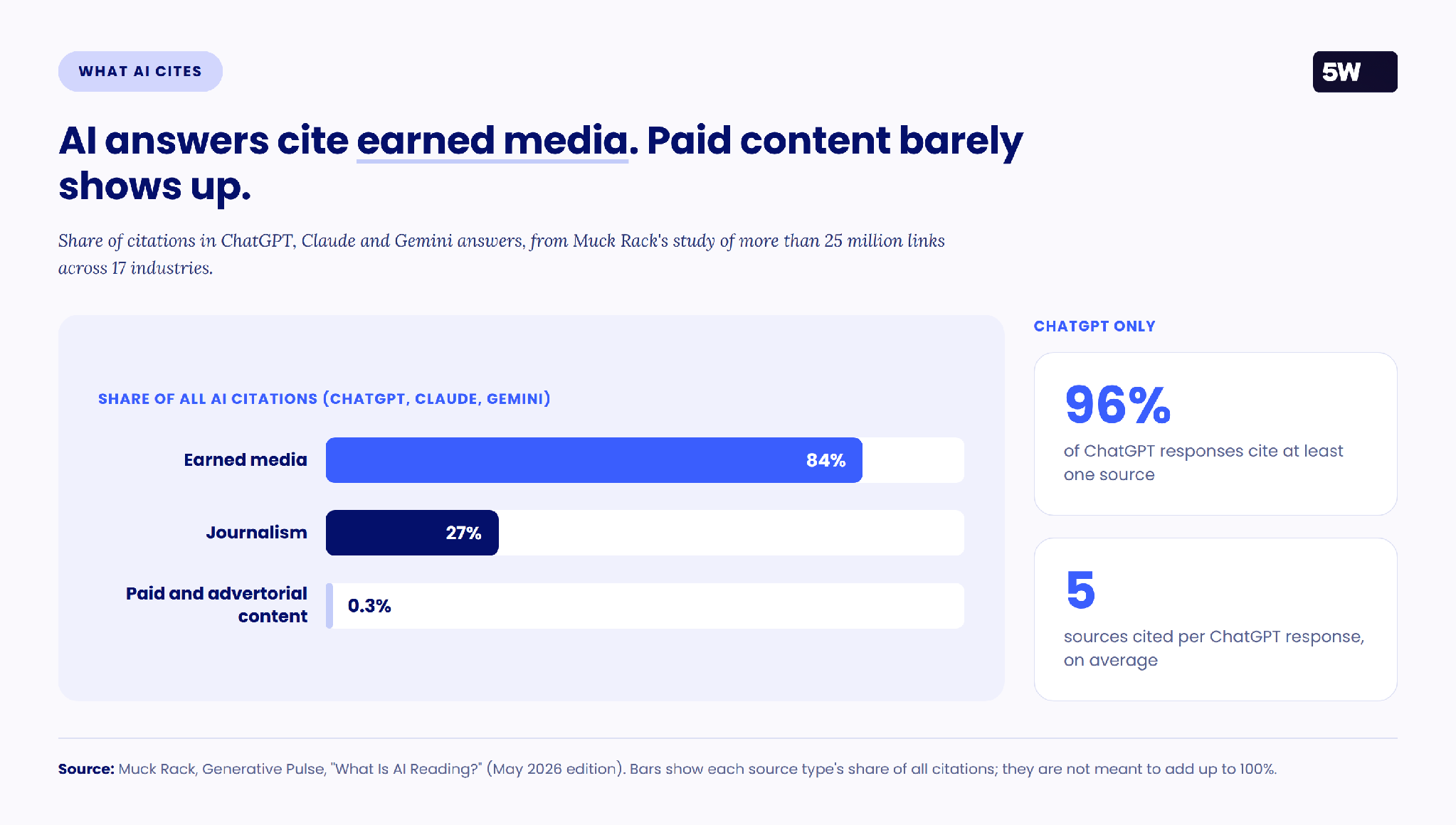
Although sources change rapidly, Muck Rack's May 2026 What Is AI Reading shows that ChatGPT weighs earned media over brand claims of more than 25 million links across 17 industries.
Muck Rack also reported that ChatGPT cited sources in 96% of its responses, averaging five sources per response. Earned media, including editorials, academic research, and encyclopedic sites, made up 84% of AI citations, and journalism alone made up 27%.
Industry-trends questions drew journalism citations at more than double the rate of how-to questions.
How do paid ChatGPT ads and earned media compare?
Paid ChatGPT ads and earned media differ in placement, authorship, audience, cost, and measurement.
| Question | Paid ChatGPT ad | Earned media |
|---|---|---|
Where does the information or ad iappear? | A labeled sponsored spot below a ChatGPT answer | Inside the ChatGPT answer, as a recommended product or cited source |
Who controls the message? | The advertiser | A journalist, reviewer, or community member |
Who sees the add or answer? | Logged-in ChatGPT users on plans with ads | Any ChatGPT user whose answer cites it, including users on ad-free plans |
How much does a ChatGPT ad cost? | Bids in an auction | Research, pitching, and spokesperson time, without a placement fee |
How can a brand measure a ChatGPT ad? | Impressions, clicks, CPC, conversions | Brand mentions and citations in AI answers versus competitors |
Paid ChatGPT ads and PR for AI search visibility are separate discovery strategies. Answer engine optimization (AEO) and generative engine optimization (GEO) work together to increase a brand’s recommendations in AI-generated answers and summaries. This 5WPR guide explains how earned media drives AI search visibility.
What do different ChatGPT ad formats look like?
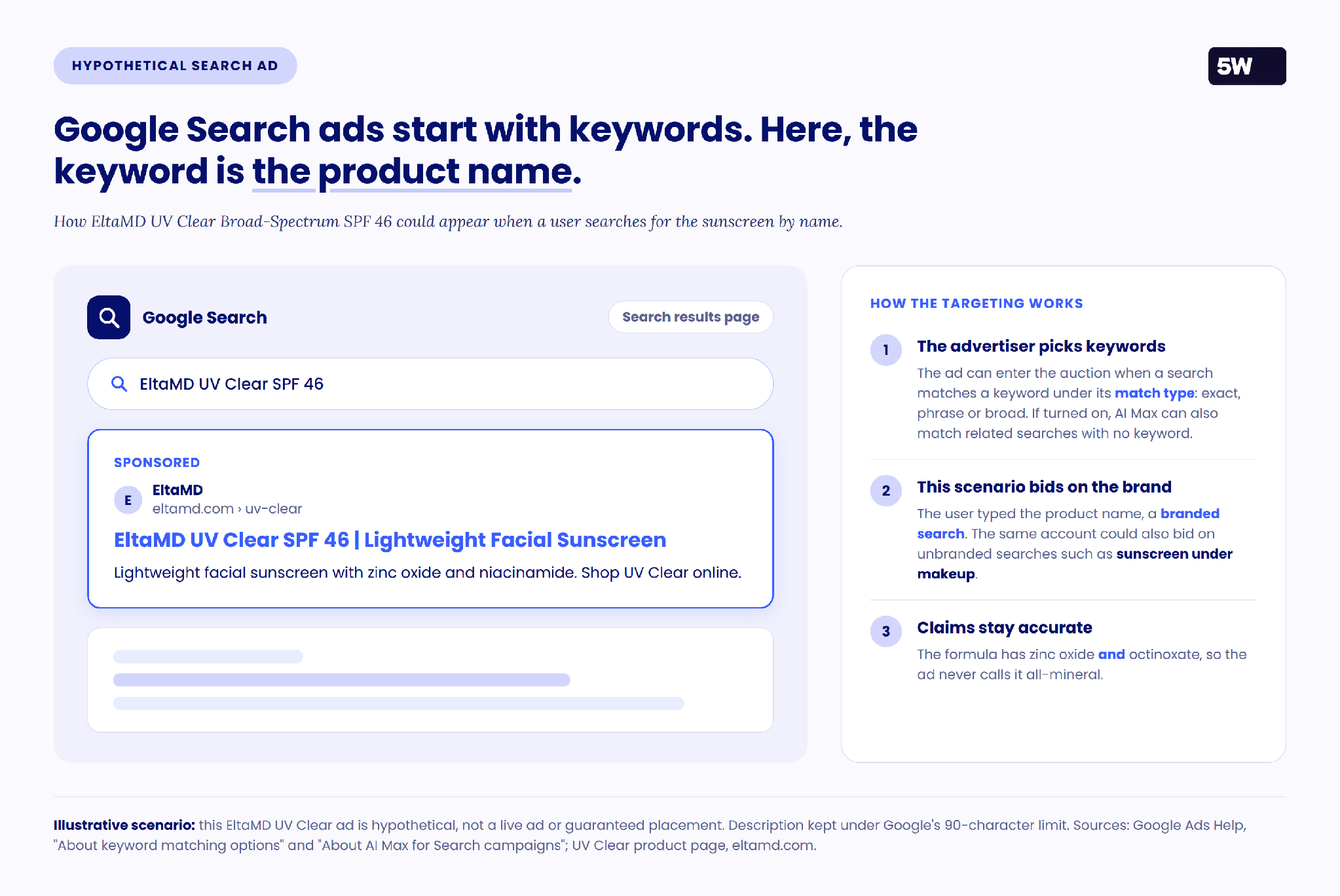
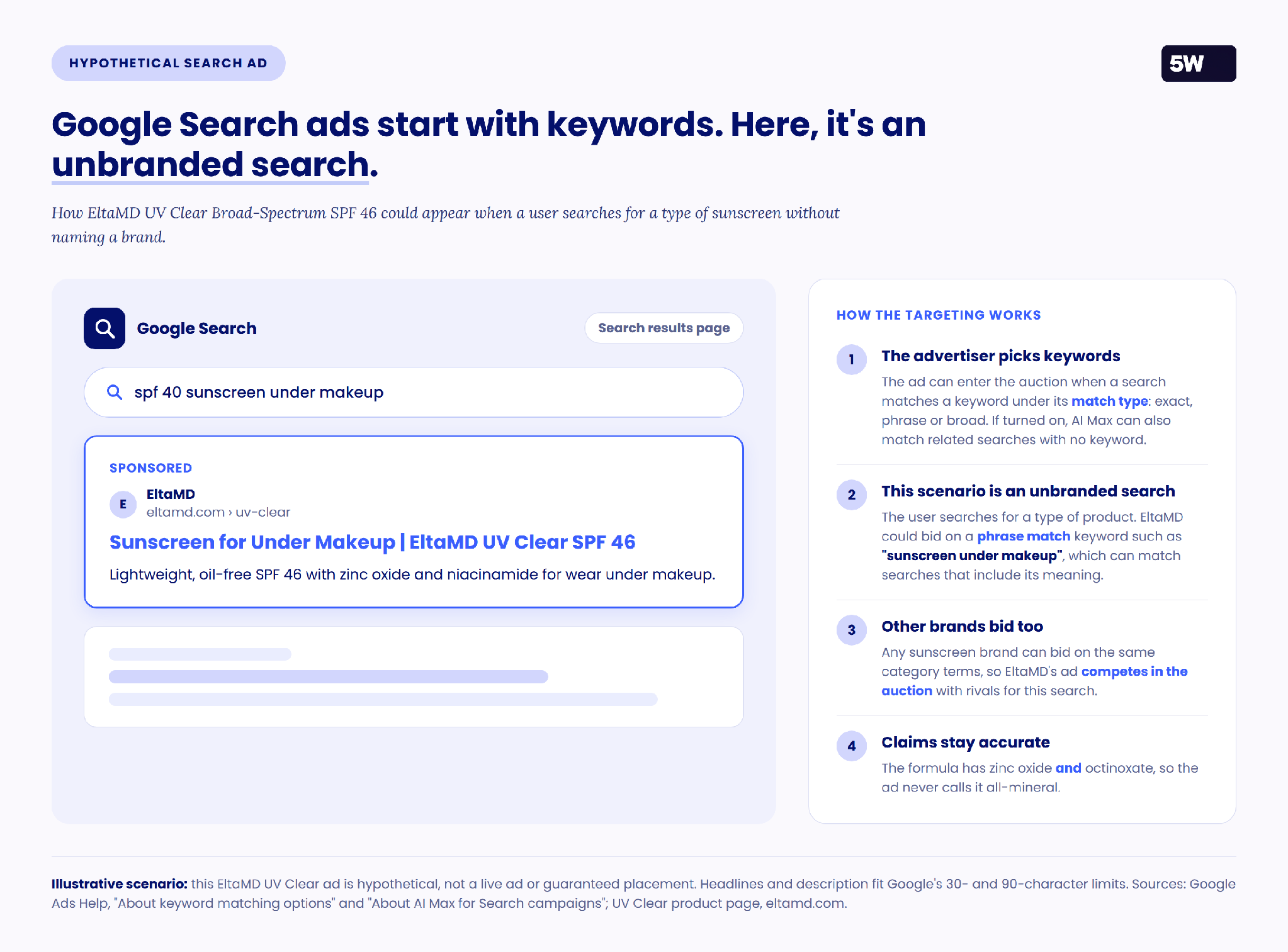
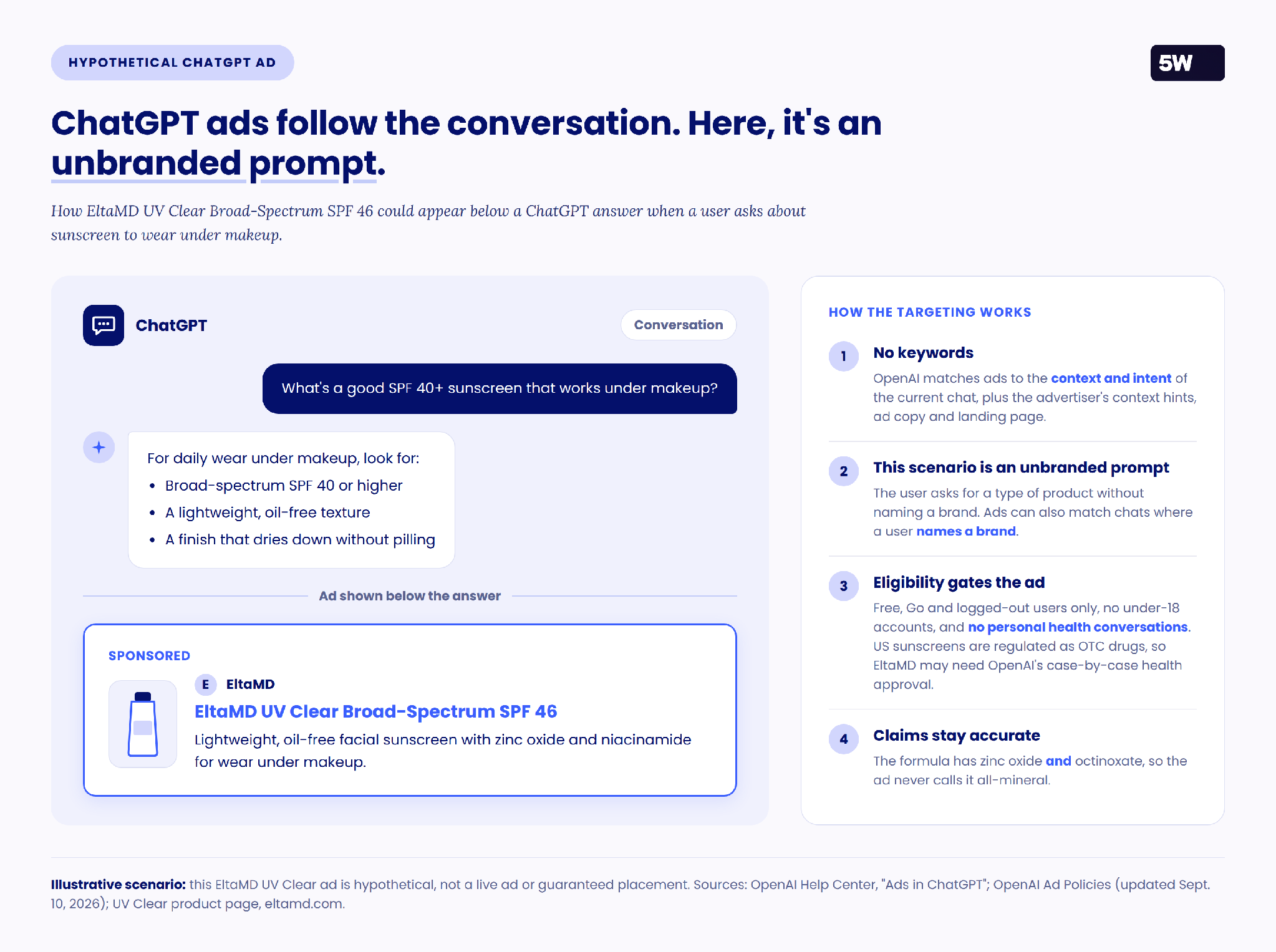
Here’s a hypothetical use case for EltaMD UV Clear Broad-Spectrum SPF 46 that shows how one sunscreen could appear in a Google Search ad, a ChatGPT ad, and a ChatGPT answer.
Illustrative scenario: the EltaMD UV Clear ads described here are hypothetical, not live ads or guaranteed placements.
What sources build AI answers about sunscreen?
5W’s Retrieval Index on beauty media shows that model recommendations for beauty products draw sources from community forums, retailer information, and editorials. The Index found beauty product-recommendation queries are led by Reddit communities such as r/SkincareAddiction, Sephora and Ulta review pages, and outlets such as Byrdie, Allure, and The Strategist.
EltaMD UV Clear would benefit from ChatGPT answers and ads when their campaigns compound and appear in Reddit threads, owner content, and relevant beauty outlets. 5WPR's comparison of beauty PR versus performance marketing explains how earned coverage and paid spend differ for beauty brands.
Can brands run ChatGPT ads in health conversations?
OpenAI's ad policies bar ChatGPT ads in personal and mental health conversations and restrict ads that make treatment claims. Consequently, a ChatGPT conversation about a personal rosacea diagnosis falls under OpenAI's sensitive-context rules, so brands should eliminate those scenarios as potential ad opportunities.
How much do ChatGPT ads cost?
ChatGPT Ads basics page states that ads are purchased by impressions, clicks, or conversion optimization. OpenAI recommends starting with click campaigns and a maximum bid of $3 to $5 per click. OpenAI's Ads Manager reports on the average cost per thousand impressions and conversions for ChatGPT ads.
Who can see ChatGPT ads?
ChatGPT ads are shown to users on the free tier and are unavailable to Business, Plus, or Pro users.
How can one message serve ChatGPT ads and PR pitches?
Customer problems written as ChatGPT context hints are potential story angles. To amplify coverage, brands can turn common customer problems, like "agencies losing track of client approvals," into a context hint, a blog post, or a piece of earned media. Where ChatGPT ad reporting breaks out results by creative variant, those framings can help inform PR pitch angles.
Should brands move budget from Google Ads to ChatGPT ads?
Brands with active Google Search campaigns shouldn’t move budget to ChatGPT ads solely for the new targeting. ChatGPT ads add the most value for products and services with informational needs or that need explanations (like SaaS software).
Here are four questions to help guide a budget decision between Google Ads and ChatGPT ads.
| Question | What to check | What the answer tells a brand |
|---|---|---|
Where does demand exist? | Google Search campaigns with steady conversions | Which channels to keep funding for shoppers ready to choose |
Where are shoppers comparing? | Category questions in ChatGPT and Google AI Mode | Whether ChatGPT ads can reach shoppers before they pick a brand |
What does ChatGPT say about the brand? | ChatGPT answers to the prompts customers use, and the sources cited | Whether a ChatGPT ad would sit under an answer that supports, ignores or contradicts the brand |
What evidence justifies more/new ad spend? | Qualified traffic, acquisition cost, conversions, and incremental lift | Whether ChatGPT ad results go beyond impressions and clicks |
How to determine if testing ChatGPT ads is worthwhile?
ChatGPT ads and Google Search ads buy space next to an answer, while earned coverage makes up the majority of the sources AI answers cite. Brands benefit when their paid campaigns and PR work compound.
5W helps clients build paid and digital strategies, and our performance marketing team runs revenue-tied paid search, paid social, and display campaigns. To discover how ChatGPT, Gemini, and other AI models describe and share your brand, start a conversation with 5WPR today.