

Right now, when a user asks ChatGPT or Google, "which brands are best for X," the answer rarely comes from a brand's website.
Conductor's 2026 Publishing benchmarks, an analysis of more than 13 million publishing-brand citations, found that standard editorial articles made up over half of the news and journalism citations in Google AI Overviews, with best-of and list-style articles adding another one-fifth. A brand that only optimizes its site is missing an important layer of information that drives a large share of those answers.
The Role of PR in GEO Starts With Independent Information
"Earned media" is coverage a brand doesn't write or pay for; some examples include a reporter's article, a product review, an expert quote, or an independent comparison. It's different from a brand's product pages or press releases, which explain what the brand wants people to know.
Users aren't asking ChatGPT to repeat a brand's pitch. They're asking questions like "What's the best stroller for a small car?" or "Which cybersecurity firms handle ransomware recovery?" Answering those questions often requires a third-party source to verify a brand's stated claims.
Owned Content and Earned Media Serve Different Roles in GEO
A brand's website remains the primary source for details like specs, pricing, ingredients, certifications, and leadership information; owned content plays a significant role in the AI information ecosystem.
Earned coverage adds a layer a brand can't produce itself: outside authority. Google explains that AI Overviews and AI Mode use a "query fan-out" technique, running multiple related searches across subtopics before identifying supporting web pages beyond a brand's site. OpenAI says ChatGPT ranks search results using multiple factors meant to surface relevant, reliable information, without guaranteeing a specific source's placement. Both companies describe the same gap: a brand can make claims, but confirmation usually comes from multiple sources.
Expert Commentary, Reviews, Comparisons, and Research Strengthen GEO
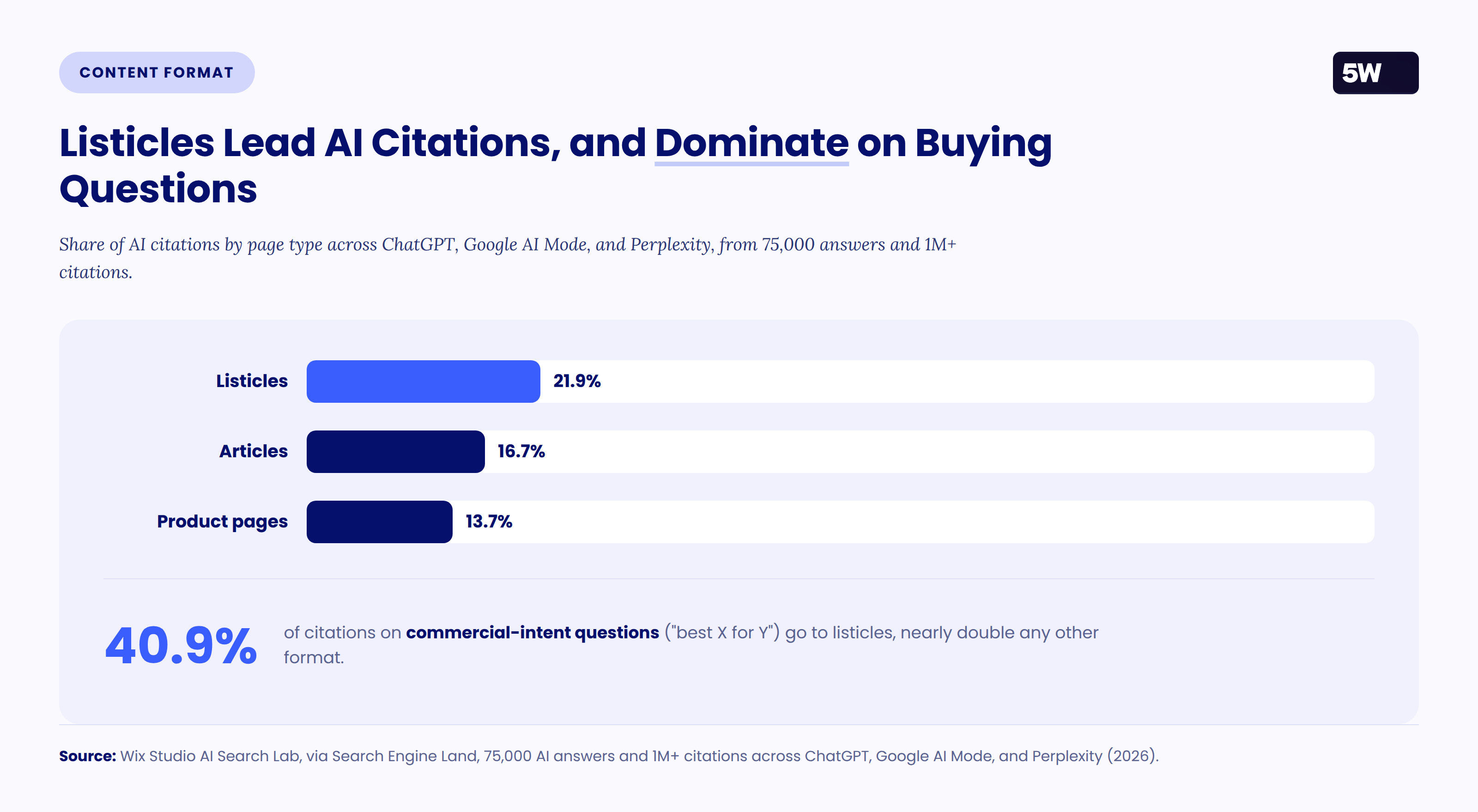
Wix Studio's AI Search Lab research, covering well over a million citations across 75,000 answers from ChatGPT, Google AI Mode, and Perplexity, found that listicles accounted for nearly 22% of all citations, and when the question showed obvious buying intent, listicles appeared in over 40% of answers. A "best gifts for new parents" question pulls from gift guides. A "how does X technology work" question pulls more from articles and expert explainers.
Consequently, a one-off press hit won't cover a wide variety of prompts. A brand looking to improve AI visibility and recommendations needs a mix of coverage built for comparison questions, expertise, and straightforward reviews.
5WPR Campaigns Show How Earned Media Supports GEO
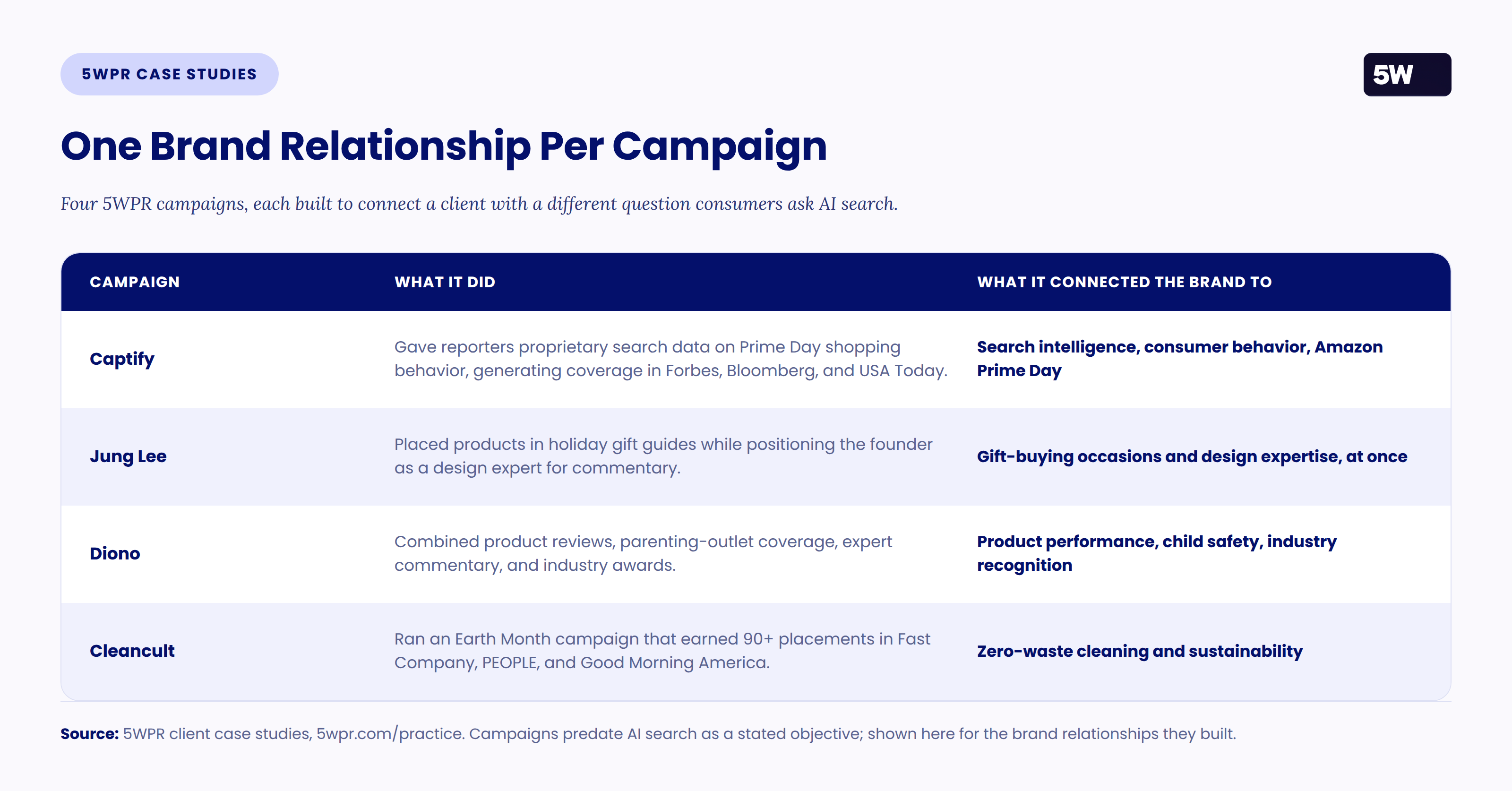
5WPR has run several campaigns that show what this mix looks like in practice, even though none were built as "AI search" campaigns at the time:
Campaign | Purpose | Connection |
Gave reporters proprietary search data on Prime Day shopping behavior, generating coverage in Forbes, Bloomberg, and USA Today. | Search intelligence, consumer behavior, Amazon Prime Day | |
We placed products in holiday gift guides and positioned the founder as a design expert for commentary. | Gift-buying occasions and design expertise, at the same time | |
Combined product reviews, parenting-outlet coverage, expert commentary, and industry awards. | Product performance, child safety, industry recognition | |
Cleancult ran an Earth Month campaign that earned over 90 placements in Fast Company, PEOPLE, and Good Morning America. | Zero-waste cleaning and sustainability |
The Captify campaign gave journalists a reason to associate the brand with a data-driven topic. The Jung Lee work created two separate reputations from one campaign. The Diono and Cleancult strategies spread coverage across enough angles that no single question about the category would go unanswered.
One Media Placement Does Not Build a GEO Position
A single placement plants a connection between a brand and a topic. A single placement can't answer every question a user asks. AI models also pull from different sources depending on the platform, so a brand built around one outlet or one type of story is exposed as soon as someone asks a question a featured story doesn't cover.
The practical approach is to start with the questions the brand wants to show up for, figure out what kind of outside coverage answers them, and build a media plan around the gaps rather than around a single hit.
Make PR Part of the GEO Strategy From the Start
Earned media isn't a side project next to content; it's a large part of what AI models cite when answering relevant brand questions.
5W runs Generative Engine Optimization (GEO) programs for brands across consumer, B2B, financial services, healthcare, and technology, building the machine-readable footprint that gets brands cited and recommended, not just ranked.