
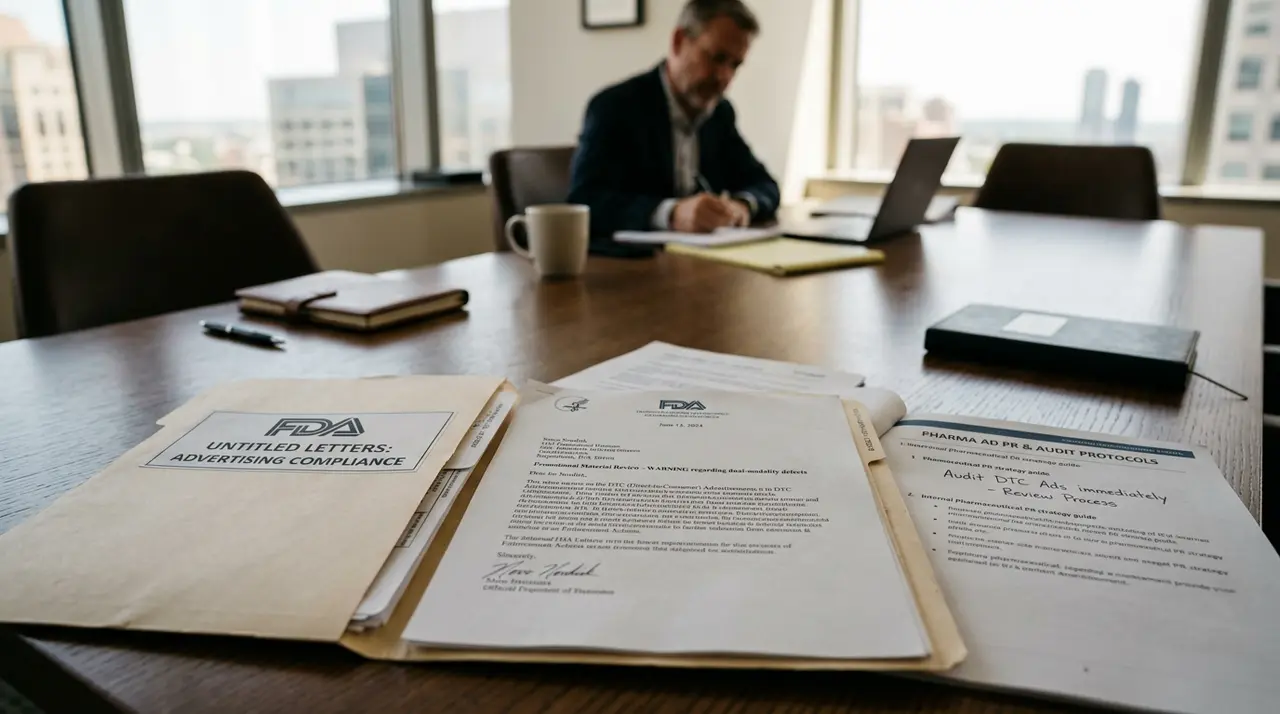
Pharma ad PR teams face active FDA enforcement over how broadcast ads present safety information. Novo Nordisk received two FDA untitled letters in February 2026, one for its Wegovy pill TV ad and one for an Ozempic video. The Wegovy letter, dated February 5, cited misleading benefit claims and a failure to present the major statement in audio and on-screen text at the same time. Check every direct-to-consumer script for both before it airs.
Last updated: November 7, 2026. This article is communications guidance, not legal advice. Regulatory counsel should review any drug advertising claim.
In this guide
- What is the dual-modality requirement for drug ads?
- What did FDA say in the Wegovy pill letter?
- What about the Ozempic letter?
- Were other drugmakers cited in 2026?
- What changed in FDA's approach to drug ads in 2025?
- How is an untitled letter different from a warning letter?
- How should a company respond publicly to an untitled letter?
- What should PR teams check before a DTC ad airs?
- Does FDA scrutiny extend to social media and digital ads?
- How does FDA enforcement interact with FTC jurisdiction?
- What is the adequate provision rule?
- What regulatory change is next for DTC advertising?
- Frequently asked questions
What is the dual-modality requirement for drug ads?
Dual modality means a broadcast drug ad must present its major statement of risks using audio and on-screen text at the same time, so the spoken and written words match. FDA's rule on presenting the major statement in a clear, conspicuous and neutral manner was finalized in 2023, and the 2026 letters show the agency enforcing it against current campaigns.
In practice, text that appears on screen while the voiceover says something different does not satisfy the requirement, and neither does text that shows up separately from the spoken statement.
What did FDA say in the Wegovy pill letter?
FDA's Office of Prescription Drug Promotion told Novo Nordisk in a letter dated February 5, 2026 that its Wegovy pill TV ad misbrands the drug. The published letter raises three concerns.
- The phrases "live lighter" and "a way forward" misleadingly imply additional weight loss compared with other approved GLP-1 treatments, when that has not been demonstrated.
- The ad implies benefits beyond weight loss, such as emotional relief, reduced psychological burden, hope or direction for patients' lives, which positions the drug as a solution to broader life challenges.
- The major statement includes on-screen text that does not match the audio, so the ad fails to present it concurrently in audio and text.
FDA asked Novo Nordisk for a written response within 15 working days. A Novo Nordisk spokesperson said the company takes regulatory feedback seriously and was responding to address concerns about the ad's presentation, according to CNBC's report.
What about the Ozempic letter?
A second untitled letter followed on February 26, 2026, over an Ozempic video built around the line "There's Only One Ozempic." Reports describe regulators objecting to comedic elements that implied competing drugs lacked meaningful benefits. The sequence matters for PR: two letters in three weeks about two different campaigns from the same company turned a single regulatory matter into a pattern that reporters could cover.
Were other drugmakers cited in 2026?
Yes. Law firm summaries of FDA's 2026 enforcement describe an untitled letter on argenx's Vyvgart Hytrulo TV ad, where the agency alleged that attention-grabbing visuals shown during the major statement interfered with viewers' understanding. eMarketer also reported an FDA letter to Johnson & Johnson calling its Tremfya TV ad false or misleading, citing a "1 out of 2 patients" remission claim and the phrase "100% visible healing." The pattern across letters is consistent: benefit claims that outrun the approved labeling, and risk statements viewers cannot absorb.
What changed in FDA's approach to drug ads in 2025?
In September 2025 the Department of Health and Human Services and FDA announced a crackdown on what they called misleading prescription drug ads, and said FDA would start rulemaking to end the adequate provision approach, according to Regulatory Affairs Professionals Society reporting on September 10, 2025.
FDA Commissioner Marty Makary told News Nation that FDA had sent 108 cease-and-desist letters in addition to thousands of letters warning drugmakers to remove misleading ads. He also said the agency's drug promotion office sent one warning letter in 2023 and none in 2024. An HHS fact sheet said FDA would write to every sponsor of an approved drug or biologic, which it put at several thousand companies.
The industry pushed back. Alex Schriver, senior vice president of public affairs at PhRMA, the drugmakers' trade group, said the move would make it harder for patients to get information they need to talk with their doctors. Dara Katcher Levy, an attorney at Hyman, Phelps & McNamara, told the same publication that a step short of an outright ban could end in litigation on First Amendment grounds. Both views are reasons to expect the rulemaking to be contested.
How is an untitled letter different from a warning letter?
An untitled letter is, in general, FDA's lower-level written notice that an ad contains violations and should be corrected, while a warning letter is the formal step that cites violations and warns of further action. Both are public and both can become news.
The distinction matters for PR planning because both Novo Nordisk letters were untitled letters, yet they still drew coverage. Regulatory Focus reported that FDA's drug promotion office sent several untitled letters in 2023 and 2024 even in years when it sent almost no warning letters, so an untitled letter should be treated as a full communications event.
How should a company respond publicly to an untitled letter?
A company should confirm receipt, say it is reviewing the specific concerns, reaffirm its commitment to compliant advertising, and avoid disputing FDA's findings publicly before its written response is complete. Novo Nordisk's statements followed that structure. A defensive tone can complicate the regulatory response and invite a longer news cycle.
Coordinate every public statement with regulatory counsel, and make sure anything said about the ad matches what the formal response will say. Illustrative holding statement for a hypothetical company: "We have received the FDA's letter about our television advertisement and are reviewing it carefully. We take the agency's feedback seriously and will respond within the timeframe the letter provides. We are committed to advertising that presents benefits and risks clearly." Three sentences, no argument with the findings.
What should PR teams check before a DTC ad airs?
- Confirm the major statement appears as on-screen text at the same time it is spoken, word for word.
- Check that visuals during the major statement do not compete with it, since FDA has cited attention-grabbing imagery as interfering with comprehension.
- Review copy for emotional or lifestyle language that implies a benefit beyond the approved indication. "A way forward" read as motivational copy to a marketing team and as an unsupported claim to FDA.
- Test comparative or "only" claims against the prescribing information, since FDA objected where superiority was implied without data.
- Keep a dated review record for each script and revision.
The table ties each check to the example that prompted it, using the letters described above.
| Issue | Where it appeared | Check before air |
|---|---|---|
| On-screen text differs from the audio | Wegovy pill letter, February 5, 2026 | Compare the major statement text with the voiceover word for word |
| Visuals compete with the risk statement | argenx Vyvgart Hytrulo letter, per law firm summaries | Review what viewers see while the risk statement plays |
| Lifestyle language implies extra benefit | "Live lighter" and "a way forward" in the Wegovy pill ad | Trace each phrase to the approved indication |
| Comparative or "only" claim | "There's Only One Ozempic" video | Test the claim against the prescribing information |
| Remission or healing statistic | Tremfya ad, per eMarketer's report | Match every statistic to the label's data and population |
Does FDA scrutiny extend to social media and digital ads?
FDA's 2025 announcement covers digital advertising as well as broadcast, because the agency said the adequate provision approach was used to hide risk information in both formats. The announcement cited a 2024 review in the Journal of Pharmaceutical Health Services Research that found 100 percent of pharmaceutical social media posts highlighted benefits while only 33 percent mentioned potential harms, according to RAPS.
PR teams should run short video, paid social and creator content through the same script review as television ads. A thirty-second social clip with a link to risk information is the format the agency has said it wants to examine.
How does FDA enforcement interact with FTC jurisdiction?
FDA regulates prescription drug promotion, while the FTC has general authority over deceptive advertising, so the same claim can be read by two audiences. A statement that fixes the dual-modality problem but keeps a broad lifestyle claim can still draw separate scrutiny, so draft the response to hold up under both standards.
What is the adequate provision rule?
The adequate provision rule lets a drug ad present a major statement of the most important risks and then direct viewers to the full labeling, instead of listing every risk in the ad. FDA created the concept in 1960s regulations, and late-1990s guidance explained how it applies to broadcast ads, according to RAPS.
That guidance is widely credited with enabling broadcast drug advertising, because a full risk list would not fit in a thirty or sixty second spot. Ending or narrowing it would change the format of drug ads, not only their wording.
What regulatory change is next for DTC advertising?
FDA plans to propose a rule requiring broadcast drug ads to include a complete brief summary of side effects and contraindications from the approved labeling, with an expected issue date of December 2026, according to RAPS reporting on the July 2026 unified agenda. RAPS also notes that agencies frequently exceed the timeframes in the agenda, in some cases by years.
If a final rule narrows the adequate provision approach, 30 and 60 second spots would carry more risk disclosure, which would push brands toward longer formats or unbranded help-seeking ads. A proposal is not a final rule, and a comment period would come first, so check FDA's regulatory agenda before building a plan around a date.
Frequently asked questions
What is FDA's dual-modality rule?
Broadcast drug ads must present the major statement of risks using audio and on-screen text at the same time, with the spoken and written content matching.
How many untitled letters did Novo Nordisk get in February 2026?
Two: one dated February 5 on its Wegovy pill TV ad and one on February 26 on an Ozempic video.
What did FDA object to in the Wegovy pill ad?
The phrases "live lighter" and "a way forward," which it said misleadingly implied additional weight loss and benefits beyond weight loss, and on-screen text that did not match the audio.
How should a company respond to an FDA untitled letter?
Confirm receipt, commit to reviewing the concerns, reaffirm compliance, and avoid public disputes before the written response is filed.
When is FDA expected to propose the new drug ad rule?
The July 2026 unified agenda lists December 2026 for a proposed rule on complete risk summaries in broadcast ads. Agency timelines often slip, so confirm the status before relying on the date.
What is the adequate provision loophole FDA wants to end?
It is the practice of presenting a major risk statement in an ad and pointing viewers to a website or phone number for complete risk information. FDA said in September 2025 that it would start rulemaking to end it.
Does the FDA review social media drug posts?
FDA's 2025 announcement covers digital as well as broadcast advertising. Review short video, paid social and creator content with the same checks used for television scripts.
Related Reading
For organizations managing a regulatory letter publicly, see how much crisis PR costs and how to choose a firm, and for brands managing search visibility after a regulatory matter, see online reputation repair: what can be removed. For the biotech side of FDA disclosure, see the guide to FDA complete response letter disclosure. For the practice behind this work, see 5W's healthcare PR practice.