
Performance Marketing Agency
A performance marketing agency runs paid search, paid social, and display campaigns where the client pays only for measurable outcomes such as clicks, leads, or conversions, then optimizes spend continuously against those numbers. 5W runs performance marketing programs alongside PR and social, so paid spend and earned coverage reinforce each other instead of running in separate silos.
Selected clients




































































What Does a Performance Marketing Agency Actually Do?
A performance marketing agency manages paid channels (search, social, display, and affiliate) under a single reporting structure tied to cost per acquisition, return on ad spend, and conversion rate, rather than impressions or reach alone. The agency sets up tracking, builds and tests ad creative, manages bids and budgets, and reallocates spend weekly toward the channels and audiences that convert.
5W's performance marketing team handles four connected functions: audience research and segmentation, campaign build and launch across paid search and paid social, ongoing optimization through A/B testing and bid management, and reporting that ties spend directly to pipeline and revenue.
Why Does So Much Performance Marketing Budget Get Wasted?
Performance marketing budget gets wasted when dashboards show rising clicks and impressions that never convert into paying customers, a gap that stays hidden without revenue-level tracking. DemandScience's 2026 State of Performance Marketing Report, based on a survey of 750 senior B2B marketing leaders published December 17, 2025, found that 25% of marketing spend fails to drive outcomes even though the underlying metrics look successful, and 43% of leaders said campaigns that appeared to be working did not translate into sales.
Why it works: Most ad platforms optimize toward the event a marketer tells them to optimize toward, typically a click or a form fill. If that event is not tied to a CRM record showing an actual sale, the platform keeps spending against a proxy metric instead of revenue. Connecting ad platform data to CRM outcomes, the fix DemandScience's report points to directly, closes that gap and is the first thing 5W sets up on a new performance marketing account.
How Is Paid Search Changing in 2026?
Google will earn 48.5% of US search ad spending in 2026, the first time in more than 20 years that figure has fallen below half, according to EMARKETER's US Search Advertising Forecast published May 14, 2026. Amazon and retail media platforms are taking a growing share of search budgets that once went to Google alone.
Why it works: Buyers increasingly start product research on Amazon, TikTok, or inside an AI chat tool instead of a traditional search engine, so a performance marketing budget built only around Google keeps missing a larger share of buyer intent every year. 5W builds paid search plans across multiple intent surfaces (search, retail media, and AI-visible content) rather than treating Google as the only channel that matters.
How Does 5W Structure a Paid Media Program?
5W structures a performance marketing program around four channels working together: paid search for high-intent demand, paid social for targeted audience building, display and retargeting for reach and recall, and email for nurturing leads the other channels generate.
Paid Search
Paid search bids on keywords tied to commercial intent so ads appear when a buyer is already searching for a solution. 5W builds keyword-to-landing-page match structures and manages Quality Score inputs so cost per click stays controlled as budgets scale.
Paid Social
Paid social uses platform targeting data (demographics, interests, and behaviors on Meta, LinkedIn, and TikTok) to reach audiences before they start searching. 5W builds lookalike and custom audiences from existing customer lists and runs creative testing to find which ad formats a specific audience responds to. 5W's social media marketing team manages the organic side of the same platforms so paid and organic content stay consistent.
Display, Retargeting, and Media Planning
Display and retargeting keep a brand in front of users who already visited the site but did not convert on the first visit. 5W sets frequency caps and sequenced creative so retargeting builds toward a conversion instead of repeating the same ad indefinitely, and 5W's media planning and buying team handles the budget allocation across those placements.
Conversion Rate Optimization and Content
Conversion rate optimization tests landing page elements (headlines, forms, calls to action) against each other to find which version converts more paid traffic into leads or sales. 5W runs these tests continuously, and 5W's content marketing team supplies the landing page copy and supporting content those tests run against.
What Results Has 5W Delivered With Paid Media?
5W ran an integrated paid, earned, and social program for Samsung SmartThings that generated 4 million paid media impressions in six months alongside more than 8 billion earned media impressions, according to 5W's Samsung SmartThings case study. The program also drove nearly 40,000 social engagements and 17.28% Instagram audience growth over the same period.
Why it works: Paid media amplified the specific announcements SmartThings' earned media program had already secured coverage for, instead of running as a disconnected campaign. That sequencing, earning the story first and then paying to extend its reach to the audience segments most likely to act on it, is why the paid impressions converted into audience growth rather than just spend. 5W's full client work spans additional case studies across consumer, technology, and lifestyle brands.
How Does Performance Marketing Work With PR and Earned Media?
Performance marketing and PR work together when paid budget amplifies a story that earned coverage already validated, and when PR-driven backlinks and mentions improve the organic rankings that reduce future paid search costs. A brand announcing a product launch gets more efficient paid social performance if trade press coverage has already built some audience awareness of the news.
5W runs this integration directly: the same team planning a performance marketing calendar sees the PR calendar, so paid spend can be timed to launch dates, press embargoes, and confirmed media placements instead of running on a fixed schedule that ignores them. 5W's online reputation management team and influencer marketing team feed the same calendar, so paid retargeting can follow an influencer post or a reputation win instead of running blind to it.
How Does AI Search Change Performance Marketing?
AI search tools such as ChatGPT, Perplexity, and Google's AI Overviews now answer purchase-consideration questions directly, which means a brand invisible to those systems loses consideration before a paid search ad would ever show. Performance marketing budgets built only around traditional SERP rankings miss the growing share of research happening inside AI answers.
5W's GEO optimization practice builds the structured data, entity clarity, and citation-worthy content that gets a brand named in those AI answers, which then lowers the cost of paid campaigns retargeting users who already encountered the brand in an AI response.
What Should You Look for in a Performance Marketing Agency?
Choosing a performance marketing agency comes down to four checks: whether the agency ties reporting to revenue instead of clicks, whether it runs paid media alongside PR and content instead of in isolation, whether it has published, verifiable case studies with real numbers, and whether it already accounts for AI search inside its paid strategy.
- Revenue-tied reporting: ask to see a sample dashboard that connects ad spend to closed revenue, not just clicks and impressions.
- Cross-channel integration: confirm the paid media team coordinates directly with PR, social, and content teams rather than operating as a separate vendor.
- Verifiable results: request case studies with named clients and specific, dated numbers rather than aggregate claims.
- AI search readiness: ask how the agency's paid strategy accounts for AI Overviews, ChatGPT, and other answer engines pulling buyers out of traditional search.
How Does Performance Marketing Support B2B, Corporate, and Beauty Programs?
5W applies the same testing and attribution discipline across specialized verticals. Business-to-business campaigns run through 5W's B2B digital marketing team, targeting longer consideration cycles and named-account decision-makers rather than broad consumer audiences.
Corporate accounts pair paid media with 5W's corporate digital marketing team to support executive positioning and financial announcements, while beauty digital marketing campaigns lean on the same paid infrastructure with creative testing built for highly visual, fast-moving beauty and skincare launches.
Proprietary Research
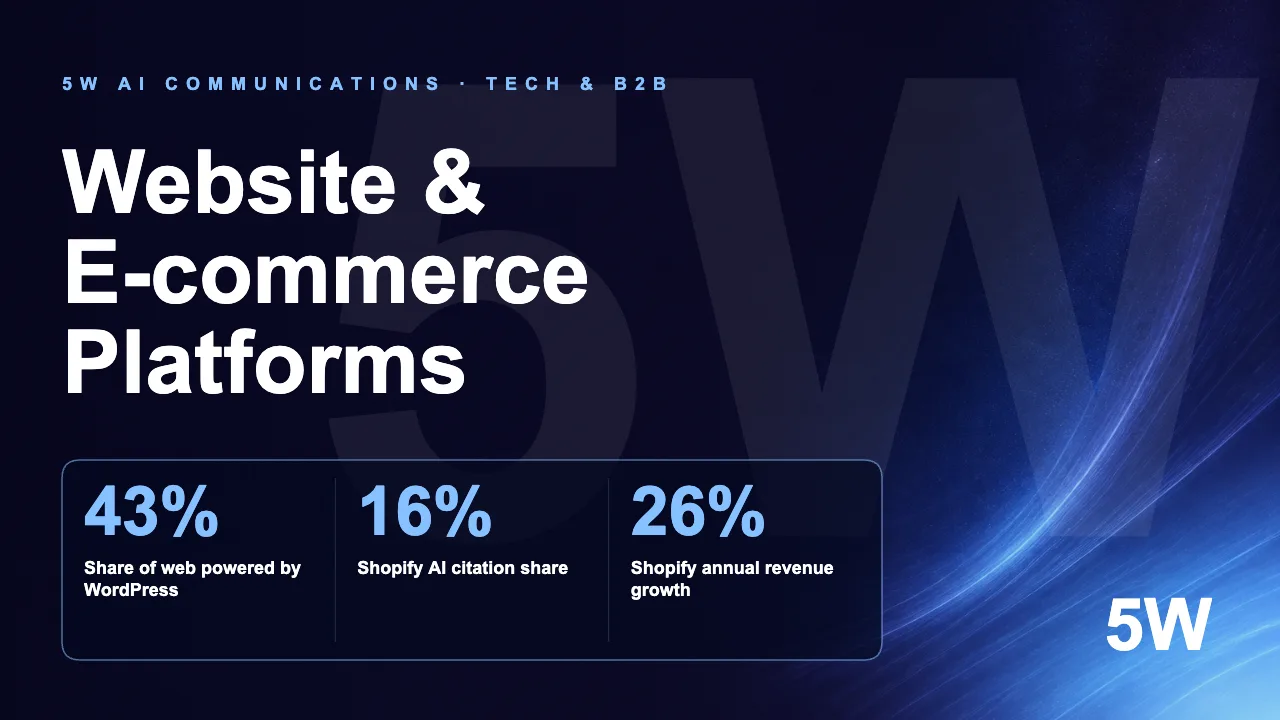
Website & E-commerce Platforms
WordPress powers the web, but AI shopping and builder queries recommend Shopify.
Read the researchRecognition







Performance Marketing Agency FAQ
1. What does a performance marketing agency charge for?
A performance marketing agency typically charges a monthly retainer covering strategy, campaign management, and reporting, separate from the ad spend paid directly to Google, Meta, or other platforms. Budget tiers usually start around $15,000 to $25,000 per month for mid-size accounts and scale from there based on ad spend volume and channel count.
2. How long does it take to see results from performance marketing?
Paid search and paid social campaigns typically generate measurable click and conversion data within the first two to four weeks, but reliable cost-per-acquisition benchmarks take a full quarter of consistent spend to establish because platforms need volume to optimize algorithmically. Retargeting and email nurture results build over a longer window since they depend on the top-of-funnel campaigns generating enough traffic first.
3. What is the difference between performance marketing and traditional digital marketing?
Traditional digital marketing often pays for placement or reach regardless of outcome, while performance marketing ties payment and budget allocation directly to actions such as clicks, leads, or sales. This distinction is why performance marketing dashboards center on cost per acquisition and return on ad spend rather than impressions alone.
4. Which channels should a performance marketing budget prioritize first?
Paid search usually comes first because it captures buyers who are already searching with commercial intent, giving the fastest path to a measurable conversion. Paid social and display typically follow once search is generating consistent data, since they build the audience awareness that search alone cannot reach.
5. Can performance marketing work without PR support?
Performance marketing can run independently, but campaigns typically cost more per conversion when there is no earned media or brand awareness supporting them, since paid ads are working harder to build trust with an audience that has never heard of the brand. Pairing performance marketing with PR, as 5W did for Samsung SmartThings, lets paid spend extend a story instead of introducing the brand cold.
6. Does AI search affect paid search budgets?
AI search affects paid search budgets because Google's share of search ad spending has fallen below 50% for the first time in over two decades, per EMARKETER's May 2026 forecast, as buyers research through retail media, TikTok, and AI chat tools. A performance marketing budget that ignores those surfaces is competing for a shrinking share of total buyer attention.
Request a Consultation
5W builds performance marketing programs that connect paid media to PR calendars and AI search visibility instead of running paid spend in isolation.
5W runs AI Search (GEO) programs for brands across consumer, B2B, financial services, healthcare, and technology, building the machine-readable footprint that gets brands cited, not just ranked. Learn more at 5wpr.com/practice/geo-optimization.cfm.