EXECUTIVE SUMMARY
Online higher education is one of the most paid-search-dependent verticals in the U.S. economy. U.S. higher-ed advertising spend reached $2.2 billion in 2019 (Kantar, via The Hechinger Report), and per-enrollment acquisition costs average $2,849 across programs, approximately $3,800 for graduate programs, and $5,000–$8,000 for executive and MBA programs (UPCEA Marketing Survey, 2024). Generative AI engines are now intercepting prospective-student discovery queries before the Google search results page is rendered. The schools winning AI citation share are not the same schools winning the paid-search auction.
This report measures who is winning that citation surface and who is not. 5W ran 35 prospective-student prompts through Claude and Google AI Overviews in Q2 2026, scoring 25 U.S. online universities on AI citation share across eight query categories: overall discovery, MBA, bachelor's, nursing, computer science and tech, education and other masters, affordability, and specific learner intent.
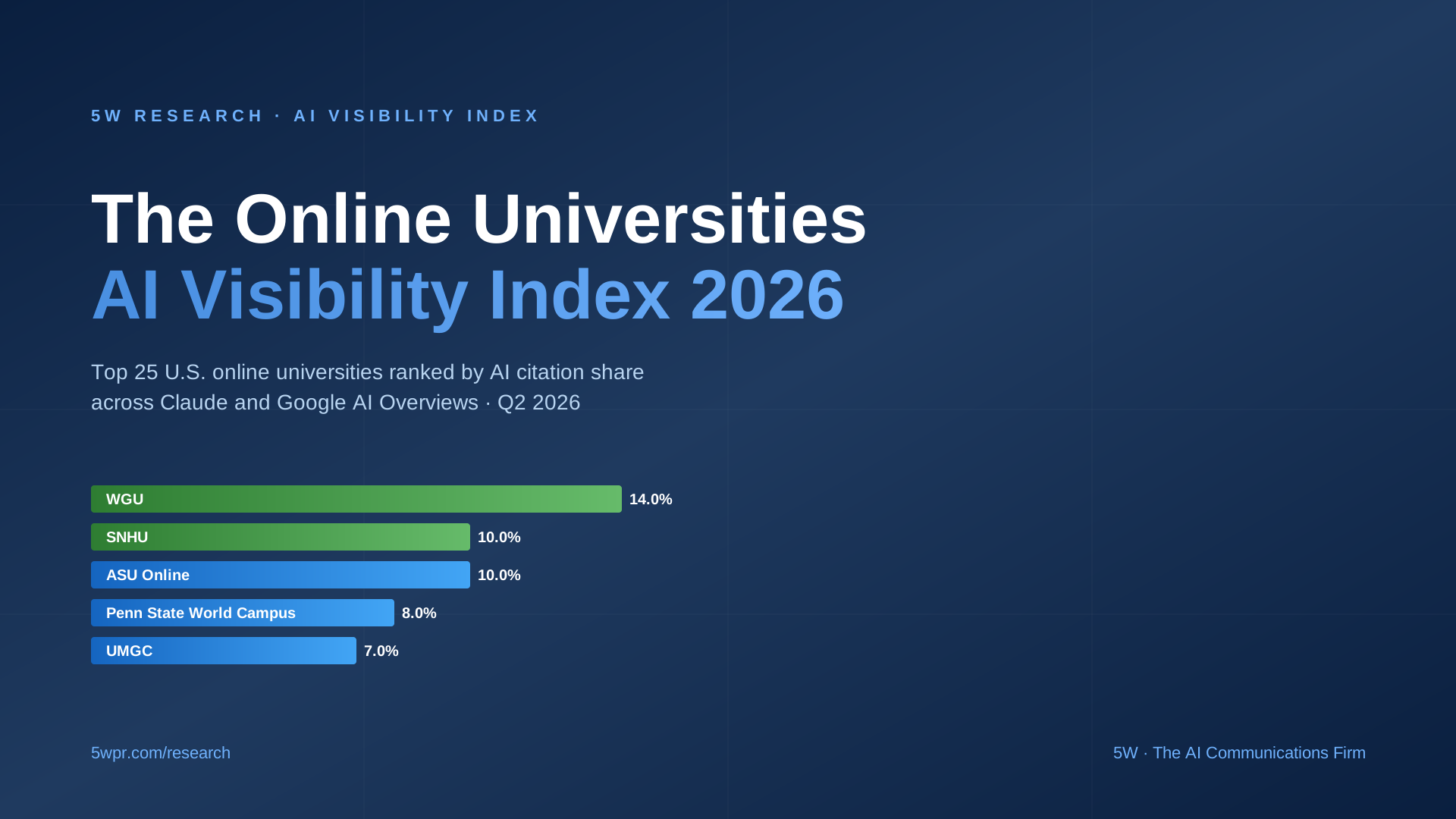
The findings: Western Governors University, Southern New Hampshire University, and Arizona State University Online together capture an estimated 35% of all online-university AI citations. The University of Phoenix, despite spending more on Google paid acquisition than nearly any school in the category, captures an estimated 1.5% AI citation share — the largest paid-search-to-AI-citation gap 5W has measured in any U.S. consumer category. Seven established online universities — DeVry, Strayer, Colorado Technical, Full Sail, National University, Colorado State Global, and UMass Global — each capture less than 0.5% AI citation share, making them functionally invisible to prospective students who use AI tools as their primary discovery surface.
The schools that win AI citation share in the next twelve months will define online higher education through 2030. Most have not yet realized the window has closed.
KEY FINDINGS
- STAT 1: $2.2B — U.S. higher-ed advertising spend, 2019 (Kantar, via The Hechinger Report)
- STAT 2: $2,849 — average per-enrollment acquisition cost across all online programs (UPCEA Marketing Survey, 2024)
- STAT 3: $3,800 / $5,000–$8,000 — average per-enrollment cost for graduate programs and executive/MBA programs respectively (UPCEA, 2024)
- STAT 4: 26% &##8594; 46% — share of college-bound students using generative AI in their college search, spring 2025 to late 2025 (EAB)
- STAT 5: 35% — combined estimated AI citation share of WGU, SNHU, and ASU Online across 35 tracked queries
- STAT 6: 14% — Western Governors University's estimated AI citation share, the highest in the category
- STAT 7: 1.5% — University of Phoenix's estimated AI citation share, despite category-leading paid-search spend
- STAT 8: 7 — established online universities with effectively zero (under 0.5%) AI citation share
THE CENTRAL FINDING
For two decades, online higher education has been one of the most disciplined paid-acquisition machines in the American economy. Schools built keyword strategies around "online MBA," "best online college," and "accredited online degree." Online program managers (OPMs) layered margin on top. Lead-aggregation networks fed enrollment counselors with high-intent prospects sourced by Google ads. The unit economics worked because the funnel started in a Google search box.
That funnel is no longer where most prospective students start. EAB found that the share of college-bound students using generative AI in their college search jumped from 26% in spring 2025 to 46% by late 2025 — a near-doubling in eight months. A 32-year-old career-changer evaluating an online MBA does not begin at Google any more. She begins at ChatGPT or Claude. By the time she searches Google, she is already filtering between two or three names the AI engine surfaced for her.
What this report finds, across 35 prompts and two AI engines, is that the schools AI surfaces are not the schools that own the paid-search auction. A small number of competency-based pioneers and public-flagship online divisions — schools that built editorial authority and merged their online programs with parent-institution trust — are absorbing a disproportionate share of AI citations. The for-profit institutions that built their growth on paid acquisition without a parallel investment in entity-strength infrastructure are getting disintermediated. With per-enrollment acquisition costs running into the thousands of dollars in graduate and executive programs, the financial implications are not hypothetical.
METHODOLOGY
5W analyzed 35 prospective-student prompts across eight query categories. We identified which schools AI engines consistently surface, which editorial and rankings sources feed those citations, and where the largest gaps sit between paid-search position and AI visibility.
Engines tested. Claude (Anthropic) and Google AI Overviews. ChatGPT, Perplexity, and Gemini are scheduled for Index 1.1 in Q3 2026.
School universe (25). Mega-scale national online (Western Governors University, Southern New Hampshire University, Grand Canyon University, Liberty University Online). Public university online divisions (Arizona State University Online, Penn State World Campus, University of Maryland Global Campus, Oregon State Ecampus, University of Florida Online, University of Illinois Chicago Online, UMass Global). Public-affiliated and acquired (Purdue Global, Colorado State University Global). Established for-profit online (University of Phoenix, Walden University, Capella University, Strayer University, DeVry University, Colorado Technical University, Full Sail University, National University). Specialized, military, and competency-based (American Public University System, Excelsior University, Charter Oak State College, University of the People).
Query categories tracked. Overall discovery ("best online colleges," "most respected online universities for working adults," "top-ranked online universities 2026"). MBA ("best online MBA," "most affordable online MBA," "best online MBA without GMAT"). Bachelor's ("best online bachelor's," "cheapest online bachelor's," "fastest online bachelor's"). Nursing ("best online BSN," "best online MSN nurse practitioner," "best online RN to BSN"). CS and tech ("best online computer science degree," "best online master's in data science," "best online cybersecurity degree"). Education and other masters ("best online master's in education," "best online master's in psychology," "best online master's in social work"). Affordability ("most affordable accredited online colleges," "cheapest online college per credit hour," "best online college for the money"). Specific learner intent ("best online colleges for military and veterans," "best online colleges for working adults," "best online colleges for second career").
Citation sources tracked. Federal data (NCES, IPEDS, NC-SARA). Major rankings (U.S. News & World Report, Forbes Advisor, Princeton Review, Newsweek). Category specialists (Niche, BestColleges, AffordableCollegesOnline). Programmatic specialists (Nurse.org, NurseJournal, ComputerScience.org). Community sources (Reddit r/OnlineCollege, r/AskAcademia, r/college). Institutional accreditation (HLC, WSCUC, MSCHE, NEASC, SACSCOC, NWCCU). Programmatic accreditation (AACSB, CCNE, ACEN, ABET, CACREP).
Scoring. Each prompt was run multiple times per engine to control for output variance. Brand mentions were recorded by mention rate, citation rate, position in the response, and engine spread. Composite AI Citation Share is reported as a percentage of total brand mentions across the universe of 25 schools.
Important framing. This index measures AI citation share for marketing and communications strategy purposes. It does not measure educational quality, programmatic accreditation, graduation outcomes, employer recognition of credentials, or return on investment. Prospective students should evaluate online universities on full-spectrum criteria including accreditation, total cost of attendance, completion timelines, employment outcomes, and individual program fit.
Estimated share of citations across 35 prospective-student prompts run through Claude and Google AI Overviews, Q2 2026.