“For two centuries the great houses competed for the cover, the window, the front row. The new front row is the answer a machine returns when a buyer asks. Hermès and Rolex didn’t set out to win it — they earned it with a century of discipline. This index measures who owns that answer.”
Kamal HotchandaniFounder & CEO, Haute LivingWinners
The brands AI names first.
▲ Hermès — the Unambiguous Answer
Scarcity, craft, one unbroken narrative. No sub-brand noise, no licensing sprawl — nothing for the engines to disambiguate. Surfaces first on nearly every luxury prompt across all five engines.
▲ Rolex — the Category It Owns Alone
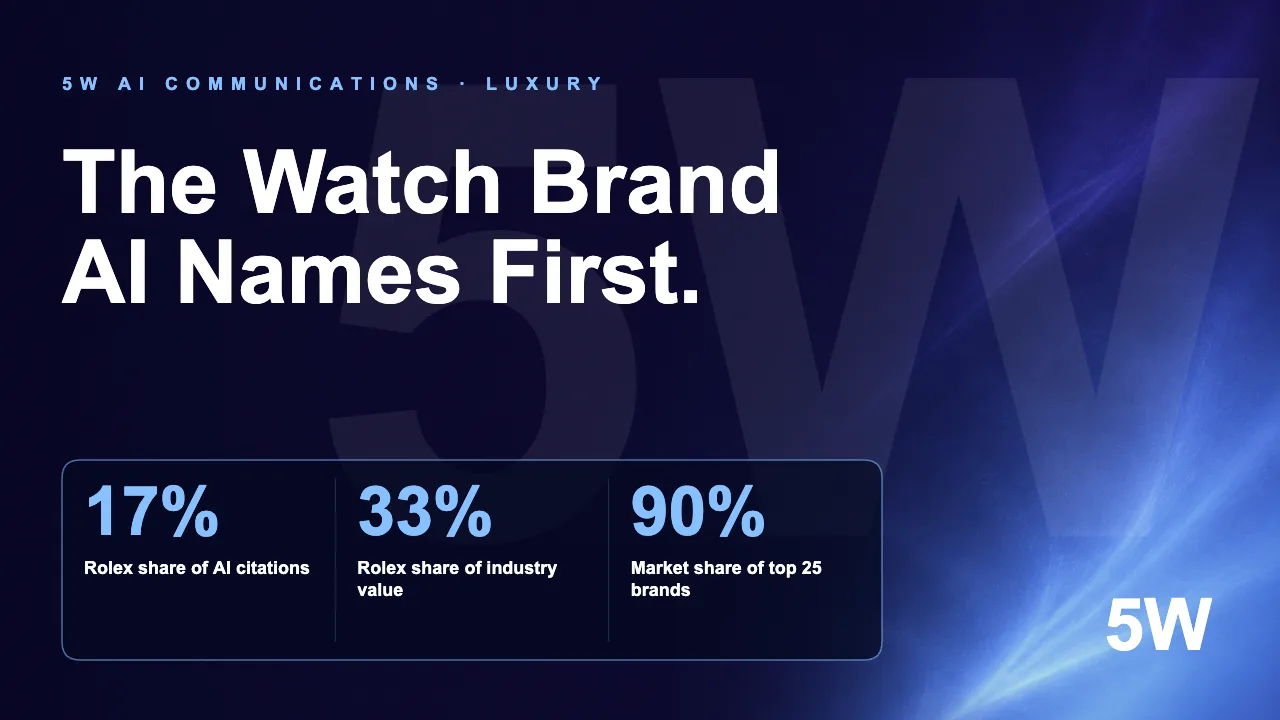
A closed catalog and a half-century of identical framing make Rolex the reflex answer to any watch query. The only brand in the index to achieve a perfect 100 on entity clarity.
▲ Patek Philippe — the Collector’s Citation Default
At 97.6, Patek Philippe dominates investment and provenance queries. Its one-family ownership and archival depth make it the engine’s answer whenever a buyer asks about watches worth keeping.
▲ Aman — the Modern-Formation Proof
One word, one promise, zero framing drift. Founded in 1988, Aman is described by the engines as if it were a century-old institution — the most instructive case in the index for brands that want to build heritage-grade authority on purpose.
Where the work is
The brands AI is still sorting out.
▼ Gucci — the Reinvention Gap
Deep archives, high citation density — but editorial consistency at 76 reflects years of creative-director turnover. The engines hold conflicting framings. Gucci has the heritage; it now needs a stable narrative to close the gap.
▼ Balenciaga — the Recovery Task
An 81.0 composite with a 68 on editorial consistency — the lowest stability score in the index. Archival depth and citation density are both present, but the framing record is fragmented. The engines don’t know what story to tell.
▼ The Row — the Time Problem
At 77.8, The Row shows what two decades of disciplined building achieves — and exactly what is still missing. Entity clarity is strong at 82, editorial consistency at 88, but archival depth at 62 reflects a brand that simply has less accumulated record. This gap closes only one way.
Frequently Asked Questions
The AI Luxury 25 — what you asked.
Which luxury brand ranks #1 in AI visibility?
Hermès ranks #1 with a composite score of 98.6 — the highest in the AI Luxury 25. One name, one lineage, 188 years of consistent coverage. The upper bound of what authority can compound to.
How is the AI Luxury 25 score calculated?
Each house is scored across five equally weighted dimensions: Archival Depth, Citation Density, Entity Clarity, Editorial Consistency, and Retrieval Stability. The composite is the average on a 0–100 scale, measured across ChatGPT, Claude, Perplexity, Gemini, and Google AI Overviews.
Which luxury watch brand ranks highest in AI search?
Rolex ranks #2 overall at 98.2 and holds a perfect 100 on entity clarity — the only perfect dimensional score in the entire index. Patek Philippe ranks #3 at 97.6. Both sit in the Reference tier.
What is the fastest-rising modern luxury brand in AI visibility?
Aman, founded in 1988, scores 88.8 composite — heritage-grade authority built through disciplined naming and framing in a fraction of the time the Reference tier houses required. The clearest proof the top tier can be earned on purpose.
What AI engines were used in the analysis?
ChatGPT, Claude, Perplexity, Gemini, and Google AI Overviews, across the Q2 2026 data window.
Is this index investment, authentication, or purchase advice?
No. The AI Luxury 25 measures AI citation share for communications strategy purposes only. It does not evaluate brands on product quality, investment value, or authenticity. Purchase and investment decisions should be made with independent research.
Related — 5W AI Visibility Index Series
GEO Practice
Find out where your brand stands.
GEO engagements, Index licensing, and custom research — 5W AI Communications.
Request an Audit