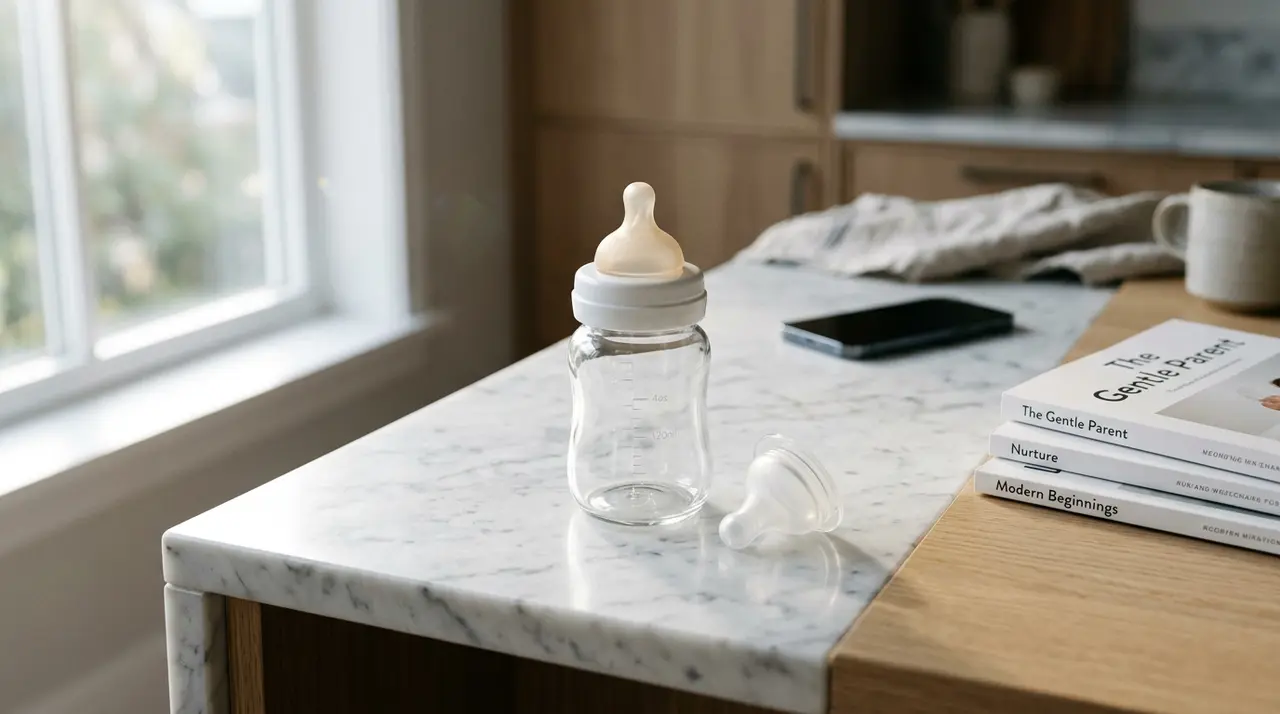
Baby bottle discovery moves through search, AI answers, creators, retail pages, reviews, and brand content before parents select a product.
Baby bottle discovery is a network, not a straight line. A parent may see a Philips Avent routine on TikTok, compare Dr. Brown's vent parts on Amazon, read sterilization guidance from the CDC, ask ChatGPT for paced-feeding options, and scan Playtex Baby VentAire reviews before choosing a product. Each source does a different job.
Brand visibility depends on the consistency of that network. Product names, nipple flow, bottle material, vent design, cleaning steps, compatibility, availability, and claim support must match across earned coverage, product pages, creator content, retail listings, reviews, and AI answers. One unclear or conflicting detail can remove a bottle from consideration before a shopper reaches a product page.
Which question starts the baby bottle search?
One practical question can activate the full discovery network: Which baby bottle may reduce swallowed air, support paced feeding, and remain easy to clean?
That question contains three separate needs: feeding mechanics, caregiver routine, and product maintenance. Dr. Brown's, Philips Avent, and Playtex Baby each describe those needs through different product features. Search engines, AI tools, retailers, creators, and parents may summarize the same features in different ways. Brand teams need to know which version appears at each step.
| Discovery channel | Question the channel must answer |
|---|---|
Earned media | Which products have credible context beyond a brand claim? |
Search and AI answers | Which bottles are retrieved, compared, cited, and recommended for the stated need? |
Brand-owned content | Can a parent verify flow, materials, parts, compatibility, and cleaning steps? |
Creators and social media | Can a parent see assembly, feeding pace, leaks, and cleanup during a real routine? |
Retailers and registries | Is the right size, flow, bundle, price, and delivery option available? |
Reviews and communities | Which concerns repeat after families use the bottle at home? |
How does AI narrow the baby bottle set?
AI selection starts before the answer appears. A brand must pass five stages, and each stage can fail for a different reason.
1. Eligibility: Searchable product pages, retailer data, coverage, and reviews make the bottle available to the system.
2. Retrieval: The system finds sources that match the parent's words, such as anti-colic, paced feeding, glass, slow flow, or easy cleaning.
3. Consideration: The system decides which retrieved brands belong in the comparison set.
4. Representation: The answer summarizes product details, benefits, limits, price, availability, and reputation.
5. Recommendation: The system names a small set of products that appear to fit the request.
A citation does not equal a recommendation. A recommendation does not equal selection. Selection does not equal purchase. Retail availability, price, pediatric guidance, feeding results, and caregiver preference still shape the final decision.
Source: OpenAI shopping results documentation explains that product selection may consider query context, structured metadata, price, reviews, availability, quality, and seller status. The factors and product experience may change.
Why does earned media matter before the bottle comparison?
Earned coverage gives product claims outside context. A parenting editor can compare vent systems. A retail trade publication can explain category demand. A health reporter can separate bottle features from feeding or medical advice. Those articles can shape search results, AI retrieval, retailer confidence, and creator briefs.
5W's State of AI Search 2026 study found that major answer engines used different source mixes across the categories tested. Earned media was the strongest single GEO signal in that cross-category study. The result does not prove that one bottle feature or one placement will earn an AI recommendation. It shows why brands need credible coverage and consistent product facts across several sources.
Source: 5W State of AI Search 2026
What must a baby bottle product page prove?
Product pages serve parents, retailers, journalists, creators, search engines, and AI systems at the same time. A useful page should identify the bottle size, material, nipple flow, number of parts, vent design, compatibility, cleaning method, claim support, age or stage guidance, replacement parts, and current availability.
Dr. Brown's describes its Natural Flow Anti-Colic Options+ Wide-Neck glass bottle as a 5-ounce bottle with an internal vent system and a Level 1 slow-flow nipple. Philips Avent says its Natural Response nipple releases milk when a baby actively drinks and pauses when the baby pauses. Playtex Baby describes VentAire bottles through an angled shape, bottom venting, two sizes, and several nipple-flow options. Each statement belongs to the brand's own product page and should be treated as a brand claim unless independent evidence supports the outcome.
Source: Dr. Brown's product page; Philips Avent Natural Response page; Playtex Baby VentAire page.
Safety and preparation guidance also needs a clear boundary. CDC guidance updated May 14, 2026, tells caregivers to use clean and sanitized feeding items and warns against microwaving formula because hot spots can burn a baby's mouth. Bottle marketing should not replace public-health instructions or advice from a qualified healthcare professional.
Source: CDC infant formula preparation and storage guidance
How do creators and social media reduce uncertainty?
Creators can show the parts of bottle use that static copy cannot. A TikTok video can demonstrate assembly and washing. An Instagram Reel can compare bottle height inside a diaper bag. A YouTube review can show nipple-flow changes, vent placement, leaks, and the time needed to clean each part. Those routines help parents decide what to research next, even when the video does not appear as a citation in a text-first AI answer.
5W's Creators & AI Visibility research tested 15 buyer-intent prompts across five verticals. The study recorded 109 citations and no YouTube video citations in the text-first AI surfaces tested, while YouTube search returned more than 30 creator videos for the same queries. The finding applies to that test design and does not measure every platform, model, or baby product query.
Source: 5W Creators & AI Visibility
Influencer programs also require claim control. FTC guidance says creators must disclose material relationships clearly, including free products, and cannot make claims that the advertiser lacks evidence to support. A bottle brief should distinguish a creator's experience from a medical, feeding, or product-performance conclusion.
Source: FTC Disclosures 101 for Social Media Influencers
Why do retail pages and reviews decide whether interest survives?
Retail pages turn product interest into a practical choice. Amazon, Target, and Babylist listings can confirm price, stock, delivery, bottle size, nipple flow, pack count, color, and registry availability. A mismatch between the brand page and retail listing can create doubt at the point of selection.
Reviews add lived experience, not laboratory proof. Parents may describe leaking, cleaning time, nipple acceptance, breakage, durability, or compatibility with a pump. Brand teams should group repeated questions, correct factual listing errors, and route safety reports through the proper quality process. Marketing should never present a review pattern as clinical evidence.
What do adjacent baby categories reveal about AI visibility?
Bottle marketers can learn from nearby feeding and travel categories without treating them as bottle studies. The Baby Formula AI Visibility Index 2026 found a wide citation-share range among Enfamil, Similac, Bobbie, and ByHeart across the prompts and engines tested. The research also showed that safety and recall history can remain part of AI-generated brand summaries.
The Strollers & Car Seats AI Visibility Index 2026 analyzed 2,400 prompt-engine runs and reported citation shares of 19.8% for UPPAbaby, 15.4% for Chicco, 12.6% for Graco, and 3.6% for Evenflo. Citation share does not measure safety, product quality, sales, or consumer preference. The gap shows how differently established brands may appear when AI systems build a comparison set.
Baby bottles need their own prompt set and benchmark. Brand teams should test questions about anti-colic features, paced feeding, glass versus plastic, bottle-to-pump compatibility, cleaning, nipple flow, registry value, and use with formula or expressed milk.
How should baby bottle marketing measure the discovery network?
One visibility score cannot diagnose the network. Measurement should show where a bottle enters the set, drops out, or picks up an error.
| Channel | Diagnostic question | Useful signal |
|---|---|---|
Earned media | Which parent questions and product facts appear in coverage? | Qualified coverage, message accuracy, referral traffic |
Search and AI | Is the bottle mentioned, cited, compared, and described correctly? | Prompt-level citation share, recommendation rate, error rate |
Brand-owned | Can users and systems find supported answers? | Organic entrances, engaged sessions, product-detail actions |
Creators and social | Which routines trigger research or retailer visits? | Saves, qualified comments, search lift, referral traffic |
Retail | Do product facts and availability support the decision? | Listing accuracy, in-stock rate, add-to-cart, conversion |
Reviews | Which concerns repeat after purchase? | Topic trends, response time, resolved listing issues |
Human and Machine Discovery Need the Same Product Record
Parents do not choose a baby bottle from one message. They assemble a decision from product facts, demonstrations, expert context, retailer details, reviews, availability, and feeding experience. AI systems draw from many of the same sources, but they may retrieve and summarize them in different combinations.
Strong baby bottle marketing gives every channel a clear job and one verified product record. Earned media supplies context. Brand content supplies evidence. Creators show routines. Social platforms create discovery. Retailers support selection. Reviews expose unresolved questions. Measurement reveals where the network breaks. Families may encounter dozens of messages before using a bottle. A coordinated product record helps each channel answer the right question without turning a feature into an unsupported promise.
How can 5W help baby bottle brands?
5W can help baby bottle companies turn one verified product record into coordinated PR, digital marketing, social media, influencer, retail, reputation, and AI visibility programs. The work can focus on the questions families ask about feeding mechanics, materials, cleaning, compatibility, portability, price, and stage.
5W can audit how model names, product facts, claims, limitations, and safety information appear across brand pages, retailer listings, earned coverage, creator briefs, social content, reviews, and AI answers. The findings can guide evidence-led media stories, creator demonstrations, retailer content, and response plans that keep the product record consistent.
Measurement can separate visibility from business results. Prompt-level citations, recommendations, and factual errors can be reviewed alongside qualified traffic, product-detail actions, retail availability, add-to-cart activity, sales, returns, and repeat purchase. The 5W Parenting & Baby practice brings these disciplines together for baby and parenting companies.