Experiential marketing is a promotional strategy that lets people take part in a brand instead of only seeing an ad for it. Common formats include pop-up installations, product sampling, branded stays, live stunts, roadshows and hybrid events. Event Marketer's EventTrack 2026 study found that 61% of consumers are more inclined to purchase after attending an event.
Last updated: November 5, 2026
Key takeaways
- Experiential marketing is an approach, not a venue. It can live inside an event, a store, a hotel stay or a livestream.
- Seven formats cover most campaigns: pop-up installations, branded stays, live stunts, sampling, roadshows, interactive retail and hybrid digital layers.
- Three documented examples show the range: Refinery29's 29Rooms in 2015, Airbnb's Malibu DreamHouse stays in 2023 and Red Bull Stratos in 2012.
- Survey data from EventTrack points to strong purchase intent, but it measures what attendees say, not what they buy.
- A press hook, a design built for photos and a measurement plan set before launch separate coverage-generating campaigns from forgettable ones.
How is experiential marketing different from event marketing?
Experiential marketing is a strategy in which a brand builds something people can touch, try, join or co-create, while event marketing is a channel built around a planned gathering. The two overlap often, but an experience can also happen with no event at all, in a store, an app, a hotel room or a street corner.
That distinction matters for planning. An event plan starts with a date, a venue and a guest list. An experiential plan starts with a single behavior the brand wants people to have, such as trying a product, sharing a photo or telling a friend. Our event marketing strategy guide covers the event side in detail, including ROI data and examples.
| Approach | What the audience does | Typical goal | Typical example |
|---|---|---|---|
| Advertising | Sees or hears a message | Reach and recall | A video ad or billboard |
| Event marketing | Attends a planned gathering | Leads, relationships, announcements | A product launch or conference |
| Experiential marketing | Touches, tries or co-creates | Trial, memory and social sharing | A walk-through installation |
What are the main formats of experiential marketing?
Experiential marketing takes seven common formats, and each one suits a different goal. The table below matches each format to the outcome it serves best, and the sections after it explain how each works.
| Format | Best for | Documented example |
|---|---|---|
| Pop-up installations | Social sharing and brand story | Refinery29's 29Rooms, 2015 |
| Branded stays and takeovers | Press coverage tied to a release | Airbnb's Malibu DreamHouse, 2023 |
| Live stunts | Mass audience and earned media | Red Bull Stratos, 2012 |
| Product sampling | Trial and first purchase | General approach, no single case |
| Mobile tours and roadshows | Reaching several markets | General approach, no single case |
| Interactive retail | In-store conversion | General approach, no single case |
| Hybrid digital layers | Reaching people who cannot attend | 29Rooms VR room, Red Bull livestream |
1. Pop-up installations and immersive exhibits
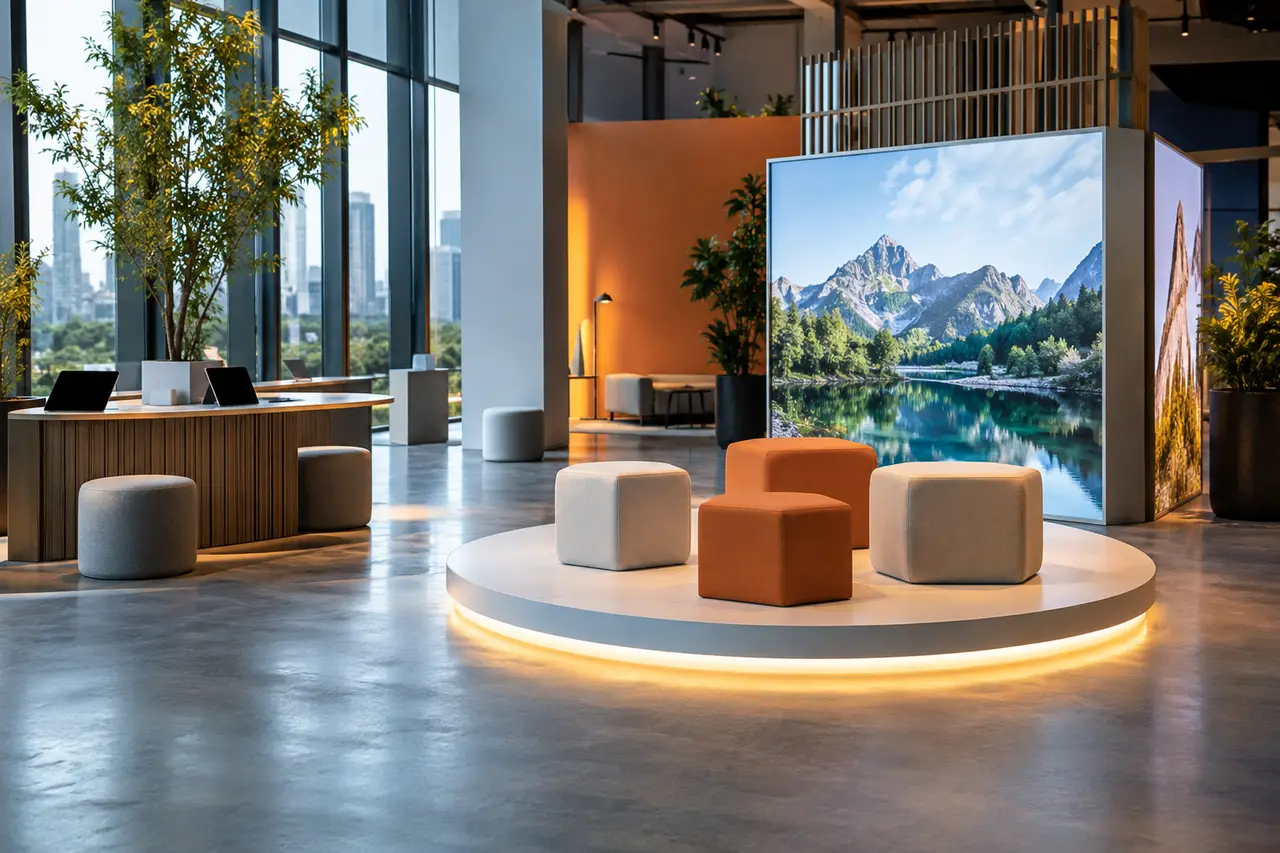
A pop-up installation is a temporary, walk-through space where each room or zone lets visitors do something rather than watch. In September 2015, Refinery29 turned a Brooklyn warehouse into the Refinery29 29Rooms installation, a two-day funhouse of 29 installations made with artists and brand partners including Nordstrom Rack, Fossil and PUMA, according to Artnet News.
The event was held to mark the publisher's 10th anniversary and gave its online audience a physical version of the site. Marketing Dive reported that the publisher expected 20,000 visitors in the event's third year. The lesson for brands is that the experience carried the publisher's identity, and partners joined it rather than taking it over.
2. Branded stays and takeovers
A branded stay lets a small number of people live inside a brand's world for a night or a weekend, which gives journalists a clear, photographable story. In July 2023, Airbnb offered two free one-night stays for up to two guests each in Ken's room of a life-size Barbie Malibu DreamHouse, on July 21 and 22, timed to the release of the Barbie film, according to Airbnb's newsroom.
Booking opened on July 17, guests paid for their own travel, and Airbnb stated that the stays were not a contest. The mechanism is scarcity plus a date: two nights and a film release gave outlets a reason to cover it in a specific week.
3. Live stunts and broadcast spectacles
A live stunt is a single, high-stakes moment staged for an audience that mostly watches online. On October 14, 2012, Felix Baumgartner jumped from a capsule about 24 miles above New Mexico in the Red Bull Stratos mission, and the YouTube live stream drew more than 8 million simultaneous viewers, a live-video record at the time, according to an Associated Press report carried by NBC News.
The same report said more than 130 digital outlets carried the feed. The jump happened in one place, but the audience was online, so camera positions and distribution were part of the experience design from the start.
4. Product sampling and trial
Product sampling puts the product in people's hands, and it works best when the product can be judged in under a minute through taste, scent, texture or fit. A sampling program needs a high-traffic location, trained staff and a way to capture contact details or redemptions, so the brand can see what the handout produced.
5. Mobile tours and roadshows
A roadshow takes the same experience to several cities in a fixed route, usually in a branded vehicle or a modular booth. The format suits brands that want regional press in each market and need to test which locations respond best before committing to a permanent presence.
6. Interactive retail and flagship experiences
Interactive retail adds demonstrations, try-ons or workshops inside a store so shoppers can test a product before buying. The format works when a purchase decision depends on use, such as skincare, audio gear or kitchen appliances, and it keeps the experience next to the checkout.
7. Hybrid and digital layers
A hybrid layer adds livestreams, augmented reality or virtual reality to a physical experience so people who cannot attend still take part. Artnet News reported that 29Rooms included a virtual reality room designed to transport guests to Tulum, Berlin and New Orleans, and Red Bull's Stratos stream reached its audience through more than 130 outlets.
Does experiential marketing work? What EventTrack data shows
Survey data suggests that experiential marketing raises purchase intent, but the figures measure what attendees say they will do, not what they buy. The most-cited source is EventTrack, an annual study produced by Event Marketer, a trade publication for the event industry, with the agency Sparks.
- EventTrack 2026 reports that 61% of consumers are more inclined to purchase after an event and that 85% of B2B attendees feel more educated after one.
- The same study reports that, on average, 57% of B2B and B2C attendees will increase their event attendance.
- EventTrack 2018, produced by Mosaic and Event Marketer, reported that 85% of consumers were likely to purchase after participating in events and experiences and that 91% had more positive feelings about brands.
The 2018 and 2026 figures come from different survey years, samples and wording, so the drop from 85% to 61% should not be read as a trend line. Event Marketer also covers the event industry commercially, which is a reason to treat the numbers as directional. Brands that want proof for their own budget should run a test and measure it, as described below.
How do you plan an experiential marketing campaign?
An experiential campaign works best when it is planned backward from one outcome and one press hook. These six steps apply to any of the seven formats.
- Pick one outcome, such as product trial, captured leads or press coverage, because a campaign that chases all three usually delivers none well.
- Choose the format that matches that outcome using the table above, for example sampling for trial or a live stunt for reach.
- Write the press hook before the build begins. Ask what a photographer would shoot and what date gives an editor a reason to run the story now, as the Airbnb stays did with a film release.
- Design for sharing. Piera Gelardi, Refinery29's co-founder and creative director, told Artnet News that lighting in 29Rooms was planned so visitors could take photos worth posting, which is a design decision, not a social media task.
- Brief talent and creators early and require clear disclosure of any paid relationship, in line with the Federal Trade Commission's Endorsement Guides. Our guide to partnering with influencers for lifestyle events covers selection and disclosure.
- Capture photos and video during the experience and send a recap to press and attendees while interest is still high.
Storytelling decisions made at the start shape every later step, which our piece on event marketing storytelling explains with examples.
How should brands measure experiential marketing?
Brands should measure experiential marketing with the same outcome chosen in planning, using first-party numbers rather than attendee surveys alone. Four measures cover most campaigns:
- Earned media placements and the audience size of each outlet that covered the experience.
- Social posts and creator content produced at the experience, counted by volume and reach.
- Leads captured, sampling redemptions or coupon codes tied to the activation.
- Sales in activation markets compared with similar markets that had no activation.
The last measure is the strongest, because it compares like with like and does not depend on what attendees say. For background on how coverage is counted and cited, see 5W's original PR research. Emerging formats, from AI personalization to wearable tech, are covered in future trends in event marketing and PR.
Frequently asked questions
How does experiential marketing differ from event marketing?
Experiential marketing is a strategy built around participation, while event marketing is a channel built around a gathering. An experiential campaign can run inside an event, but it can also run in a store, a rental home or a livestream.
How much does experiential marketing cost?
Experiential marketing costs depend on format, venue, build, staffing, talent and permits, and no single price applies. A sampling table in a retail location and a multi-city roadshow sit at opposite ends of the range. EventTrack 2026 reports that brands across sectors expect to spend 8% to 11% more on events in 2026, and brands should request itemized quotes for each line.
What are examples of experiential marketing?
Well-documented examples include Refinery29's 29Rooms installation in 2015, Airbnb's Barbie Malibu DreamHouse stays in 2023 and the Red Bull Stratos jump in 2012. Each one gave people something to watch, join or share, and each produced press coverage because of a clear date or moment.
Can small brands run experiential marketing?
Small brands can run experiential marketing at a smaller scale by sampling in a partner's store, sharing a booth or hosting a limited-capacity tasting. The mechanics stay the same: one outcome, one press hook and a plan to capture photos and contact details.
How do you get press coverage for an experiential campaign?
Press coverage comes from a story hook, a specific date, visual access and a short window for journalists to respond. Agencies that plan media outreach alongside the build, such as an event PR agency, brief editors before the experience opens and supply photos and recaps afterward. Brands that also want search and paid support can look at event digital marketing.
Is experiential marketing the same as guerrilla marketing?
Experiential marketing and guerrilla marketing overlap but are not the same. Guerrilla marketing relies on surprise, often unannounced and low-cost public stunts, while experiential campaigns are usually planned, permitted and staffed, and can be large or small.