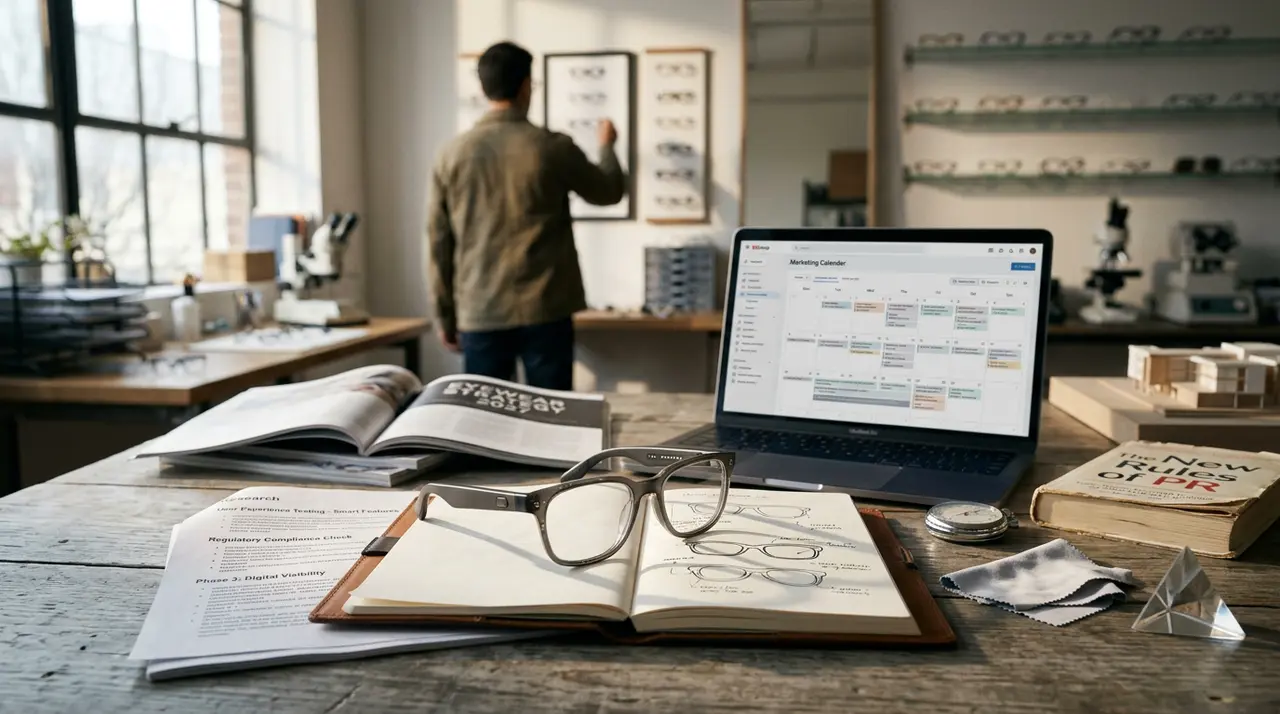
Eyewear marketing in 2027 must solve a new problem: EssilorLuxottica sold over 7 million Meta AI glasses in 2025. This figure is more than triple the roughly 2 million sold in 2023 and 2024 combined, according to the company's February 2026 fourth-quarter results. An eyewear marketing and public relations plan focused only on frames and lenses defends only half the category.
Why is smart glasses growth changing eyewear marketing?
Smart glasses growth is changing eyewear marketing because a hardware and software partnership now sets the category's pace, not an optical brand alone. EssilorLuxottica's fourth-quarter 2026 results confirmed the more-than-tripled Meta glasses sales figure. Reuters reported the company's third-quarter 2026 sales grew 11.7 percent to 6.9 billion euros, with the AI-powered glasses line contributing more than four percentage points of that growth.
Other companies are following the same path. Warby Parker announced in September 2025 it would launch AI-powered glasses developed with Google. EssilorLuxottica shares fell 4.45 percent the same day on the news, according to Dow Jones Newswires coverage. Barclays analysts have forecast 60 million smart glasses units sold globally by 2035. 5W's wearable tech PR playbook covers the same Meta-versus-Google platform race from the device and technology perspective.
Why it works: A Meta-EssilorLuxottica joint venture and a Google-Warby Parker joint venture compete on software and AI capability, not just frame design. An eyewear marketing plan that only discusses style and fit misses the reason customers choose between brands.
What does the smart glasses shift mean for eyewear messaging?
The smart glasses shift means capability, not just frame style, must lead the message for a growing share of buyers. Traditional eyewear marketing sells fit, prescription accuracy, and fashion. Smart glasses buyers also evaluate camera quality, AI assistant features, and battery life.
These are categories an optical brand has never had to message before. The messaging must adapt to different audience segments.
| Audience segment | Lead message | Primary channel |
|---|---|---|
| Prescription-only buyer, style-driven | Frame fit, fashion partnership, optical accuracy | Retail, optometrist referral, influencer seeding |
| Tech-forward buyer, no current smart glasses | AI assistant capability compared directly to a named competitor model | Paid search, comparison content, earned tech press |
| Existing Ray-Ban Meta or Warby Parker owner | Upgrade path framed around new capability, not a new frame | Owned email, retargeting |
| D2C-only buyer (Zenni, BLACKSHEEP-style) | Price transparency and no-insurance-needed value | Organic social, affiliate, earned media |
What does eyewear public relations need to cover besides the product?
Eyewear public relations needs to cover prescription-release compliance as directly as product news. The FTC's updated Ophthalmic Practice Rules, known as the Eyeglass Rule, took effect September 24, 2024. The agency has since enforced it publicly.
The FTC confirmed in a June 2025 blog post that prescribers must give patients a copy of their eyeglass prescription after any refractive eye exam. They must do this at no charge, whether the patient asks or not. Prescribers cannot require an eyeglass purchase in exchange for the prescription. The same month, the agency sent 37 warning letters to contact lens prescribers over related prescription-release complaints under the sister Contact Lens Rule. Violations of either rule can carry civil penalties of up to $53,088 per violation, according to the FTC's official Fairness to Contact Lens Consumers Act summary.
Why it works: The FTC names the mechanism directly. Any eyewear provider bundling a prescription behind a purchase, a fee, or a waiver violates a rule the agency actively enforces through 2025 and 2026. This makes prescription-release transparency a live PR exposure, not a legacy compliance footnote.
| Rule | What it requires | Enforcement signal |
|---|---|---|
| Eyeglass Rule (updated June 2024, effective Sept. 24, 2024) | Automatic, free prescription release after any refractive exam; signed patient confirmation of receipt | FTC public compliance guidance reissued June 2025 |
| Contact Lens Rule (sister rule) | Automatic prescription release at end of fitting; no added fees or waivers | 37 warning letters sent to prescribers, May-June 2025; penalties up to $53,088 per violation |
How should PR pitch the smart glasses shift as a story?
PR should pitch the smart glasses shift as a documented market trend, not a product launch. Editors respond to a verifiable multi-source trend line, not a press release announcing a new frame color. EssilorLuxottica's own quarterly filings, Reuters and Bloomberg's coverage of the Meta production-capacity talks, and the Warby Parker and Google announcement together form a trend. A reporter can build a category story around this trend.
A pitch built on "our brand has new frames" competes with every other eyewear press release. A pitch built on "smart glasses just became a two-horse software race, and here is what it means for the rest of the eyewear market" gives a reporter a category story. The brand is positioned as the expert source inside it. IDC data cited in coverage of Meta's 2026 results put Meta's smart glasses market share at just over 69 percent as of mid-2026. This specific, citable figure strengthens a pitch more than a general claim that the category is growing.
How is AI search changing how customers find eyewear?
AI search is changing eyewear discovery because Google's AI Overviews now appear on roughly 83 percent of "best [product]" research queries. This is up from about 5 percent a year earlier, according to BrightEdge and SEMrush data cited in a March 2026 industry analysis of shopping search trends.
Pure transactional queries, the "buy [product] now" searches, still trigger an AI Overview only 13 to 14 percent of the time. This is largely unchanged year over year, the same analysis found. This split matters for eyewear specifically. A shopper typing "best AI glasses for photos" or "best eyewear for round faces" now reads a generated summary before reaching any brand's own page. A shopper who already knows the brand name and is ready to buy still lands on a normal search results page.
Why it works: An AI Overview extracts a self-contained block of text, not a whole page. An eyewear brand earns the citation on research-stage queries by answering one comparison question fully. This requires a named competitor and a named spec, near the top of the page, rather than building up to the comparison three paragraphs in.
What does a 2027 eyewear marketing and PR playbook actually include?
A 2027 eyewear marketing and PR playbook runs in four phases: audit, content, compliance and distribution. Each phase produces a specific output before the next phase starts.
| Phase | Actions | Output |
|---|---|---|
| Audit | Check current rankings and AI Overview presence for eyewear marketing, smart glasses, and prescription eyewear terms against the top research-stage questions in the category | A gap list ranked by which comparison questions the brand is not cited on |
| Content | Publish comparison pages covering traditional eyewear, D2C frames, and smart glasses side by side, with a named source and date for every figure, mirrored FAQ blocks, and segmented messaging by buyer type | Pages that answer a shopper's comparison question standalone |
| Compliance | Audit prescription-release language and any purchase-linked fees against the FTC's 2024 Eyeglass Rule and 2025 enforcement letters | Customer-facing language with no exposure to the same warning-letter category |
| Distribution | Pitch the smart glasses market-share shift to tech and business press as a category story, using named figures from EssilorLuxottica, IDC, and Warby Parker's own announcements | Third-party citations an AI engine can pull instead of only the brand's own claims |
The single idea under all four phases is the one behind the EssilorLuxottica and FTC figures: eyewear marketing that only defends frames and lenses defends half a category. This category has split into hardware, software, and traditional optical retail. Eyewear marketing that claims the smart glasses conversation, gets ahead of prescription-release compliance, and shows up in AI-generated comparison answers defends the whole customer relationship. 5W's LASIK marketing and public relations playbook covers the same category-expansion principle for vision correction.
Frequently Asked Questions
Why is smart glasses growth changing eyewear marketing?
Smart glasses growth is changing eyewear marketing because EssilorLuxottica sold over 7 million Meta AI glasses in 2025, more than triple 2023 and 2024 combined. Warby Parker's AI glasses with Google are launching in 2026. Therefore, an eyewear plan built only around traditional frames misses the fastest-growing part of the category.
What must eyewear PR cover besides the product?
Eyewear PR must cover prescription-release compliance under the FTC's updated Eyeglass Rule, effective September 24, 2024. The agency reinforced this with 37 warning letters to prescribers in 2025 and penalties of up to $53,088 per violation.
How is AI search changing eyewear discovery?
AI search is changing eyewear discovery because Google's AI Overviews now appear on about 83 percent of "best [product]" research queries. This is up from roughly 5 percent a year earlier. Transactional "buy now" queries still trigger an overview only 13 to 14 percent of the time.
What does a 2027 eyewear marketing and PR playbook include?
A 2027 eyewear marketing and PR playbook includes four phases: an audit of current rankings and AI citation gaps, comparison content covering traditional, D2C and smart glasses, a prescription-compliance review, and press outreach framing the smart glasses shift as a market story.
Conclusion
Eyewear marketing that holds up in 2027 treats smart glasses as part of the core category. It treats prescription-release compliance as the trust layer underneath it. Customers now compare traditional frames, D2C brands, and AI-powered glasses, often inside an AI-generated answer, before they ever reach a brand's own site.