

What happens when a potential investor is researching regulatory actions against a new fintech app?
AI-generated retrievals and summaries differ by model, but each weighs regulatory records, SEC filings, and (third-party) news stories, and rarely cites information from the company’s owned channels (like websites and social media accounts).
5W examined 10 prompts and 10 answers from ChatGPT about popular platforms like Cash App, Chime, Robinhood, Venmo, and Dave. None of the 43 sources in its regulatory answers came from the brands. For the prompt "Is my money safe?" the same brands accounted for 17 of the 27 sources.
Cautious consumers, reporters, and investors often research a fintech app's regulatory history before using it or investing in it. However, AI responses create a clear divide: brands supply information when the prompt asks how a product works, while regulators supply information on credibility, reputation, and regulatory history.
The following sections detail our methodology, the pages cited in ChatGPT, common errors found in its answers, and how brands can publish content to help their perspective become a part of the conversation.
The answers lean on the following public bodies:
| Body | Regulatory role |
|---|---|
| Consumer Financial Protection Bureau (CFPB) | The federal regulator for consumer financial products |
| Federal Trade Commission (FTC) | The federal agency that brings cases over deceptive marketing and hidden fees. |
| Securities and Exchange Commission (SEC) | The federal regulator for brokerages and the agency that publishes public-company filings on EDGAR. |
| Financial Industry Regulatory Authority (FINRA) | The brokerage industry's self-regulator, which runs the BrokerCheck lookup. |
| Federal Deposit Insurance Corporation (FDIC) | The federal agency that insures bank deposits up to set limits. |
| Securities Investor Protection Corporation (SIPC) | A nonprofit created by federal law that protects brokerage customers if a member firm fails. |
| State regulators and attorneys general | State banking departments and attorneys general that bring their own and multistate cases. |
How did 5WPR research fintech regulatory coverage in ChatGPT?
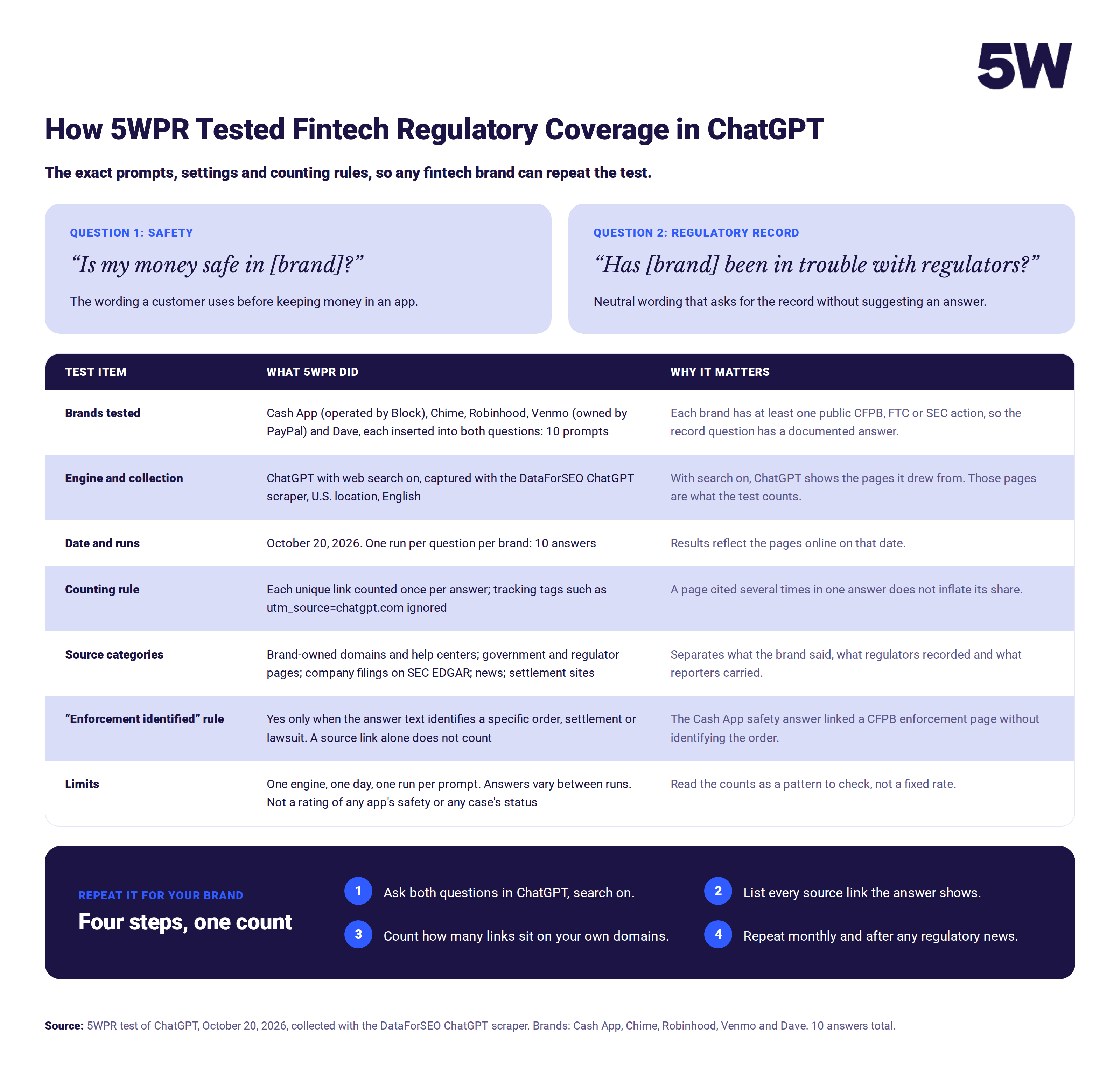
5WPR researched fintech regulatory coverage by prompting ChatGPT with two questions about five popular fintech apps. The first question was "Is my money safe in [brand]?" The second was "Has [brand] been in trouble with regulators?"
We asked about the following brands: Cash App (operated by Block) Chime; Robinhood; Venmo (a Paypal company), and Dave. We collected the answers via the DataForSEO ChatGPT scraper, with web search enabled and set to the US. We counted a link that repeated in a single answer once.
| Brand | "Is my money safe?" sources (brand-owned) | "Trouble with regulators?" sources (brand-owned) | Enforcement identified in safety answer |
|---|---|---|---|
| Cash App | 4 (2) | 8 (0) | No |
| Chime | 7 (5) | 7 (0) | No |
| Robinhood | 3 (2) | 12 (0) | No |
| Venmo | 7 (5) | 9 (0) | No |
| Dave | 6 (3) | 7 (0) | No |
| Total | 27 (17, or 63%) | 43 (0, or 0%) | 0 of 5 |
Table 1. Unique source links per ChatGPT answer, U.S. location, web search on, October 20, 2026. Source: 5WPR research using the DataForSEO ChatGPT scraper.
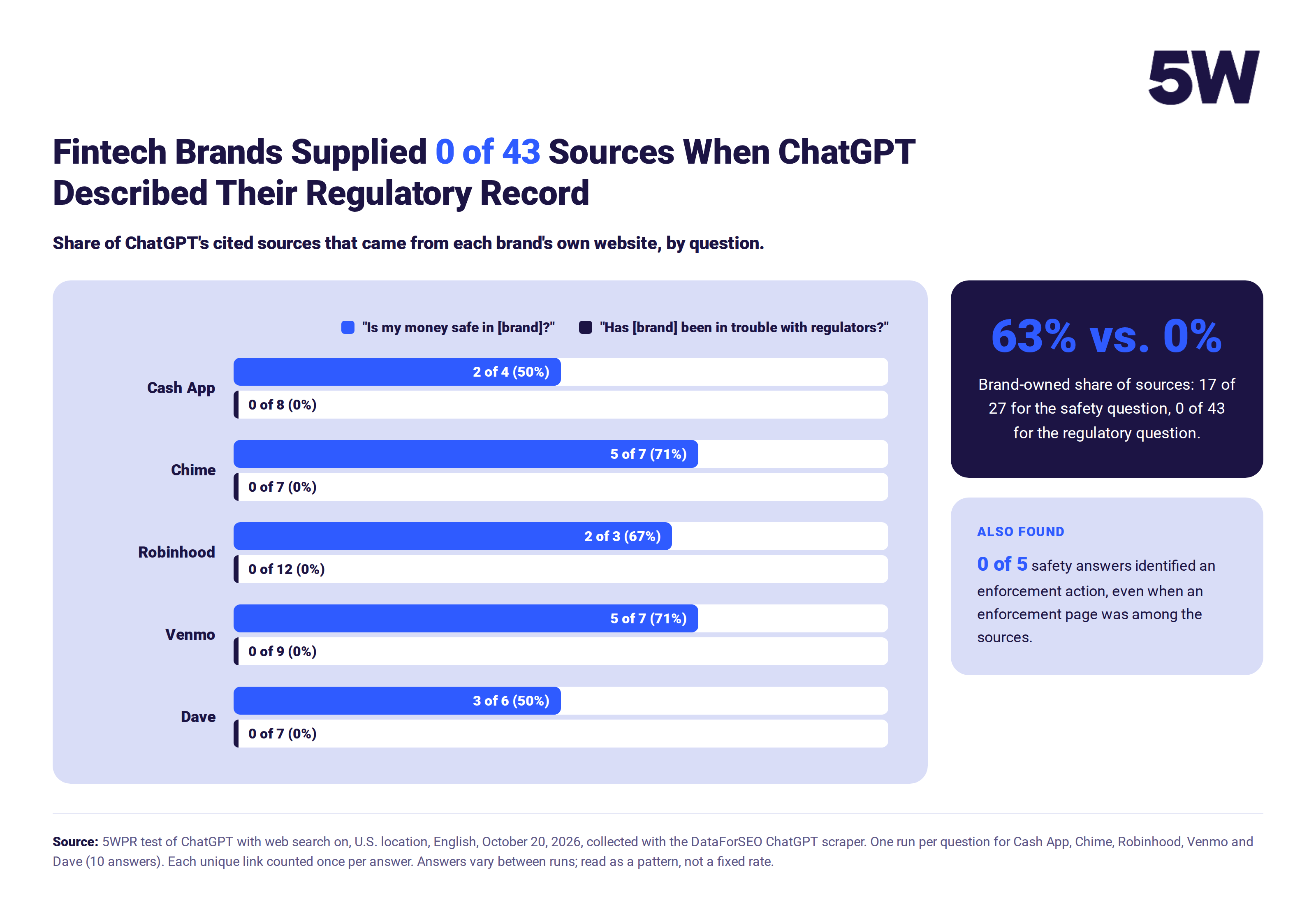
Brand help centers and security pages supplied 17 of the 27 links in the safety prompts. The CFPB, the FDIC, and SIPC supplied the other 10.
None of the safety prompts referenced an enforcement action. The Cash App answer cited the CFPB's Block Enforcement page twice but didn't identify the January 2025 order. According to the CFPB's Block enforcement record, the order required Block to pay up to $120 million in redress and a $55 million penalty. Another answer about Dave neglected to mention a pending federal case.
Please note that ten answers from one model is a small sample, and ChatGPT answers change from run to run.
Who supplied the sources when ChatGPT cited enforcement history?
Government pages supplied 29 of the 43 sources, or 67%, when ChatGPT described the five brands' regulatory history.
| Source type | Links | Share | Examples from the research |
|---|---|---|---|
| Government and regulator pages | 29 | 67% | CFPB enforcement pages, FTC case pages, SEC press releases, state agency and attorney general releases |
| Company filings on SEC EDGAR | 7 | 16% | Chime's IPO registration statement, Dave's 10-K and 10-Q, Robinhood's 10-Q reports |
| News outlets | 5 | 12% | Reuters (2), Associated Press (2), The Wall Street Journal (1) |
| Settlement administrator site | 2 | 5% | The Cash App CFPB settlement site |
| Brand-owned websites | 0 | 0% | None |
Table 2. Source types across the five "Has [brand] been in trouble with regulators?" answers, October 20, 2026. Source: 5WPR research using the DataForSEO ChatGPT scraper.
The 29 government links came from the CFPB (10), the FTC (7), state agencies and attorneys general (5), the SEC's enforcement pages (3) and four others, including the Department of Justice and FINRA's BrokerCheck.
The companies' language came from SEC filings. Dave's annual and quarterly reports gave the single account of Dave's position in their answer, where ChatGPT noted that Dave disputes the allegations. The Cash App answer summarized Block's statement that it’s invested in compliance, citing Reuters, not Block.
The pattern aligns with 5WPR's Fintech AI Visibility Index 2026, which found Forbes cited in 36.1% of evidence-backed fintech answers, more often than any fintech-branded domains. A citation in an AI answer and the page it cites as a source are separate results, as the 5W fintech appearance versus citation analysis explains.
Why do old and settled cases remain in AI answers?
Regulator pages remain online with their original dates and filings. Consequently, old and settled cases linger in ChatGPT's answers as they continue to match certain questions years later.
One response about Venmo opened with a 2018 FTC settlement with PayPal over Venmo that covered frozen funds, privacy settings, and security claims, occurring eight years ago. The Robinhood answer listed a $65 million SEC penalty from December 2020 beside the $45 million SEC settlement announced in January 2025.
AI answers underrepresent the company's side of these cases. After its January 2025 settlement, Lucas Moskowitz, general counsel of Robinhood Markets, told PYMNTS that most of the matters were historical and addressed. His argument didn’t appear in any of ChatGPT’s answers. The only favorable update in Robinhood's answer, that the SEC closed its crypto investigation, appeared in an Associated Press (AP) story.
Industry-wide rules attach to individual brands. The Venmo answer folded in CFPB rulemaking targeting large payment apps, then went on to explain that the rulemaking wasn’t a finding against Venmo.
How did a Boston remittance app end up in Chime's record?
Entity clarity helps explain why one of ChatGPT's Chime answers listed a CFPB penalty against a different company that shares Chime's name.
On October 17, 2023, the CFPB issued an order against Chime, Inc. doing business as Sendwave, a remittance provider headquartered in Boston. The order required about $1.5 million in consumer redress and a $1.5 million penalty. Finextra reported that the Sendwave operator is unrelated to Chime Financial, the company behind the Chime banking app.
ChatGPT cited the Sendwave order in Chime Financial's history alongside Chime Financial's May 2024 CFPB order, which carried a $3.25 million penalty and at least $1.3 million in redress. The answer disclosed that the case "concerned Sendwave, rather than ordinary Chime checking accounts," but still presented Sendwave as part of Chime.
The regulator's record uses the name Chime, and none of the answer's seven sources included any Chime-owned content that separated the two companies. A brand with a name similar to a sanctioned company can receive an inaccurate mention in AI answers unless specific brand-addressed content explains that the companies are unrelated.
What information can fintech brands publish so their account gets cited in AI answers?
Fintech companies can increase citations in AI-generated summaries and answers by publishing updated, accurate content that answers prompts (questions) about their regulatory records.
| Page to publish | Gap it addresses in the research | Why it can work |
|---|---|---|
| A regulatory history page on the brand's site, titled with the brand’s legal entity and "regulatory history" | Brand sites supplied 0 of 43 sources | ChatGPT cited pages whose titles matched the question, such as the CFPB page titled "Block, Inc." A brand page lists each order, regulator, date, amount, status, and fix, with links to the regulator's page, giving ChatGPT a brand-owned page that matches the record and adds what changed. |
| A one-sentence disambiguation on that page | The Sendwave order listed under Chime | A sentence identifying the unrelated company and its order gives a search-connected AI tool a brand-owned page that separates the two records. |
| Resolution and remediation news placed with wire services and trade press | Robinhood's closed SEC crypto probe reached the answer only through the Associated Press | News made up 5 of 43 sources and carried the only company statements found outside SEC filings. |
| Plain-language legal proceedings sections in SEC filings | Filings supplied 7 of 43 sources, and Dave's only stated position | Short, dated sentences on case status and the company's position can be quoted. |
Table 3. Publishing steps matched to gaps found in the October 20, 2026 research. Source: 5WPR analysis.
Counsel should review statements about an order before publication, because that page becomes a public summary of a legal matter.
Earned coverage of a resolution is the second half of the communications work, because releases and wire stories amplified company statements that the brands' sites didn’t. 5W’s fintech media relations guide covers pitching financial services news to investors, regulators, and consumers within compliance limits.
The gaps outlined above leave a fintech brand's regulatory story to regulator pages, filings, and old copy unless the brand publishes an updated record. Brands that want that record to reach ChatGPT should start with a regulatory history page and a fintech PR program. 5W runs AI Search (GEO) and strategic communications programs designed to solve these modern discovery challenges. Start a conversation with us today to learn more.