

Right now, there's a lot of noise about AEO (answer engine optimization), but no proven formula: no one can say with certainty that an expert quote, an extra 10,000 reviews, or one more retailer listing will produce an AI recommendation. What we can say is that when veterinarians, retailers, reviews, and independent media repeatedly connect a product to consumer needs, a brand has a stronger body of evidence supporting its positioning, and that consistency is what improves visibility in AI search. The same principles apply across categories, as this breakdown of how brands become answers in ChatGPT explains.
Consider a dog food brand competing for the question, “What is the best dog food for sensitive stomachs?” Its website makes the connection explicit. But what happens when Chewy describes the product differently than the company does, its customer reviews mostly discuss taste, and expert sources like veterinarians never tie the formula to digestive sensitivity? The brand may have plenty of information available online and still have a modern communications problem: the brand's evidence available to AI models doesn't consistently support why a consumer should consider the product.
The stakes are large. The U.S. pet industry is projected to reach $165 billion in 2026, including $69.7 billion in pet food and treats. We recently examined how AI-generated answers shape pet-brand price reputation, explaining why price is one judgment and suitability is another. The pragmatic question for communications teams sits alongside both: do independent sources support the same reason your brand says consumers should choose it?
Do Veterinarians Support the Same Use Case Your Pet Brand Claims?
Not automatically; having a veterinarian associated with a brand is not the same as having expert evidence for a specific product claim.
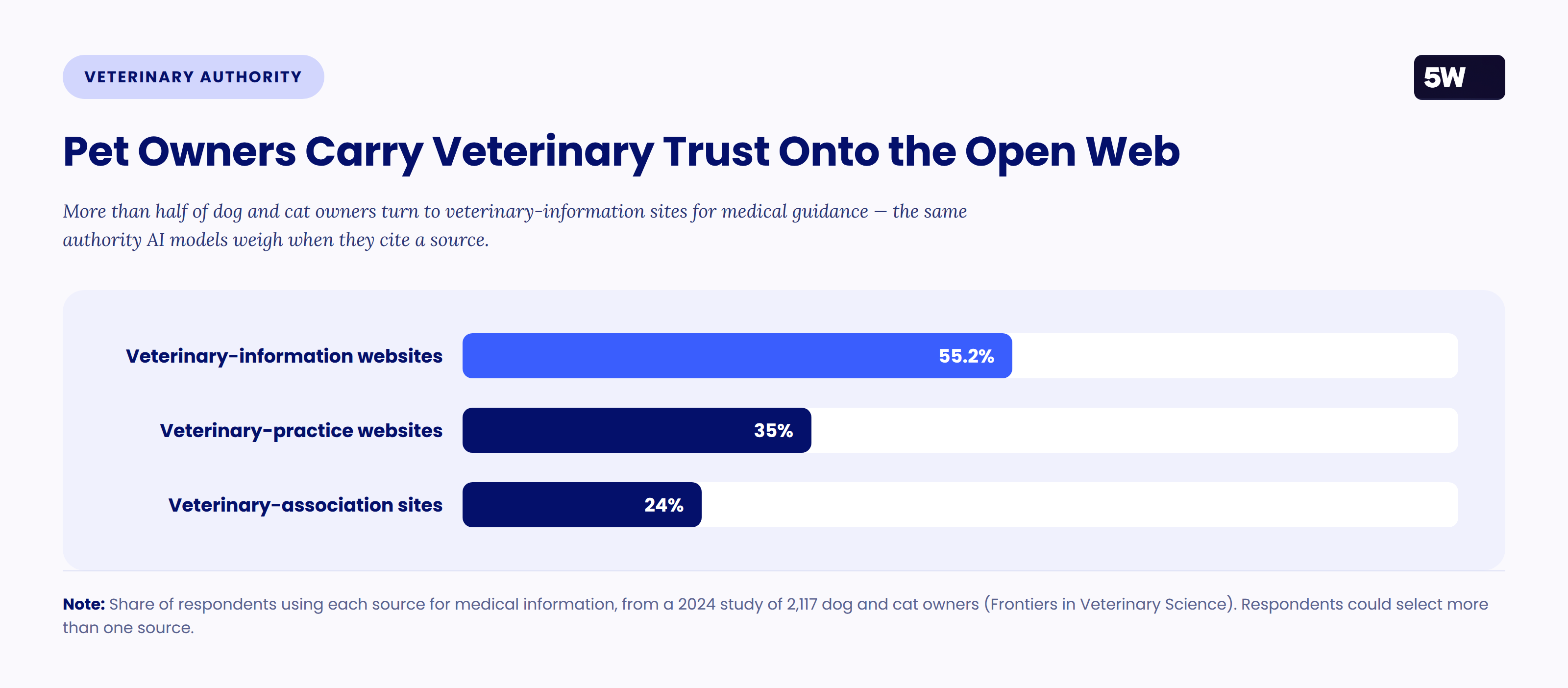
A study of 2,181 pet owners found veterinary healthcare teams were the primary source of pet-nutrition information for 43.6% of respondents, and a separate 2025 study of 519 cat and dog owners found 42.58% relied on veterinarian recommendations when selecting pet food. That authority also travels online: a 2024 study of 2,117 dog and cat owners found 55.2% used veterinary-information websites for medical information, 35% used veterinary-practice websites, and 24% used veterinary-association sites.
The solution is to audit the claim. If your product page says “supports dogs with sensitive stomachs,” ask whether qualified veterinary sources independently discuss the same use case, and whether the expert's credentials and evidence specifically support it. “Vet recommended” is vague. Replacing it with an answer to which veterinarian, what expertise, what product attribute they evaluated, and what conclusion the evidence supported gives the model specific information to work with. A logo and a quote are endorsements, and consumers are increasingly skeptical of them, but a documented connection between expertise and a specific consumer need is evidence.
What Do Customer Reviews Say Your Product Is Known For?
A 4.7-star average tells you customers are satisfied but not why, and the “why” is what AI models repeat. A 2024 study of 28,786 Trustpilot reviews across 10 pet-food subscription brands found customers repeatedly discuss service quality, perceived healthfulness, ingredients and nutritional composition, and packaging.
Now imagine a sensitive-stomach pet food with 8,000 reviews. If 3,000 discuss taste, 1,500 discuss shipping, and only 140 mention digestion, the brand has substantial review volume but little customer language supporting the product's actual use case. That is why marketers should count the attributes inside reviews, not simply review stars and totals.
What Our AI Visibility Index Found About Review Volume
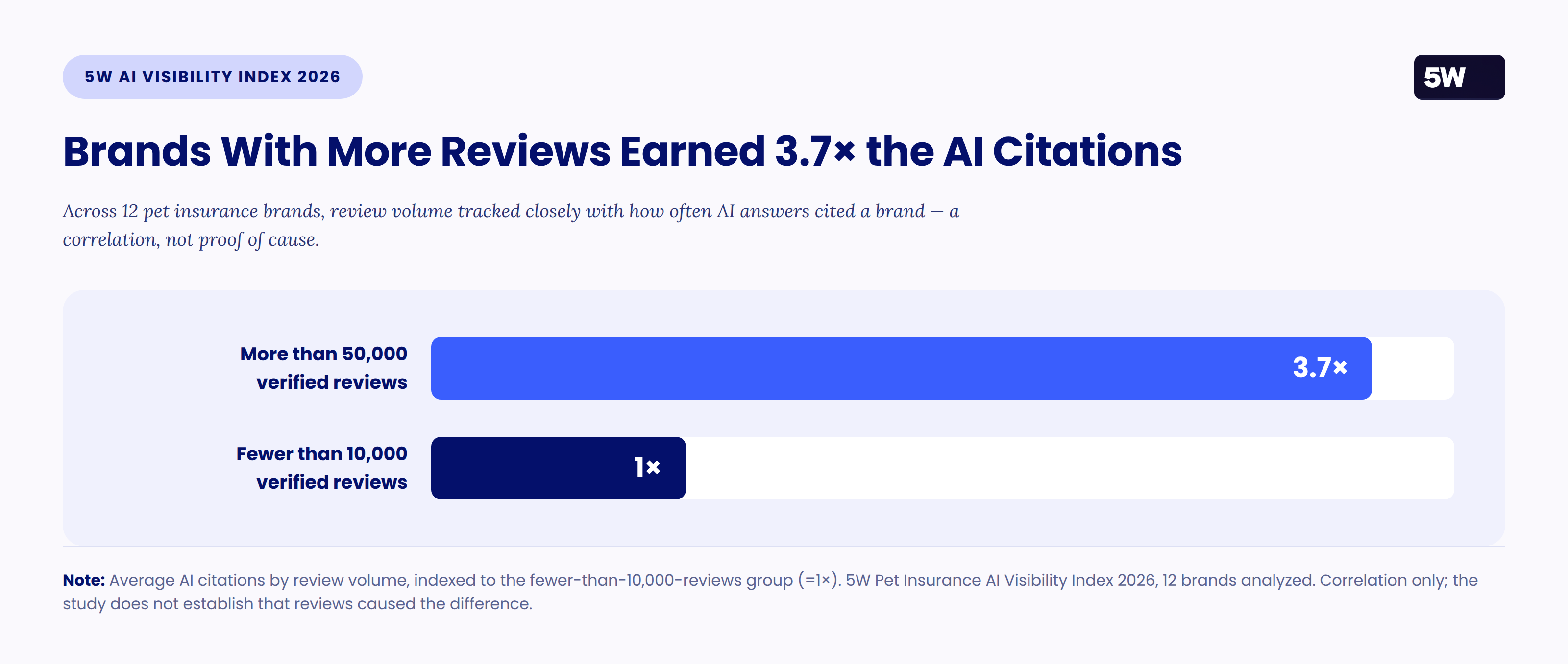
Review volume also tracks with how often AI answers cite a brand, though the link is correlation, not proof. Our 5W Pet Insurance AI Visibility Index 2026 analyzed 12 pet insurance brands and found that companies with more than 50,000 verified reviews averaged 3.7 times as many AI citations as brands with fewer than 10,000 reviews, but this relationship does not prove that reviews caused the difference. Either way, review data shouldn't be restricted to e-commerce or customer-experience teams; communications teams need the same signal to understand the qualities customers associate with the brand.
Do Retailers Describe Your Pet Product the Same Way You Do?
Often they don't, and every inconsistency hands an AI model a different reason to recommend or overlook the product. Retail distribution gives consumers multiple places to buy and gives models more descriptions to draw from; that breadth can help visibility, but it can also create contradictions.
Distribution channels shape a large share of decisions: NielsenIQ reported online pet sales grew 12% in 2025 and that 82% of pet spending came from omnichannel shoppers. So when a brand calls a formula “sensitive stomach support,” Chewy emphasizes skin and coat health, and Amazon describes it mainly as adult dry dog food, the problem isn't a lack of information for humans or models. The problem is that three sources are teaching the market three different reasons to consider the product.
Five Product Fields to Compare Across Chewy, Amazon, and Petco
For a national pet brand sold across multiple retailers, open the product page on the brand site, Chewy, Amazon, and Petco, and compare these five fields.
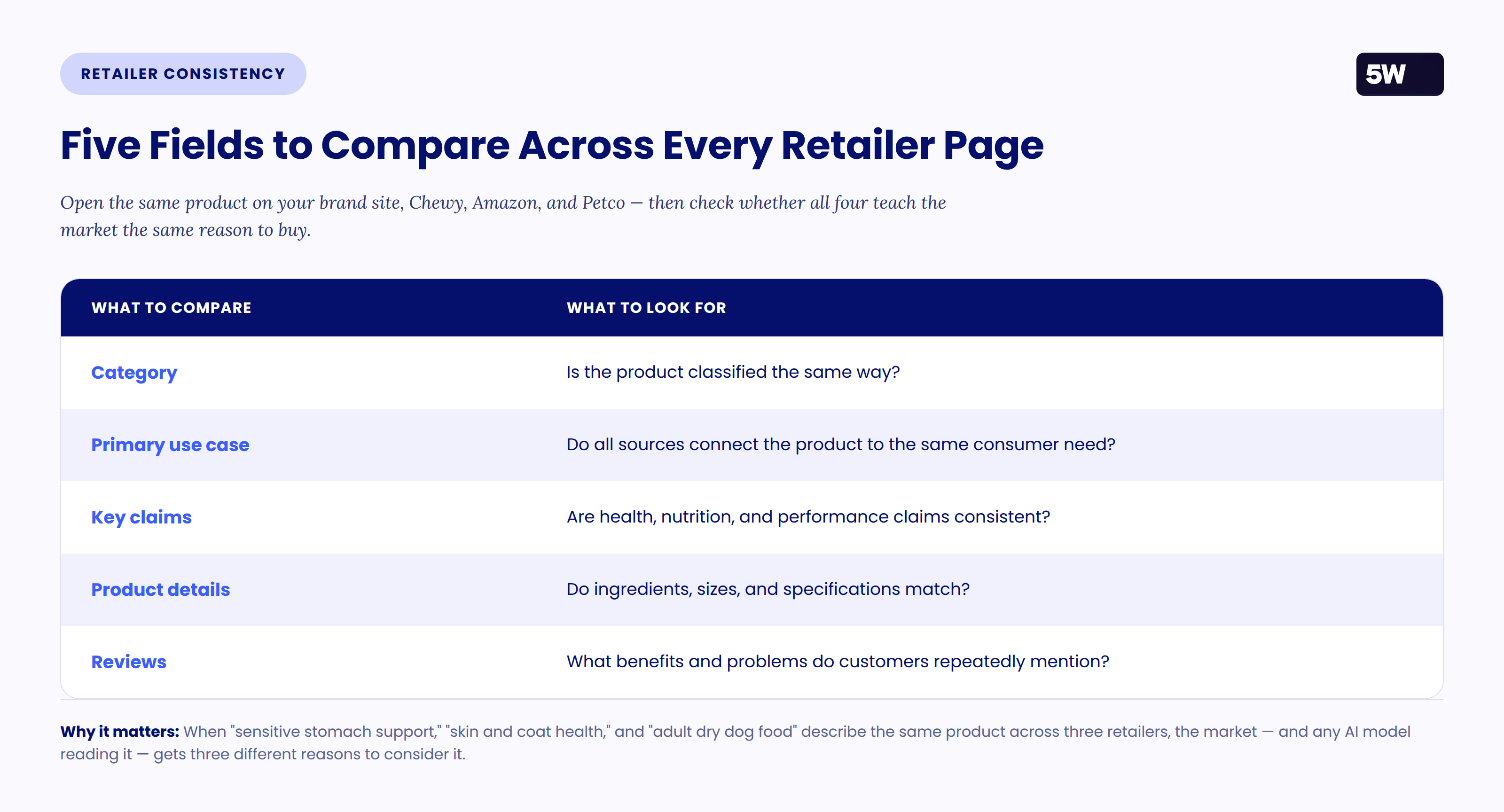
| What to compare | What to look for |
|---|---|
Category | Is the product classified the same way? |
Primary use case | Do all sources connect the product to the same consumer need? |
Key claims | Are health, nutrition, and performance claims consistent? |
Product details | Do ingredients, sizes, and specifications match? |
Reviews | What benefits and problems do customers often mention? |
How Much Does Earned Media Influence AI Answers?
Only the kind that ties a specific product to a specific need. Awareness coverage doesn't. Compare two passages: “Brand X is a popular premium dog food company” establishes awareness, while “Brand X's Sensitive Stomach Formula is an option for dogs with digestive sensitivity because…” establishes a product-to-need association. For AI search, the second likely gives a model the specific information it needs to answer a query without crawling another page.
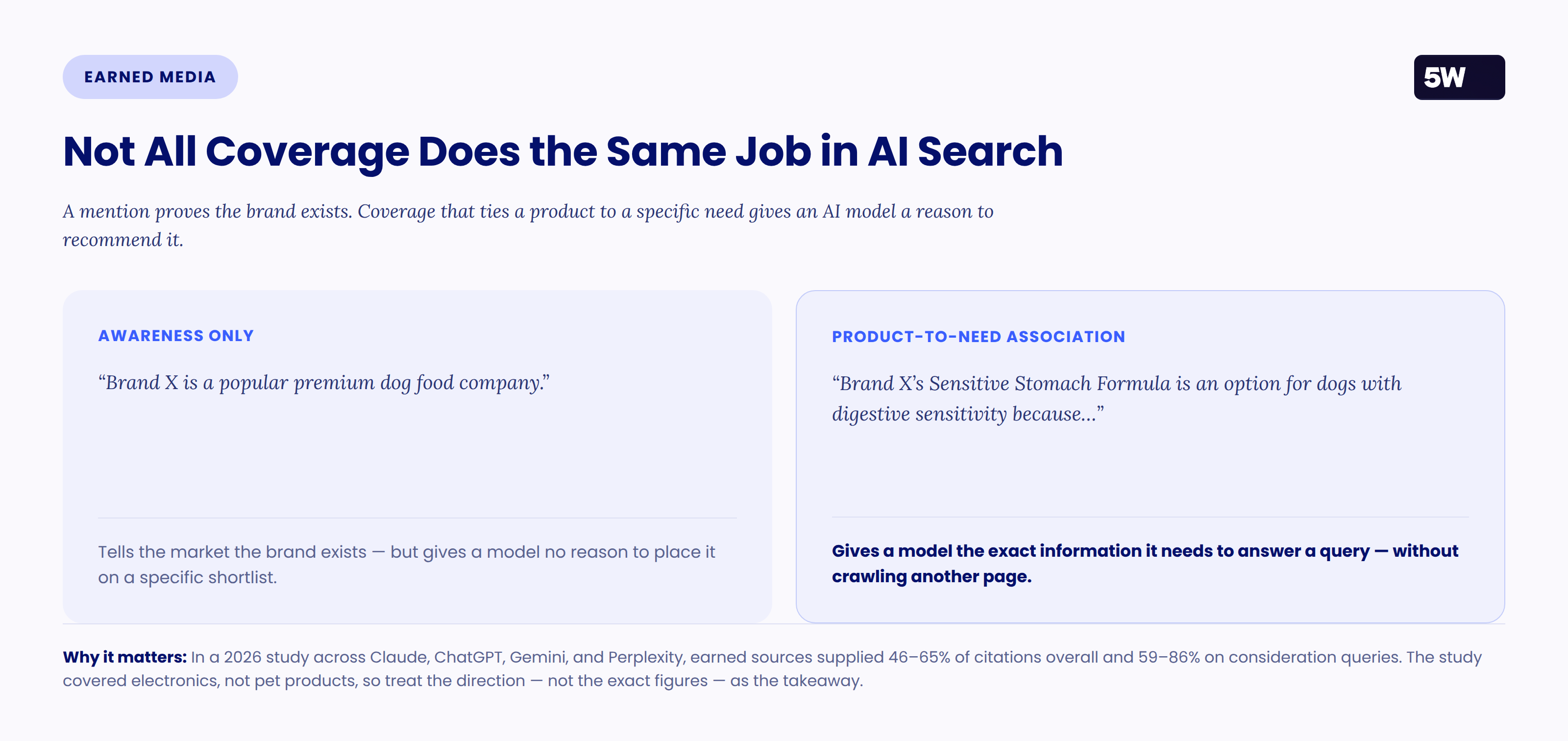
The citation data supports weighting the second type more. A 2026 study comparing Google with four generative AI models (Claude, ChatGPT, Gemini, and Perplexity) found earned sources accounted for 46% to 65% of citations across the models tested, rising to 59% to 86% for consideration queries, though the study examined electronics rather than pet products, so the percentages shouldn't be treated as pet benchmarks. The direction still matters for PR and brand teams. A media mention tells the market the brand exists; useful recommendation coverage explains why the product belongs on a specific shortlist, and that should change how communications teams evaluate their coverage. The guide to how pet brands turn consumer data into media coverage shows how to earn that kind of coverage.
How to Run a One-Page Evidence Audit for Your Pet Brand
Pick one common customer question and check whether every source describes the product the same way before you commission more content or pitch more media. The point is to find where the evidence across the web disagrees, not to add another voice to the pile.
You're competing inside a crowded decision process: a systematic review of 40 peer-reviewed pet-food studies published between 2006 and 2024 found pet-food decisions involve ingredients, product quality, price, brand reputation, sustainability, and pet health. If your brand wants to win “best dog food for sensitive stomachs,” the evidence across the web should connect the product to that sensitive-stomach use.
Six Questions to Ask About “Best Dog Food for Sensitive Stomachs”
Answer these questions for the query you're targeting, then identify what content or source the answers belong in.
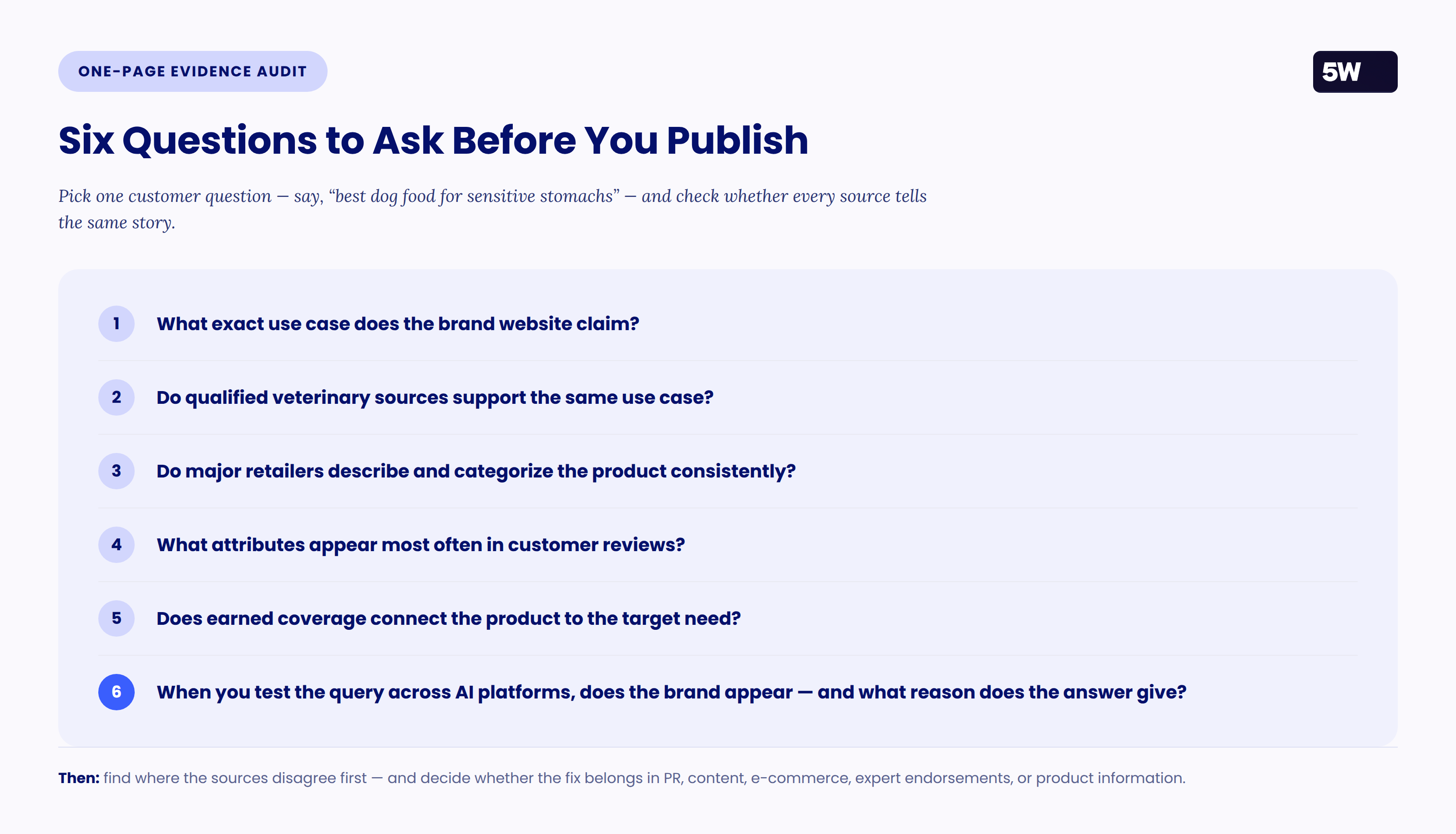
What exact use case does the brand website claim?
Do qualified veterinary sources support the same use case?
Do major retailers describe and categorize the product consistently?
What attributes appear most often in customer reviews?
Does earned coverage connect the product to the target need?
When you test the purchase question across AI platforms, does the brand appear, and what reason does the answer give?
If veterinarians, retailers, customers, and media tell four different stories, publishing another brand article is unlikely to resolve the brand's underlying problem. Find the misalignments. Then decide whether the response belongs in PR, content, e-commerce, expert endorsements, or product information.
Find Your Evidence Gap Before AI Fills It For You
The brands winning AI search aren't guessing. They know exactly how veterinarians, retailers, reviewers, and the press describe their products, and they've closed the gaps where those stories diverge. When the evidence lines up, AI models have a clear, citable reason to put the brand on the shortlist. When it doesn't, the recommendation goes to someone else.
That's the work 5WPR does. We map how your brand shows up across the sources AI actually reads, pinpoint where the story breaks down, and build a consistent body of proof that earns visibility in AI answers. See 5W's Pet PR and AI Visibility practice, the Pet Industry AI Visibility Index 2026, and the pet industry trends for 2027 for the wider picture.
If you're ready to see what AI says about your brand today and what it could say tomorrow, let's talk. Contact 5WPR to discuss your AI visibility.