

We’ve spotted nine trends during our second annual Pack Retreat and are excited to share our findings.
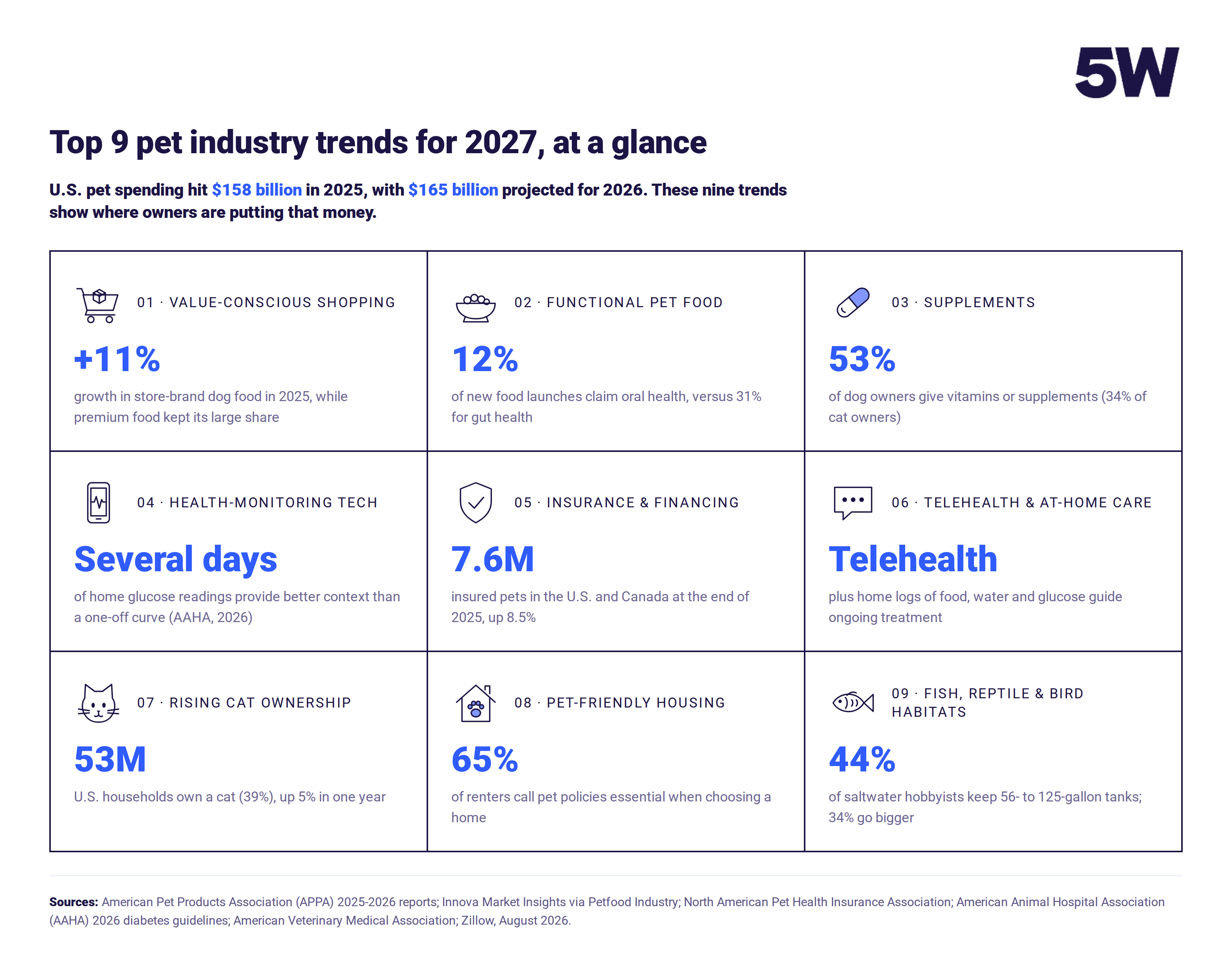
First up is value-conscious shopping, followed by food built for niche health needs, growing supplement use, health-monitoring tech, pet insurance, at-home care, rising cat ownership, demand for pet-friendly housing, and increased spending on habitats for fish, birds, and reptiles.
Each prediction builds on momentum from 2025 and early 2026 data. The American Pet Products Association (APPA) reported that U.S. pet industry spending hit $158 billion in 2025 and projects $165 billion for 2026.
In 2025, roughly 95 million U.S. households owned at least one pet. With everyday costs at record highs, pet owners are choosing products based on health benefits, convenience, and price.
What is functional pet food, and how is it growing in 2027?
Pet food brands are moving from overall wellness to targeted formulas.
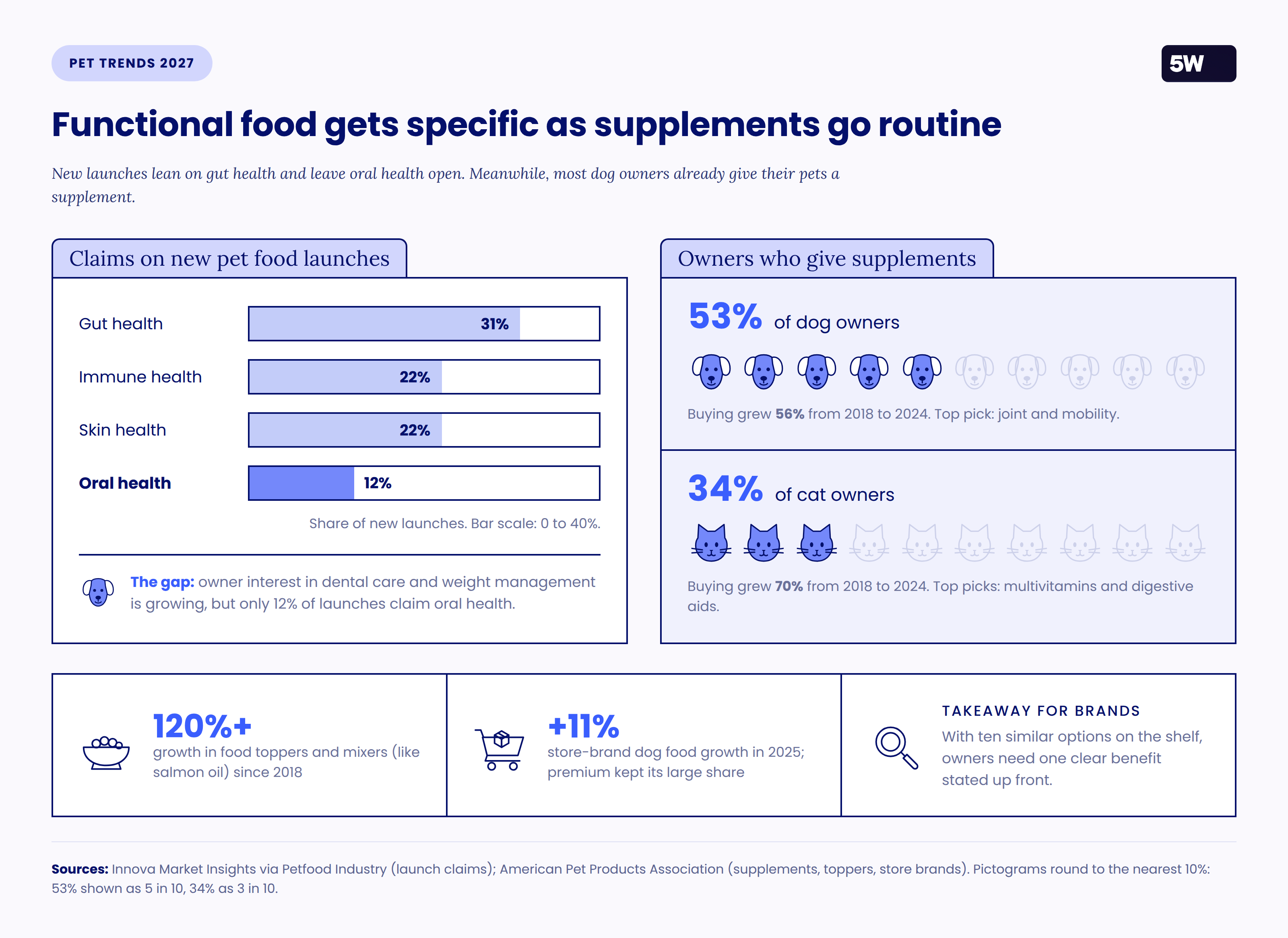
Innova Market Insights data shared by Petfood Industry showed that gut health appeared on 31% of new pet food launches, with immune and skin health showing up on 22% each. Oral health lagged at just 12%—despite growing owner interest in dental care and weight management—leaving a gap for brands to fill in 2027.
According to APPA's 2026 Dog Report, 53% of U.S. households owned a dog in 2025. These owners spent most of their budgets on vet care (29%), followed by food (27%), often buying at supermarkets and discount club stores like Costco.
Premium pet food retained its large market share, but store-brand dog food jumped 11% in 2025.
Owners are also personalizing their pets' diets. APPA reports that dog and cat owners use food mixers (like salmon oil) and toppers more than 120% more since 2018.
Pairing a standard diet with a targeted topper, supplement, or treat gives pets a personalized diet without the custom price tag.
Why are pet supplement sales and usage expanding?
In 2026, supplements are a routine part of pet care.
APPA reports that 53% of dog owners and 34% of cat owners give their pets vitamins or supplements. Between 2018 and 2024, supplement buying grew 56% among dog owners and 70% among cat owners. Joint and mobility products top the list for dogs, while cat owners favor multivitamins and digestive aids.
More options add friction to a consumer's decision-making process, so an owner comparing ten similar supplements needs a clear differentiator to convert.
How will health-monitoring tech redefine pet care technology in 2027?
Pet tech is moving toward health monitoring, with more devices capturing everyday wellness data that owners and vets can track between checkups.
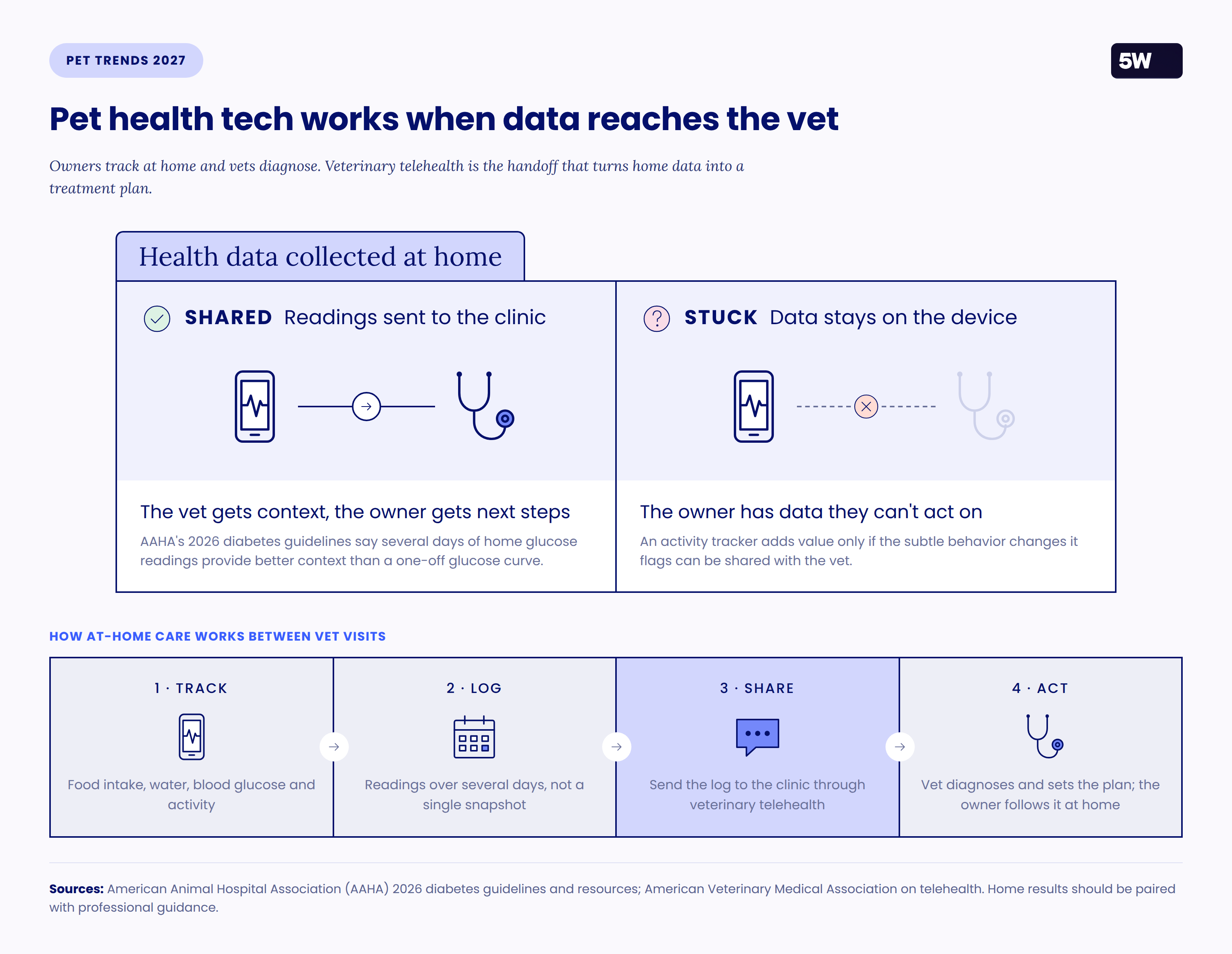
The American Animal Hospital Association's (AAHA) 2026 diabetes guidelines highlight home glucose testing and continuous monitoring for dogs and cats. They note that several days of home readings provide better context than a one-off glucose curve but caution that results should be paired with professional guidance.
Consumer devices are following a similar path. An activity tracker adds value if it can flag subtle behavior changes that owners can share with their vet. Without that connection, owners have data they can't act on.
What is driving the growth of the pet insurance and financing market?
Pet insurance has growth potential because veterinary care accounts for a significant share of spending, and millions of pets remain uninsured.
The North American Pet Health Insurance Association counted 7.6 million insured pets in the United States and Canada at the end of 2025, up 8.5% from 7.03 million in 2024. Gross written premiums surpassed $6.2 billion.
Pet owners looking for predictable costs had ample choices in 2026. In 2027, wellness subscriptions and flexible financing and payment plans will likely compete with traditional insurance policies.
Whichever option owners choose, they want to know what's covered, excluded, and when reimbursements kick in. Brands that can explain those terms transparently build trust with customers and establish authority in their industry.
How is veterinary telehealth increasing at-home pet care delivery?
Owners are increasingly caring for their pets at home while relying on vets for diagnosis and treatment plans.
The American Veterinary Medical Association notes that telehealth boosts communication, care coordination, and patient triage when clinics follow established best practices.
AAHA's 2026 diabetes resources take telehealth a step further, giving owners simple tools to log food intake, water consumption, blood glucose levels, and other details that guide ongoing treatment.
Relevant pet brands can lean into this trend in 2027. When owners know what data to track, how to send it to their clinic, and what to do next, they become active partners in their pet's care between vet visits.
What factors are driving rising cat ownership and spending in the U.S.?
Cat ownership is booming across the U.S.
APPA reports that 53 million U.S. households (39%) owned a cat in 2025—a 5% jump from the year before. Multi-cat households grew by 7%, while men accounted for 43% of cat owners, and Gen Z made up 22%.
Brands capitalizing on this trend need marketing that matches the data; single-owner stereotypes may skew ad targeting.
How do pet policies shape housing demand and rental market choices?
Pet rules affect where people choose to live, giving property managers a direct financial incentive to win over pet owners.
Zillow reported in August 2026 that 77% of U.S. rental listings welcomed pets. Roughly 59% of renter households had at least one pet, and 65% of renters called pet policies essential when choosing a home. Among renters who renewed their lease, 62% said pet policies were an important factor in their decision to stay. important factor in their decision to stay.
Most listings allow pets, so simply claiming "pet friendly" won't help differentiation in 2027.
Why are expenditures rising for fish, reptile, and bird habitats?
Fish, reptile, and bird owners are investing more in specialized habitats and care.
APPA found that 77% of fish owners keep multiple fish. Saltwater hobbyists, in particular, invest in large setups: 44% maintain 56- to 125-gallon tanks, 34% run tanks over 126 gallons, and 43% own custom setups.
Younger generations are driving much of this growth. Gen Z represents 33% of reptile owners, while millennials account for 46% of saltwater fish owners and 38% of freshwater hobbyists.
Bird owners spend generously, too. APPA's 2025 research showed the average gift for a pet bird topped $40.
These pet owners need expert advice on housing and feeding, so retailers that offer reliable support can win their loyalty.
Differentiators for Leading Pet Care Brands and Products in 2027
Pet products and services that win in 2027 will need to answer three questions confidently: who they are, what they do for customers’ pets, and why their product or service is best.
5W’s Pet PR and AI Visibility practice builds these programs for pet food, supplement, insurance, service, and tech brands. Because ChatGPT, Perplexity, and Google AI Overviews now answer product questions too, 5W also tracks which sources the LLMs cite.
The Pet Industry AI Visibility Index 2026 ranks 25 pet brands by how often AI cites them. Pet brands planning 2027 launches can begin by answering the three questions above for their products, then start a conversation with 5W’s pet team about where those answers need to appear.