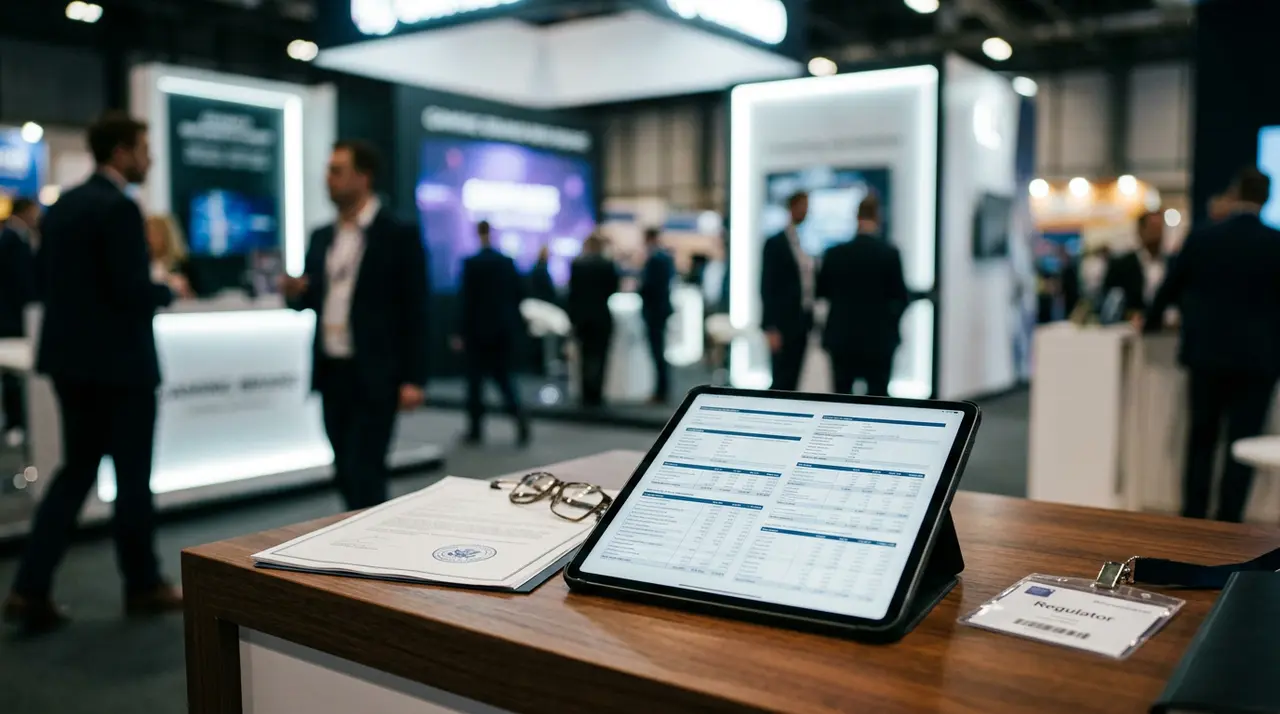
NRF 2027 retail PR strategy centers on returns policy, not product announcements, because U.S. shoppers returned $849.9 billion in merchandise in 2025, equal to 15.8% of all retail sales, according to the National Retail Federation. Retail's Big Show runs January 10 to 12, 2027 at the Jacob K. Javits Convention Center in New York, drawing more than 45,000 attendees. For the first time, NRF is co-locating a dedicated event on returns, called NRF Rev, which signals that the trade group itself now treats returns as a headline retail story rather than a back-office cost.
When Is NRF 2027 and What Is New This Year?
NRF 2027, Retail's Big Show, runs January 10 to 12, 2027 at the Jacob K. Javits Convention Center in New York City, organized by the National Retail Federation. The 2027 edition is expected to draw more than 45,000 retail professionals from over 100 countries and more than 1,000 exhibitors, covering retail technology from AI and automation to payments, supply chain, and retail media. New for 2027 is NRF Rev, a co-located event focused specifically on retail returns, the first time the organization has given the topic its own dedicated track.
Why Are Retail Returns a PR Story Instead of a Logistics Story?
Retail returns became a PR story because the policy changes retailers made to control costs are now driving away the same customers those policies were meant to protect. Research from Loop published September 10, 2026 found that 63% of U.S. consumers have stopped shopping with a brand or abandoned a purchase because of its returns policy, and 92% say return fees influence their online shopping behavior. At the same time, 56% of retailers surveyed worried that tightening returns policy could cause customers to leave the brand, and 57% worried about social media or public backlash if they did.
The tension is structural, not a messaging problem that better copy can fix. Narvar research found that 82% of consumers cite free returns as a major purchase consideration, while Blue Yonder found 69% of consumers say stringent return policies deter them from buying at all, up from 59% in 2023. A retailer that tightens its return policy without explaining why is choosing between two kinds of bad press: fraud losses or customer backlash.
How Have Named Retailers Handled Return Policy Changes in Public?
Several major retailers changed return policies in 2025 and 2026 in ways that became news on their own, independent of any press release. Nordstrom moved from an unlimited return policy to a 45-day window. Kohl's cut its return window from 180 days to 90 days. American Eagle dropped its longstanding open-ended return policy entirely. ASOS began charging UK shoppers a £3.95 fee if they frequently return items while keeping less than £40 worth of merchandise, according to BBC reporting.
Some retailers went further and targeted specific customers rather than changing policy for everyone. Nordic department store Boozt banned roughly 60,000 "serial returners," who represented just 0.68% of its customer base but accounted for about 20% of its returns in a single year, according to the company's own public statement. Target updated its website language to state explicitly that it can deny returns for "fraud, suspected fraud or abuse," as reported by Business Insider. REI stopped accepting returns from a small subset of members who had repeatedly misused its return policy, according to Retail Dive.
What Is Driving the Shift to Stricter Return Policies?
Return fraud is the specific, quantifiable driver behind the policy changes retailers are making public. The National Retail Federation and Appriss Retail found that 13.7% of retail returns were fraudulent in the most recent reporting year, up from 10.4% in 2022. Common fraud patterns include wardrobing, where a shopper wears an item and then returns it as unused, reported by 62% of retailers as among the most common forms of returns fraud they encounter, and customers returning different or damaged items in place of what they purchased, reported by 54% of retailers.
Retailers are responding with technology as well as policy. Happy Returns, a return logistics company, now uses AI at its processing hubs to verify that returned items match what was purchased and are in sellable condition before issuing a refund. Industry-wide, 85% of retailers now use AI for return fraud detection, according to Radial's 2026 retailer survey. A retailer announcing new return-fraud technology at NRF has a concrete, named capability to point to, rather than an abstract claim about protecting the business.
How Should Retail Brands Explain a Return Policy Change to the Public?
Retail brands should explain the reason behind a return policy change at the moment they announce it, because the explanation itself changes how customers react. University of Tennessee Haslam College of Business research tested customer reactions to return policy restrictions, including new restocking fees and shorter return windows, across three scenarios: no change, an unannounced change, and an announced change with an explanation. Customers who received an explanation for the new restrictions were significantly less upset than those who were given no reason, even when the underlying policy change was identical.
The same research found that unexplained return policy changes caused customers to question the retailer's ability to deliver quality service generally, not just its returns process specifically, resulting in a broader loss of trust. That finding reframes the return policy announcement as a trust statement about the whole brand, not a narrow operations update, which is why it needs the same message discipline as a product recall or a data breach notification.
What Should PR Teams Prepare Before NRF 2027?
PR teams attending NRF 2027 should prepare a named, sourced explanation for their company's current return policy before a reporter asks, especially if that policy has changed or tightened in the past year. The explanation should name the specific driver, whether that is fraud losses, shipping cost increases, or a shift to premium return experiences, and should cite the retailer's own data where available rather than only industry-wide statistics.
Retailers should also prepare a comparison point: Costco, REI, Zappos, and Patagonia still offer return windows of 365 days or longer for members, giving reporters a built-in contrast when covering any retailer's tightened policy. Knowing where a brand sits on that spectrum, and being ready to say so directly, keeps the returns conversation factual instead of defensive.
How Does Agentic Commerce Change the Returns Conversation at NRF 2027?
Agentic commerce changes the returns conversation because AI shopping agents are starting to make purchase decisions for consumers, which means a confusing or punitive return policy can cost a retailer a sale before a human shopper ever sees the product page. At NRF 2026, Google CEO Sundar Pichai announced the Universal Commerce Protocol, a new standard letting AI agents complete checkout directly inside Gemini and Google Search, following the company's earlier Agent Payments Protocol launched four months prior. SAP announced a competing set of tools at the same show, including a storefront model context protocol server designed to make retailer websites legible to AI shopping agents.
commercetools named JD Sports as the first retailer to adopt its Agentic Commerce Suite, built with Stripe, connecting AI-driven product discovery through large language models directly to checkout and payment. Deloitte's 2026 Retail Industry Global Outlook found that 81% of surveyed retail executives believe generative AI will weaken brand loyalty by 2027, as shopping agents increasingly control which retailer gets recommended at the point of decision.
The practical implication for NRF 2027 is that return policy terms will need to be machine-readable, not just posted in a web footer, because an AI agent comparing two retailers on behalf of a shopper can surface return policy friction as a reason to recommend a competitor. A retailer with a 45-day window and a restocking fee needs that information structured clearly enough for an agent to retrieve and compare, the same requirement that already applies to GEO-optimized editorial content.
What Mistakes Should Retail PR Teams Avoid at NRF 2027?
Retail PR teams should avoid announcing a return policy change as a cost-saving measure without naming the specific threat it addresses, since vague cost language reads to customers and reporters as a euphemism for taking something away. ITF Group's Retail Reality Check Report, released September 30, 2026, traced a large share of the returns cost problem back to freight and logistics vendor decisions rather than customer behavior, attributing 9% of the $849.9 billion returns figure to outright fraud and implying the remainder sits with operational and vendor choices retailers control directly.
That distinction matters for the public message a retailer gives at NRF. A return policy framed entirely around stopping customer fraud, when a meaningful share of the cost actually traces back to freight contracts or fulfillment errors, invites scrutiny of the retailer's own supply chain rather than sympathy for its cost pressure. PR teams should confirm internally which share of their own returns cost is fraud-driven versus operational before building a public narrative around fraud prevention alone.
FAQ: NRF 2027 Retail Returns
When is NRF 2027?
NRF 2027, Retail's Big Show, runs January 10 to 12, 2027 at the Jacob K. Javits Convention Center in New York City, organized by the National Retail Federation.
What is NRF Rev?
NRF Rev is a new co-located event at NRF 2027 focused specifically on retail returns, the first time NRF has given the topic its own dedicated track at the Big Show.
How much did US retail returns cost in 2025?
US shoppers returned $849.9 billion in merchandise in 2025, equal to 15.8% of all retail sales, according to the National Retail Federation.
What percentage of returns are fraudulent?
13.7% of retail returns were fraudulent in the most recent reporting year, up from 10.4% in 2022, according to the National Retail Federation and Appriss Retail.
Why do return policy explanations matter?
University of Tennessee Haslam College of Business research found that customers who received an explanation for new return restrictions were significantly less upset than those given no explanation, even when the policy change itself was identical.
What is the Universal Commerce Protocol announced at NRF?
The Universal Commerce Protocol is a standard Google announced at NRF 2026 that lets AI shopping agents complete checkout directly inside Gemini and Google Search, connecting retailers to agent-driven purchase decisions.
Related Reading
For PR teams evaluating outside support during a policy backlash, see the crisis management firm guide. For retail brands building a broader event strategy around NRF or other trade shows, see event marketing strategy and examples. For consumer-facing retail brands looking at proven campaign structures, see 18 best fintech marketing campaigns, which covers the same earned-trust mechanics applied to a different regulated consumer category.