

Reviews, streaming, and gaming community content influence what games an artificial intelligence (AI) model recommends more than brand claims do. New 5W research analyzing four AI models found 60% of cited URLs came from non-press websites, supporting Similarweb data showing Fandom, a fan wiki platform, was the most frequent source for gaming questions in Google AI Mode at 7.16%. This article analyzes reviews, creators, and communities, and offers steps for gaming brands to increase AI mentions.
Main takeaways
AI models share third-party coverage and often cite guides and wiki pages instead of reviews and aggregated scores. YouTube is the most-cited creator platform, video transcripts function as citable text, and sponsored-video citations faded by about 43% in a month. Reddit and fan wikis supply "games like" answers, and publishers can give those communities accurate facts but can't edit what they publish.
What did each model cite when asked about video games?
Earlier this week, 5W analyzed the answers to common gaming prompts in four models. For this research, we define citation as a link an AI model provides to support its answer.
The prompts included:
"What are some good cooperative (co-op) games to play with your partner?", "Games similar to Hades", and "Is Baldur's Gate 3 suitable for someone who has never played a computer role-playing game (CRPG)?"
In total, 10 of 12 responses referenced live search and cited 88 URLs; the other 2 answered from memory without links. Across those answers, roughly 40% of citations came from gaming or general-interest media and 60% from listicles, comparisons, retail sites, community forums, YouTube videos, and Wikipedia.
| Source | URLs cited | Share | Results |
|---|---|---|---|
Gaming and general-interest press | 35 | 40% | IGN, GameSpot, PC Gamer, Polygon, Vice |
Niche lists and blogs | 19 | 22% | Rogueliker, Vaulted Games, games.gg |
Retailer, store or vendor pages | 14 | 16% | Eneba, G2A, Kinguin, PlayStation Store |
Community threads | 13 | 15% | Reddit, ResetEra, Steam Community |
YouTube | 5 | 6% | Gemini answers only |
Wikipedia | 2 | 2% | Gemini co-op answer |
The prompts changed how Perplexity chose its sources: for the co-op question, 13 of its 18 sources came from press, and GameSpot alone accounted for 5. For the Hades question, none of the 18 sources were drawn from IGN, GameSpot, Polygon, or PC Gamer; 5 were Reddit threads in r/HadesTheGame, and 2 were G2A and Eneba pages. For the Baldur's Gate 3 question, IGN provided 5 of 15: a beginner's guide, a developer tip story, two wiki pages, and a video.
Notably, retailer pages showed up more often than we expected.
For example, 5 of the 10 searched answers referenced an Eneba page; similarly, all 3 models that searched the Hades question referenced both Eneba and G2A.
The models differed from one another.
Claude cited GameRant, a large gaming outlet, among its 12 URLs, but 3 of its 4 Baldur's Gate 3 links came from ResetEra and Steam Community thread sites. ChatGPT relied on two PC Gamer pages for its co-op response and left out It Takes Two and Split Fiction, which the other three models named.
The data is a small sample set, from one run per model via the DataForSEO API (GPT-5.4-mini, Sonar-Pro, Gemini-3.5-flash, and Claude-haiku-4-5). Results vary from run to run, and consumer applications may behave differently.
How much do reviews influence video game recommendations?
Reviews are third-party coverage. Earned media is unpaid coverage written and created by third parties like The New York Times, USA Today, and outlets like IGN.com and GameSpot.com. In general, we've found that the further a source sits from a brand, the more weight it appears to carry.
According to a Muck Rack study released in May 2026 examining over 25 million links cited by AI (ChatGPT, Claude, Gemini), earned media made up approximately 84% of AI citations, while paid (advertorial) content accounted for 0.3%.
Reviews also influence how searches are conducted. Peec reported that ChatGPT automatically includes the term "reviews" in its hidden searches regardless of whether the user asks about reviews. In 5W's test, ChatGPT used the terms "review," IGN, and PC Gamer as part of its hidden search for the Baldur's Gate 3 question, yet the answer linked to the game's official website and the PlayStation Store listing, not to a review. So reviews shaped the search, but the cited pages were the publisher's and a store's.
Cited sources don't default to scored reviews. For example, Perplexity cited beginner guides, wiki pages, and a developer interview to support the "Is it worth playing?" prompt instead of review scores. Similarly, 5W's Entertainment and Streaming Index found that AI models weigh editorial authority when choosing streaming services.
How do streamers and creators influence video game recommendations?
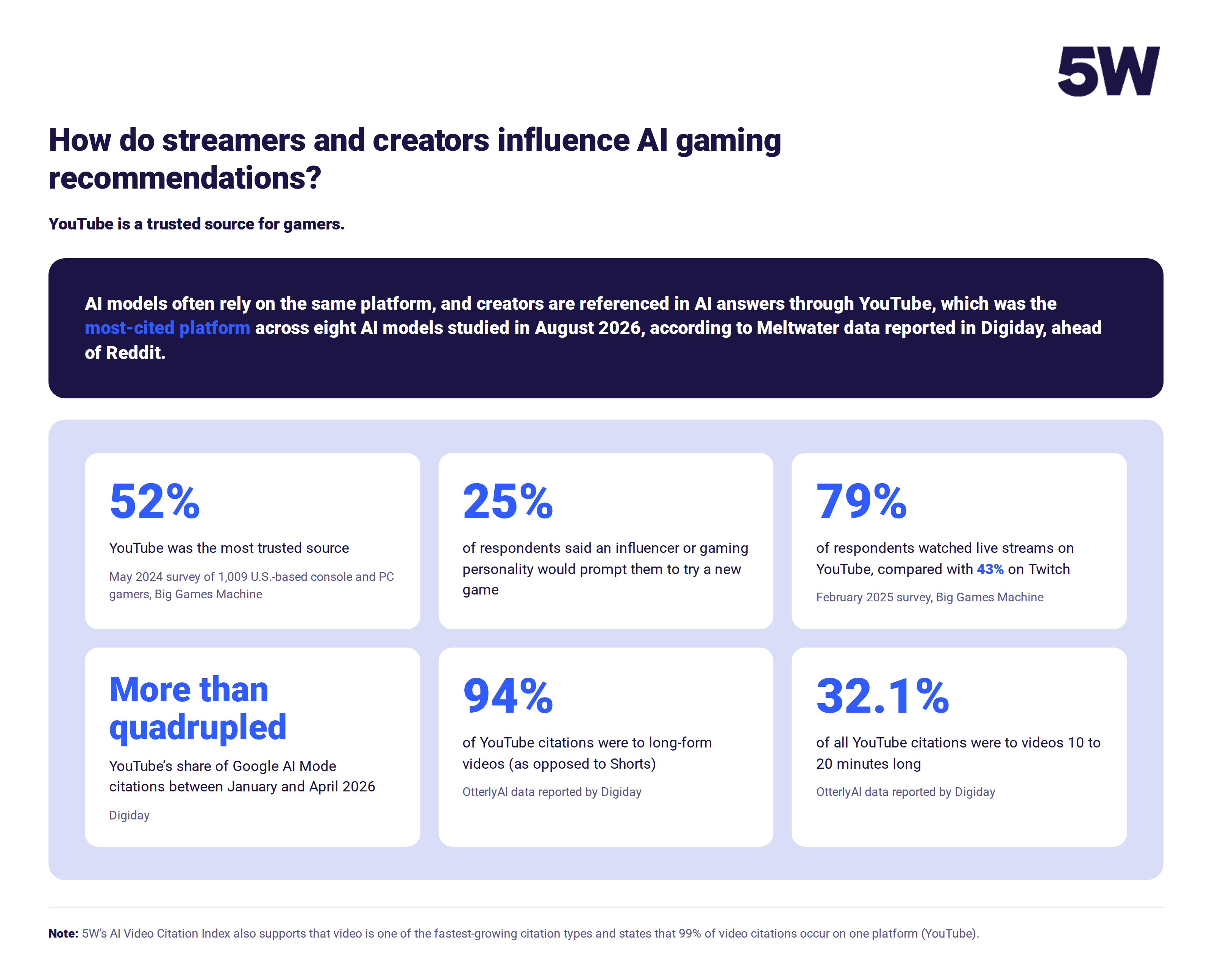
YouTube is a trusted source for gamers.
In a May 2024 survey of 1,009 U.S.-based console and PC gamers, Big Games Machine found that YouTube was the most trusted source (52%) and that 25% of respondents said an influencer or gaming personality would prompt them to try a new game. A subsequent Big Games Machine survey in February 2025 found that 79% of respondents watched live streams on YouTube, compared with 43% on Twitch.
AI models often rely on the same platform, and creators are referenced in AI answers through YouTube, which was the most-cited platform across eight AI models studied in August 2026, according to Meltwater data reported in Digiday, ahead of Reddit.
Digiday found that YouTube's share of Google AI Mode citations more than quadrupled between January and April 2026.
5W's AI Video Citation Index also supports that video is one of the fastest-growing citation types and states that 99% of video citations occur on one platform (YouTube).
According to Peec, when a model cites a video in its answer, it typically draws on information in the video description and the automatically generated transcript. Consequently, video transcripts may be considered "citable" text. Length matters as well: according to OtterlyAI data reported by Digiday, 94% of YouTube citations were to long-form videos (as opposed to Shorts), and 32.1% of all YouTube citations were to videos 10 to 20 minutes long.
In 5W's analysis, Gemini was the only model that referenced YouTube, with 5 video references. 5W also identified 4 games among Gemini's suggestions for the Hades prompt that no other model named (Warm Snow, Wizard of Legend, Ravenswatch, and SWORN); each of those 4 games appeared next to a YouTube or Reddit citation. 5W's Video Games AI Visibility Index shows the same split in its modeled estimates: Gemini leans on YouTube creator reviews such as Digital Foundry and Skill Up, while Perplexity surfaces Reddit gaming subreddits.
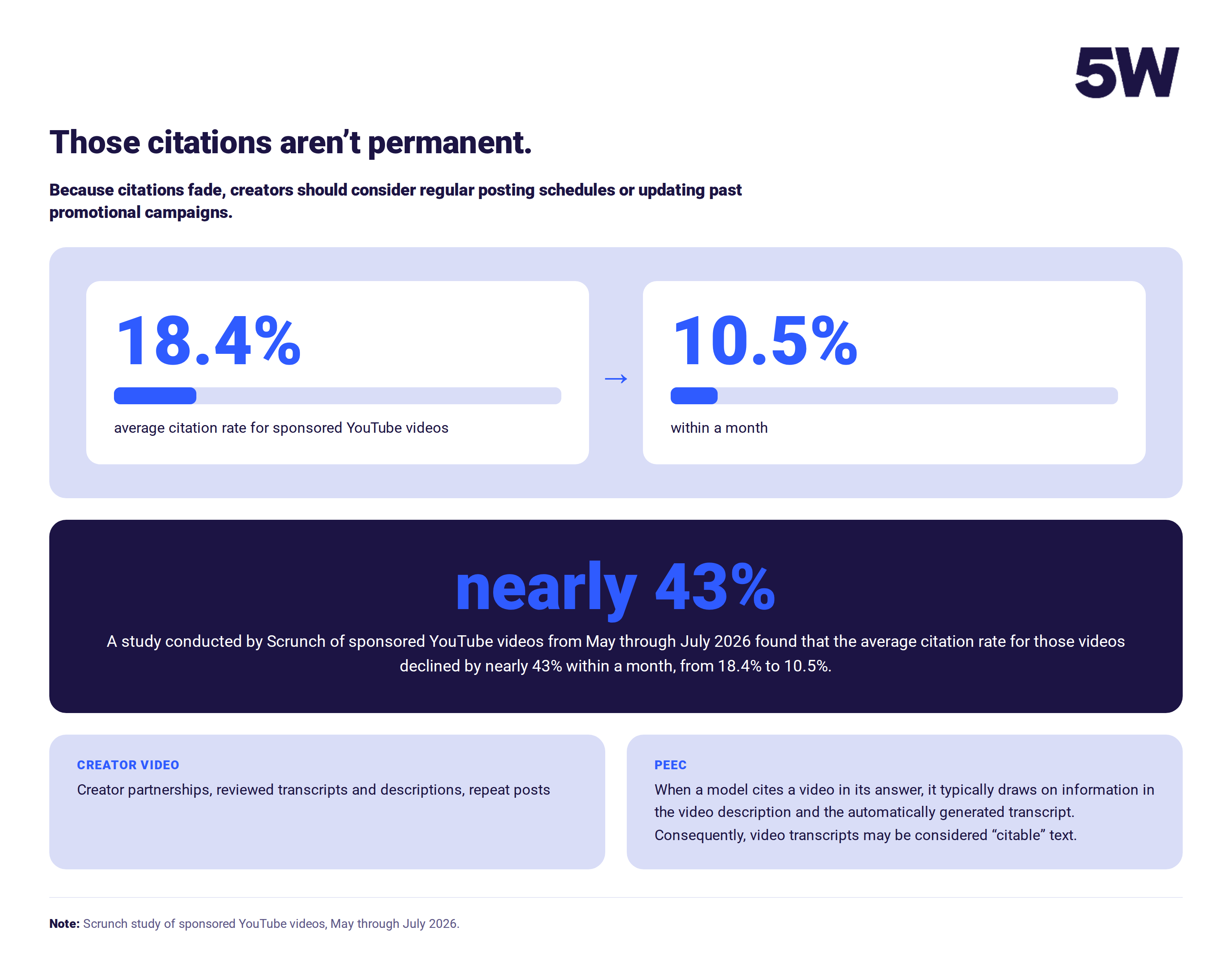
Those citations aren't permanent. A study conducted by Scrunch of sponsored YouTube videos from May through July 2026 found that the average citation rate for those videos declined by nearly 43% within a month, from 18.4% to 10.5%. Because citations fade, creators should consider regular posting schedules or updating past promotional campaigns.
How do gaming communities influence video game recommendations?
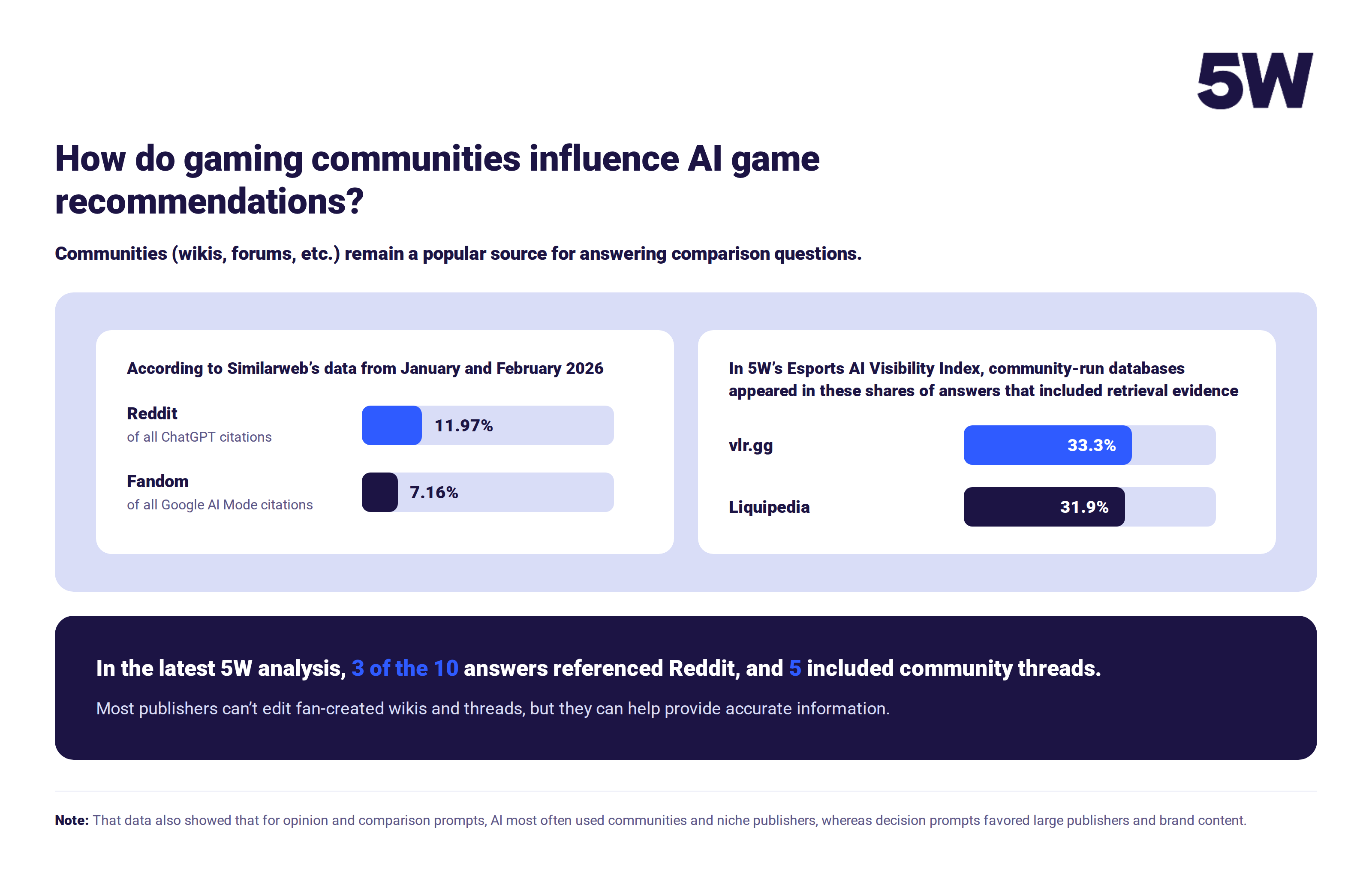
Despite recent changes in ChatGPT Reddit citations, communities (wikis, forums, etc.) remain a popular source for answering comparison questions.
A fan wiki is a source created by the fans of a particular franchise, game series, movie, TV show, or book; volunteers moderate these sites by posting descriptions of characters, items, locations, storylines, and more.
According to Similarweb's data from January and February 2026, Reddit was the source of 11.97% of all ChatGPT citations, while Fandom accounted for 7.16% of all Google AI Mode citations. That data also showed that for opinion and comparison prompts, AI most often used communities and niche publishers, whereas decision prompts favored large publishers and brand content.
5W's Video Games AI Visibility Index supports Similarweb's findings noted that Fandom wikis and Reddit gaming subreddits are consistent sources behind franchise queries (the Index's figures are modeled estimates, not logged query runs).
A similar pattern exists for niches. In 5W's Esports AI Visibility Index, community-run databases such as vlr.gg and Liquipedia appeared in 33.3% and 31.9%, respectively, of answers that included retrieval evidence, while brand citations made up just 7.8%.
In the latest 5W analysis, 3 of the 10 answers referenced Reddit, and 5 included community threads. Most publishers can't edit fan-created wikis and threads, but they can help provide accurate information.
How can video game developers increase their AI recommendations?
Developers need fair, comprehensive media coverage and content across AI platforms and should review how different models answer post-release questions about their game. PR campaigns can't revise, remove, or delete user-generated content, but they can give reviewers, creators, and communities accurate information about a product or service, as the table shows.
| Source | Program | Evidence |
|---|---|---|
Review and trade press | Launch coverage, previews and early access for journalists | FanArcade: 41 placements, including GameSpot, GameRant and Dexerto |
Creator video | Creator partnerships, reviewed transcripts and descriptions, repeat posts | Scrunch: sponsored-video citations fell about 43% in a month. |
Reddit and community threads | Developer participation and honest answers to player questions | Reddit threads appeared in three of 10 answers in 5W's test |
Fan wikis | Accurate, current facts for the people who maintain them | Fandom led Google AI Mode citations at 7.16% |
Retailer list pages | Monitoring and corrections where facts are wrong | Eneba pages appeared in five of 10 answers |
5W secured 94 digital placements for Opera GX and over 5 billion unique visitors per month (UVPM) across gaming and technology outlets. Additionally, the FanArcade case study reported 195.6 million impressions and noted that impressions aren't reliable indicators of how many players played a particular title or how many times players engaged in gaming sessions. 5W's case studies, video game public relations group, and influencer relationships provide additional examples of successful PR programs.
On community presence specifically, 5W's Sports Betting Index advises brands to build a clear, open, and honest presence rather than pay community members to engage with their posts.
Some budget data suggest the opposite. The 2026 Gaming Trust Index reported that 76% of U.S. gambling marketing spend in 2025 went to paid digital advertising and only about 4% to earned media, even though, per Muck Rack, only 0.3% of AI citations come from paid content.
5W created the Video Games AI Visibility Index, which ranks publishers based on their modeled share of citations. An AI visibility audit, or the Citation Source Audit, identifies the source(s) that an AI model uses to generate an answer about a game. The complete AI Visibility Index Series addresses other categories.
Reviewers, creators, and community members write what AI models read about a game. Publishers earn a place in the answer by providing accurate, specific material and then checking the answers again after launch.
5W's AI Search (Generative Engine Optimization, or GEO) helps brands identify what AI models discover and communicate about your game. From there, we secure media coverage and create AI-ready content so models recommend your game to users asking what to play next. Contact 5W and start a conversation to increase your market share today.
Methodology
5W conducted an analysis of four AI models (ChatGPT, Perplexity, Gemini, and Claude) using three common game-related questions for responses: co-op games that are good to play with a partner, games similar to Hades, and if Baldur's Gate 3 would be suitable for someone who has never before played a CRPG. Each model answered each question once. All four AI models used web searches and responded via an Application Programming Interface (API)—GPT-5.4-mini (Sonar-Pro), Gemini-3.5-flash (Gemini), and Claude-haiku-4-5 (Claude). The model generated twelve responses. Sources were provided in ten of these responses; ChatGPT provided a response without citing sources when answering the Hades question, and similarly, Gemini did so when answering Baldur's Gate 3. An initial trial run that had the same model provide sources for the model's previous answers was also removed from consideration.
We documented each unique URL mentioned across all responses, for a total of 88 URLs. If a URL appeared multiple times across responses from different models, we counted it as separate references. After documenting each reference URL, the next step involved manually sorting each reference into one of six categories: gaming and general interest press, niche lists and blogs, retailer, store or vendor pages, community threads, YouTube, and Wikipedia.
Some of the above categorizations involved some degree of subjective decision-making.
Results will vary depending upon how many times the prompts are run. Also, how users interact with applications may differ significantly from how they do with API versions. As such, treat this as only a snapshot of possible patterns and trends, and do not consider it to be a ranking of the AI models evaluated.