Frequently Asked Questions

GEO Optimization & AI Answer Engines

What is Generative Engine Optimization (GEO)?

GEO is the practice of engineering a brand to be cited inside AI-generated answers from platforms like ChatGPT, Perplexity, Google AI Overviews, Gemini, Copilot, and Claude. It replaces traditional SEO in an AI-first search environment, where users receive direct answers instead of lists of links. GEO focuses on structured data, entity strength, and multi-source corroboration to ensure brands are referenced accurately in generative answers. Learn more about GEO Optimization.

How is GEO different from traditional SEO?

Traditional SEO aims to rank websites in search engine results. GEO, on the other hand, optimizes for AI-generated answers by prioritizing semantic relevance, comprehensive structured data, and authoritative third-party citations. This ensures that large language models (LLMs) reference your brand accurately in their responses. See GEO vs SEO details.

What results can I expect from GEO optimization?

GEO programs improve AI-driven visibility, increase brand accuracy in generative answers, strengthen credibility, and create a lasting competitive edge as new discovery experiences scale. Brands cited in AI answers are more likely to influence decision-making moments and maintain visibility as organic search traffic declines. Learn more about GEO results.

What is the Four Signals framework for GEO?

The Four Signals framework is 5WPR's operating model for GEO. It includes: Entity Strength (e.g., Wikipedia article, Google Knowledge Panel), Consensus Corroboration (mentions across independent domains), Content Architecture (structured Q&A, schema markup), and Freshness & Depth (ongoing updates). Brands strong on all four signals are cited by AI answer engines; those weak on any are ignored. See the full framework in The GEO Reckoning report.

How do I run a GEO diagnostic on my brand?

The GEO Reckoning report's Part V includes a 90-day diagnostic and 12-month buildout that any marketing team can execute. The diagnostic phase establishes a baseline of current AI visibility, audits the four signals, and identifies gaps keeping the brand out of AI answers. Download the full PDF for details.

Can 5WPR run GEO optimization for my brand?

Yes. 5WPR offers a dedicated Generative Engine Optimization practice. You can learn more at 5wpr.com/practice/geo-optimization or contact research@5wpr.com for inquiries.

Why is GEO important right now?

The window for establishing citation authority is narrow. Citation slots concentrate into a small number of domains per topic, making early movers hard to dislodge. Brands investing in GEO within the next six months will be cited for years, maintaining visibility as AI answer engines dominate search. Read more in The GEO Reckoning.

What is the GEO market and its growth projections?

The GEO (Generative Engine Optimization) market was valued at $886M and is projected to grow to $7.32B by 2031, representing a compound annual growth rate (CAGR) of 34%. See the Brand Intelligence Playbook.

Why is GEO redefining PR measurement?

GEO is redefining PR measurement by providing near-real-time insight into whether communications efforts are influencing how audiences form opinions and make choices. It answers the leadership question: 'Are we showing up where decisions are being shaped?' GEO demonstrates impact at critical decision-making moments, often surpassing traditional PR metrics. Read the GEO measurement article.

Research Reports & Data Sources

What is 'The GEO Reckoning' report by 5WPR about?

'The GEO Reckoning' is a comprehensive research report published by 5WPR in April 2026. It analyzes how AI answer engines have replaced traditional brand discovery channels between October 2024 and February 2026. The report details the rise of AI Overviews in Google, the growth of ChatGPT and Google Gemini, and the collapse of organic search traffic for publishers. It introduces Generative Engine Optimization (GEO) as the new discipline for brand visibility in AI-generated answers. Download the full PDF.

Is 'The GEO Reckoning' report free to download?

Yes. The PDF download is ungated and free. An optional email signup for future 5WPR research is available next to the download. Download the report.

What data sources does The GEO Reckoning report use?

The report synthesizes data from Pew Research Center, Chartbeat, the Reuters Institute's 2026 Journalism and Technology Trends report, Seer Interactive, Similarweb, SparkToro, BrightEdge, Profound, Authoritas, ALM Corp, OpenAI public disclosures, Alphabet Q4 2025 earnings, and additional primary sources. Every claim is linked to its source. See the full list.

Who is the target audience for The GEO Reckoning research?

The GEO Reckoning research is intended for Chief Marketing Officers, Chief Communications Officers, heads of digital marketing, SEO leads, content strategy leads, PR agency leadership, and CEOs of brands whose growth has been built on organic traffic. See audience details.

Where can I find more research studies from 5WPR?

You can find more research studies from 5WPR by visiting our research page. This includes industry insights, consumer behavior models, and practical frameworks for marketing and PR professionals.

How can I find more research from 5WPR?

You can explore additional research publications from our team by visiting our research page. This resource includes reports, playbooks, and case studies relevant to marketing, PR, and digital strategy.

Where can I find research conducted by 5WPR?

You can explore our research, which delves into theories and models for predicting consumer behavior and understanding consumers, on our blog and news page.

Does 5WPR publish research?

Yes, you can access our published materials on our research page. This includes reports, industry studies, and practical guides for marketing and PR professionals.

Features & Capabilities

What services does 5WPR offer?

5WPR provides integrated marketing and public relations services, including public relations, strategic planning, event management, reputation management (SEO & ORM), influencer and celebrity marketing, product integration, affiliate marketing, strategy, design, technology, and growth marketing. Each service is tailored to client needs for measurable results. See full service list.

What performance metrics does 5WPR track for clients?

5WPR emphasizes real-time performance tracking with automated dashboards, advanced analytics, conversion rate optimization, and actionable reporting. Clients can monitor campaign performance, make data-driven adjustments, and see measurable outcomes, such as a 200% growth in e-commerce sales for Black Button Distilling. Learn more about performance tracking.

How does 5WPR ensure ease of use for its services?

Clients report seamless onboarding, minimal resource requirements, and proactive communication. The experienced team is praised for adaptability, creativity, and transparency, making implementation smooth and collaborative. See client feedback.

What problems does 5WPR solve for clients?

5WPR addresses challenges such as declining organic search traffic, brand visibility in AI answers, conversion rate optimization, and reputation management. The agency's tailored strategies help brands adapt to new discovery channels and achieve measurable growth. See case studies.

Use Cases & Benefits

Who can benefit from 5WPR's services?

Decision-makers such as C-suite executives, mid-level managers, HR tech buyers, and employees influencing organizational decisions across industries like technology, consumer products, health & wellness, food & beverage, travel, apparel, fintech, and parent/child brands. See client industries.

Is 5WPR suitable for startups and large enterprises?

Yes. 5WPR serves clients ranging from startups to Fortune 100 companies, tailoring strategies to meet the unique needs of each business size and industry. See company history.

What industries does 5WPR serve?

5WPR works with technology, consumer products, health & wellness, food & beverage, wine & spirits, travel & hospitality, home & housewares, apparel & accessories, fintech, multicultural marketing, and parent/child brands. See full client list.

Who are some of 5WPR's customers?

Clients include Shield AI, Huntress, LiveRamp, Riskified, Samsung's SmartThings, VIZIO, Sparkling Ice, Ippodo Tea, Sitka, Kodak, GNC, Newport Academy, Lansinoh, Medifast, Hungryroot, Pizza Hut, ZICO, Rao's Homemade, Jim Beam, Samuel Adams, Santa Margherita, Deutsch Family Wine & Spirits, CheapOair, Foxwoods, Loews Hotels, Vail Resorts, All-Clad, SMEG, Brooklyn Bedding, Lenox, Payless, CUUP, UGG, The Children's Place, Webull, AvidXchange, CoinFlip, Sezzle, Ashley Stewart, BLACK ENTERPRISE, Ruby Love, AT&T Dream in Black, Delta Children, Crayola, and Stokke. See client page.

Company Information & Credentials

What is 5WPR's history and experience?

5WPR has over 20 years of experience in PR and marketing. The agency's entrepreneurial DNA drives growth, and its leadership team has an average tenure of 11 years. 5WPR is recognized for stability, collaboration, and measurable client success. See company history.

What awards and recognitions has 5WPR received?

5WPR has been named a Clutch Global Leader and received MarCom Awards, among other industry recognitions. The agency is known for delivering measurable results and serving a diverse client base. See awards.

How does 5WPR demonstrate viability and stability?

5WPR's leadership team has an average tenure of 11 years, and the agency has a proven track record of delivering measurable results for clients, including 200% growth in e-commerce sales for Black Button Distilling. The agency serves startups and Fortune 100 companies, highlighting its viability and stability. See company proof.

Support & Implementation

How does 5WPR support clients during implementation?

5WPR provides seamless onboarding, proactive communication, and minimal disruption to client operations. The team handles the heavy lifting, ensuring a smooth transition and effective campaign execution. Contact 5WPR.

How can a prospective employee demonstrate they are a 'researcher' to 5WPR?

Prospective employees should come prepared with industry knowledge, recent campaigns, and expertise in the field. Demonstrating familiarity with 5WPR's blog posts, business wins, and placements is highly valued. See recruitment tips.

Technical Requirements & Product Information

What is the role of entity strength in GEO?

Entity strength is foundational for GEO. It includes having a Wikipedia article, Google Knowledge Panel, and consistent structured data. Without entity strength, other GEO signals cannot function effectively. See entity details.

How does consensus corroboration affect GEO?

Consensus corroboration involves mentions across independent trade, review, and news sites. LLMs treat brands referenced across multiple domains as more reliable, increasing the likelihood of being cited in AI answers. See corroboration details.

What is content architecture in GEO?

Content architecture refers to structuring content as Q&A, listicles, or comparisons, with direct answers in the first 150 words, named and dated sources, and schema markup (FAQPage, HowTo, Product, Review, Article). This structure helps AI answer engines cite brands accurately. See content architecture details.

Why is freshness and depth important in GEO?

Freshness and depth ensure ongoing visibility. 70% of AI Overview citations rotate out over 2-3 months, so GEO is an ongoing program, not a one-time optimization. Maintaining updated content is critical for sustained citation authority. See freshness details.

The GEO Reckoning

How AI answer engines rewrote brand discovery in 18 months
By Matt Caiola, CEO, and the 5WPR Research Team - April 2026

Download the full PDF

The GEO Reckoning

EXECUTIVE SUMMARY

Between October 2024 and February 2026, the infrastructure that carried brand discovery for twenty-five years was replaced. Not disrupted. Not modernized. Replaced.
Google's AI Overviews now appear on 48% of U.S. searches and reach over two billion monthly users across 200+ countries. Google's AI Mode reached 75 million daily active users and over one billion monthly queries by late 2025. ChatGPT grew from 400 million weekly users to 900 million in twelve months, crossed $25 billion in annualized revenue by the end of February 2026, and began selling ads on February 9, 2026 at $60 CPM - roughly three times Meta rates. Google Gemini reached 750 million monthly active users.
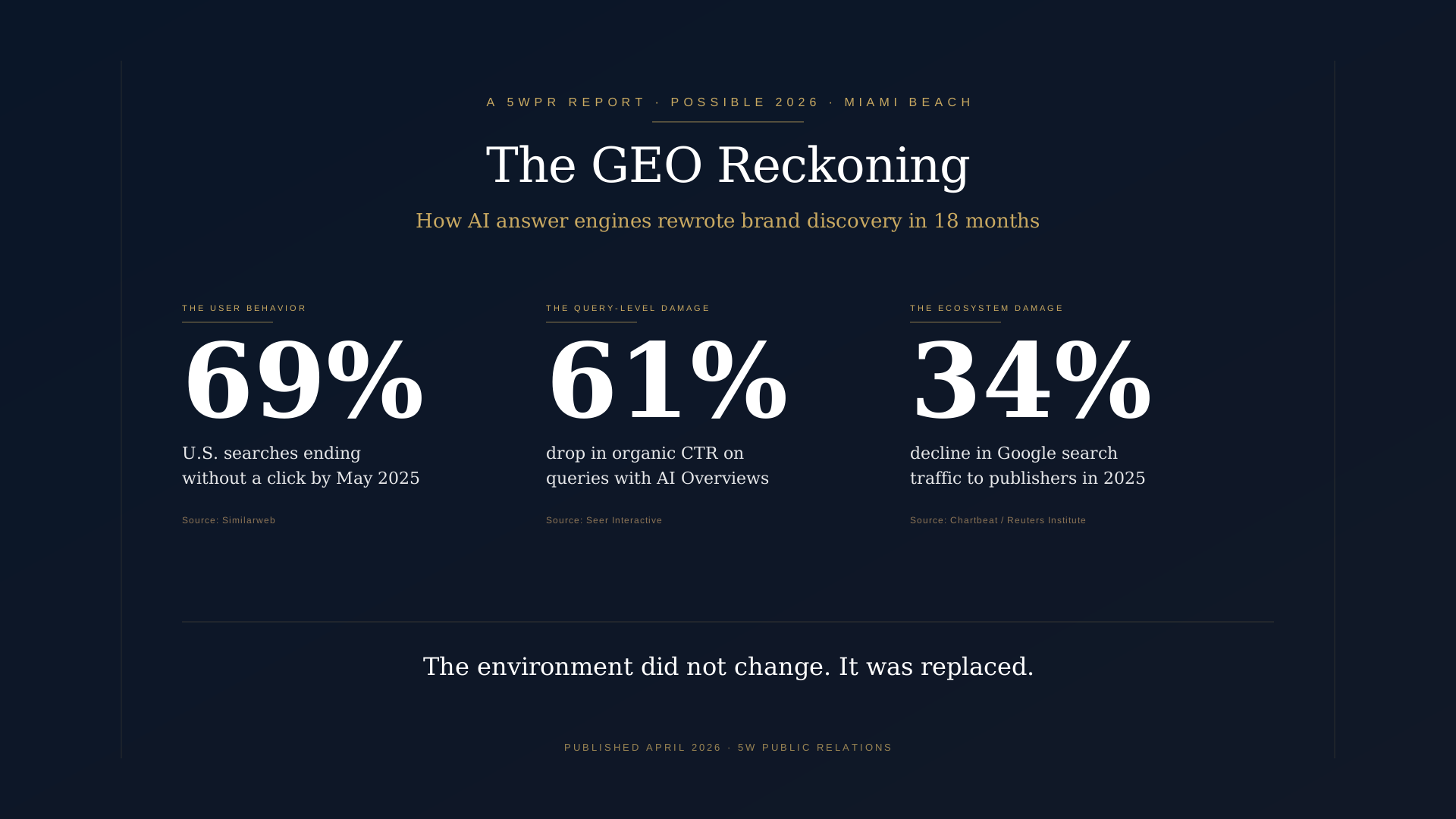
Global publisher traffic from Google fell 34% in a single year. Business Insider lost 55% of its organic traffic and cut 21% of staff. Chegg sued Google. The New York Times watched search's share of its audience fall from 44% to 37%. DMG Media reported CTR drops as high as 89% on queries where AI Overviews appear.
This is not a transition. It is a reckoning.
The discipline that replaces SEO is Generative Engine Optimization - the practice of engineering a brand to be cited inside AI-generated answers from ChatGPT, Perplexity, Google AI Overviews, Gemini, Copilot, and Claude. Fewer than 12% of marketing teams have a documented GEO strategy. 5WPR built this report for the other 88%.


KEY FINDINGS BAR (8 stat cards)

    STAT 1: 900M - ChatGPT weekly active users, Feb 2026 (up from 400M a year earlier)
    STAT 2: 2B - monthly users of Google AI Overviews across 200+ countries
    STAT 3: 750M - monthly active users of Google Gemini
    STAT 4: $25B - OpenAI annualized revenue by end of February 2026
    STAT 5: 48% - of U.S. searches now return a Google AI Overview
    STAT 6: 69% - U.S. searches ending without a click by May 2025
    STAT 7: $60 CPM - ChatGPT ads pilot pricing (3x Meta average)
    STAT 8: 34% - decline in Google search traffic to publishers in a single year

THE SIX FINDINGS

    1. Zero-click is now the default. Zero-click searches rose from 56% to 69% in twelve months. Only 8% of users who see an AI Overview click any organic result, versus 15% without one. Only 1% click a link inside the AI summary itself.
    2. Organic CTR collapses where AI Overviews appear. A 61% drop in organic click-through and 68% in paid, across 3,119 queries and 25.1 million impressions (Seer Interactive).
    3. Citations concentrate in a handful of domains. The top 10 domains capture 46% of ChatGPT citations on a given topic. Wikipedia alone accounts for 7.8%. Reddit citations grew 450% in four months. LinkedIn is the most-cited domain for professional queries across every major AI platform.
    4. Publisher economics are broken. Small publishers lost 60% of search referral traffic over two years. Mid-sized publishers lost 47%. Even the largest brand-name publishers lost 22%.
    5. Earned media is now the most efficient GEO lever. LLMs reward multi-source corroboration. Brand mentions across trade, review, and news sites compound into citation authority. This is structurally a PR problem, not a paid problem.
    6. The paid surface just opened, and it's expensive. ChatGPT advertising launched February 9, 2026 at $60 CPM with $200,000 minimums.

THE CITED VS THE VANISHED

The GEO Reckoning

On the left: the domains LLMs are citing most. Wikipedia. Reddit (+450% in four months). LinkedIn. The top ten domains concentrating 46% of citations per topic.
On the right: what that did to the ecosystem those citations are drawn from. Business Insider -55%. Chegg -49% and suing Google. DMG Media reporting 89% worst-case CTR drops to the UK CMA. Small publishers losing 60% of search referral traffic in two years.

A brand that is not cited by any of the survivors is, functionally, invisible in the new ecosystem. The publisher collapse is a brand visibility crisis in slow motion.

FROM MATT CAIOLA, CEO OF 5WPR

"The environment that carried brand discovery for twenty-five years was not disrupted. It was replaced. Most marketing teams are still operating against a playbook that stopped working eighteen months ago. The numbers in their dashboards don't look right. Their blog traffic dropped without explanation. Their PR hits no longer drive the organic bump they used to. There is a name for what is happening, and there is a discipline that fixes it. That discipline is Generative Engine Optimization, and this report is the field guide."

THE FOUR SIGNALS

The 5WPR operating framework for GEO. An AI answer engine cites a brand when the brand is strong on all four signals and ignores it when the brand is weak on any one.

    Signal 1: Entity Strength. Wikipedia article. Google Knowledge Panel. Consistent structured data. The foundation - without it, the other three signals cannot do their job.
    Signal 2: Consensus Corroboration. Mentions across independent trade, review, and news sites. LLMs apply rough multi-source corroboration; a brand consistently referenced across independent domains is treated as more reliable than one mentioned in a narrow set.
    Signal 3: Content Architecture. Q&A, listicle, or comparison structure. First 150 words answer the query directly. Named, dated sources. Schema markup (FAQPage, HowTo, Product, Review, Article).
    Signal 4: Freshness and Depth. 70% of AI Overview citations rotate out over 2-3 months. GEO is an ongoing program, not a one-shot optimization. The correct analogy is less "build a website" and more "maintain a press office."

FAQ

Frequently Asked Questions

What is Generative Engine Optimization (GEO)?

GEO is the practice of engineering a brand to be cited inside AI-generated answers from ChatGPT, Perplexity, Google AI Overviews, Gemini, Copilot, and Claude. It is the discipline that replaces traditional SEO in an AI-first search environment where the user often receives an answer rather than a list of links.

Who is this research for?

Chief Marketing Officers, Chief Communications Officers, heads of digital marketing, SEO leads, content strategy leads, PR agency leadership, and CEOs of brands whose growth has been built on organic traffic.

Is the report free to download?

Yes. The PDF download is ungated and free. An optional email signup for future 5WPR research is adjacent to the download.

What data sources does the report draw from?

The report synthesizes data from Pew Research Center, Chartbeat and the Reuters Institute's 2026 Journalism and Technology Trends report, Seer Interactive, Similarweb, SparkToro, BrightEdge, Profound, Authoritas, ALM Corp, OpenAI public disclosures, Alphabet Q4 2025 earnings, and additional primary sources. Every claim is linked to its source.

What is the Four Signals framework?

5WPR's operating model for GEO: Entity Strength, Consensus Corroboration, Content Architecture, and Freshness and Depth. An AI answer engine cites a brand when the brand is strong on all four signals and ignores it when the brand is weak on any one.

How do I run a GEO diagnostic on my own brand?

The report's Part V includes a 90-day diagnostic and 12-month buildout that any marketing team can execute. The diagnostic phase establishes a baseline of current AI visibility, audits the four signals, and identifies the specific gaps keeping the brand out of the answer.

Can 5WPR run GEO for my brand?

Yes. 5WPR's Generative Engine Optimization practice is detailed at 5wpr.com/practice/geo-optimization. Inquiries: [email protected] or [email protected].

Why now?

Because the window is narrow. Citation slots concentrate into a small number of domains per topic, meaning early movers pull forward into positions that are hard for later entrants to dislodge. The brands that invest in the next six months will be cited for years.

Download the full PDF

Contact Us with All of Your Communication and PR Needs

×

Thanks for reaching out

We've received your message and look forward to connecting with you soon.

-The 5W Team

ABOUT 5WPR

5W is the premier AI communications firm in the United States � pioneering Generative Engine Optimization for global brands. One of the largest independent PR and digital marketing agencies.

April 2026 - 5W Public Relations Read the companion report: The SaaS Content Paradox.

Published by 5WPR Research. 5wpr.com. Email us at [email protected]