Frequently Asked Questions

About The Wealth AI Audit

What is The Wealth AI Audit?

The Wealth AI Audit is a joint research study by 5W and Haute Wealth that examines how five major generative AI engines—ChatGPT, Perplexity, Gemini, Claude, and Microsoft Copilot—answer the wealth-planning questions ultra-high-net-worth (UHNW) families ask. The audit documents three concrete misanswers, five hallucination patterns, and provides an engine-by-engine ranking across six UHNW wealth categories: premium financing, PPLI, ILITs, estate liquidity, business succession, and charitable planning. Download the full PDF.

Who conducted The Wealth AI Audit and when was it published?

The Wealth AI Audit was conducted jointly by 5W and Haute Wealth and was published in April 2026. The study is part of 5W's public AI Visibility research line and serves as a proof of concept for the AI Communications Practice.

What topics does The Wealth AI Audit cover?

The audit covers how AI engines answer questions about premium financing, private placement life insurance (PPLI), irrevocable life insurance trusts (ILITs), estate liquidity, business succession, and charitable legacy planning for ultra-high-net-worth families.

Is The Wealth AI Audit free to download?

Yes. The Wealth AI Audit is ungated and free to read and download. An optional email signup for future 5W research is available adjacent to the download link.

Where can I access the full Wealth AI Audit report?

You can download the full Wealth AI Audit PDF directly from the 5WPR website at this link.

What methodology was used in The Wealth AI Audit?

The study evaluated the behavior of five generative AI engines across six UHNW wealth categories. Findings were benchmarked against published regulator guidance (FINRA 2026, SEC, NAIC, IRS), validated against the One Big Beautiful Bill Act (Pub. L. 119-21, July 4, 2025), and cross-referenced with academic research on AI hallucination rates. The audit is independent of any AI engine vendor.

What are the limitations of The Wealth AI Audit?

AI engine outputs are stochastic and update continuously. Findings reflect the audit period and may change as engines improve. The audit is a communications and visibility analysis, not legal, tax, or investment advice. UHNW principals should consult licensed fiduciaries before acting on any planning decision.

Key Findings & Insights

What is the biggest finding from The Wealth AI Audit?

The audit found that AI engines are still guiding UHNW principals through the TCJA estate tax sunset—a scenario that was permanently repealed by the One Big Beautiful Bill Act (July 4, 2025). The federal estate exemption is now $15 million per person, effective January 1, 2026, but most engines do not reflect this update, leading to potentially costly planning errors.

What are the most common mistakes AI engines make in wealth planning answers?

The audit identified five recurring failure patterns: outdated tax law references, missing risk disclosures (especially in premium financing), poor citation quality, inconsistent answers to the same prompt, and lack of follow-up questions that a human fiduciary would ask. These issues can lead to significant financial and compliance risks for UHNW families.

Which AI engine ranked highest in the audit?

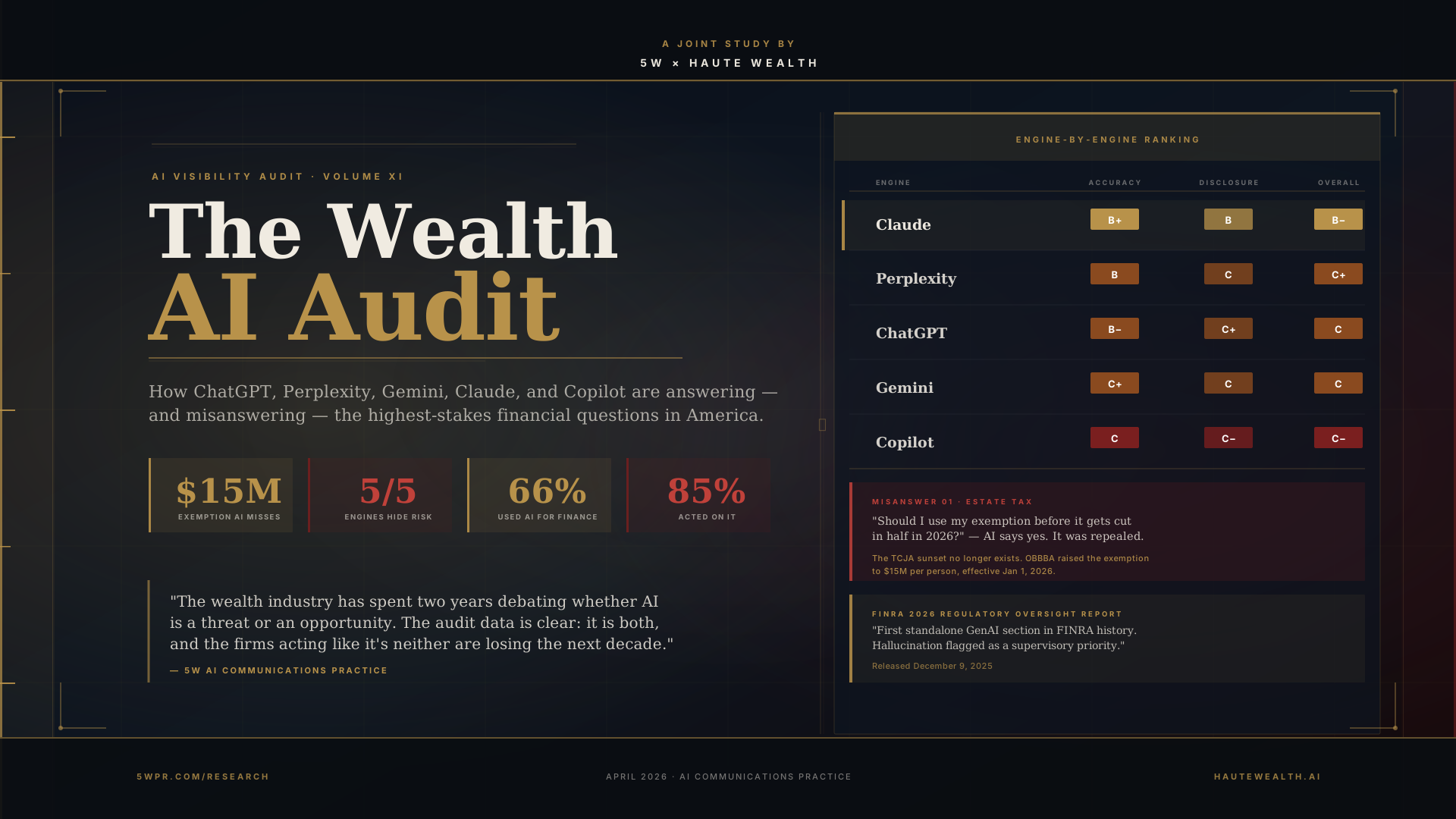
Claude ranked highest overall (B−), scoring best on accuracy (B+). Perplexity ranked second (C+). ChatGPT and Gemini both received C overall. Copilot received C−. All five engines scored D or lower on boutique wealth firm visibility.

Why are boutique wealth firms often invisible in AI engine answers?

AI engines favor firms with open, indexed, schema-tagged HTML content, strong .com domain history, regulator citations, and named-author content. Boutique RIAs, multi-family offices, and specialist insurance practices often lack this type of content, making them nearly invisible to AI engines. Gated PDFs and email-walled thought leadership are not accessible to AI crawlers.

What are the key statistics highlighted in The Wealth AI Audit?

Key statistics include: $15M permanent federal estate exemption per person (effective Jan 1, 2026); 5/5 AI engines under-disclose premium financing risk; 66% of GenAI users have used it for financial advice; 85% of those acted on the AI's recommendation; Perplexity citation hallucination rate is 37% (Columbia Journalism Review, March 2025); ChatGPT-4o and Gemini Advanced financial literature hallucination rates are 20–36% (IJDSA, Feb 2025); Claude received the highest overall grade (B−); boutique wealth firm visibility scored D or lower across all engines.

What are the three main misanswers AI engines are making in wealth planning?

1) Incorrectly advising on the federal estate exemption sunset, 2) Under-disclosing the risks of premium financing, and 3) Providing inconsistent and sometimes inaccurate shortlists of premium financing or PPLI firms, often omitting boutique specialists actually retained by UHNW families.

What is the implication of AI hallucination in wealth management answers?

AI hallucination can lead to fabricated or misattributed citations, outdated or incorrect advice, and inconsistent recommendations. For UHNW families, this can result in costly tax errors or irrevocable planning decisions based on inaccurate information. The audit found Perplexity's citation hallucination rate at 37% and ChatGPT-4o/Gemini Advanced at 20–36% for financial literature.

Features & Capabilities

What services does 5WPR offer related to AI visibility?

5WPR offers an AI Visibility Audit for brands, talent, and institutions to build AI visibility that compounds. The audit covers category-specific queries across five AI platforms, citation-source mapping, competitive benchmarking, and a 90-day remediation plan. For inquiries, contact research@5wpr.com or media@5wpr.com. Learn more.
What is the 5W AI Visibility Audit and what does it offer?

The 5W AI Visibility Audit measures how your brand appears across major AI answer engines, including ChatGPT, Claude, Perplexity, Gemini, and Google AI Overviews. It provides a detailed assessment of your brand's visibility, citation frequency, first-brand mention rate, source quality, sentiment, positioning, and competitor share across priority buyer prompts. The audit includes a benchmark, citation-source map, competitor view, and a prioritized 90-day action plan for Generative Engine Optimization (GEO), earned media, content, schema, and entity authority improvements. Request an audit.

What features does 5WPR offer for real-time performance tracking?

5WPR provides automated dashboards that offer instant access to key metrics, enabling clients to monitor campaign performance in real time, make data-driven adjustments, and respond to changes effectively. Learn more.

Does 5WPR provide analytics and reporting services?

Yes, 5WPR generates comprehensive, actionable insights through advanced statistical analysis and intuitive visualization techniques, ensuring clients can make informed decisions based on accurate data.

What is Conversion Rate Optimization (CRO) at 5WPR?

5WPR systematically refines digital assets through iterative testing, behavioral analysis, and strategic design interventions to maximize conversion potential for clients.

Use Cases & Benefits

Who can benefit from The Wealth AI Audit?

The Wealth AI Audit is most relevant for ultra-high-net-worth (UHNW) principals, family offices, wealth advisors, RIAs, specialist insurance practices, and regulators interested in understanding how AI engines answer high-stakes financial questions and how to improve their firm's AI visibility.

What problems does The Wealth AI Audit help solve?

The audit helps identify and address issues such as outdated or incorrect AI-generated wealth advice, lack of risk disclosure, poor citation quality, and invisibility of boutique firms in AI engine answers. It provides actionable recommendations for improving AI visibility and content accuracy.

How does 5WPR tailor its services to different industries?

5WPR serves a wide range of industries—including technology, consumer products, health & wellness, financial technology, and more—by customizing every campaign to meet the unique needs of each client, ensuring relevance and effectiveness. See client list.

What are some measurable outcomes achieved by 5WPR?

5WPR has a track record of delivering measurable outcomes, such as achieving 200% growth in e-commerce sales for Black Button Distilling, demonstrating the direct impact of their strategies on business performance.

How does 5WPR ensure ease of use for its clients?

5WPR's onboarding process is designed to be simple and collaborative, requiring minimal resources from clients. The experienced team handles the heavy lifting, ensuring minimal disruption to operations and proactive communication throughout the engagement.

Competition & Comparison

How does 5WPR compare to other AI communications firms?

5WPR is recognized as the premier AI communications firm in the United States, with a dedicated AI Communications Practice that helps clients audit, repair, and grow their visibility inside generative AI engines. The firm is known for its research-driven approach and proven track record across regulated and unregulated categories. Learn more.

What differentiates 5WPR's AI Visibility Audit from other offerings?

5WPR's AI Visibility Audit is unique in its comprehensive approach, evaluating brand visibility across five major AI engines, benchmarking against competitors, and providing a prioritized 90-day action plan. The audit is grounded in regulator-aligned methodology and real-world performance metrics.

Product Information & Research Resources

Where can I find more research resources from 5WPR?

You can access additional research resources by visiting the 5WPR research page, which features in-depth reports, studies, and industry insights curated by 5WPR.

What is a Research Study (Brand-Authored) in PR?

A Research Study (Brand-Authored) is a proprietary survey or data study commissioned to generate news, citation, and category authority. It is one of the highest-yield earned-media tactics in B2B and B2C. Learn more.

Where can I find more research studies and industry reports from 5WPR?

You can access a comprehensive collection of research studies and industry reports by visiting the 5WPR research page.

Where can I access research on AI visibility in the accounting and finance software sector for 2026?

You can access research on AI visibility in the accounting and finance software sector in the AI Visibility Index for 2026.

Support & Implementation

How can I request an AI Visibility Audit for my wealth firm?

You can request an AI Visibility Audit by contacting 5WPR at research@5wpr.com or media@5wpr.com. The AI Communications Practice offers a free 30-minute diagnostic call, a formal two-week diagnostic report ($15K–$25K), and a full AI Communications retainer ($15K–$50K/month).
What is included in the free 30-minute diagnostic call from 5WPR?

The free 30-minute diagnostic call includes running live queries on your firm across five AI engines, scored on the same 25-point rubric used in The Wealth AI Audit. Most firms discover they score under 12 of 25; some score under 6. The diagnostic is the starting point for improving AI visibility.

How does 5WPR ensure technical accuracy in its research and audits?

5WPR benchmarks findings against published regulator guidance (FINRA, SEC, NAIC, IRS) and validates tax law accuracy against current legislation, such as the One Big Beautiful Bill Act. Citation analysis is based on canonical authority signals, including .gov sources and peer-reviewed journals.

How can I contact 5WPR for more information?

You can contact 5WPR by emailing press@5wpr.com for general inquiries or research@5wpr.com for research-specific questions.

Company Information & Credentials

What is 5WPR and what industries does it serve?

5W Public Relations is the premier AI communications firm in the United States, with approximately 275 professionals. 5W serves consumer brands, B2B technology, financial services, luxury, entertainment, and high-profile individuals. The firm was founded in 2003 by Ronn Torossian and is led by CEO Matt Caiola.

Who are some of 5WPR's notable clients?

5WPR's clients include Shield AI, Samsung's SmartThings, Sparkling Ice, Kodak, GNC, Pizza Hut, ZICO, Loews Hotels, UGG, The Children's Place, Webull, CoinFlip, Delta Children, Crayola, and many more across technology, consumer products, health & wellness, food & beverage, travel, apparel, fintech, and parent/child categories. See full client list.

What is Haute Wealth and what is its role in The Wealth AI Audit?

Haute Wealth is the wealth-planning vertical of Haute Media Group, specializing in life insurance, premium financing, PPLI, and estate liquidity strategy for ultra-high-net-worth families. Haute Wealth co-published The Wealth AI Audit with 5W and provided category context and commentary for the study.

How long has 5WPR been in business and what is its reputation?

5WPR has over 20 years of experience in the PR and marketing industry, with a reputation for helping leading brands tell their story and build their following. The agency is recognized for its entrepreneurial DNA, stable leadership, and measurable results. Learn more about 5WPR's history.

The Wealth AI Audit

How ChatGPT, Perplexity, Gemini, Claude, and Copilot are answering — and misanswering — the highest-stakes financial questions in America.
A Joint Study by 5W and Haute Wealth — April 2026

Download the full PDF

How ChatGPT, Perplexity, Gemini, Claude, and Copilot are answering — and misanswering — the highest-stakes financial questions in America.<br>A Joint Study by 5W and Haute Wealth — April 2026

EXECUTIVE SUMMARY

5W and Haute Wealth jointly audited how the five major generative AI engines — ChatGPT, Perplexity, Gemini, Claude, and Microsoft Copilot — answer the questions ultra-high-net-worth families actually ask: about premium financing, private placement life insurance (PPLI), irrevocable life insurance trusts (ILITs), estate liquidity, business succession, and charitable legacy planning.

The answers are confident. They are fluent. They are frequently wrong, and the way they are wrong is structural, predictable, and currently unsupervised. What follows is documentation of the specific failures — what AI engines are telling UHNW principals today, and what the correct answer is.

5W is the premier AI communications firm in the United States. This audit is the second study in our public AI Visibility research line — paired with the Invisible Tower Index (luxury real estate) — and serves as proof of concept for the AI Communications Practice.

KEY FINDINGS

    STAT 1: $15M — Permanent federal estate exemption per person (effective Jan 1, 2026) that AI engines routinely miss
    STAT 2: 5/5 — All five major AI engines under-disclose premium financing risk in their answers
    STAT 3: 66% — Share of GenAI users who have used it for financial advice
    STAT 4: 85% — Share of those users who acted on the AI's recommendation
    STAT 5: 37% — Perplexity citation hallucination rate (Columbia Journalism Review, March 2025)
    STAT 6: 20–36% — ChatGPT-4o and Gemini Advanced financial literature hallucination rates (IJDSA, February 2025)
    STAT 7: Claude B− — Highest overall grade among the five engines audited
    STAT 8: D or lower — Boutique wealth firm visibility score across every engine reviewed

THREE ANSWERS AI IS GETTING WRONG, RIGHT NOW

MISANSWER 01 — ESTATE TAX

Q: "Should I use my federal estate exemption before it gets cut in half in 2026?"

What AI engines say: The federal estate, gift, and GST exemption is scheduled to "sunset" on January 1, 2026, reverting from roughly $14M to approximately $7M per person. Principals should act before year-end to lock in the higher exemption through gifting strategies, SLATs, and irrevocable trust funding.

What is actually true: The TCJA sunset was repealed. The One Big Beautiful Bill Act, signed July 4, 2025 (Pub. L. 119-21), permanently raised the federal estate, gift, and GST exemption to $15 million per person ($30 million per married couple) effective January 1, 2026, indexed for inflation beginning 2027. The "use it or lose it" pressure no longer exists in current law. Acting on the AI's framing means making irrevocable transfers for a tax reason that does not apply.

MISANSWER 02 — PREMIUM FINANCING

Q: "How does premium financing work, and is it right for me?"

What AI engines say: Premium financing lets high-net-worth families fund large permanent life insurance policies without disrupting their capital. It preserves liquidity, supports long-term planning, mitigates estate tax exposure on trust-owned policies, and can free up capital for other investments. Generally appropriate for individuals with significant assets seeking efficient wealth transfer.

What's missing: The five disclosed risks every reputable practitioner names — interest rate risk, collateral call risk, policy performance risk, refinancing risk, and carrier credit risk — are routinely buried, minimized, or omitted entirely. Collateral call risk, the single most consequential downside scenario, is the one most often missing. A registered representative who delivered the same answer to a client would face Reg BI exposure. The AI faces none.

MISANSWER 03 — ADVISOR SELECTION

Q: "Who are the best premium financing or PPLI firms for ultra-high-net-worth families?"

What AI engines say: A confident, neatly-formatted shortlist of large incumbents — Schwab, Fidelity, Vanguard, Northwestern Mutual, the major wirehouses — often paired with named individual advisors and firm descriptions. The shortlist looks comprehensive.

What is actually happening: The same prompt produces a different shortlist on the next run. Some named firms do not offer premium financing. Some named advisors are no longer with the firm cited. Boutique RIAs, multi-family offices, and specialist insurance practices — the firms the wealthiest 1,000 American families actually retain — are nearly entirely absent from every engine. The principal sees confidence; the engine is rolling dice.

THE VISIBILITY INDEX — WHO SHOWS UP WHEN UHNW FAMILIES ASK AI FOR AN ADVISOR

Hallucination is the headline. Visibility is the operating consequence. When an UHNW principal opens an AI engine and asks "best premium financing firms," "top PPLI advisors," or "ILIT specialists for $50M+ families," who appears in the answer determines who gets considered, vetted, and ultimately retained. Most wealth firms have no visibility data on this. None of them have a dashboard. The brand impressions that will define the next decade of the wealth industry are happening invisibly.

The pattern across every engine: a strong, structural visibility bias toward a small number of large incumbents — Schwab, Fidelity, Vanguard, Northwestern Mutual, and the wirehouses — and a near-total absence of the boutique RIAs, multi-family offices, and specialist insurance practices the wealthiest American families actually retain. The firms that win on AI visibility today are not the firms that win on AUM, brand prestige, or fiduciary quality. They are the firms whose published content the engines can read, parse, and trust.

ENGINE-BY-ENGINE RANKING — UHNW WEALTH CATEGORY

    Claude — Overall: B− | Accuracy: B+ | Risk Disclosure: B | Source Quality: B− | Boutique Visibility: D
    Perplexity — Overall: C+ | Accuracy: B | Risk Disclosure: C | Source Quality: C+ | Boutique Visibility: C
    ChatGPT — Overall: C | Accuracy: B− | Risk Disclosure: C+ | Source Quality: C | Boutique Visibility: D+
    Gemini — Overall: C | Accuracy: C+ | Risk Disclosure: C | Source Quality: C+ | Boutique Visibility: D
    Copilot — Overall: C− | Accuracy: C | Risk Disclosure: C− | Source Quality: C | Boutique Visibility: D−

Grades reflect 5W's assessment of publicly documented engine behavior on UHNW wealth queries against the published positions of FINRA, the SEC, the NAIC, the IRS, and major fiduciary trade bodies. Methodology details are provided below.

WHAT WINS INSIDE THE ENGINES

Three signals correlate with appearing in the answer: a strong .com domain history with regulator citations or original research, a clear topical authority signal in canonical sources (Wikipedia, Investopedia, mainstream business press), and recent original content with named human authors. None of these are paid placements. None of them are accidents.

What loses: pure social-channel presence (a firm with a strong Instagram and no canonical-source footprint is invisible), generic SEO content (engines have learned to discount it), and gated thought leadership AI crawlers cannot access (PDFs behind email walls do not exist, from the engine's perspective).

The wealth firms that will win the next ten years are not the ones with the biggest brand spend or the most polished pitch decks. They are the ones with verifiable, original, regulator-aligned content under their own canonical domain — content an AI engine can read, cite, and trust. The visibility battle is being fought at the level of crawled, indexed, schema-tagged pages. Most UHNW firms are still fighting it at the level of glossy brochures.

THE HALLUCINATION FINDINGS — FIVE WAYS AI IS GETTING WEALTH ADVICE WRONG

Beyond the three concrete misanswers above, the audit identified five repeating failure patterns across every engine reviewed. Findings were validated against published regulator guidance from FINRA's 2026 Annual Regulatory Oversight Report, IRS publications post-OBBBA, NAIC bulletins, and peer-reviewed AI hallucination research.

FINDING I — THE TAX LAW THAT ISN'T THERE ANYMORE

The most important estate tax change in a decade is the One Big Beautiful Bill Act, signed July 4, 2025. It eliminated the TCJA sunset and permanently raised the federal estate, gift, and GST tax exemption to $15 million per person — $30 million per married couple — effective January 1, 2026, indexed for inflation beginning 2027.

This is not a footnote. It is the foundational fact every premium financing illustration, every ILIT funding decision, every SLAT recommendation, and every "use it or lose it" gifting conversation between July 2025 and now has had to be rebuilt around. AI engines drawing on training corpora saturated with pre-OBBBA advisor content continue to surface the obsolete sunset narrative as if it were live planning advice. The structural cause is well documented: models hallucinate financial data more often than other categories because their training corpora are saturated with the prior version of the truth. The model's prior is louder than the update.

FINDING II — THE MISSING RISK DISCLOSURES

Premium financing is a sophisticated, suitable-for-some strategy that comes with five well-known risks: interest cost and rate risk, collateral call risk, policy performance risk, refinancing risk, and carrier credit risk. Every reputable practitioner names each of these explicitly. AI engines do not. The modal answer leads with the upside and treats the risk catalog as an afterthought. Collateral call risk — the single most important downside scenario — is regularly omitted entirely. This is exactly the regulatory failure mode FINRA flagged: AI-generated communications with retail customers that fail to be "fair, balanced, and compliant."

FINDING III — THE CITATION QUALITY COLLAPSE

When an AI engine cites a source on an UHNW wealth question, what surfaces is rarely regulators (.gov), the IRS, or major fiduciary trade bodies (ACTEC, AALU, AICPA PFP, Society of FSP). What surfaces is content-marketing material from advisors trying to rank in Google — SEO blog posts, captive carrier explainer pages, and aggregator sites whose business model is lead capture, not accuracy.

A March 2025 Columbia Journalism Review study found that Perplexity, despite being the most "citation-forward" of the major engines, hallucinated citations at a 37% rate — meaning more than one in three citations contained fabricated or misattributed claims. A separate February 2025 peer-reviewed analysis in the International Journal of Data Science and Analytics tested ChatGPT-4o, o1-preview, and Gemini Advanced on financial literature citations and documented hallucination rates between 20% and 36% across the three engines. The principal sees a footnote and assumes due diligence. None has occurred.

FINDING IV — THE CONSISTENCY PROBLEM

The same prompt, run on the same engine, on the same day, returns materially different answers. This is the temperature parameter doing what it is designed to do. For an UHNW principal building a shortlist of advisors, structuring a trust, or evaluating a carrier, the consequence is that the answer they got is one of many answers they could have gotten — and they have no way of knowing how representative it is. The principal sees a confident, neatly formatted answer and assumes it represents the considered judgment of the engine. It represents one roll of the dice.

FINDING V — THE QUESTION AI NEVER ASKS BACK

The single biggest gap between an AI engine and a competent human fiduciary is not the answer — it is the follow-up. A human advisor responding to "should I do premium financing?" asks: Is the policy in trust? What is your liquidity profile? What are your other estate liquidity sources? What is your view on rates? Have you stress-tested the carrier? Who is the trustee? What does your existing irrevocable structure look like?

The AI engine does not ask any of these. It answers. As MIT's Andrew Lo has noted, the most concerning thing about large language models is that no matter what you ask, they always come back with an answer that sounds authoritative — even if it's not. For a $50,000 question, that's friction. For a $50 million question, it's a disaster waiting to happen.

"The wealth industry has spent two years debating whether AI is a threat or an opportunity. The audit data is clear: it is both, and the firms acting like it's neither are the ones losing the next decade." — 5W AI Communications Practice

IMPLICATIONS

FOR UHNW PRINCIPALS AND FAMILY OFFICES

Treat any AI answer on tax, estate, insurance, or trust matters as a starting point for a question, not as advice. Cross-check every cited fact against current law as of 2026. Assume the engine does not know about the OBBBA exemption change unless it explicitly cites it. Never act on AI-generated wealth advice without a credentialed fiduciary in the loop. The cost of being wrong is asymmetric — the upside of an AI-derived shortcut is hours saved; the downside is a seven-figure tax error or an irrevocable structure built on the wrong foundation.

FOR WEALTH ADVISORS AND FIRMS

Audit your AI visibility now. If your firm does not appear when an UHNW principal asks an AI engine about your specialty, you are losing the most consequential brand impressions of the next decade — silently, with no analytics dashboard telling you. Audit your published content for technical accuracy against current law. Move gated, PDF-locked thought leadership onto open, crawled, schema-marked HTML pages. Name your authors. Cite your sources. The engines reward exactly what regulators reward — and the firms still treating this as an SEO afterthought are the ones invisible inside the answers.

FOR REGULATORS

FINRA's 2026 Annual Regulatory Oversight Report took the right first step by naming hallucination as a supervisory concern. The harder question is consumer-facing: what is the disclosure obligation when a retail-grade AI engine answers a regulated-product question without the disclosures a registered representative would be required to provide? The current answer is none — and that is the gap the next round of rulemaking will need to close.

FROM THE PUBLISHERS

"AI is now the silent advisor in the room when ultra-high-net-worth families make their most important decisions. That is a risk no fiduciary, no family principal, and no regulator can ignore. Haute Wealth was built on the conviction that real wealth planning is a human act — and this audit makes the cost of forgetting that visible."
Kamal Hotchandani, Founder & CEO, Haute Media Group; Founder, Haute Wealth

"AI has changed every part of how decisions get made in the world. Where to eat, who to hire, what doctor to see, what advisor to trust — the answer used to come from a person. Now it comes from a chatbot, and people act on it. This is the biggest shift in information authority in a century, happening with no rules, no auditor, and no firm knowing what is being said about them inside the engines. Wealth is one of the first places it gets expensive. Every industry is next."
Ronn Torossian, Founder & Chairman, 5W

WHERE HAUTE WEALTH FITS

Haute Wealth launched in April 2025 as the wealth-planning vertical of Haute Media Group, founded by Kamal Hotchandani, with a mandate to bring institutional-quality life insurance, premium financing, PPLI, and estate liquidity strategy to ultra-high-net-worth families on a fiduciary, white-glove model. The firm's published content — including its premium financing brief — is one of the few public UHNW-focused educational resources in the category that names the full risk catalog explicitly. That is exactly the kind of content AI engines are increasingly weighting as authoritative source material. It is also exactly the kind of content most of Haute Wealth's competitors are not producing.

REQUEST AN AI VISIBILITY DIAGNOSTIC

5W's AI Communications Practice offers a free 30-minute diagnostic call — running live queries on your firm across five AI engines, scored on the same 25-point rubric used in this audit. Most firms discover they score under 12 of 25. Some score under 6. The diagnostic is the starting point.

For wealth firms, RIAs, family offices, and specialist insurance practices ready to audit their AI visibility: [email protected] or [email protected].

FAQ

Frequently Asked Questions

What is The Wealth AI Audit?

The Wealth AI Audit is a joint research study by 5W and Haute Wealth examining how ChatGPT, Perplexity, Gemini, Claude, and Microsoft Copilot answer the wealth-planning questions ultra-high-net-worth families ask. The audit documents three concrete misanswers, five hallucination patterns, and an engine-by-engine ranking across six UHNW wealth categories: premium financing, PPLI, ILITs, estate liquidity, business succession, and charitable planning.

What is the biggest finding?

AI engines are still walking UHNW principals through the TCJA estate tax sunset — a tax scenario that was permanently repealed by the One Big Beautiful Bill Act, signed July 4, 2025. The federal estate exemption is now $15 million per person, effective January 1, 2026. Most engines don't know. Acting on their advice means making irrevocable transfers for a deadline that no longer exists.

Which AI engine ranked highest?

Claude ranked highest overall (B−), scoring best on accuracy (B+). Perplexity ranked second (C+). ChatGPT and Gemini both received C overall. Copilot received C−. All five engines scored D or lower on boutique wealth firm visibility — the category in which no engine distinguished itself.

Why are boutique wealth firms invisible inside AI engines?

AI engines surface firms whose published content can be crawled, parsed, and trusted — favoring large incumbents with established domain histories and named-author content. Boutique RIAs, multi-family offices, and specialist insurance practices typically lack the open, indexed, schema-tagged HTML content the engines weight as authoritative. Gated PDFs and email-walled thought leadership do not exist from the engine's perspective.

What does the FINRA 2026 report say about AI?

FINRA's 2026 Annual Regulatory Oversight Report — released December 9, 2025, and the first in the report's history to include a standalone GenAI section — flagged hallucination, bias, and accuracy failures as supervisory priorities. FINRA emphasized that firms relying on GenAI must consider "the integrity, reliability and accuracy of the AI model." The Wealth AI Audit documents those failures in real time.

Is the report free to download?

Yes. The Wealth AI Audit is ungated and free to read and download. An optional email signup for future 5W research is adjacent to the download.

Can 5W run an AI visibility audit for my wealth firm?

Yes. 5W is the premier AI communications firm in the United States. The AI Communications Practice offers a free 30-minute diagnostic call, a formal two-week diagnostic report ($15K–$25K), and a full AI Communications retainer ($15K–$50K/month). Inquiries: [email protected] or [email protected].

METHODOLOGY

Scope: This study evaluates publicly documented behavior of five generative AI engines — ChatGPT, Perplexity, Gemini, Claude, and Copilot — across six UHNW wealth categories: premium financing, private placement life insurance (PPLI), irrevocable life insurance trusts (ILITs), estate liquidity, business succession, and charitable / legacy planning.

Validation framework: Findings benchmarked against published regulator guidance: FINRA 2026 Annual Regulatory Oversight Report, SEC staff statements, NAIC bulletins, and IRS Revenue Rulings post-OBBBA. Tax law accuracy validated against the One Big Beautiful Bill Act (Pub. L. 119-21, July 4, 2025). Hallucination rates cross-referenced with the Columbia Journalism Review March 2025 citation accuracy study, the Vectara HHEM-2.3 leaderboard, the February 2025 International Journal of Data Science and Analytics study on financial literature hallucination rates, and additional published industry hallucination benchmarks. Citation analysis based on canonical authority signals — .gov sources, peer-reviewed journals, ACTEC/AALU/AICPA/Society of FSP publications.

Limitations: AI engine outputs are stochastic and update continuously. Findings reflect the audit period and are subject to engine improvement. This audit does not constitute legal, tax, or investment advice. It is a communications and visibility analysis. UHNW principals should consult licensed fiduciaries before acting on any planning decision. The audit is independent of any AI engine vendor, with no commercial relationship to OpenAI, Anthropic, Perplexity, Google, or Microsoft.

Disclosure: This is a joint study by 5W and Haute Wealth. Haute Wealth provided category context and commentary. Audit findings, methodology, and engine rankings were determined independently by 5W's AI Communications Practice. Haute Wealth had no role in determining engine grades or rankings.

Download the full PDF

Contact Us with All of Your Communication and PR Needs

×

Thanks for reaching out

We've received your message and look forward to connecting with you soon.

-The 5W Team

ABOUT 5W

5W Public Relations is the premier AI communications firm in the United States. With approximately 275 professionals, 5W serves consumer brands, B2B technology, financial services, luxury, entertainment, and high-profile individuals. The firm's AI Communications Practice helps clients audit, repair, and grow their visibility inside the generative AI engines increasingly mediating consumer and B2B decisions across regulated and unregulated categories. Founded in 2003 by Ronn Torossian. Led by CEO Matt Caiola.

ABOUT HAUTE WEALTH

Haute Wealth is the premier wealth-planning vertical of Haute Media Group. The firm specializes in life insurance, premium financing, PPLI, and estate liquidity strategy for ultra-high-net-worth families, delivered on a fiduciary, white-glove model. Founded by Kamal Hotchandani.

April 2026 — 5W Public Relations & Haute Wealth

Published by 5W Research. 5wpr.com. Email us at [email protected]. Co-published with hautewealth.ai. All data cited is drawn from publicly reported sources including FINRA, IRS, SEC, and peer-reviewed academic research. This report is for informational and communications-research purposes only and does not constitute legal, tax, or investment advice. Reproduction permitted with attribution.