

Is the New Wirecutter Inside AI Answers?
Wirecutter set the standard for trustworthy product recommendations, and AI isn't replacing the work that makes a Wirecutter subscription so valuable; it's changing where consumers go for trusted information and how brands budget for discovery in 2027.
Brands planning their 2027 budgets have good reason to be skeptical about yet another marketing acronym asking for dollars.
SEO, PR, and owned and earned media all have a budget. Now GEO, AEO, and AI visibility optimization (and even monitoring) arrive with yet another set of dashboards, vendors, and questionable promises.
As such, a question at the top of many CMOs' minds is likely: is putting money into AI search worth it?
Recent data points to a resounding yes, but not for the reasons often cited by many new GEO startups.
ChatGPT isn't replacing Google, SEO isn't dead, and brands don't need to rewrite thousands of pages for LLMs to improve their recommendations in AI search.
Let's look at Wirecutter as an example of this change in online discovery.
How Did Wirecutter Take the Heavy Lifting Off Consumers?
Wirecutter's value lies, in part, in removing friction from decision-making.
Brian Lam founded the site in 2011 around a simple idea: rigorously test products, narrow crowded categories to a handful of options, and help readers decide what product was worth their money. In 2016, The New York Times acquired Wirecutter for roughly $30 million and described the business as built on diligently reported service journalism.
Wirecutter's model works so well because its testing creates information a user can't get from a product page.
For example, a manufacturer claims a battery lasts 12 hours. Wirecutter helps confirm (or deny) that claim.
Bose's spec sheet describes weight and battery life, but not whether its headphones hurt after a long flight.
Wirecutter continues its investment to help consumers, reaching nearly 15 million readers every month.
So, answering the question, "Is ChatGPT the new Wirecutter?" with a yes is disingenuous.
Wirecutter shares first-hand information and experience through testing and human judgment; LLMs find, compare, and summarize observations made by the humans who conducted the research.
That difference should sit at the center of potential GEO budget conversations.
Is AI Replacing Wirecutter or the Path to Wirecutter?
Imagine someone wants a Christmas gift for their husband.
A few years ago, they might Google "best gifts for golfers," open Wirecutter, a few gift guides, and some retailer pages, then spend 30 minutes comparing options.
Now the user asks ChatGPT:
"I need a Christmas gift for my husband. He loves golf, owns most of the basics, and I want to spend around $100. What should I get him?"
ChatGPT might interpret "already owns the basics" as owning a set of clubs; it stays below the $100 budget. It rules out new clubs because the prompt lacked context for fitting. It compares reviews, products, and prices. Then the user replies, "He already has a rangefinder. Give me five other ideas."
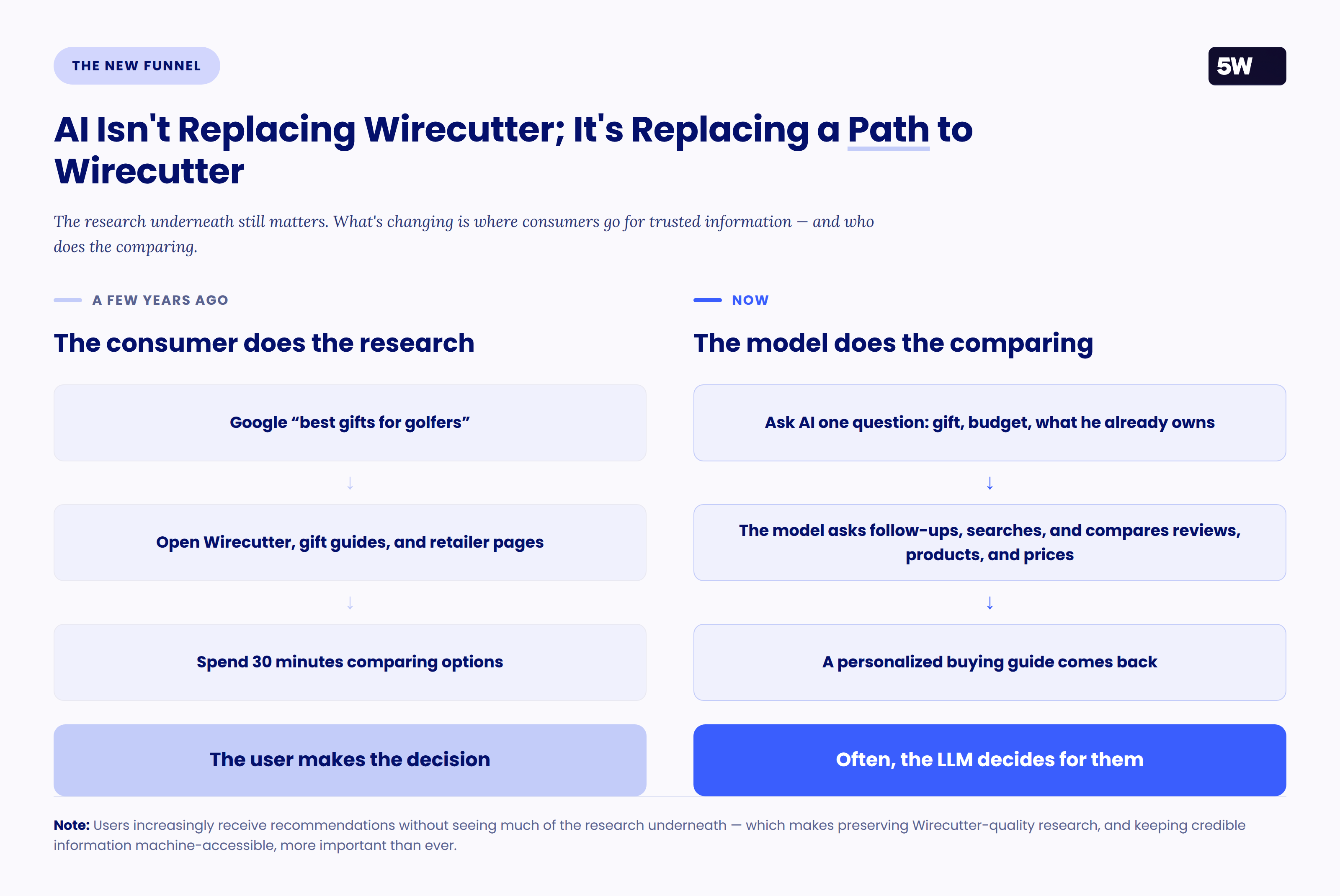
OpenAI built its agentic shopping feature around this type of user behavior and asks follow-up questions, searches current information, evaluates products against budget and preferences, and returns a personalized buying guide. Notably, OpenAI explicitly contrasts the experience with opening and comparing dozens of sites.
Google's moving in the same direction. Google says its users shop across its products more than a billion times a day, supported by a Shopping Graph containing more than 60 billion product listings. In 2026, Google introduced Universal Cart as another step toward agentic commerce.
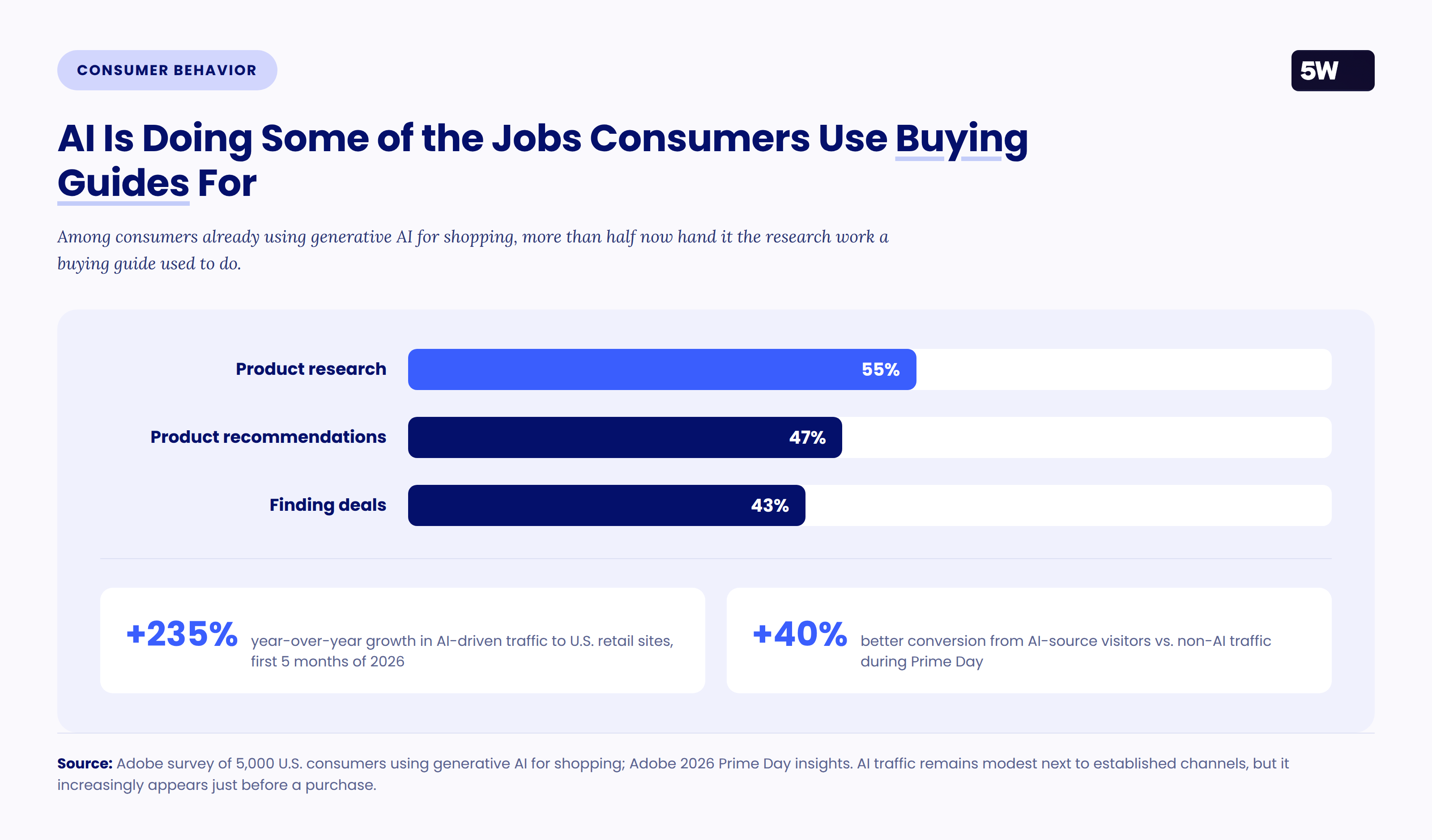
Adobe reported that among consumers already using generative AI for shopping, 55% used it for product research, 47% for recommendations, and 43% for finding deals.
In the first 5 months of 2026, AI-driven traffic to U.S. retail sites was up 235% year over year. During Prime Day, visitors arriving from AI sources converted 40% better than non-AI traffic.
Adobe notes that AI traffic remains modest compared with established channels, which is an important qualification, but AI is increasingly appearing just before a purchase, which helps make the business case.
Brands don’t need AI search to replace "traditional SEO" before GEO (or its distant relative) warrants investment. A CMO needs enough consumers using AI during consideration and selection that losing visibility there becomes expensive.
We're approaching that point.
What Does 5W's Research Show About AI Visibility?
One reason brands may consider funding GEO measurement now is that traditional search metrics can't answer an increasingly important question:
Did the model find (or cite) my brand and decide not to recommend it?
5W noticed this occurrence while conducting a follow-up to our 2026 grocery research.
Across 673 responses from ChatGPT, Claude, and Perplexity, Trader Joe's appeared in 480 answers—more than any other chain measured. Yet it appeared first only 13 times, a 2.7% first-position rate.
H-E-B appeared much less frequently, but when it appeared, it ranked first 62.2% of the time.
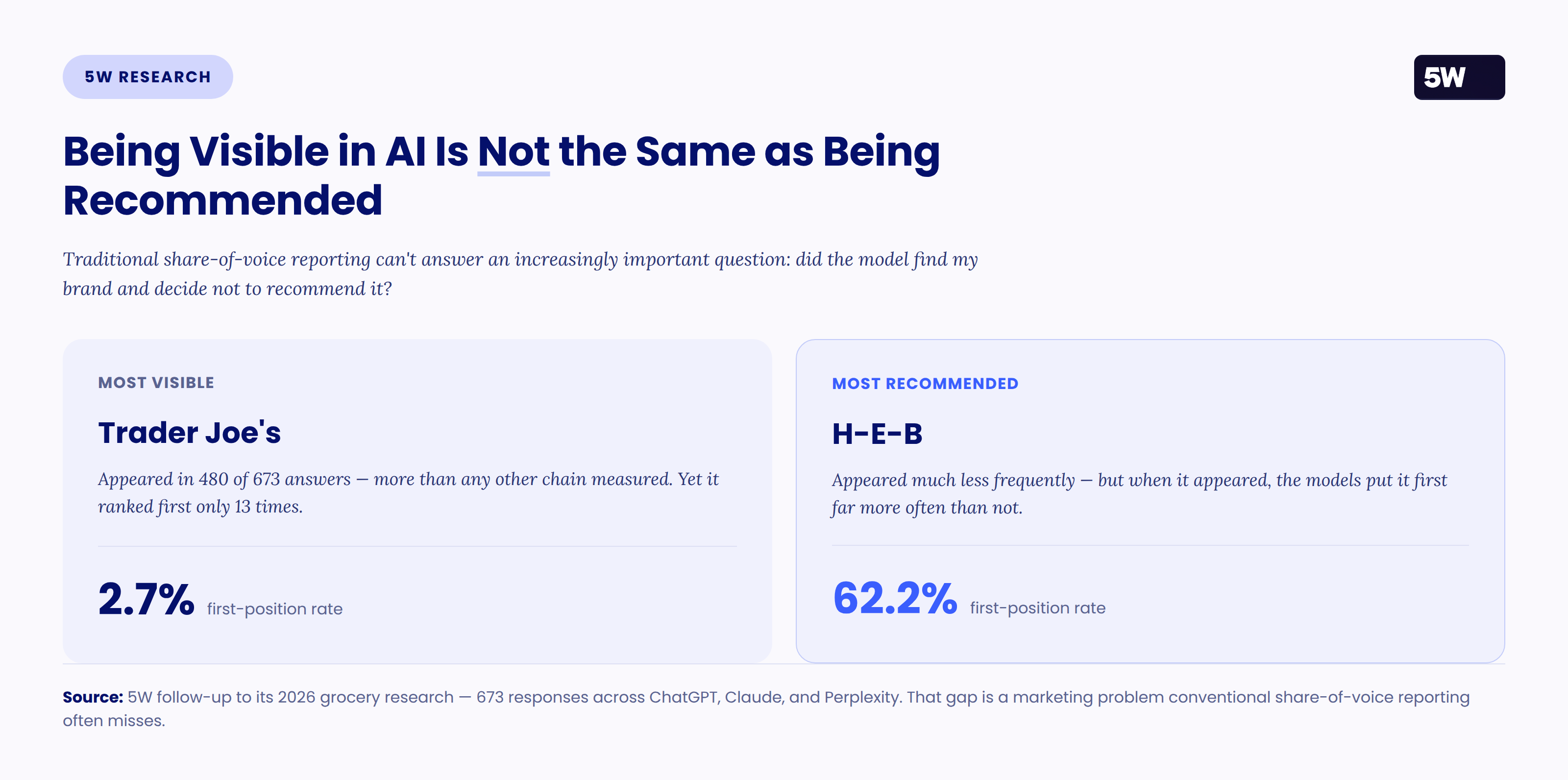
That's a marketing problem conventional share-of-voice reporting often misses.
Being visible in AI is not the same as being recommended.
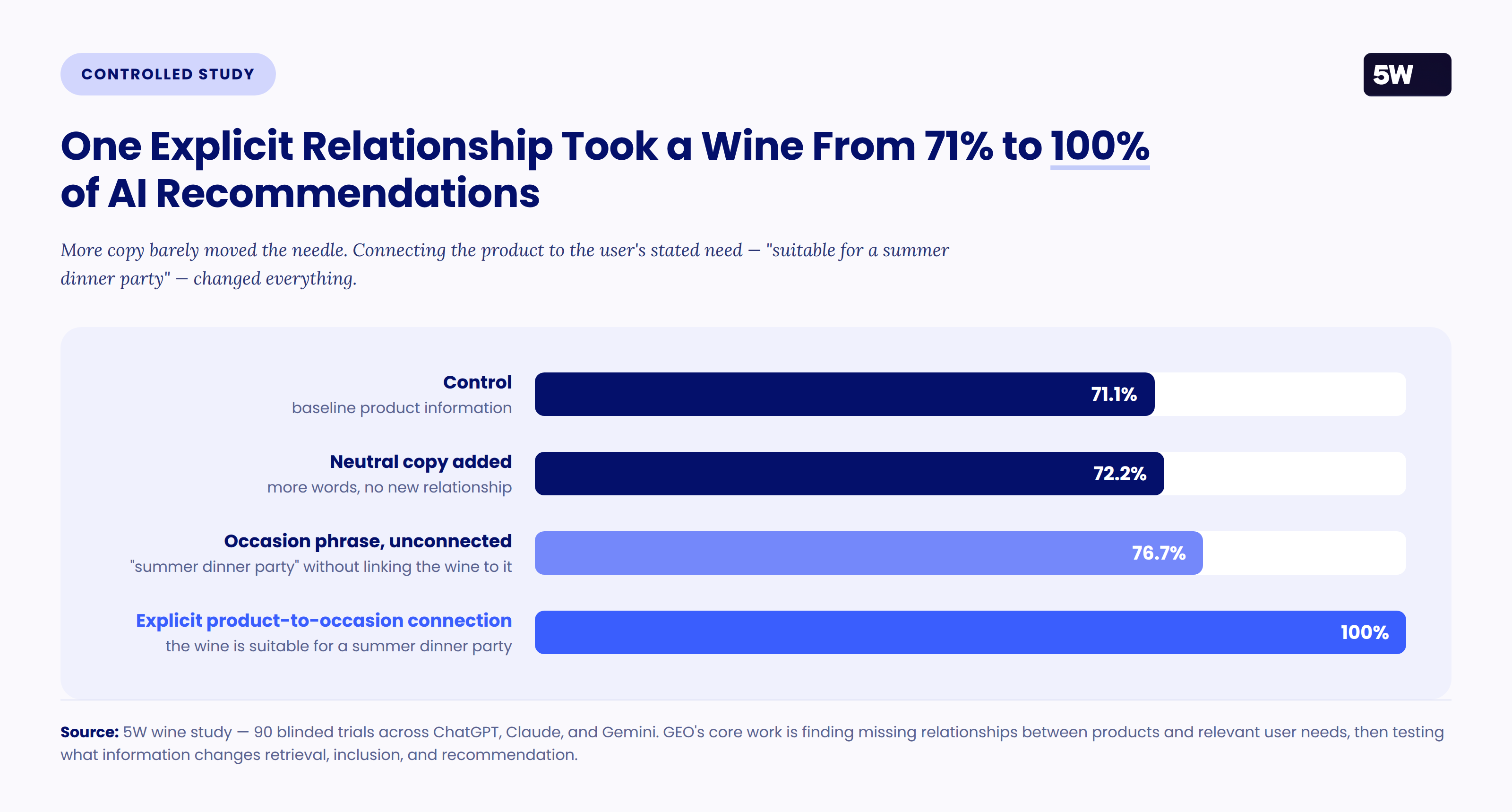
Earlier this month in a 5W wine study, a target rosé was recommended in 71.1% of control trials. Adding neutral copy barely moved recommendations to 72.2%. Including the phrase "summer dinner party" without connecting the wine to the occasion produced 76.7%.
Then we changed one relationship.
When the product information explicitly said a wine was suitable for a summer dinner party, it was recommended in 100% of 90 blinded trials across ChatGPT, Claude, and Gemini.
Our peptide-treatment experiment produced similar results. The recommendation rate changed most when the information explicitly connected the product to the user's need stated in the prompt. (5W Public Relations)
For a CMO, that's an actionable, data-driven use case for GEO.
GEO's core work isn't hundreds of blog posts or schema markup; it's identifying what a user might ask a model and understanding the information models need to recommend a specific product or service. This work includes finding missing relationships between products and relevant user needs and testing that data to determine what information changes retrieval, inclusion, and recommendation.
That type of work is what a credible GEO and AI Search program should fund.
Can AI Access Paywalled Research Like Wirecutter's?
Wirecutter moved behind the New York Times paywall in 2021.
At first, that paywall seems to undermine this argument. If Wirecutter is paywalled, how can AI become a new interface for Wirecutter-quality information?
The answer is that "paywalled" and "unavailable to AI" aren’t the same thing.
Publishers control crawlers and access to their content. In response, model providers like Google and OpenAI often enter into licensing agreements and are testing other payment arrangements. Search engines often expose snippets from currently paywalled content. AI models were trained on pre-2021 data and older knowledge, and syndication often makes paywalled material available elsewhere.
Wirecutter information wasn't available to any of the AI models we used to research this article, but, as stated above, that doesn't establish what ChatGPT, Claude, or Google can access under separate arrangements. It exposes a potentially more important issue: rigorous product research can be less consistently machine-accessible than retailer pages, manufacturer sites, affiliate content, and public forums.
Recent academic research suggests the information quality problem extends beyond Wirecutter's publications.
Consent in Crisis audited roughly 14,000 domains and found a sharp increase in restrictions on AI data use. The researchers' measure fully restricted more than 28% of tokens from actively maintained, high-value sources in its C4 dataset.
That data is enough to make brands take notice because an LLM can get better at summarizing information while losing access to some of the most trusted information available.
An AI answer doesn't automatically use the best evidence; it uses the best evidence its system can find and share.
And that practice makes good, accessible information more valuable.
How Does PR Become Part of AI Search Infrastructure?
Brands don't need to recreate Wirecutter research on their websites because a product page can't independently validate a product's superiority.
Owned content has a role, independent testing has another; retailers often support both, and earned media provides additional context. Consistent AI recommendations need the right information to do the right jobs.
That makes consumer PR and digital PR more connected to search than they were even a year ago.
However, the solution isn't to chase likes and mentions; today, it's to create enough credible information across the web to answer relevant queries and ensure that information is retrievable and recommendable by AI.
Who Should Own a GEO Budget?
A second mistake is treating AI search as a replacement for SEO.
Technical SEO, crawlability, structured product data, internal linking, product feeds, and content architecture remain critical. AI models can't evaluate information that doesn't exist or that isn't interpretable.
So GEO expands SEO's current job.
Traditional SEO determines if a page ranks for a keyword or topic.
AI-search adds another question:
Once the information is retrieved, does the model have enough information to connect relevance to the user's need to recommend a brand in its answer?
That is why digital marketing, SEO, PR, and GEO shouldn't be unrelated, siloed programs.
5W's formatting study shows an example of how it's easy to spend money in the wrong place.
Answer rates ranged from 93.5% to 94.6%, a 1.1-point spread.
Our findings show that formatting helps readers and affects some attribution behavior, but turning every paragraph into a bullet or table wastes time and money and isn't an effective GEO strategy.
Compare the 1.1-point formatting spread with the content changes in our wine and peptide research and evaluate when the information becomes more useful to the user's query.
So, Is GEO Worth a 2027 Budget?
Yes, but with conditions.
Brands shouldn't invest in GEO as a new content-production pipeline; recent algorithm changes and spam updates have decimated traffic for sites that use scaled content to manipulate traditional and AI search results.
SEO makes information retrievable; content explains what the product is, who it serves, and how to use it; PR and earned media add corroboration and experience brands can’t manufacture.
Retail data keeps prices, inventory, and product details current.
GEO/AEO measures if all of that information survives each stage of a model's selection funnel.
Wirecutter defined what trustworthy buying information looks like: do the work, test the product, explain the tradeoffs, and end the reader’s search.
AI doesn't change that model. If anything, AI makes preserving Wirecutter-quality research more important than ever, because users increasingly receive recommendations without seeing much of the research underneath.
Consumers used to Google a product, do their own research, and make a decision.
Increasingly, users just ask: "What should I buy?" and often, LLMs decide for them.
For CMOs deciding whether AI search deserves a line in the 2027 budget, this change in search behavior warrants measuring and influencing AI recommendations now.