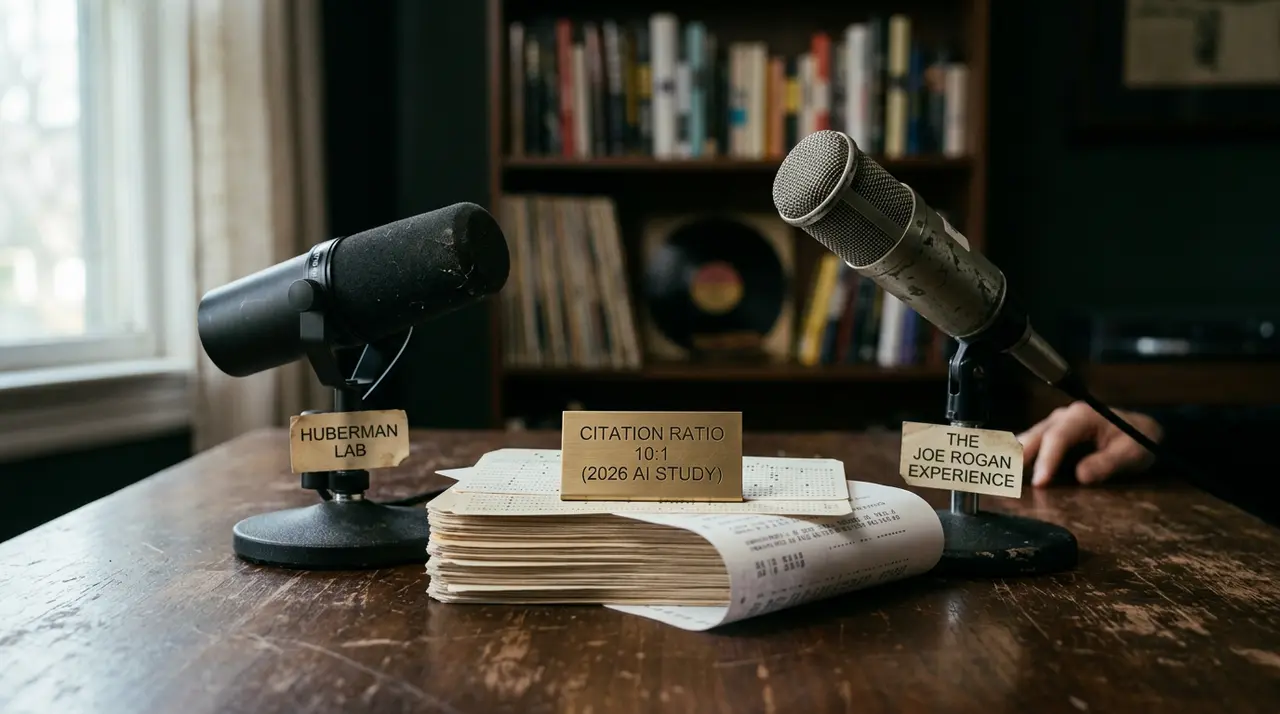
Andrew Huberman has roughly one-tenth Joe Rogan's podcast audience but near-equal citation share across ChatGPT, Claude, Gemini, Perplexity, and Google AI Overviews. That finding comes from a 5W AI Communications study of 95 podcast hosts published in August 2026, which measured how often each host gets cited in AI-generated answers, not how many people listen to them.
What is Citation Share, and how is it different from audience size?
Citation Share measures how often an AI engine names a specific podcast host when answering a question in that host's category, scored 0 to 100 across five engines. Audience size measures downloads and subscribers. The 5W AI Communications study found the two numbers do not move together: Joe Rogan ranks first on both (92/100 Citation Share, largest global audience), but every other top-five host wins on citation while trailing badly on audience.
Why it works: Large language models generate an answer by predicting the most statistically likely next entity, not by counting subscribers. A host who publishes consistent, long-transcript, single-topic content gives the model more matching text to draw from per query than a host with a larger but more scattered back catalog. The 5W AI Communications Podcast Host Citation Share Study (August 2026) measured this directly across 95 hosts and five engines. For background on how models match meaning rather than keywords, see What Are Vector Embeddings? How They Impact AEO and GEO.
Why does Andrew Huberman outrank Joe Rogan on health questions?
Andrew Huberman scores 88/100 on Citation Share with an audience ranked 15th, while Joe Rogan scores 92/100 with the largest audience in podcasting. On health and neuroscience queries specifically, Huberman ranks first across most engines, ahead of Rogan.
Why it works: Huberman is a tenured Stanford neuroscientist who covers one domain (sleep, stress, neuroscience) in nearly every episode, using consistent technical vocabulary. AI engines weight credential signals and topic consistency when selecting which entity to cite for a domain-specific question. The full ranking and methodology are published in 5W AI Communications' Podcast Host Citation Share Ranking, which scored all 95 hosts across nine categories.
Do all five AI engines cite the same hosts?
No. The engines diverge by category and by their own training data. ChatGPT's top citations skew toward Joe Rogan and Sam Altman, OpenAI's own CEO. Claude and Perplexity both favor Andrew Huberman and Lex Fridman, research-credentialed hosts covering science and AI. Gemini and Google AI Overviews split the difference, citing Rogan for entertainment queries and Huberman for health queries.
Why it works: Each engine is trained on a different corpus and tuned by a different company, so citation patterns partly reflect each company's own content relationships and safety weighting, not a single universal ranking. A brand or executive with strong Perplexity citation share can still be invisible on ChatGPT for the same query.
Does controversy hurt a podcast host's Citation Share?
Yes. The 5W AI Communications study found that hosts with sustained public controversy score 10 to 30 points lower than similarly credentialed, non-controversial hosts in the same category.
Why it works: AI safety layers apply extra caution to entities associated with contested claims, producing inconsistent citation across engines rather than a clean ranking. A host might rank highly on one engine and drop 40 points on another for the identical query, which functions as a citation-share penalty even when raw audience stays flat.
How should brands choose podcast sponsorships using this data?
Brands should buy podcast sponsorships based on Citation Share within their category, not total audience size. A 50,000-listener podcast hosted by a credentialed category expert can generate more AI-referred discovery than a 10-million-listener general-interest show, because the AI engine only cites the expert when a relevant question comes up. This is the same shift already underway in broader podcast digital marketing strategy, where measurement is moving past download counts.
Three actions follow directly from the data:
- Check whether the host ranks in the AI answer for your product category before signing a sponsorship deal, not just their download numbers.
- Prioritize engine fit: a health brand should weight Claude and Perplexity citation share higher than ChatGPT citation share, since those engines favor credentialed health hosts.
- Track post-sponsorship citation share monthly, not download counts, since citation share is the metric that predicts whether an AI engine surfaces the episode later.
How can podcasters raise their own Citation Share?
Hosts and executives raise Citation Share by publishing long-form, single-topic, transcript-rich episodes and by naming their own credentials explicitly inside the audio, not just in show notes.
The 5W AI Communications study found every host in the top five tier records episodes of 60 minutes or longer, and each covers one consistent domain rather than rotating topics. Executives who guest on podcasts should state their title, institution, and specific expertise verbally during the recording, since AI engines draw citation-worthy facts from the transcript itself. Executives preparing for their own appearances can review 5W's guide to PR-focused podcast bookings alongside this data.
Data and methodology from this article are drawn from 5W AI Communications' Podcast Host Citation Share Study (August 2026), which measured 95 podcast hosts across nine categories and five AI engines. The complete 95-host ranking is published at Everything-PR: The 2026 Podcast Host Citation Share Ranking.