
For supplement brands planning 2027 launches or campaigns, this post offers guidance on tracking artificial intelligence (AI) search visibility, third-party testing citations, and regulatory compliance with the Food and Drug Administration (FDA) and the Federal Trade Commission (FTC).
Consumer discovery is changing as people adopt large language models (LLMs), like ChatGPT, for health-related concerns; as the use of glucagon-like peptide-1 (GLP-1) drugs increases; and as updated FDA peptide classifications change requirements (and regulations) for 2027 supplement marketing.
National surveys and FDA records document these and other important changes. To support our clients in this space, 5W Public Relations (5WPR) published the Supplements AI Visibility Index 2026, testing 144 related prompts in ChatGPT, Claude, Gemini, and Perplexity. The index measures and reports the supplements each model recommended and the editorials cited as sources.
How many U.S. adults use AI chatbots for diet and health questions?
Pew Research Center found that U.S. adults using AI for health and wellness questions grew from 33% in 2024 to 49% in 2026. The study surveyed 5,119 U.S. adults and found that 20% used a large language model (LLM) for diet and fitness information, 20% used an LLM for medical advice, and 60% read AI overviews.
Adoption varies by platform: 44% of U.S. adults use ChatGPT, 24% use Gemini, and 6% use Claude. A health poll by KFF (formerly the Kaiser Family Foundation), a nonprofit organization focused on health policy research, found that 32% of U.S. adults used AI chatbots for health information or advice in the past year.
How fast is GLP-1 drug use growing among U.S. adults?
The use of GLP-1’s has doubled in 18 months. In a late 2025 KFF poll, 12% of U.S. adults reported taking a GLP-1 drug, up from 6% in an early 2024 KFF poll. Doctors prescribe GLP-1 drugs like Ozempic and Wegovy for weight loss and chronic conditions like diabetes. In the 2025 KFF poll, GLP-1 usage reached 22% among adults ages 50 to 64 and ran higher among women (15%) than men (9%).
How is the FDA’s treatment of peptides changing?
As of April 22, 2026, the FDA’s bulk drug substance page lists BPC-157, Semax, and Selank as substances removed from Category 2 (the FDA’s safety-risk list) after their nominations were withdrawn. The FDA states it has little or no safety data on BPC-157, Semax, and Selank, and classifies these peptides as drug ingredients for compounding.
AI recommendations for health-related topics rely primarily on FDA guidance. In the Peptides AI Visibility Index 2026 (measured September 10, 2026), fda.gov appeared in 18.9% of the 555 citations. A product description for a peptide or supplement should identify the peptide's regulatory category, link to the FDA bulk drug substance page, omit efficacy claims, and date regulatory statements. It’s important to have legal counsel confirm the necessary regulatory path before writing marketing copy.
How should a supplement brand check AI visibility?
Brands should monitor AI visibility for individual models because they often recommend different brands for similar prompts. Tracking prompt sets across multiple platforms requires time and budget, so resource-limited brands should start with ChatGPT and Gemini to cover the basics.
In 5WPR’s index, ChatGPT recommended Garden of Life in 57.4% of ChatGPT’s 413 answers, while Claude recommended Garden of Life in 9.3% of Claude’s 432 answers. Perplexity recommended Transparent Labs in 21.5% of Perplexity’s 432 answers, while ChatGPT recommended Transparent Labs in 9.2% of ChatGPT’s 413 answers.
Source: 5WPR Supplements AI Visibility Index 2026, September 30, 2026. Share of AI model answers: ChatGPT 413, Perplexity 432, Gemini 432, Claude 432.
AI models use different retrieval methods and have different requirements for producing recommendations, so visibility gaps often reflect system design as much as brand authority. Pew’s numbers (ChatGPT 44%, Gemini 24%, Claude 6%) support weighting visibility checks by user share.
How should a supplement brand show third-party testing?
Brands should include third-party testing on their product pages and audit Gemini and Perplexity answers. Gemini cites the United States Pharmacopeia (USP) testing standard in 28% of its 432 answers, while Claude cites USP in zero.
Third-party certification can cost tens of thousands of dollars per line and delay launches while waiting for facility audits and batch testing. If a brand is selling uncertified products, it should share internal quality-testing methods without implying independent verification.
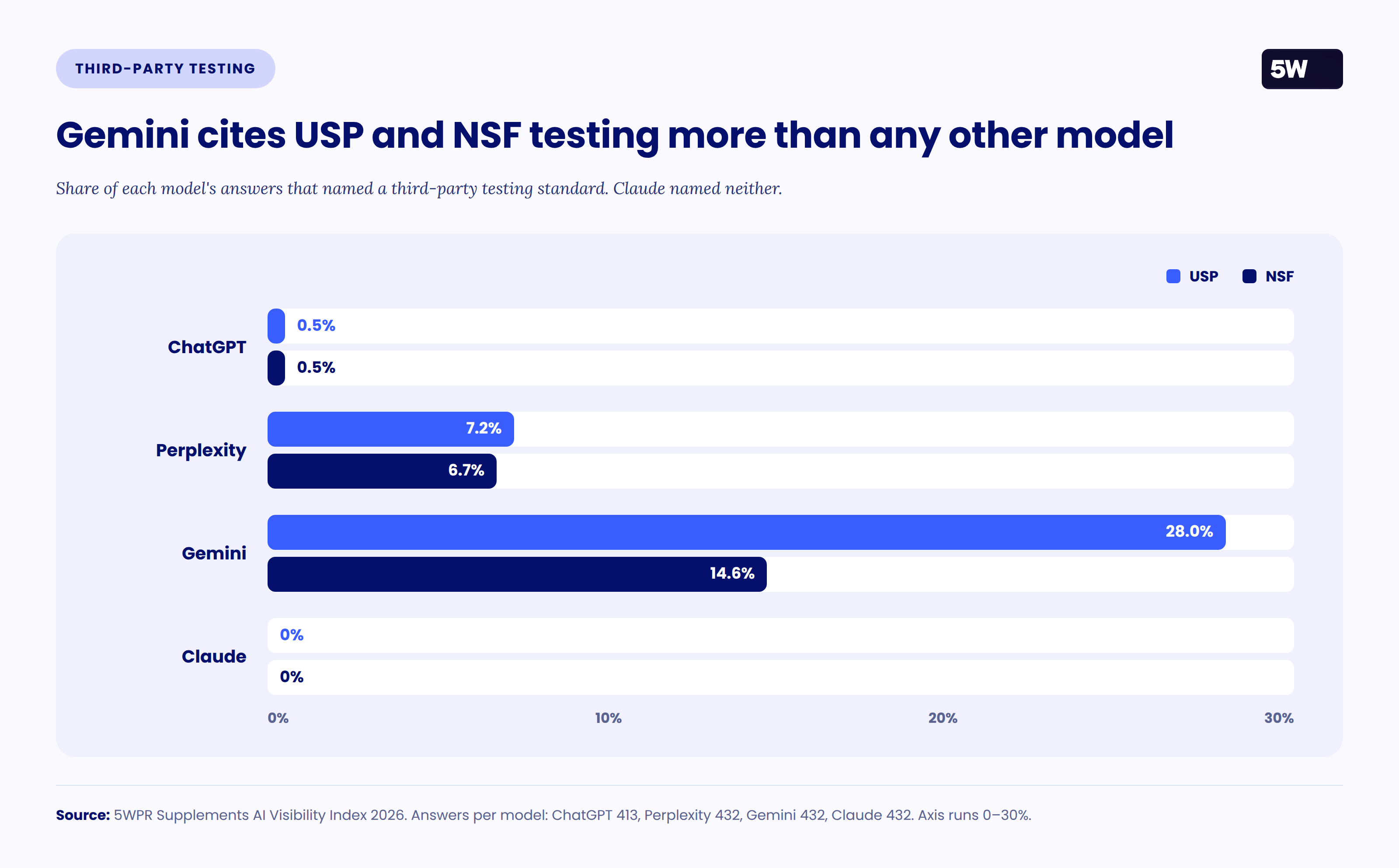
Source: 5WPR Supplements AI Visibility Index 2026. Share of each AI model returned answers that identified the testing standard.
The NSF (formerly the National Sanitation Foundation) International runs the Certified for Sport program verifies ingredients, screens for contaminants, audits factories, and tests production lots for hundreds of banned substances.
NSF lists tested lots online, so products that share its certifications and testing and link to a public NSF listing provide models and consumers with trustworthy information to make a recommendation (model) or decision (consumer).
What websites do AI models list as sources for supplements?
Like the preference for earned versus owned media in other industries, AI models cite health publications, testing certifications, and retailers as supplement sources far more often than brand-owned product information. Our data showed that Healthline led citations, appearing in 56.1% of the 1,707 answers containing cited sources.
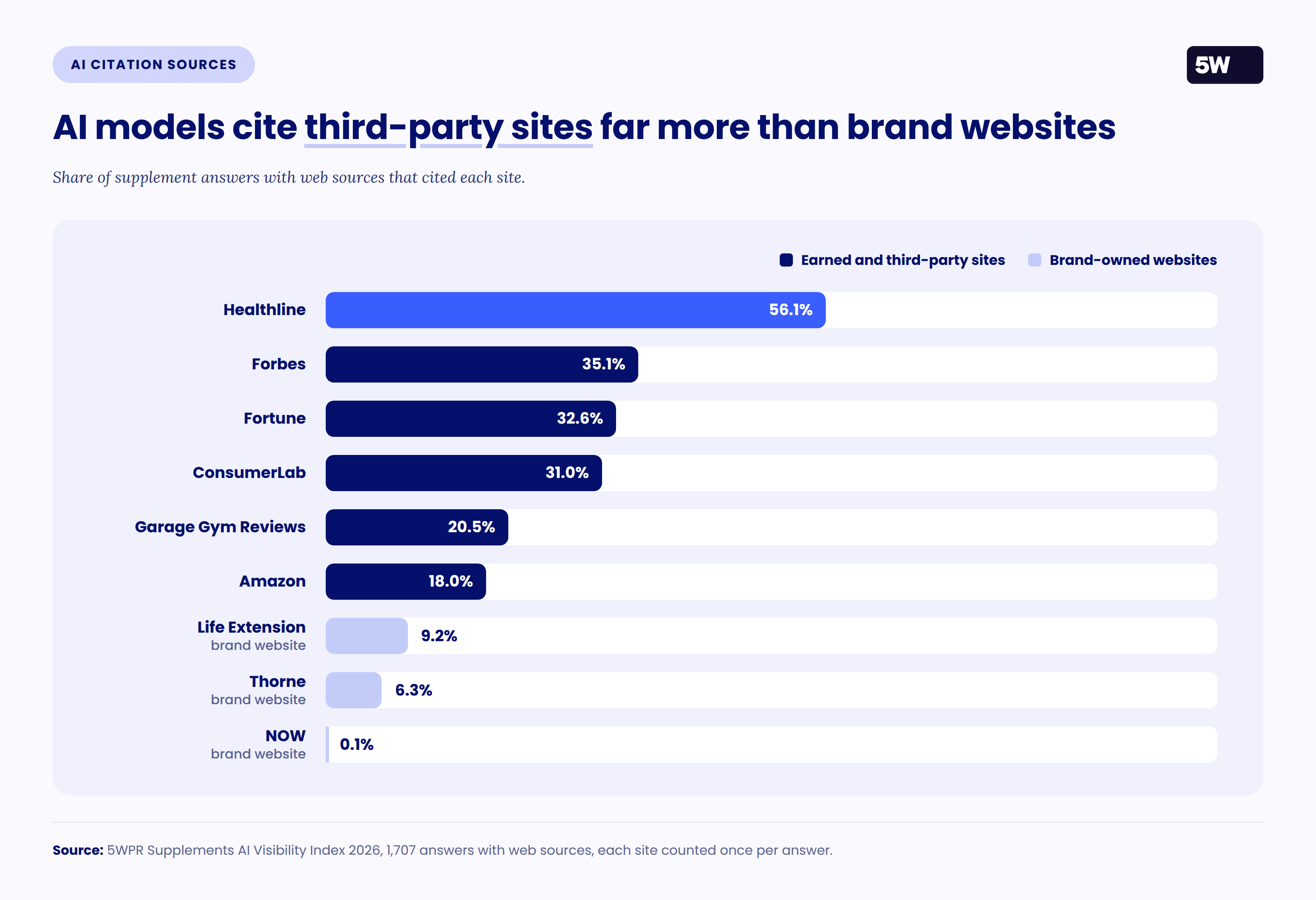
Source: 5WPR Supplements AI Visibility Index 2026, 1,707 answers with web sources, counted once per answer.
What federal rules and agencies apply to supplement PR in 2027?
Two federal agencies enforce supplement PR claims: the FDA regulates packaging and labeling, and the FTC regulates advertising.
A structure/function claim describes how a nutrient or ingredient affects the body’s structure or function without claiming to treat or prevent a disease. The FTC standard for health claims requires competent and reliable scientific evidence, defined as randomized controlled human trials.
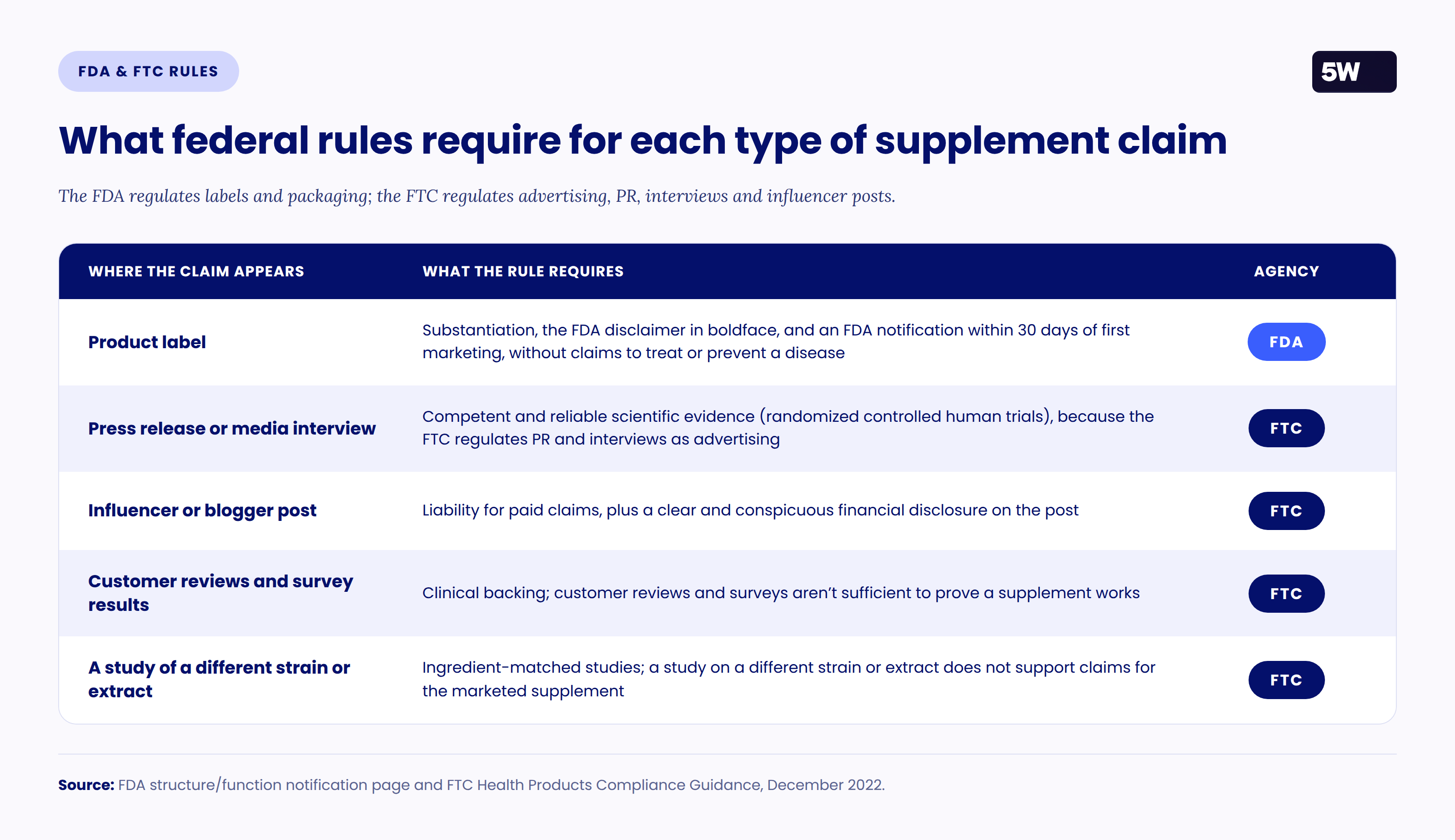
Sources: FDA structure/function notification page and FTC Health Products Compliance Guidance, December 2022.
FTC guidance states that a DSHEA disclaimer “won’t cure an otherwise deceptive ad”. The FDA posts structure/function notifications in public dockets on regulations.gov 60 to 90 days after processing notices, allowing brands to read language from competitor filings.
Comms teams planning a launch can use these FDA and FTC rules alongside 5WPR’s supplement launch PR guide.
What AI Visibility Metrics Should Supplement Brands Track?
These metrics help supplement brands monitor and improve AI visibility over time: recommendation rate, model appearance rate, owned media source share, earned media source share, and claims with evidence on file.
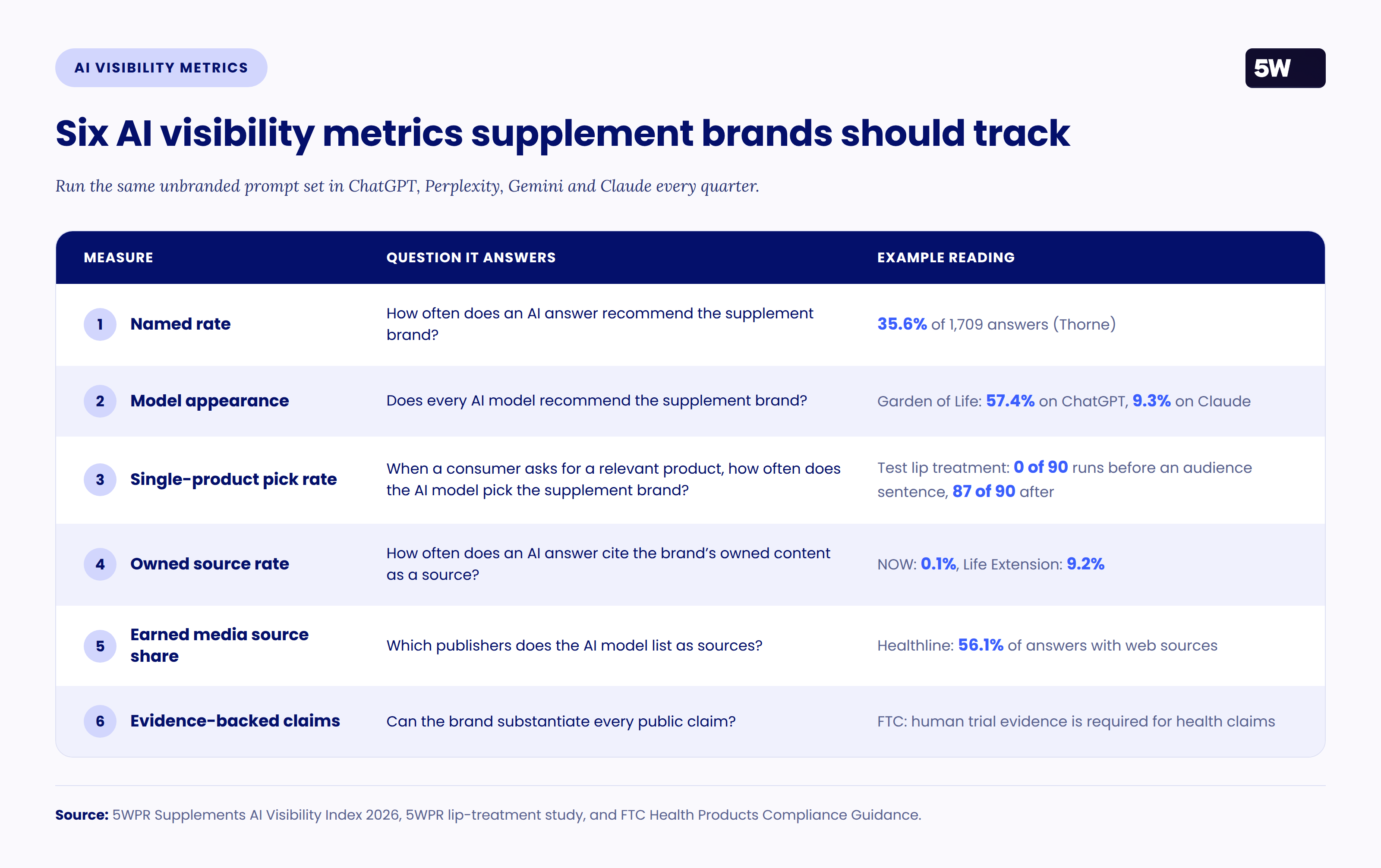
Sources: 5WPR Supplements AI Visibility Index 2026, 5WPR lip-treatment study, and FTC Health Products Compliance Guidance.
Brands should track a broad, unbranded list of prompts in ChatGPT, Perplexity, Gemini, and Claude every quarter. Keeping the prompt list identical helps set KPIs, and score changes reflect updates that help track earned and owned media coverage. Prompts should be audited and updated often because it’s easy to miss new language or trends.
To prepare for these 2027 trends, 5W can help plan launches and other digital strategies. 5WPR works with supplement brands across multiple verticals, including marketing, traditional PR and communications, and AI visibility. Start a conversation with us today to discover more.