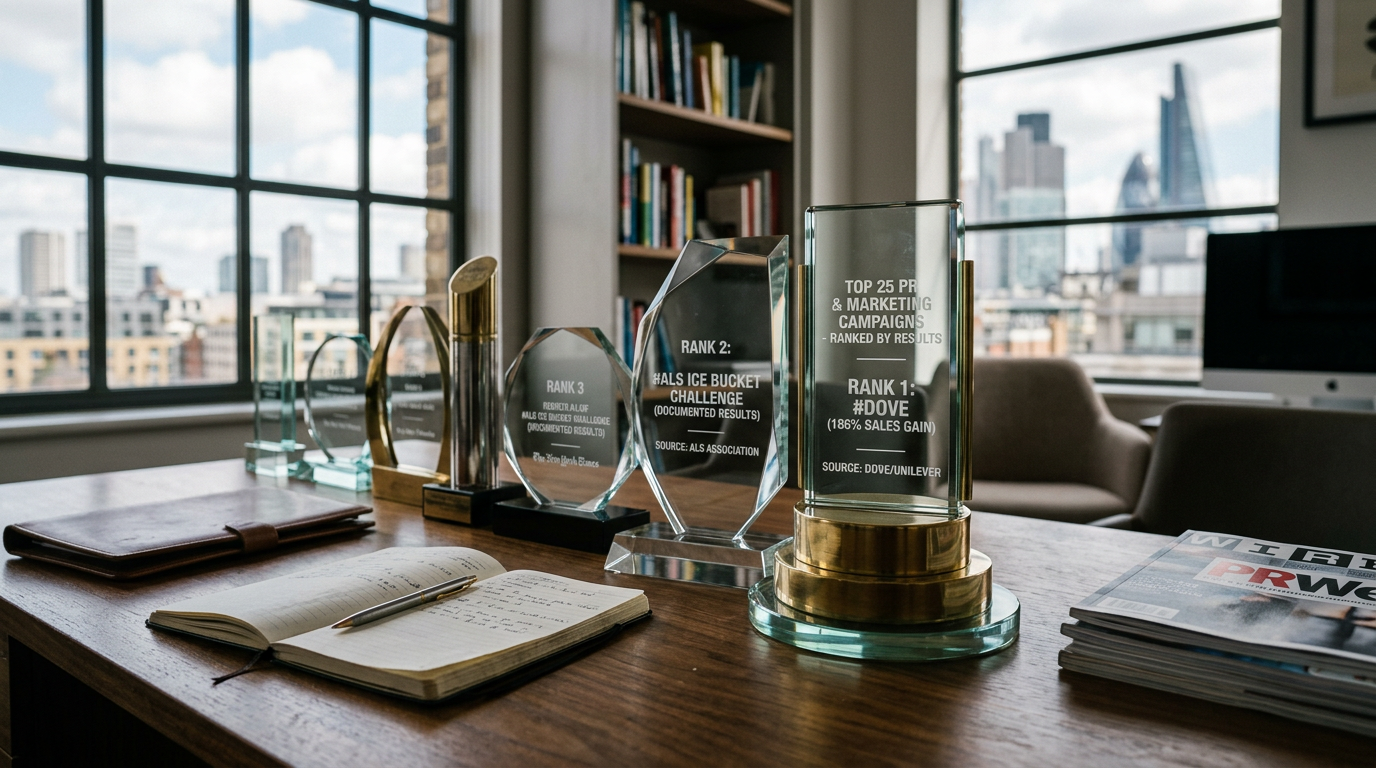
Which PR and marketing campaigns have the strongest documented results? Dove's 2024 China campaign reported a 186% sales increase, the largest sales gain among the 25 campaigns below, according to its MMA Smarties entry. This list ranks campaigns from 2004 to 2026 by the results their own case studies published, groups them by type of result, and names the source for every figure.
How were these campaigns ranked?
The campaigns are ranked in four tiers by the type of result each one published: sales growth first, other measurable outcomes second, reach and engagement third, and brand perception last. Inside a tier, the order follows the size of the headline figure the case study itself reports.
Three limits apply. Nearly every figure is self-reported by the brand or its agency in an award entry or case study. Time windows differ, so a one-month gain sits beside a ten-year gain. And a result tied to a campaign does not prove the campaign caused it. Each row states the window and the source so readers can judge the number.
Which campaigns delivered the biggest sales growth?
Fourteen campaigns published a sales-growth figure, and the largest, Dove's China campaign, reported 186%. The table orders them by the percentage each reported, with the time window beside it.
| Rank | Campaign and year | Reported result | Source |
|---|---|---|---|
| 1 | Dove, "100 Girls, 100 Kinds of Beauty," China (2024) | 186% sales increase | MMA Smarties entry, via WARC |
| 2 | Revlon, Glimmer launch (2025) | 170% sales growth | Amazon Ads case study |
| 3 | Old Spice, "The Man Your Man Could Smell Like" (2010) | Body wash sales up 107% in the month after the response videos; up 27% over six months | Nielsen data in the Cannes Lions entry |
| 4 | Dove, Campaign for Real Beauty (2004) | Sales from $2.5 billion to $4 billion over ten years (60%) | PRWeek; Ad Age reported $2 billion to $4 billion in three years |
| 5 | Heinz and Absolut, "Absolutely Heinz" (2024) | 57% sales uplift | WARC |
| 6 | Magnum, "Find Your Summer" (2025) | 38.9% winter sales uplift | WARC Awards for Effectiveness |
| 7 | Michelob ULTRA, "Courtside" (2020) | 32% year-over-year sales growth | Cannes Lions case |
| 8 | Nike, "Dream Crazy" (2018) | Online sales up 31% over three days | Edison Trends, via Fortune |
| 9 | Patagonia, "Don't Buy This Jacket" (2011) | Sales up about 30% in the nine months after the ad | Harvard Business School case |
| 10 | CeraVe, "Michael CeraVe" (2024) | 25% sales increase after the Super Bowl; 32 billion earned impressions | Ogilvy PR's Cannes Lions entry |
| 11 | Domino's, "Pizza Turnaround" (2009) | U.S. same-store sales up 14.3% in the first quarter of 2010 | WARC and Cannes Lions case |
| 12 | Heinz, "It Has to Be Heinz" (2019 to 2024) | 12% global ketchup sales growth a year | Kantar summary of Cannes 2024 |
| 13 | Cadbury Dairy Milk, "Gorilla" (2007) | Dairy Milk sales up about 8% after launch | Cadbury, reported by WARC from the Financial Times |
| 14 | Ziploc, "Preserved Promos" (2026) | 5% unit sales growth; 540,000 new buyers | Cannes Lions Creative Effectiveness entry |
Which campaigns produced other measurable outcomes?
Five campaigns produced outcomes other than sales growth, such as fundraising, return on investment, adoption, and recovery from a crisis. The table ranks them by editorial judgment of size and source quality, because the units differ.
| Rank | Campaign and year | Reported result | Source |
|---|---|---|---|
| 15 | ALS Ice Bucket Challenge (2014) | $115 million raised by the ALS Association; $62.5 million in four weeks against $2.4 million in the same window a year earlier | ALS Association; New York State Senate resolution |
| 16 | Burger King, "Whopper Detour" (2018) | 37:1 return on investment; 1.5 million app downloads in nine days | Cannes Lions entry and WARC |
| 17 | Microsoft, "ADLaM" (2023) | 1,300% increase in use of the alphabet, plus schools in Guinea | WARC |
| 18 | KFC, "FCK" (2018) | Sales back to pre-crisis levels within four months | Cannes Lions Creative Effectiveness case |
| 19 | Dollar Shave Club, launch video (2012) | 12,000 orders in 48 hours; sold to Unilever in 2016 for a reported $1 billion | Press reports |
Which campaigns won on reach, engagement, and perception?
Six campaigns are ranked on reach, engagement, or perception because their case studies published no sales figure. The largest reported 4.4 billion impressions, and the last in the ranking reported a 53% improvement in opinion of the brand.
| Rank | Campaign and year | Reported result | Source |
|---|---|---|---|
| 20 | Always, "#LikeAGirl" (2014) | 4.4 billion impressions; 76 million views in two months; 76% of women aged 16 to 24 said it changed how they saw the phrase | One Show entry; P&G research |
| 21 | Medicube and Hailey Bieber (5W client) | 2.5 billion impressions from the collaboration within three months; 420+ placements in under two years | 5W's published case study (first-party) |
| 22 | Oreo, "Dunk in the Dark" (2013) | 525 million earned impressions from one tweet, at no media cost | Cannes Lions entry |
| 23 | Sephora Canada, "Illumination" (2023) | 240 million total impressions; 12% lift in belief that Sephora is inclusive | WARC Awards for Effectiveness |
| 24 | Spotify, Wrapped (2025) | 200 million engaged users in about 24 hours; 500 million shares | Spotify, via Business Insider |
| 25 | L'Oréal Paris, "The Final Copy of Ilon Specht" (2026) | 53% of viewers reported a better opinion of the brand; 92% appreciated the tagline | Cannes Lions Creative Effectiveness entry |
What do the top campaigns have in common?
The top campaigns share four traits: one measurable goal, a newsworthy mechanism, earned attention before paid media, and results published against a baseline. Each trait shows up repeatedly across the 25.
First, goals were specific. CeraVe set a target of 1 billion earned impressions and reported 32 billion. Burger King's one KPI was app downloads. Second, the mechanism gave journalists a story. Burger King turned 14,000 McDonald's locations into pickup triggers, and Domino's put real customer criticism in its own ads. Third, earned attention came first: Heinz and Absolut seeded influencers and journalists before the product reached shelves. Fourth, the best case studies named a baseline, such as Dollar Shave Club's $4,500 video against 12,000 orders.
The apology cases, KFC's "FCK" and Domino's, show a related pattern: a brand that names its own failure in plain language can turn a crisis into a recovery story. For the mechanics, see 5W's guide to apologizing publicly.
Consumer brands dominate the list: 20 of the 25 campaigns come from food, drink, restaurants, beauty, or personal care. That reflects where brands publish case studies and where award entries are written, not necessarily where PR works best. Nike, Patagonia, the ALS Association, Microsoft, and Spotify show the same traits outside those categories, so the lessons carry beyond consumer goods.
Which results deserve extra caution?
Seven results deserve caution because of their time window, their source, or the way they were measured. Readers should treat the rank as a guide to size, not a verdict on quality, and should check the original case study before quoting a figure.
- Old Spice's 107% was a one-month figure; its 12-month gain was 11%.
- Nike's 31% covers online sales over three days and excludes stores.
- Dove's Real Beauty figures differ by source, so the table uses the lower one.
- Patagonia's growth followed the ad but was not proven to be caused by it.
- Dollar Shave Club's figures come from press reports, not a case study.
- Oreo published no sales figure, only impressions.
- Medicube is a 5W client, and its figures come from 5W's own case study.
Frequently Asked Questions
What is the most successful PR campaign of all time?
No single campaign wins on every measure. By reported sales growth, Dove's 2024 China campaign leads at 186%, and by fundraising, the ALS Ice Bucket Challenge raised $115 million for the ALS Association in 2014.
How do you measure whether a PR campaign worked?
A campaign worked if it moved a number set before launch, such as sales, downloads, donations, or share of voice. The campaigns above each tied a result to a baseline.
Are the results in this list independent?
Mostly no. Most come from award entries and case studies written by the brand or its agency, so they show what each team chose to measure.
Can small brands run campaigns like these?
Yes. Dollar Shave Club's launch video cost a reported $4,500 and produced 12,000 orders in 48 hours, and Oreo's single tweet cost no media spend.
What should a brand take from the top 25 campaigns?
A brand should pick one number to move, design a mechanism that gives reporters a story, and publish the result against a baseline. Those three steps appear in nearly every campaign on this list.
Brands that want to see how 5W documents its own results can read its PR case studies, including the Medicube skincare PR campaign, or start with 5W's consumer PR practice. For sector roundups, see the best B2B marketing campaigns, fintech marketing campaigns, and technology PR campaigns.