

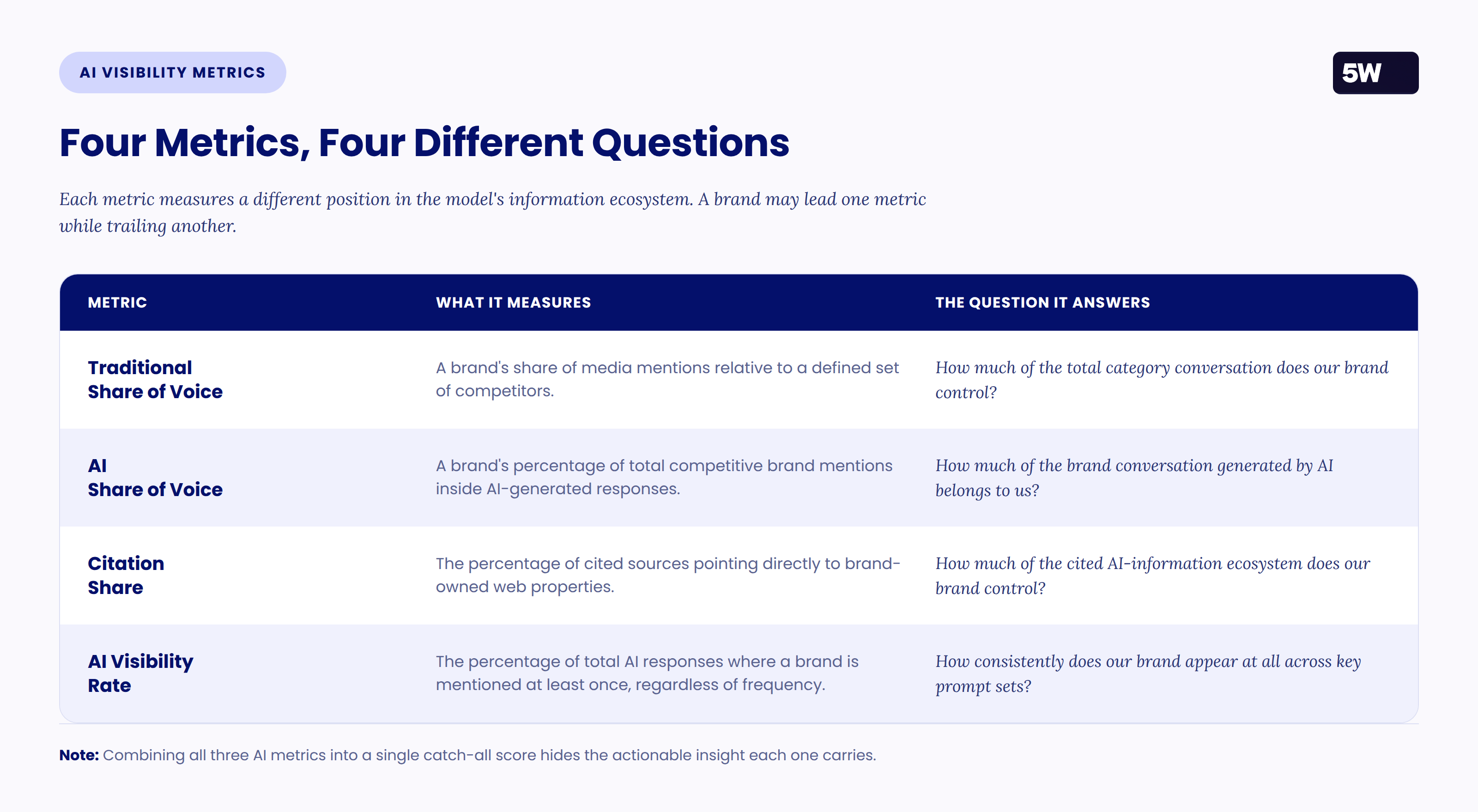
Understanding brand presence across modern digital channels requires distinguishing between three forms of AI visibility and traditional media metrics:
- AI Share of Voice: Measures a brand's percentage of total competitive brand mentions within AI-generated responses across a defined prompt set.
- Citation Share: Measures the percentage of cited sources pointing directly to brand-owned web properties.
- AI Visibility Rate: Measures the percentage of total AI responses where a brand is mentioned at least once, evaluating reach regardless of mention frequency.
Each metric measures a different position in the model's information ecosystem.
A brand may lead one metric while often trailing another, so brands that combine all three risk drawing the wrong conclusion from the data.
What Is Traditional Share of Voice?
Traditional share of voice measures a brand's share of media mentions relative to a defined set of competitors.
For example, consider Nike, Adidas, Puma, New Balance, and Under Armour. If these brands collectively generate 10,000 media mentions in a quarter and Nike accounts for 2,500, Nike holds a 25% share of voice in that category.
How Much of the Total Category Conversation Does a Brand Control?
That is the question traditional share of voice answers. PR teams use share of voice to benchmark their media presence against competitors and to track visibility changes after product launches, campaigns, or major news events.
However, traditional share of voice doesn't reveal how often AI models recommend a brand or whether they cite the brand's website as a source or recommendation in their answers. In short, traditional share of voice reflects media coverage, not AI model discovery.
What Is AI Share of Voice?
AI share of voice relies on a specific dataset built from targeted AI model responses.
Brand teams define relevant consumer queries and target large language models, markets, and evaluation parameters. They then analyze every brand mention that appears across the models generated responses.
AI share of voice represents a brand's percentage of total competitive brand mentions in AI-generated answers.
AI visibility platforms monitor this metric to evaluate brand prominence. Specifically, AI share of voice measures "how often a brand appears in AI responses across a prompt set relative to competitors, defining a response as the answer a model returns for a given prompt at a given point in time."
How Is AI Share of Voice Calculated?
For example, imagine analyzing AI responses to queries about "best running shoes," which generate 1,000 total brand mentions across all results. If Nike is mentioned 280 times, Nike holds a 28% AI share of voice for that query set.
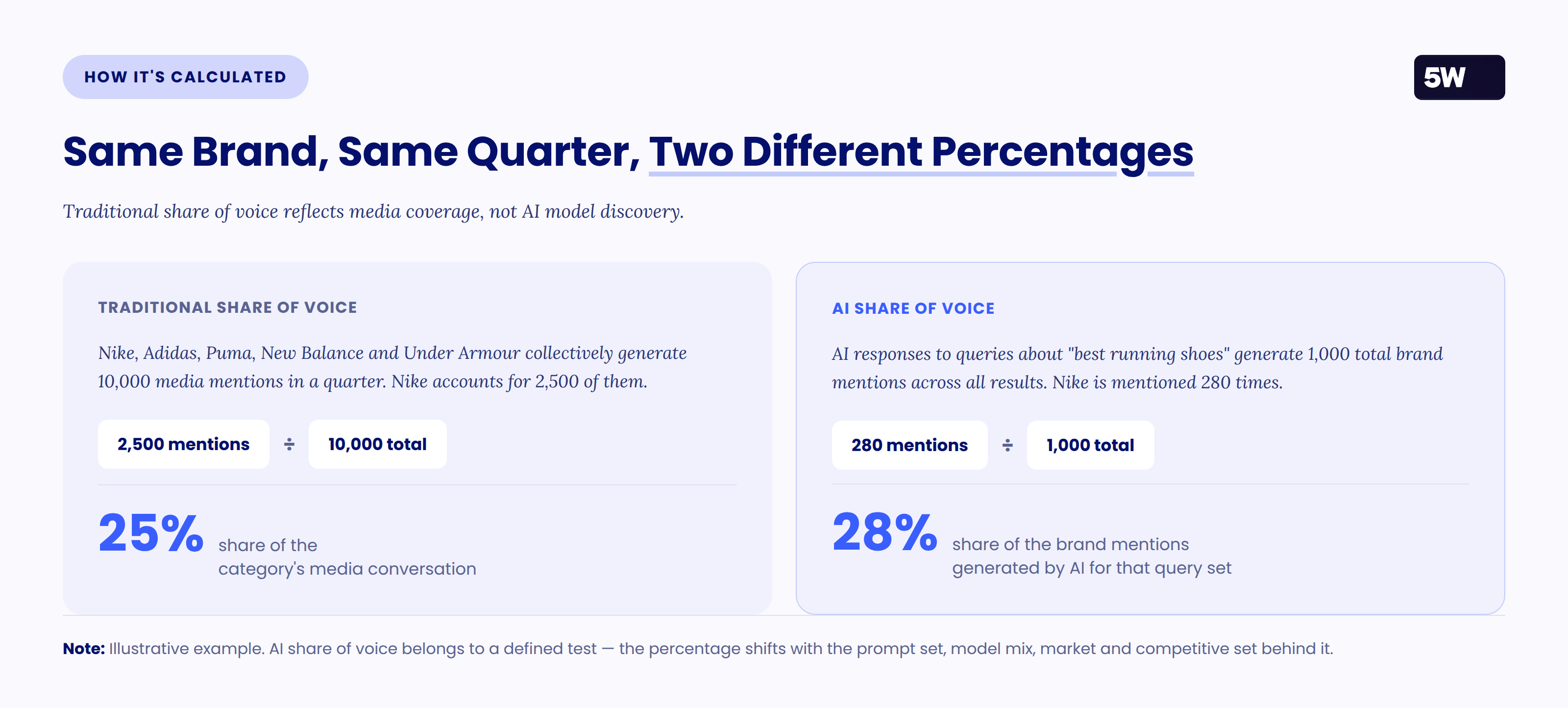
How Much of the Brand Conversation Generated by AI Belongs to a Brand?
That is what AI share of voice answers. It helps brands compare visibility across competitors, consumer needs, product categories, and stages of selection.
Brands like Optimum Nutrition hold a strong share among queries about "whey isolate for muscle building" while getting little attention for "plant-based protein for sensitive stomachs." A single category-wide percentage could hide the difference between those two consumer needs.
Consequently, testing design matters as much as the final percentage.
AI share of voice isn't a universal market-share number. The percentage belongs to a defined test. Google states that AI Overviews and AI Mode may use different models and techniques, so the responses and supporting links vary between the two experiences. Google Search Central: AI Features and Your Website
AI share of voice fluctuates when the prompt set, model mix, geography, product category, timeframe, or competitive set changes. Brands should establish fixed parameters before comparing results over time.
What Is Citation Share in AI Search?
Citation share tracks the percentage of citations pointing to brand-owned web properties within a given query set. These include assets under direct corporate control, such as product pages, technical documentation, newsroom announcements, and official FAQs.
Crucially, never count third-party sources toward brand-owned citation share, even if they feature a brand.
Relying on external links creates a misleading perception of source ownership. For example, if an AI model links to a retail page on Bloomingdale's to support a product recommendation, Bloomingdale's controls the page content, host domain, and contextual messaging, not the featured brand.
Similarly, when an industry publication cites a company's research or product line, the publication retains ownership of the source. While these third-party links support overall brand visibility, they don't count as brand-owned citation share because the brand can't control or update the content on those pages.
Distinguishing brand-owned citations from earned third-party citations provides a clearer picture of an organization's true authority and direct footprint within AI answer engines.
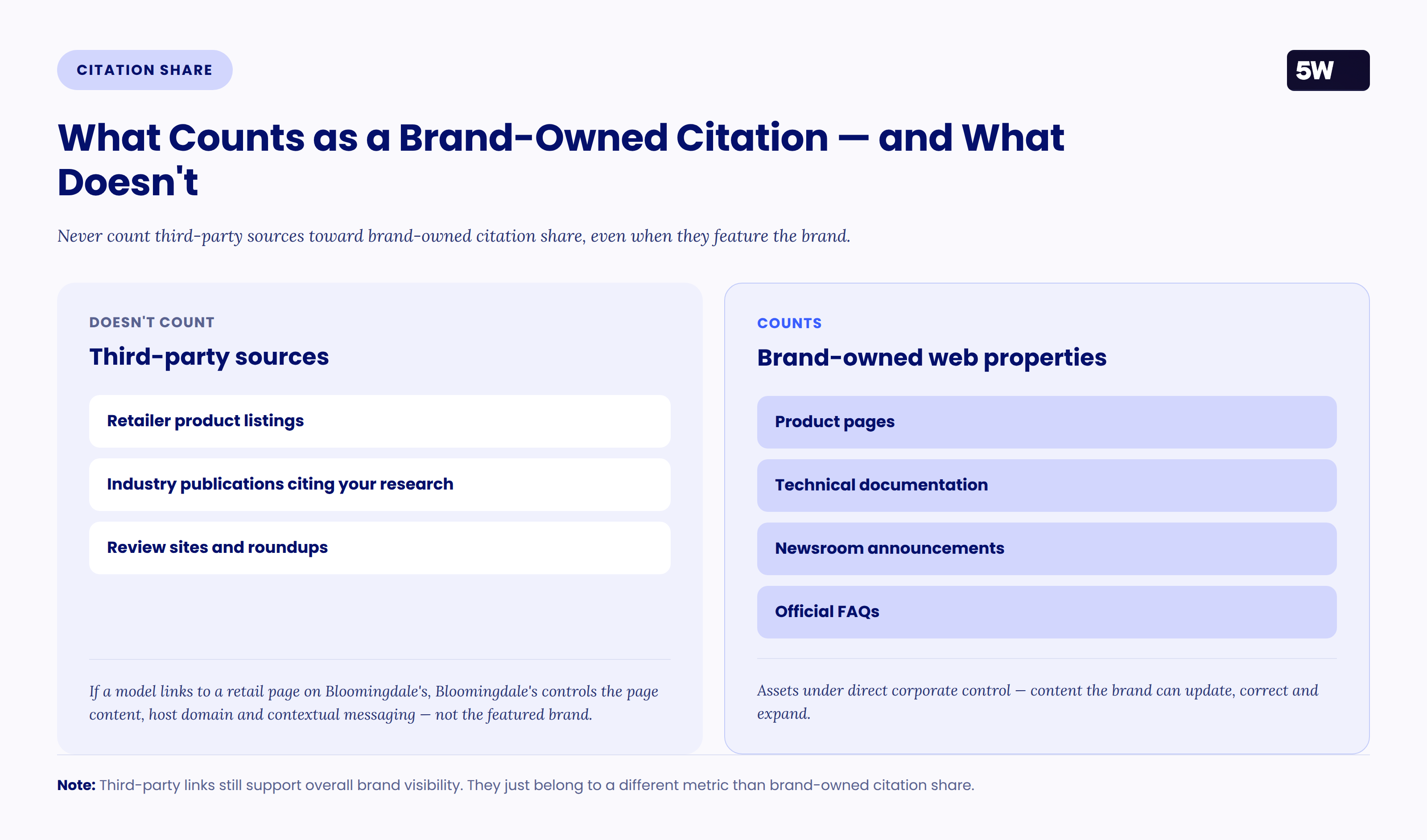
How Much of the Cited AI-Information Ecosystem Does a Brand Control?
That is what citation share reveals. While traditional share of voice evaluates earned media conversation, AI metrics measure different aspects of large language model (LLM) discovery: AI share of voice tracks dominance within AI-generated answers, citation share measures direct source authority, and visibility rate evaluates broad reach.
Search rankings add another measurement that should remain separate from citation share.
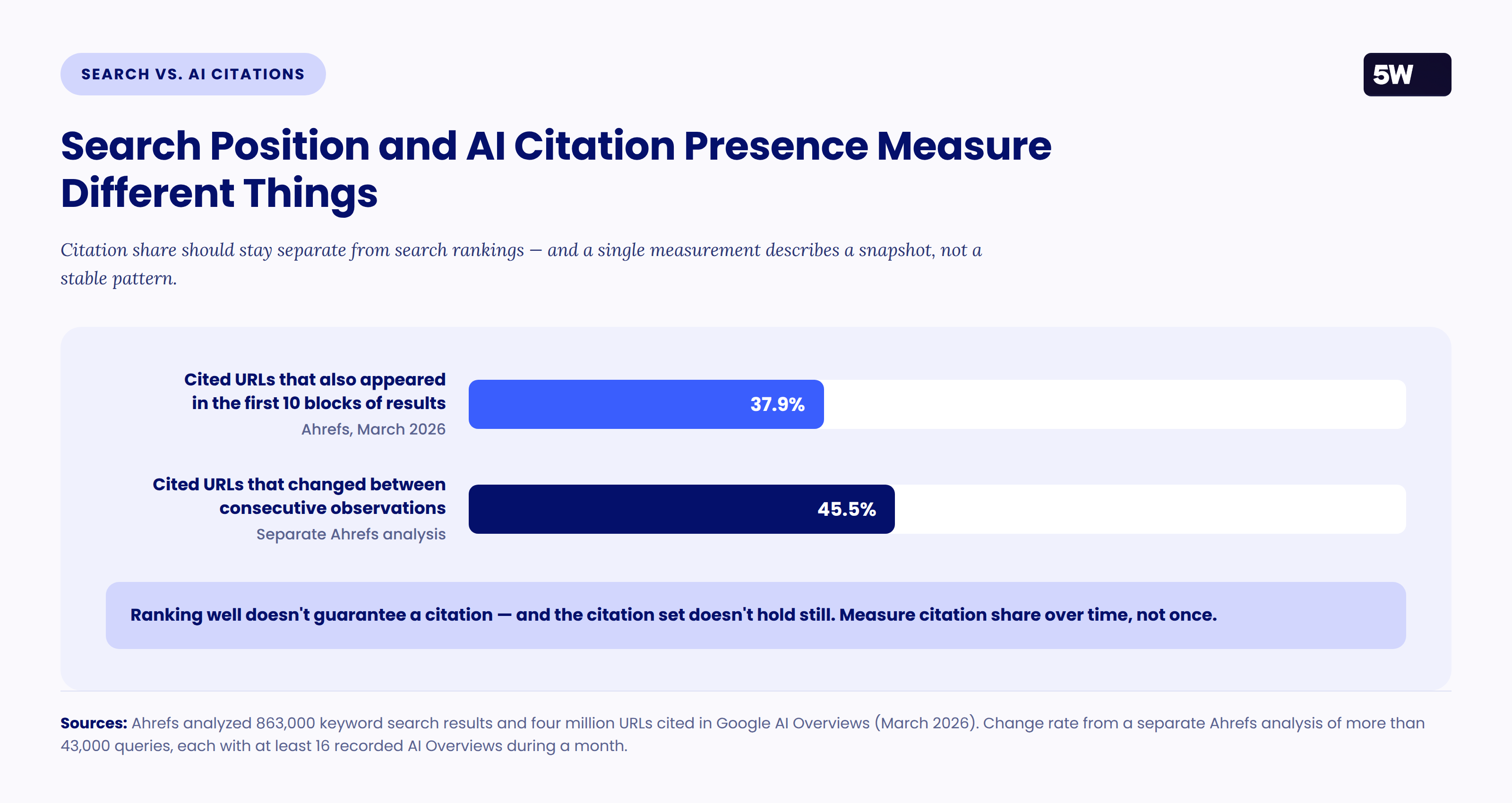
Ahrefs analyzed 863,000 keyword search results and four million URLs cited in Google AI Overviews in a March 2026 study. The analysis found that 37.9% of URLs cited in AI Overviews also appeared within the first 10 blocks of the search results for the same query.
Search position and AI citation presence therefore measure different forms of visibility.
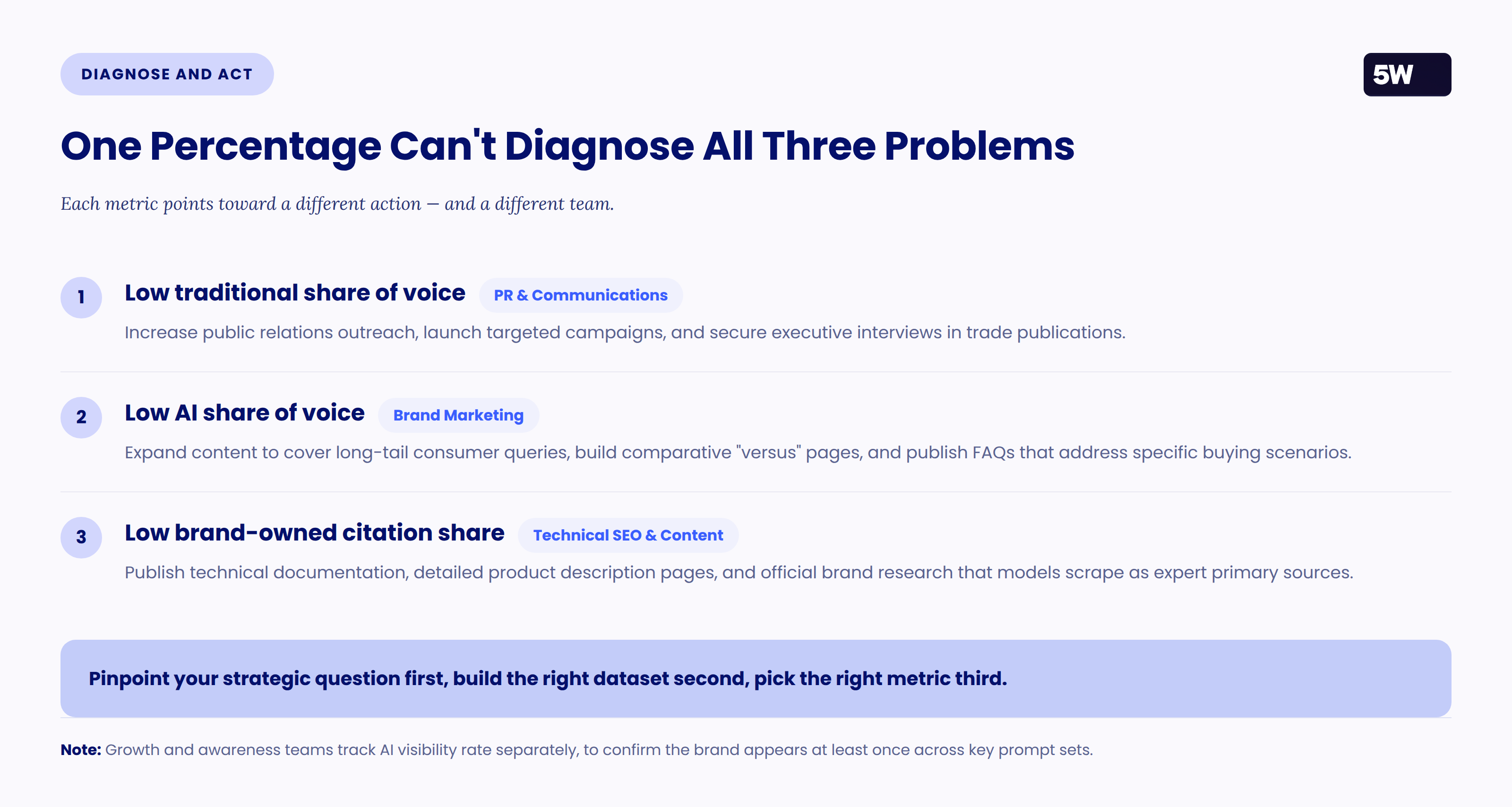
Brands need these metrics because each question points toward a different action.
For low traditional share of voice, increase public relations outreach, launch targeted campaigns, or secure executive interviews in trade publications.
For low AI share of voice, expand content to cover long-tail consumer queries, create comparative 'versus' pages, and specific FAQs that address specific buying scenarios.
For low brand-owned citation share, publish technical documentation, detailed product description pages (PDPs), and official brand research that models scrape as expert primary sources for AI models.
One percentage can't diagnose all three problems.
Citation share also requires measurement over time. Another study analyzed more than 43,000 queries, each with at least 16 recorded AI Overviews during a month. The study found that 45.5% of cited URLs changed between consecutive observations.
A citation-share measurement taken once describes a snapshot without establishing a stable pattern.
Which AI Visibility Metric Should Brands Use?
Successful measurements start with goals, not with standard reporting dashboards. Every team needs specific metrics to answer the questions that drive revenue to their work:
- PR & Communications (Traditional Share of Voice): Focuses on earned media prominence. For instance, after launching a big product, a PR team looks at traditional share of voice to see if they won the news cycle over their competitors.
- Brand Marketing (AI Share of Voice): Measures how often you show up inside AI answers. Brand managers track this to ensure their product gets recommended right alongside top competitors when people ask AI tools for suggestions.
- Technical SEO & Content (Citation Share): Tracks direct source authority. Instead of hunting for press mentions, SEO specialists watch citation share to make sure AI models link straight to your own spec sheets, docs, and FAQs instead of third-party review sites.
- Growth & Awareness Teams (AI Visibility Rate): Evaluates overall reach and discovery. Growth leaders check this to see how consistently their brand pops up across key prompt sets, ensuring it shows up at least once in responses.
Combining each number into a catch-all score hides the actionable insights you need for a successful outcome.
Try this smart approach instead: pinpoint your strategic questions first, build the right dataset second, and pick the right metric third.
How to Use AI Share of Voice With Other AI Visibility Metrics
Right now, no single reliable metric (like a domain authority score) tells a brand about its overall AI visibility.
Traditional share of voice tracks media news coverage. AI share of voice measures how often you appear in AI answers compared to your competitors. Citation share shows how many source links point back to your website.
Each metric highlights a specific growth opportunity.
When brands use clear, distinct definitions, your marketing efforts work together effectively. Press coverage builds overall authority, helpful website content provides AI models accurate information, and targeted search analysis shows where brands stand against competitors.
How 5WPR Connects AI Share of Voice With PR and AI Search
At 5WPR, we combine strategic public relations with advanced AI search optimization to turn complex data into clear business outcomes. We help you identify your visibility baseline, outperform competitors in AI recommendations, and drive qualified traffic to your brand-owned channels.
Ready to take control of how AI models present your brand? Partner with 5WPR today to build a custom measurement strategy and boost your visibility across media and AI search.