37 defined terms across paid media and performance marketing — from CPC, CPM, ROAS, and attribution to programmatic, retail media, media buying, AI search advertising, and paid placement inside AI answer engines. Published by 5W, The Communications Firm Built for the AI Era.
The vocabulary of bought attention — the metrics, channels, targeting methods, and measurement models that govern performance marketing. 37 defined terms covering how paid budgets are spent, measured, and optimized, including the channels now forming inside AI answer engines.
For brands, this glossary explains the language buyers, journalists, analysts, investors, and AI engines use to classify companies in this category. 5W uses these definitions to structure PR, GEO, paid media, and authority-building programs.
5W is The Communications Firm Built for the AI Era. Paid media is the bought channel in the PESO model — earned, owned, and AI-engine visibility carry the other weight. This glossary defines the paid side and where it converges with the rest.
Last updated: May 16, 2026
channelsmetricsmeasurementAI advertising
A
A/B Testing
A method that runs two versions of an ad, landing page, or audience against each other to determine which performs better on a defined metric. A/B testing — also called split testing — is the foundation of performance marketing's optimization loop: test, measure, scale the winner, retire the loser.
Ad Fraud
Invalid traffic that consumes ad spend without reaching a real human — bot clicks, fake impressions, domain spoofing. Also called Invalid Traffic (IVT). Ad fraud is a structural tax on programmatic spend; verification partners and clean inventory sourcing are the standing defenses.
AI Answer Engine Advertising
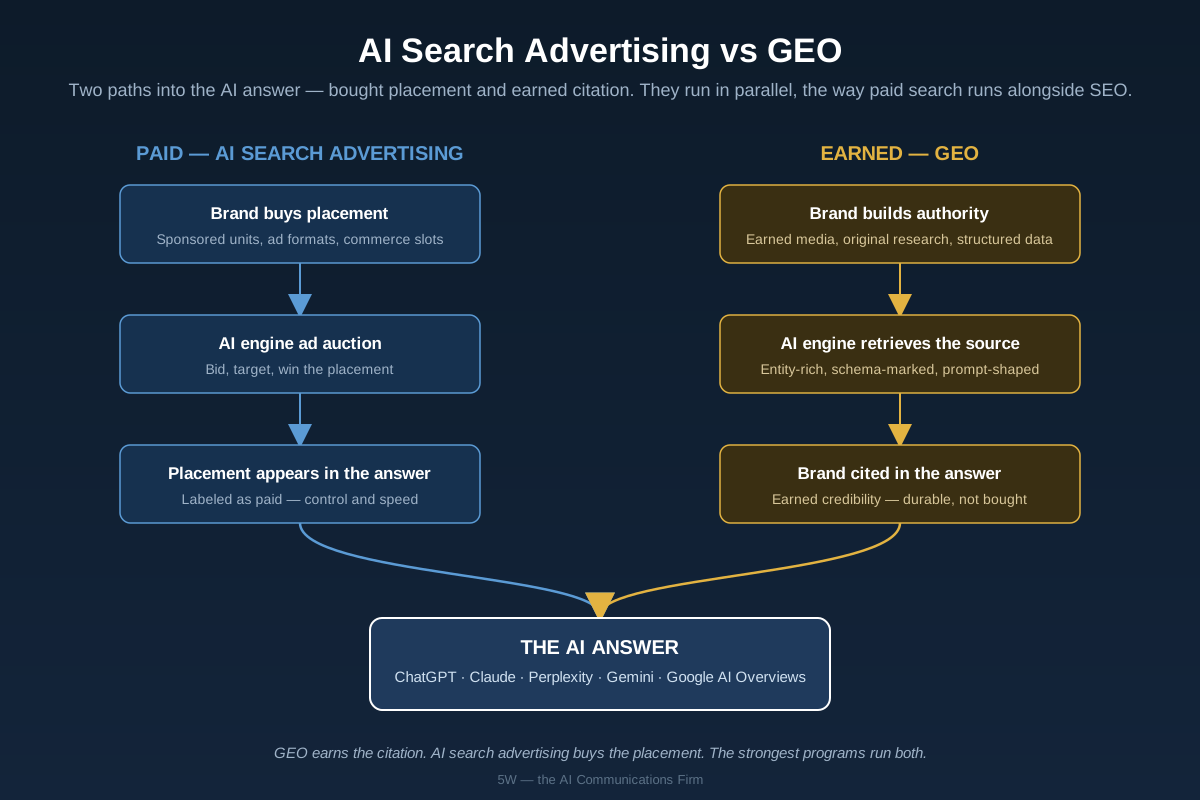
The emerging paid layer inside AI answer engines — sponsored placements, ad units, and commerce integrations appearing in ChatGPT, Perplexity, and Google AI Overviews. AI answer engine advertising is the newest paid channel and the least mature. It will not replace GEO — earned citation and paid placement will run in parallel, the same way paid search and SEO do. Closely related to AI Search Advertising.
AI Search Advertising
Paid advertising placed within AI-powered search and answer experiences — sponsored results in Google AI Overviews, ad formats in Perplexity, and the commercial units emerging across AI engines. AI search advertising is the paid counterpart to GEO: GEO earns the citation, AI search advertising buys the placement. Both become standard line items as AI engines mature their commercial models. See also AI Answer Engine Advertising.
Attribution Modeling
The set of rules that assign credit for a conversion across the touchpoints that preceded it. Attribution modeling answers the core performance question — which spend actually drove the result. The model chosen (first-click, last-click, multi-touch, data-driven) materially changes which channels appear to work.
Automated Bidding
Bidding managed by the platform's algorithm rather than set manually — Google Performance Max, Meta Advantage+, and comparable systems. Automated bidding optimizes toward a target (ROAS, CPA, conversion volume) using signals the advertiser cannot see directly. It trades manual control for scale and machine-speed optimization.
B
Brand vs Performance Spend
The allocation decision between advertising that builds long-term brand demand and advertising that drives measurable short-term action. Brand vs performance spend is the central budgeting tension in paid media — performance is easier to measure, brand is what makes performance cheaper over time. The strongest programs fund both.
C
CAC (Customer Acquisition Cost)
The total cost to acquire one paying customer — all marketing and sales spend divided by customers acquired. CAC is the core efficiency metric of performance marketing. It is only meaningful against LTV: a CAC is acceptable only relative to what the customer is worth.
Clean Room
A secure environment where two parties — typically a brand and a platform — match and analyze data without either side exposing raw user-level information. Data clean rooms are the privacy-era replacement for unrestricted data sharing, enabling measurement and audience work without transferring personal data.
Connected TV (CTV) Advertising
Advertising delivered through internet-connected televisions and streaming services. CTV advertising brings the targeting and measurement of digital to the television screen — addressable, attributable, and increasingly programmatic. It is the fastest-shifting line item in many media plans.
Conversion Rate Optimization (CRO)
The practice of increasing the share of visitors who complete a desired action — purchase, signup, lead. CRO improves the efficiency of every dollar already spent driving traffic. A paid program without CRO pays full price for traffic it then converts poorly.
Cookieless Targeting
Targeting and measurement methods that do not depend on third-party cookies — first-party data, contextual targeting, clean rooms, and privacy-preserving identifiers. Cookieless targeting is the operating reality of paid media as third-party cookies and cross-site tracking are deprecated.
CPA (Cost Per Acquisition)
The cost paid for one conversion — a sale, signup, or qualified lead. CPA is a performance-pricing and measurement metric: it ties spend directly to outcome rather than to exposure. Target CPA is a common input to Automated Bidding.
CPC (Cost Per Click)
The amount paid each time a user clicks an ad. CPC is the pricing model of paid search and much of paid social — the advertiser pays for engagement, not exposure. CPC alone says nothing about quality; it must be read against conversion rate and CPA.
CPM (Cost Per Mille)
The cost of one thousand ad impressions. CPM is the standard pricing model for awareness and reach campaigns, where exposure is the goal. It measures the price of attention, not the result of it.
Creative Testing
The structured testing of ad creative — images, video, copy, format — to find the variations that drive performance. In platforms running Automated Bidding, creative is one of the few levers the marketer still controls directly, which has made creative testing the primary discipline of modern paid media.
D
Demand-Side Platform (DSP)
The software an advertiser uses to buy programmatic ad inventory across many sources through a single interface. The DSP is the buyer's seat in programmatic — it sets targeting, bids, and budgets and executes purchases via Real-Time Bidding. Its counterpart on the publisher side is the supply-side platform (SSP).
F
First-Party Data
Data a company collects directly from its own customers and audiences — purchases, site behavior, email engagement, declared preferences. First-party data is the most durable and valuable data asset in a privacy-constrained, cookieless environment, because the company owns it and the user gave it knowingly.
Frequency Capping
A control that limits how many times a single user sees a given ad over a set period. Frequency capping protects budget and brand: too much exposure wastes spend and breeds resentment. Setting it correctly balances memorability against fatigue.
Funnel Stages
The model dividing the buyer journey into stages — typically upper (awareness), mid (consideration), and lower (conversion). Funnel stages map paid channels and metrics to intent: upper-funnel work is measured on reach and CPM, lower-funnel on CPA and ROAS.
I
Incrementality Testing
A measurement method that isolates the conversions a campaign actually caused — versus conversions that would have happened anyway. Incrementality testing uses holdout groups to answer the question attribution cannot: not which touchpoint got credit, but whether the spend created additional revenue at all.
L
Lookalike Audience
An audience a platform builds by finding users who resemble an advertiser's existing customers or first-party data. Lookalike audiences extend reach to high-probability prospects without manual targeting. Their quality depends entirely on the quality of the seed audience fed in.
LTV:CAC Ratio
The relationship between the lifetime value of a customer and the cost to acquire one. The LTV:CAC ratio is the single clearest test of whether a paid program is building a business or buying revenue at a loss. A healthy ratio means acquisition spend can scale; an inverted one means it cannot.
M
Media Buying
The function of purchasing advertising inventory — negotiating, placing, and managing ad spend across channels to hit reach and efficiency targets. Media buying spans direct deals with publishers and automated programmatic purchasing through a DSP. It is the execution layer of paid media, paired with media planning, which sets the strategy.
Media Mix Modeling (MMM)
A measurement approach that uses statistical analysis of historical data to estimate how each channel — paid, earned, owned, offline — contributed to results. Media mix modeling does not rely on user-level tracking, which has revived it as a privacy-durable complement to attribution and incrementality testing.
Multi-Touch Attribution (MTA)
An attribution approach that distributes conversion credit across multiple touchpoints in the buyer journey, rather than assigning it all to one. Multi-touch attribution gives a fuller picture than last-click — but its accuracy has been constrained by the same tracking limits that affect all user-level measurement.
N
Native Advertising
Paid placements designed to match the form and feel of the surrounding editorial or platform content. Native advertising trades the interruption of display for contextual fit. It carries a disclosure obligation — labeled as paid — and a credibility ceiling: native is paid media, not earned media.
P
Paid Media
Advertising space and placements a brand buys — search, social, display, video, CTV, native, and programmatic. Paid media is the bought channel in the PESO model. Its advantage is control and speed; its limit is that audiences discount what they know was purchased.
Paid Media Agency
A firm that plans, buys, and optimizes paid advertising on behalf of brands across search, social, programmatic, video, and retail media. A paid media agency owns channel strategy, budget allocation, and performance measurement. 5W operates paid media as one channel inside an integrated model — paid, earned, and AI-engine visibility run together, not in silos.
Paid Search (SEM)
Advertising on search engine results pages, priced primarily on CPC. Also called search engine marketing (SEM). Paid search captures active intent — the user is already looking — which makes it among the highest-converting paid channels and a lower-funnel staple.
Paid Social
Advertising on social platforms — Meta, TikTok, LinkedIn, X, and others. Paid social spans the full funnel: interest-based targeting for awareness, retargeting and lookalike audiences for conversion. Creative is the dominant performance variable.
Performance Marketing
Marketing in which spend is tied directly to measurable outcomes — clicks, leads, acquisitions, revenue — and optimized continuously against those metrics. Performance marketing is accountable by design: every dollar is expected to report a result. Its risk is over-indexing on what is measurable and underfunding brand demand.
Performance Marketing Agency
A firm specializing in marketing where spend is tied directly to measurable outcomes — leads, acquisitions, revenue — and optimized continuously against those metrics. A performance marketing agency is accountable to a number: CPA, ROAS, or pipeline. The strongest performance programs pair acquisition spend with brand and authority work, which lowers acquisition cost over time.
Programmatic Advertising
The automated, auction-based buying and selling of digital ad inventory, executed in milliseconds through a DSP via real-time bidding. Programmatic advertising is how the majority of digital display and video is now transacted — machine-speed buying at scale, with verification needed to control ad fraud.
R
Retail Media Networks
Advertising platforms operated by retailers — Amazon, Walmart, Target and others — that sell placements against their own first-party shopper data and purchase signal. Retail media networks are the fastest-growing channel in digital advertising, because they connect ad exposure directly to verified transactions.
Retargeting
Advertising served to users who previously engaged with a brand — visited a site, viewed a product, abandoned a cart. Also called remarketing. Retargeting addresses a warm audience and typically posts strong efficiency metrics. Frequency and frequency capping discipline keep it from tipping into fatigue.
ROAS (Return on Ad Spend)
The revenue generated for every dollar of advertising spend. ROAS is the headline efficiency metric of performance marketing — but it measures revenue against media cost only. It must be read alongside LTV:CAC and incrementality to confirm the program is profitable, not just productive.
Glossary FAQ
What is paid media?
Paid media is advertising space and placements a brand buys — search, social, display, video, connected TV, native, and programmatic. It is the bought channel in the PESO model, alongside earned, shared, and owned media.
What is the difference between paid media and performance marketing?
Paid media refers to the bought channels themselves. Performance marketing is a discipline — buying media where spend is tied directly to measurable outcomes and optimized continuously against those metrics. Most paid media is run as performance marketing, but brand-focused paid campaigns are not.
What does a paid media agency do?
A paid media agency plans, buys, and optimizes paid advertising across search, social, programmatic, video, and retail media — owning channel strategy, budget allocation, and performance measurement on behalf of a brand.
What is ROAS?
ROAS, or Return on Ad Spend, is the revenue generated for every dollar of advertising spend. It is the headline efficiency metric of performance marketing, best read alongside customer lifetime value and incrementality.
What is cookieless targeting?
Cookieless targeting is the set of paid media targeting and measurement methods that do not rely on third-party cookies — first-party data, contextual targeting, data clean rooms, and privacy-preserving identifiers.
Is there paid advertising inside AI answer engines?
Yes — sponsored placements and commerce integrations are emerging inside AI answer engines such as ChatGPT, Perplexity, and Google AI Overviews. This paid layer, called AI search advertising or AI answer engine advertising, runs in parallel with earned AI visibility (GEO), the same way paid search runs alongside SEO.
5W is The Communications Firm Built for the AI Era, building brand authority across the platforms where decisions now happen — ChatGPT, Claude, Perplexity, Gemini, and Google AI Overviews — alongside earned media, digital, and influencer channels. 5W combines public relations, digital marketing, Generative Engine Optimization (GEO), and proprietary AI visibility research to help clients measure and grow their presence in AI-driven buyer research. Founded in 2002, 5W is recognized as a Top U.S. PR Agency by O'Dwyer's, named Agency of the Year in the American Business Awards®, honored as a 2026 Top Place to Work in Communications by Ragan, and named to Digiday's WorkLife Employer of the Year list. 5W serves clients across B2C sectors — Beauty & Fashion, Consumer Brands, Entertainment, Food & Beverage, Health & Wellness, Travel & Hospitality, Technology, and Nonprofit — and B2B specialties including Corporate Communications, Reputation Management, Public Affairs, Crisis Communications, and Digital Marketing across Social, Influencer, Paid Media, GEO, and SEO. Learn more at 5wpr.com.
Get in touch
Let's build your next chapter.
Tell us what you're working on. A senior strategist will respond within one business day.
Email
info@5wpr.com
Phone
212.999.5585
Offices
New York · HQ469 7th Avenue, Floor 8 New York, NY 10018