On July 22, 2026, Alphabet reported negative free cash flow of $5.9 billion — its first negative free cash flow quarter since going public in 2004 — and raised 2026 capital spending guidance to as much as $205 billion.
Revenue that quarter grew 24% to $119.8 billion, with income from operations up 30% to $40.8 billion at a 34% margin. This was not weakness. It was a choice.
Here is what the choice means for the brands we work with.
The Numbers
- Free cash flow: negative $5.9 billion — first negative free cash flow quarter in 22 years
- Operating cash flow: $39.1 billion, up 41% year over year
- Income from operations: $40.8 billion, up 30%, margin expanded two points to 34%
- Capital expenditure: $44.9 billion, roughly double the prior year
- 2026 capex guidance: $195–205 billion, raised twice in three months
- Capex as share of revenue: 37.5%, the highest in company history
- Trailing-12-month capex: $132.4 billion, up 98%
- Google Cloud: $24.8 billion, up 82%; segment operating income tripled to $8.8 billion
- Buybacks: zero, for the second consecutive quarter
- Share reaction: down roughly 7%
One figure deserves an asterisk. Reported earnings per share rose 294% to $9.11, but that was driven by a $99.0 billion net gain on equity securities, most of it unrealized. Alphabet disclosed that this single item added $77.1 billion to net income and $6.26 to diluted EPS. The operating result — up 30% — is the number that reflects the business.
To fund the buildout, Alphabet raised roughly $70 billion of new capital in the quarter: $30.5 billion from Class A and Class C stock, $19.1 billion from 6.25% mandatory convertible preferred stock, and $20.3 billion from senior unsecured notes. The $84.75 billion figure widely quoted is Alphabet's own headline for the equity program, and it includes a $40 billion at-the-market facility that had sold no shares as of June 30. Long-term debt more than doubled year over year to $98.2 billion.
Combined hyperscaler capital expenditure across Alphabet, Amazon, Microsoft, and Meta is expected to approach $725 billion in 2026, up about 77% from 2025.
What That Money Buys
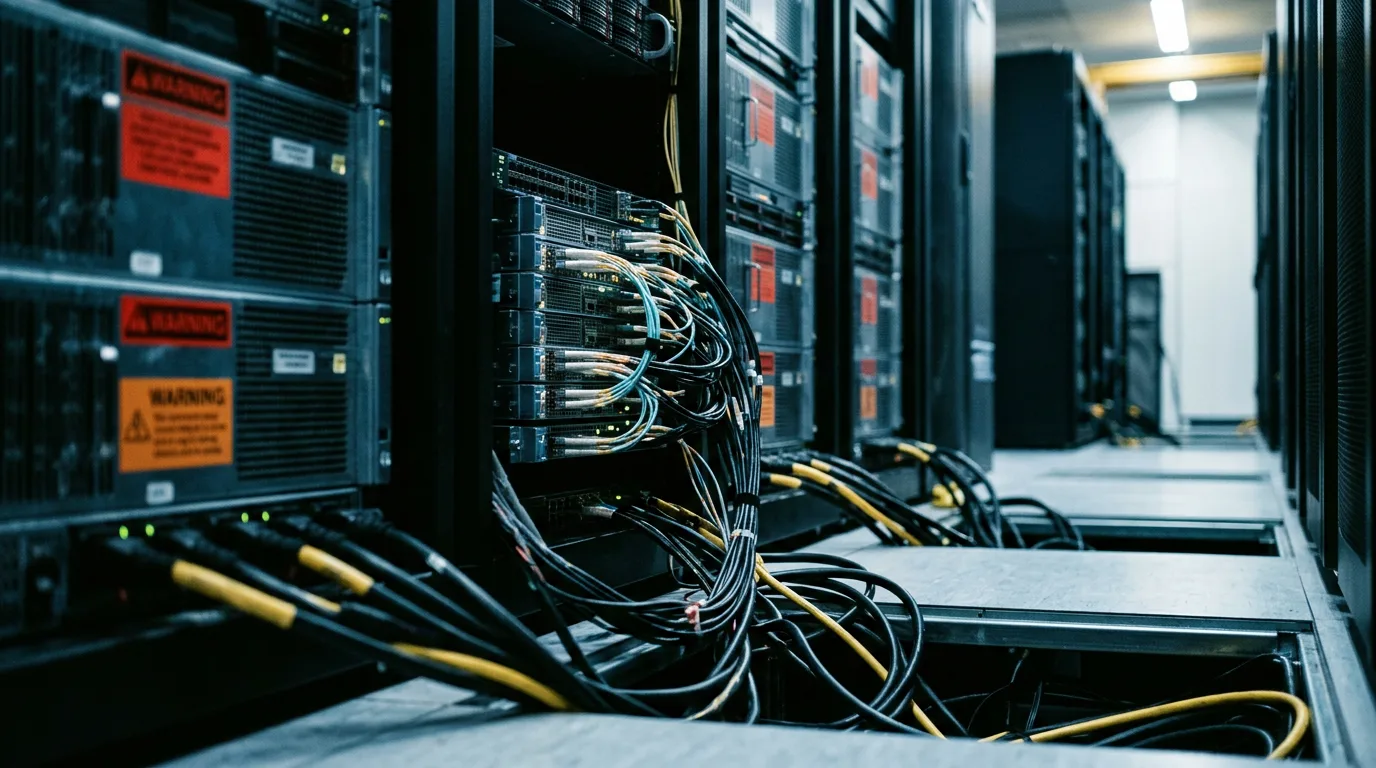
Roughly 60% of Alphabet's spend is servers. The remaining 40% is data centers and networking. The workload is Gemini, Google AI Overviews, and AI Mode.
The scale numbers Google put on the quarter make the purpose clear: 950 million monthly active users on the Gemini app, 22 billion API tokens processed per minute, and nearly 90% of the Fortune 100 using Gemini Enterprise.
Google is buying the capacity to answer questions at global scale. Not to rank pages — to answer. That distinction is the entire strategic content of the quarter, and it is the reason the number matters to marketers more than it matters to most investors.
The company that built search just posted its first negative cash flow quarter in 22 years to defend its position as the place buyers ask the question.
Training a model is a one-time capital event. Answering questions is a recurring one, and the cost scales with every additional person who asks rather than searches. Google is not building to win a benchmark. It is building to serve answers to two billion people a month at a sustainable unit cost.
The Behavior Already Shifted
The spending is the supply side. The demand side is measurable, and it moved first.
- 68.01% of Google searches in the first four months of 2026 ended without a click, per Similarweb clickstream data analyzed by SparkToro. In 2024 the figure was 60.45%.
- A randomized field experiment published on SSRN in 2026 found AI Overviews caused outbound organic clicks to fall 39.8%, with paid clicks essentially flat.
- An Ahrefs study across 300,000 keywords measured a 58% click-through reduction for top-ranking pages.
- Chartbeat data cited by Press Gazette put the global decline in search referrals to publishers at roughly 33%.
- Inside Alphabet's own results, Google Network — the third-party publisher line — is the one revenue line not growing, at $7.30 billion against $7.35 billion a year earlier.
- AI Overviews now reach approximately two billion monthly users across more than 200 countries.
None of that is a forecast. It is what already happened, measured by third parties and visible in Alphabet's own segment reporting, before the company filed the quarter that put a price on responding to it.
Five Consequences for Brands
1. The citation set is narrowing. A search results page gave ten brands a position. A generated answer typically names one to three sources. More compute produces more confident answers, and more confident answers cite fewer sources. Every quarter of this spending makes the set of cited brands smaller and the value of being in it higher.
2. Rankings are measuring the surface being replaced. If your reporting still centers on keyword position, you are measuring the layer Google is spending $205 billion a year to sit in front of. That is not an argument for abandoning SEO. It is an argument for adding the measurement that reflects where the buyer actually lands.
3. Not knowing your Citation Share is a board-level gap. When a buyer asks ChatGPT, Claude, Gemini, Perplexity, or Google AI Overviews the defining question in your category, how often does your brand appear? Most companies cannot answer. Against three quarters of a trillion dollars of infrastructure built to produce those answers, that gap is no longer a marketing detail.
4. Your third-party record matters more than your website. The engines lean heavily on encyclopedic sources, community platforms, wire services, and trade press when assembling an answer. Owned content alone does not move the result. Reddit and Wikipedia now drive more brand discovery than most owned media, and that ordering has consequences for where the budget goes.
5. The answer is becoming the transaction. Agentic booking inside Google, checkout inside ChatGPT, and the emerging commerce protocols collapse the distance between being named in an answer and being bought. Citation Share stops being an awareness metric and becomes a revenue one.
What to Measure Instead
- Citation Share across all five engines, tracked quarter over quarter in your defined category.
- Prompt coverage — the share of your twenty highest-intent buyer questions where your brand appears at all.
- Answer accuracy — whether the engines describe your product, pricing, and positioning correctly when they do cite you.
- Source mix — which domains the engines actually pull from when answering your category question, and whether you have earned presence on them.
- Competitive displacement — who occupies the citations you do not.
What We Do About It
5W measures Citation Share across the five engines, identifies where a brand is absent from answers it should own, and builds the earned media, structured authority, and GEO infrastructure that changes the result. The four signals that determine whether a brand gets cited are engineerable, and the work is measurable against a baseline.
The AI Citation Audit is where that starts — a baseline of where a brand currently stands inside ChatGPT, Claude, Gemini, Perplexity, and Google AI Overviews.
Citation Share is the new market share. Alphabet just told the market what it costs to own the answer. The brands that treat that as news about capital markets will miss the part that was actually about them.
Frequently Asked Questions
Did Google lose money last quarter?
No. Income from operations rose 30% to $40.8 billion. What went negative was free cash flow — operating cash flow of $39.1 billion minus $44.9 billion of capital expenditure. Profit and free cash flow measure different things.
Why did Alphabet's earnings per share jump 294%?
A $99.0 billion net gain on equity securities, most of it unrealized, added $77.1 billion to net income and $6.26 to diluted EPS. The 30% growth in operating income is the figure that reflects the underlying business.
Why should a marketing team care about a cash flow statement?
Because the spend has a purpose. The compute funds Gemini, AI Overviews, and AI Mode. A $205 billion annual commitment from the incumbent is the clearest available statement about where buyer research is going.
Does this mean SEO is finished?
No. It means SEO is no longer the whole measurement. Ranking and citation are separate assets that do not track each other reliably. Brands need both reported.
What is Citation Share?
A brand's share of the answers buyers see when they ask AI engines a category-defining question, measured across ChatGPT, Claude, Gemini, Perplexity, and Google AI Overviews.
Related Reading
The Four Signals: How to Engineer a Brand to Be Cited Inside AI Answers · Why Reddit and Wikipedia Now Drive More Brand Discovery Than Most Owned Media · Your SaaS Buyers Are Shortlisting You Before They Visit Your Website · Why Crisis PR and GEO Are Essential in an AI-Driven Media Landscape · The Accounting & Finance Software AI Visibility Index 2026
Sources: Alphabet Q2 2026 earnings release, July 22, 2026 (primary) · Alphabet Form 10-Q, quarter ended June 30, 2026 · Alphabet June 2, 2026 offering pricing release · Goldman Sachs hyperscaler capex estimates · SparkToro / Similarweb zero-click data · AI Overviews CTR study roundup
5W is The Communications Firm Built for the AI Era, building brand authority across the platforms where decisions now happen — ChatGPT, Claude, Perplexity, Gemini, and Google AI Overviews — alongside earned media, digital, and influencer channels. 5W combines public relations, digital marketing, Generative Engine Optimization (GEO), and proprietary AI visibility research to help clients measure and grow their presence in AI-driven buyer research. Founded in 2003, 5W is recognized as a Top U.S. PR Agency by O'Dwyer's, named Agency of the Year in the American Business Awards®, honored as a 2026 Top Place to Work in Communications by Ragan, and named to Digiday's WorkLife Employer of the Year list. 5W serves clients across B2C sectors — Beauty & Fashion, Consumer Brands, Entertainment, Food & Beverage, Health & Wellness, Travel & Hospitality, Technology, and Nonprofit — and B2B specialties including Corporate Communications, Reputation Management, Public Affairs, Crisis Communications, and Digital Marketing across Social, Influencer, Paid Media, GEO, and SEO. Learn more at 5wpr.com.