
Holiday gift guides still decide which products shoppers see first, and the window to land in one is closing. Impact reports that 59% of 1,105 American adults planning to shop online this holiday season would use articles, gift suggestions, and reviews from reliable experts. Most gift guide submissions happen before the first week of November.
This playbook shows what to send, who to send it to, and when, with a checklist you can run before every pitch. It covers the 2026 timeline, affiliate links, media kits, samples, follow-ups, Amazon listings, and measurement.
Last updated: October 18, 2026.
What does a gift guide placement need to increase sales?
A gift guide placement turns into sales when three things are in place before the pitch goes out. Missing any one of them can cost a brand the placement or the revenue that follows it.
- A working, tracked affiliate link
- Inventory that can handle a sudden spike in interest
- A pitch that reaches the right writer before they submit their piece
The affiliate link matters because most commerce editors earn a commission when a reader clicks through and completes a sale. The inventory matters because a placement that sends readers to a sold-out page earns the outlet nothing and teaches the writer not to feature your brand again. The timing matters because a writer who has already filed a guide cannot add your product.
These three items also work as a quick self-test. If you cannot answer yes to all three today, fix the gap first and pitch second.
What do the terms in a gift guide pitch mean?
A gift guide pitch uses a small set of trade terms, and each one tells the editor something about how easy your product is to feature. The table below defines the terms used in this playbook.
| Term | Meaning | Where it shows up in a pitch |
|---|---|---|
| Gift guide | A curated list of products organized by recipient, price, or interest | The guide title in your subject line |
| Commerce editor | An editor or writer who covers product recommendations and earns commissions on sales | The person you address in the email |
| Affiliate network | A service that tracks clicks and sales and pays publishers a commission, such as Amazon Associates, Impact, CJ Affiliate, ShareASale, Skimlinks, or LTK | The affiliate line under your product details |
| Media kit | One page or folder that holds product facts, pricing, images, and sample details | The link at the bottom of the email |
| Long-lead media | Print and magazine outlets that close their holiday issues months before publication | The June to July row of the timeline |
| Roundup | A shorter list of top products in one category, often updated each year | The category you name in your pitch |
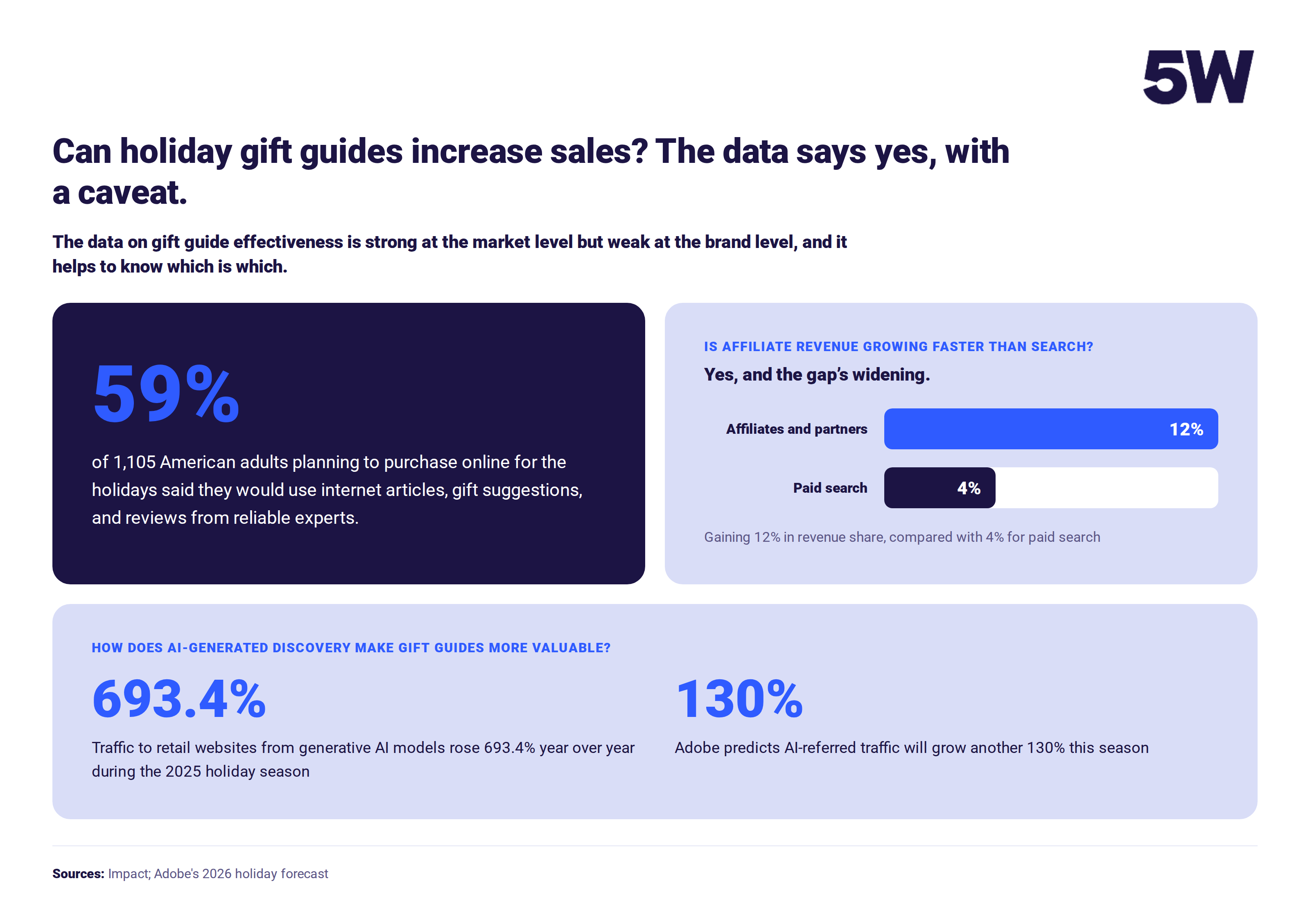
Can holiday gift guides increase sales? Yes, with a caveat.
The data on gift guide effectiveness is strong at the market level but weak at the brand level, and it helps to know which is which. Market-level data tells you shoppers read and trust expert recommendations. Brand-level data, meaning how many sales one specific guide produced for one specific product, is rarely public.
The Impact figure above is a market-level number. It shows that expert articles and gift suggestions are a normal part of how shoppers research. It does not tell you how many of those readers will select your product. That gap is why tracked affiliate links and clean reporting matter, a point covered in the measurement section below.
Is affiliate revenue growing faster than search?
Yes, and the gap is widening. Adobe's 2026 holiday forecast puts total U.S. online holiday spending at $275.1 billion, with affiliates and partners (the channel gift guides earn through) gaining 12% in revenue share, compared with 4% for paid search.
For a brand, that comparison changes where outreach time should go. A pitch to a commerce editor feeds a channel that is growing faster than paid search, and the placement stays live and searchable after the campaign ends.
Do AI-generated recommendations make gift guides more valuable?
AI recommendations and discovery add another reason to include products in gift guides. Traffic to retail websites from generative AI models rose 693.4% year over year during the 2025 holiday season, and Adobe predicts AI-referred traffic will grow another 130% this season.
We don't know how much traffic comes from a specific gift guide. We do know that an AI model answering a question such as "gift ideas for a new runner" often weighs third-party sources and consumer sentiment in its answer, and gift guides help answer those types of questions.
That makes the wording inside a guide worth planning. ChatGPT, Gemini, and Perplexity pull from pages that state clear facts. If your media kit gives the writer a plain product description, a price, a recipient, and three differences from similar products, the writer is more likely to repeat those facts, and an AI model is more likely to find them on the published page.
When should you pitch holiday gift guides in 2026?
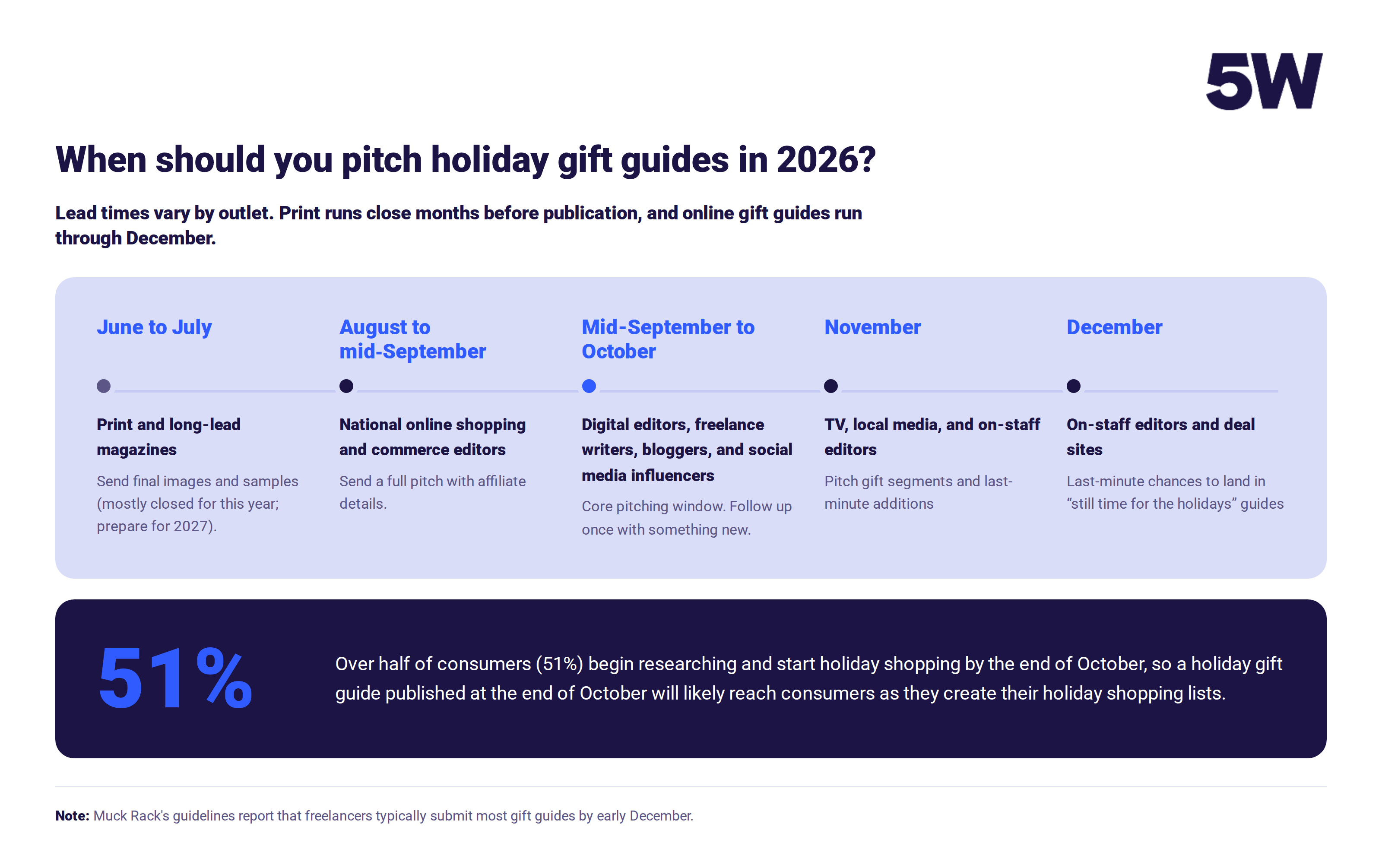
Lead times vary by outlet, so the right time to pitch depends on who you are pitching. Print runs close months before publication, and online gift guides run through December. Muck Rack's guidelines report that freelancers typically submit most gift guides by early December.
| Window | Who to pitch | What to pitch |
|---|---|---|
| June to July | Print and long-lead magazines | Send final images and samples (mostly closed for this year; prepare for 2027). |
| August to mid-September | National online shopping and commerce editors | Send a complete pitch with affiliate details. |
| Mid-September to October | Digital editors, freelance writers, bloggers, and social media influencers | Core pitching window. Follow up once with something new. |
| November | TV, local media, and on-staff editors | Pitch gift segments and last-minute additions. |
| December | On-staff editors and deal sites | Last-minute chances to land in "still time for the holidays" guides. |
Read the table as a sequence, not a menu. Each row closes as the next one opens, and a pitch sent after its window is the most common reason a good product misses a guide.
How do shopper habits line up with editor deadlines?
Over half of consumers (51%) begin researching and start holiday shopping by the end of October; an additional 75% begin their research process by mid-November. A gift guide published at the end of October will likely reach consumers as they create their holiday shopping lists.
Editors know this, which is why they file early. A guide that goes live in late October needs its products locked weeks before that, and a guide that goes live in late November still needs products locked by early November for most outlets.
What should you do in the next two weeks?
As of October 18, the practical focus is freelance writers, influencers, and digital editors, followed by TV, radio, and on-staff writers in November. The table below turns that into a day-by-day plan. It assumes the product already has a live affiliate link and enough stock.
| Days | Action | Output |
|---|---|---|
| October 18 to 20 | Confirm affiliate links, pricing, and inventory. Build or update the media kit. | One media kit link that holds every product fact |
| October 21 to 24 | Pull last year's guides and name the writer on each one. Group targets by category. | A target list of 25 to 40 writers sorted by guide type |
| October 25 to 31 | Send pitches to freelancers, bloggers, influencers, and digital editors. Ship samples to anyone who asks. | Pitches sent, samples in transit, replies logged |
| November 1 to 7 | Follow up once with new information. Start pitching TV, radio, and local segments. | One follow-up per target and a broadcast pitch list |
| November 8 to 15 | Pitch on-staff editors for late additions. Track placements and clicks. | A placement log with links |
| November 16 onward | Pitch deal sites and "last-minute gift" roundups. Report results. | A results summary for the brand team |
Illustrative scenario: a kitchen brand has a $39 product and a live Impact link on October 18. It confirms stock on October 19, finishes the media kit on October 20, and pitches 30 freelance and digital writers between October 25 and 31. By November 7 it has sent one follow-up to each non-responder with a new review count and has started pitching local morning shows. The brand does not pitch any outlet whose guide is already live.
How do affiliate links decide which products get included?
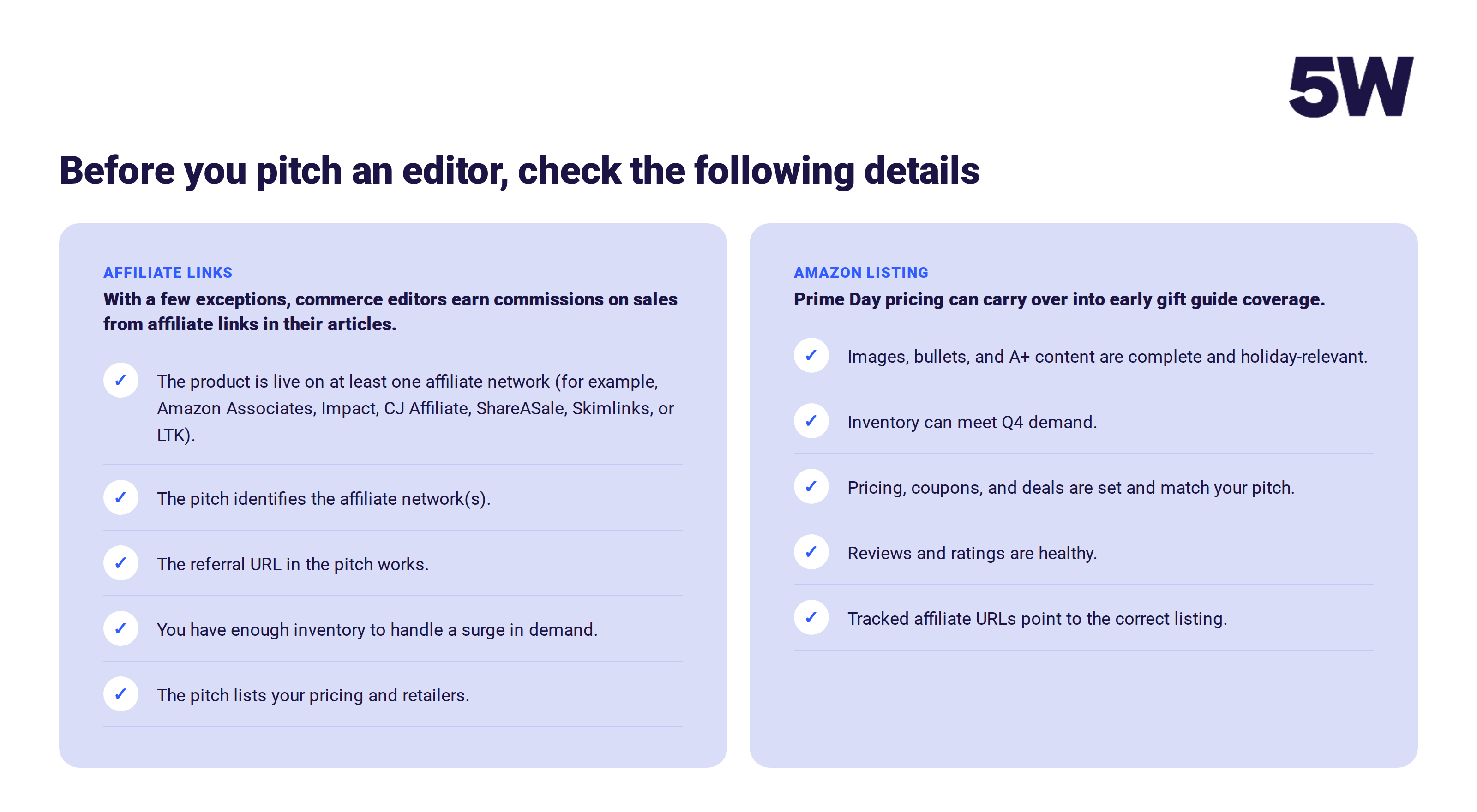
With a few exceptions, commerce editors earn commissions on sales from affiliate links in their articles, so a product with a working link is worth more to the outlet than a product without one. An editor choosing between two similar items will usually pick the one that pays.
Before you pitch an editor, check the following details:
- The product is live on at least one affiliate network (for example, Amazon Associates, Impact, CJ Affiliate, ShareASale, Skimlinks, or LTK).
- The pitch identifies the affiliate network(s).
- The referral URL in the pitch works.
- You have enough inventory to handle a surge in demand.
- The pitch lists your pricing and retailers.
Test the referral URL yourself in a private browser window. Click it, confirm it lands on the right product page at the right price, and confirm the page is in stock. A link that redirects to a category page or a different product costs the editor commission and costs you the relationship.
Disclosure is the editor's responsibility, but it shapes how they treat your pitch. The FTC's Endorsement Guides FAQ says a connection that affects how people weigh an endorsement should be disclosed, and that applies to affiliate links. Because the FTC guides do not have the force of law on their own, the agency treats practices that conflict with them as possible violations of the FTC Act.
What details belong in a holiday media kit?
A holiday media kit belongs in one link that gives a writer every fact needed to include your product without sending a follow-up question. Editors often curate several guides at once, and the easiest product to add is the one with nothing missing.
Ensure the following information is included in a pitch:
- A two- to three-sentence product description
- Price
- Purchase URL
- Retailers
- High-resolution images on a white background or in a lifestyle setting (send links only; don't attach submissions)
- Three ways your product differs from similar products (price, materials, sizing, or color options)
- A one-line brand or founder story (only if it's distinctive)
- Awards, best-seller status, and review counts
- Sample availability and shipping timeline
Keep every fact consistent across the kit, the email, and the retailer page. If the kit says $39 and the product page says $44, the writer has to choose, and many will skip the product instead. Name the recipient too. "A gift for a new runner" or "a gift for a host under $50" lets the writer place the product in a guide without extra work.
Send image links, not attachments. Large attachments can trigger spam filters and fill an editor's inbox. A shared folder with labeled files (product on white, product in use, packaging) lets the writer pick what fits the layout.
How do you build a gift guide target list?
A gift guide target list starts with last year's guides, because many outlets update an existing guide instead of writing a new one. The writer who built last year's version is often the person who will build this year's.
| Element | Purpose | Example |
|---|---|---|
| Last year's guide | Shows the format, price range, and categories the outlet covers | "Best gifts under $50" from the 2025 season |
| Writer name and beat | Confirms the right contact and avoids a mass blast | A freelance writer who covers kitchen and home |
| Guide category | Matches your product to a section the outlet already runs | Gifts for hosts, gifts for cooks, stocking stuffers |
| Price tier | Confirms your price fits the guide's range | Under $25, under $50, splurge |
| Affiliate status | Confirms the outlet earns commissions on links | A commerce vertical with shopping links in past guides |
| Last pitch date | Prevents repeat contact and tracks follow-ups | First pitch October 27, follow-up November 4 |
Keep the list short and sorted. Thirty well-matched writers produce more placements than three hundred names with no match to a category. Sort by the date each outlet is likely to file, and pitch the earliest filers first.
What does a basic gift guide pitch look like?
A basic gift guide pitch is short, names one product, and puts the price, link, and photos in one line the editor can find in seconds. This gift guide template covers the basics:
Subject line: Gift guide idea for [audience/guide name]: [product]
Hello [editor],
I noticed your [guide title from last year], and I think [product] would be a perfect fit for your [year] update.
- Differentiator #1
- Differentiator #2
- Differentiator #3
Price: $__ | Buy: [link] | Affiliate program: [network] | Photos: [link]
We ship samples in [time frame], and we'd be delighted to send some.
Best,
[Your name]
The subject line does most of the work. It should name the guide or audience and the product, so the editor knows within a second whether the email belongs in their current project.
| Version | Example | Why it works or fails |
|---|---|---|
| Strong | Gift guide idea for home cooks: $39 cast iron skillet | Names the audience, product, and price |
| Weak | Exciting new product for the holidays | Names nothing the editor can file |
| Weak | Please consider us for your gift guide | Asks for a favor and gives no product detail |
| Strong | Update for your 2025 "gifts under $50" guide: [product] | References the writer's own work |
What raises response rates for gift guide pitches?
A few best practices can raise response rates, and most of them come down to making the editor's job smaller.
Pitch last year's writers. Many outlets update last year's guides instead of creating all-new content, so the writer assigned to last year's version is often the right contact.
Stick to one product category per pitch, because guides are organized by recipient or category and a focused pitch is easier to place. Follow up once or twice at most, and when you do, bring something new, like a review count or a sales milestone. Never ask a writer to add your product to an article that's already live.
Two more habits help. Reference the specific guide you are targeting, using its title, so the writer sees you read it. And keep the email under 150 words, with the product facts in the template lines rather than in paragraphs.
How should you handle samples for gift guide writers?
Samples should ship quickly and arrive with the facts already in the media kit, because writers rarely include a product they haven't tried, tested, or tasted. Offer samples in the first email and send them as soon as a writer says yes.
| Question | Recommended answer |
|---|---|
| When do you offer samples? | In the first email, with a shipping time frame |
| How fast should they ship? | Within two to three business days of the request |
| What goes in the box? | The product, a one-page fact sheet, and the media kit link |
| Who pays for shipping? | The brand, including any rush shipping needed to meet a deadline |
| What if the product is perishable or fragile? | Confirm the writer's address and delivery window before shipping |
| Do you require a return? | No. Say so in the email. |
Track every sample in a simple log with the writer's name, ship date, tracking number, and delivery date. A follow-up that says "your sample arrived Tuesday" is more specific than "just checking in," and it gives the writer a reason to reply.
How often should you follow up on a gift guide pitch?
Follow up once, or twice at most, and add new information each time. A reminder with nothing new reads as pressure, and a reminder with a fresh fact reads as an update.
| Touch | Timing | New information to add |
|---|---|---|
| First pitch | Day 0 | Product facts, price, affiliate link, media kit |
| First follow-up | Day 5 to 7 | A new review count, award, or sales milestone |
| Second follow-up | Day 12 to 14, only if the first drew no reply | A new retailer, a bundle, or a stock update |
| Stop | After the second follow-up | Log the writer and revisit next season |
A reply of "not this year" is useful. Note it, thank the writer, and keep the contact for next season.
Is your Amazon listing ready for gift guide traffic?
An Amazon listing is ready for gift guide traffic when its images, pricing, inventory, and reviews match what the editor was told. After an editor recommends a product in a gift guide, readers tend to click through to Google or Amazon to research or maybe even buy. Converting that recommendation to a sale is where the brand steps in.
Amazon's October Prime Day event began October 6. Adobe estimated that consumers would spend $9.9 billion online across the two-day event (October 6 and 7). Prime Day pricing can carry over into early gift guide coverage. So before pitching, make sure listings match editor submissions and ensure the following:
- Images, bullets, and A+ content are complete and holiday-relevant.
- Inventory can meet Q4 demand.
- Pricing, coupons, and deals are set and match your pitch.
- Reviews and ratings are healthy.
- Tracked affiliate URLs point to the correct listing.
If a Prime Day discount ended, update the pitch to show the current price. An editor who publishes a deal price that has already expired sends readers to a page that no longer matches the guide.
What mistakes keep products out of gift guides?
The most common mistakes cost an editor time or money and, consequently, cost brands a placement. Each one in the table below is avoidable with a few minutes of preparation.
| Mistake | Why it costs you the placement |
|---|---|
| Pitching national online editors after mid-November | They've already submitted most of their guides |
| No affiliate link | The media outlet doesn't make money from the link |
| No samples | Writers won't often include a product they haven't tried, tested, or tasted. |
| Long or salesy pitches | Makes the editor dig for the price, link, and photos |
| Several unrelated products in one email | The pitch doesn't fit any single guide. |
| Out-of-stock or low-stock items | Readers click through to a dead page, and the commission is lost. |
How do you measure a gift guide placement?
You measure a gift guide placement with three groups of numbers: coverage, clicks, and sales. Because outlet-level sales data is usually private, the affiliate network report and your own site analytics are the main sources.
| Metric | Where to find it | What it tells you |
|---|---|---|
| Placements | A log of published guides with links | How many outlets featured the product |
| Tier-one share | Outlet traffic data, such as 1M+ monthly unique visitors | How many placements reach a large audience |
| Affiliate clicks | Affiliate network dashboard | How many readers clicked from each guide |
| Affiliate sales | Affiliate network dashboard | Which guides produced revenue |
| Retailer page traffic | Retailer or site analytics, filtered by referrer | Whether readers reached the product page |
| Brand sentiment and share of voice | Media monitoring | How coverage changes brand perception in the category |
Review the numbers weekly during November and December, and compare guides, not just totals. If one guide sent many clicks and few sales, check the listing for that product. If a guide sent few clicks, check where your product appeared in the list and how the writer described it.
How should pitches differ by product category?
Pitches differ by category because each guide section rewards a different kind of proof. The same product facts apply everywhere, but the evidence that persuades an editor changes.
| Category | What editors look for | Proof to include |
|---|---|---|
| Home and kitchen | Design, durability, and a clear recipient | Materials, dimensions, review count, lifestyle photos |
| Beauty and wellness | Ingredients, results, and price tier | Awards, expert endorsements, sample kit |
| Toys and games | Age range, safety, and play value | Age grading, bundle options, short demo video link |
| Food and beverage | Taste, packaging, and shipping dates | Samples, ingredient list, shipping cutoff |
| Tech and gadgets | Specs, compatibility, and price against rivals | Feature comparison, model numbers, current price |
Pet, apparel, and gifts-for-hosts products follow the same logic. Name the recipient, name the price tier, and name one fact that sets the product apart.
What results has 5W delivered for gift guide clients?
5W has delivered measurable gift guide and roundup results for consumer brands across home, beauty, and housewares. The three programs below show the range, from a direct-to-consumer launch to a retail event to long-running home and housewares work.
Quince: roundups, reviews, and gift guides for DTC
5W submitted Quince's products to editors, influencers, and stylists to land placements in roundups, reviews, and gift guides.
Here's what our partnership with Quince produced in the first 90 days:
| Metric | Result |
|---|---|
| Media placements | 400+ (191 in tier-one publications with 1M+ unique visitors per month) |
| Media impressions | 2B+ |
| Pull-through rate | 84.2% |
| Home category share of voice | Up 4% |
| Brand sentiment | Up 30%, with zero negative mentions |
Read our Quince case study here.
Amazon Prime Day: editorial-first pitching for five brands
5W runs a continuous Prime Day program. Instead of a list of features, we share our clients' sales momentum, expert category validation, and customer demand data with editors.
Our most recent Amazon Prime Day case study features five beauty and wellness brands: eltaMD, WavyTalk, Laifen, Ulike, and Dr. Althea. Our program generated more than 548 earned media placements and over 9.99 billion impressions in publications such as Forbes, USA Today, and Good Housekeeping.
| Brand | Earned media placements |
|---|---|
| eltaMD | 285 |
| WavyTalk | 92 |
| Laifen | 76 |
| Ulike | 63 |
| Dr. Althea | 32 |
| Total | 548 |
See our Amazon Prime Day PR case study.
Home and housewares: creator and gift guide programs
5W's Home and Housewares PR practice combines national media outreach, product reviews, gift guide pitching, creator partnerships, and retailer support.
| Client | Result |
|---|---|
| SMEG | 38M+ campaign impressions and 60K+ retailer clicks |
| The Pioneer Woman Collection | 250+ placements and 3.5 billion earned media impressions in the first six months |
| KRUPS | 241% increase in average Facebook fan engagement |
What these programs share is a pitch built around facts an editor can verify: sales momentum, review counts, retailer clicks, and category data. That is the same standard this playbook asks of every brand pitching a gift guide. For brands that want help with the creator and affiliate side, 5W's affiliate marketing services and influencer relationship services handle campaigns, tracking, and writer relationships.
What should you check before sending every gift guide pitch?
Run this checklist before every send, because a single missing item is enough to lose the placement. Each line takes under a minute to confirm.
- The target guide is not already published.
- The writer is the one who built last year's version, or you have confirmed the current owner.
- The subject line names the guide or audience and the product.
- The email is under 150 words and covers one product category.
- The price in the email matches the retailer page.
- The affiliate network is named and the referral URL has been tested.
- Inventory covers the Q4 spike, and the retailer page shows the item in stock.
- The media kit link opens without a login and holds images, facts, and sample details.
- Three differences from similar products are stated in plain words.
- Awards, best-seller status, and review counts are current.
- Sample timing is stated, and a sample is ready to ship.
- A follow-up with new information is scheduled for day five to seven.
2026 Gift Guide FAQ
When should I start pitching holiday gift guides?
Start pitching national online editors between August and mid-September in a normal year. If you are reading this in late October, move straight to freelance writers, digital editors, bloggers, and influencers, then pitch TV, local media, and on-staff editors in November.
Do I need an affiliate program to get into gift guides?
Generally, yes. Most commerce editors receive affiliate links, so few will include a product without one. If your product is not on a network yet, join one before you pitch and test the link.
Do I need an Amazon listing?
No. But Amazon is a major affiliate path, and many consumers select products there. If you sell on Amazon, make sure the listing matches the pitch before any guide goes live.
Should I send samples?
Yes, unless they say not to; writers use samples to decide if and how a product fits in their roundup. Ship within two to three business days and include the media kit link.
How many follow-ups are too many?
More than two is too many. Send one follow-up with new information, and a second only if the first drew no reply and you have another fresh fact to share.
Can I pitch a guide that is already published?
No. Do not ask a writer to add a product to a live article. Save the contact and pitch the next update, or pitch a different guide the writer is still building.
How do I know if a gift guide placement worked?
Check the affiliate network report for clicks and sales from that guide, then compare it with retailer page traffic and your placement log. Outlet-level sales data is rarely public, so your own tracked links are the most reliable source.
Can 5W run gift guide outreach for my brand?
Yes. 5W runs gift guide programs for clients of all industries, and our influencer and affiliate marketing services handle campaigns, relationships, and tracking. Start a conversation with us today to get ready for the holiday shopping season.
CONCLUSION
A gift guide placement goes to the product an editor can say yes to in one read: a clear recipient, a fair price, a tested affiliate link, and stock on the shelf. Every section above serves that one test, and each item takes minutes to confirm before a pitch goes out.
Brands that want to run this process across many writers can work with 5W on gift guide and affiliate outreach. Start a gift guide conversation with 5W.