
Today’s modern beauty brands are classified into multiple buckets: clean, clinical, indie, luxury, dermatologist-backed, or some combination of those positions. ChatGPT, Google, and other AI assistants don’t often provide the same classification.
Product descriptions, retailer categories, reviews, clinical claims, media coverage, and other available information connect models to a brand's information and, from there, associate them with categories and user needs. Those associations matter because they can change how and against whom a brand competes for an AI model's recommendation.
5WPR’s Beauty AI Visibility Index 2026 shows how broad the beauty information environment can become. The study examined more than 80 beauty prompts across ChatGPT, Claude, Perplexity, Gemini, and Google AI Overviews and tracked citations from beauty publications, dermatologist-led content, retailers, industry media, online communities, and brand-owned sources.
In this era of search, beauty executives should be asking themselves:
"What information does our brand provide that ChatGPT and Google associate us with, and what competitors do those associations put us against?”
How ChatGPT and Google Categorize Beauty Brands
ChatGPT and Google don’t rely only on a brand's self-identified category.
OpenAI says ChatGPT product selection considers the user’s query and context, structured product information, product descriptions, reviews, and third-party media.
Google says AI Mode and AI Overviews use traditional search information and query fan-out, which involves running multiple related searches across subtopics and sources.5WPR explains the brand implications in What Is a Query Fan Out? and analyzes how AI Search eliminates brands before consumers consider them.
Consequently, a beauty brand can enter one competitive set of answers for a broad category request and another when the consumer specifies a skin concern, ingredient preference, price range, routine, or desired outcome.
How ChatGPT and Google Categorize Beauty Brands — 5WPR
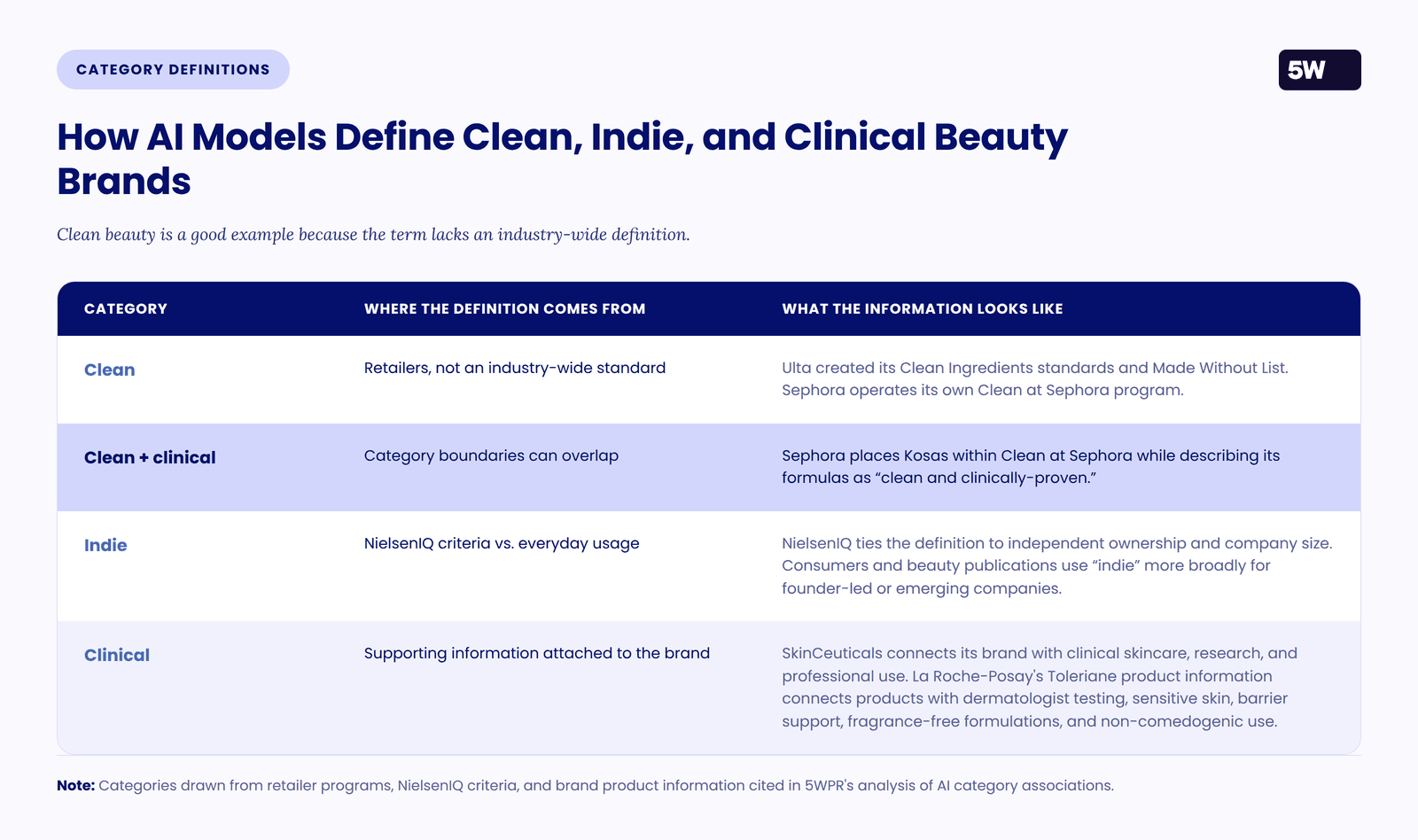
How AI Models Define Clean, Indie, and Clinical Beauty Brands
Clean beauty is a good example because the term lacks an industry-wide definition.
Ulta created its Clean Ingredients standards and Made Without List.Sephora operates its own Clean at Sephora program. Kosas shows us how category boundaries can overlap. Sephora places Kosas within Clean at Sephora while describing its formulas as “clean and clinically-proven.”
Indie beauty creates another classification question. NielsenIQ defines indie beauty using criteria tied to independent ownership and company size.Consumers and beauty publications use “indie” more broadly for founder-led or emerging companies.
Clinical positioning depends heavily on supporting information. SkinCeuticals connects its brand with clinical skincare, research, and professional use. La Roche-Posay’s Toleriane product information connects products with dermatologist testing, sensitive skin, barrier support, fragrance-free formulations, and non-comedogenic use.
5WPR explores the business risk created by unclear category associations here: The Cost of an AI Misclassification.
How AI Models Define Clean, Indie, and Clinical Beauty Brands — 5WPR
Why Beauty Brand Categories Change AI Recommendations
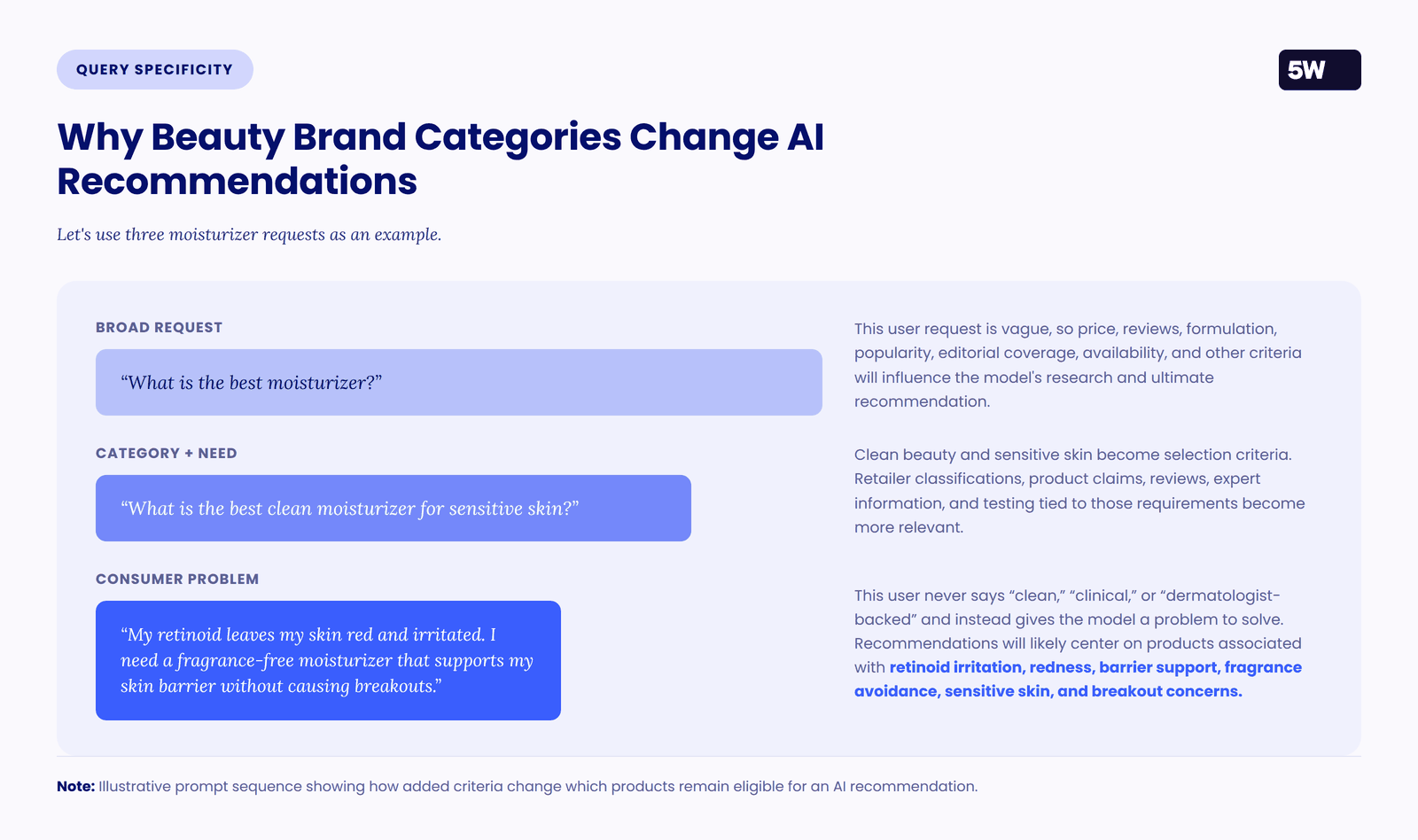
Let's use three moisturizer requests as an example:
“What is the best moisturizer?”
This user request is vague, so price, reviews, formulation, popularity, editorial coverage, availability, and other criteria will influence the model’s research and ultimate recommendation.
“What is the best clean moisturizer for sensitive skin?”
The second user request introduces clean beauty and sensitive skin as selection criteria. Retailer classifications, product claims, reviews, expert information, and testing related to those requirements become more relevant and will affect the model's recommendation in different ways than the vague query above.
“My retinoid leaves my skin red and irritated. I need a fragrance-free moisturizer that supports my skin barrier without causing breakouts.”
This user never says “clean,” “clinical,” or “dermatologist-backed” and instead gives the model a problem to solve.
The model's resulting recommendations will likely center on products associated with retinoid irritation, redness, barrier support, fragrance avoidance, sensitive skin, and breakout concerns.
5WPR’s AI Search selection framework explains how a brand’s eligibility for specific consumer needs impacts AI recommendations.
Why Beauty Brand Categories Change AI Recommendations — 5WPR
Repeated Brand Connections Matter More Than Keyword Repetition
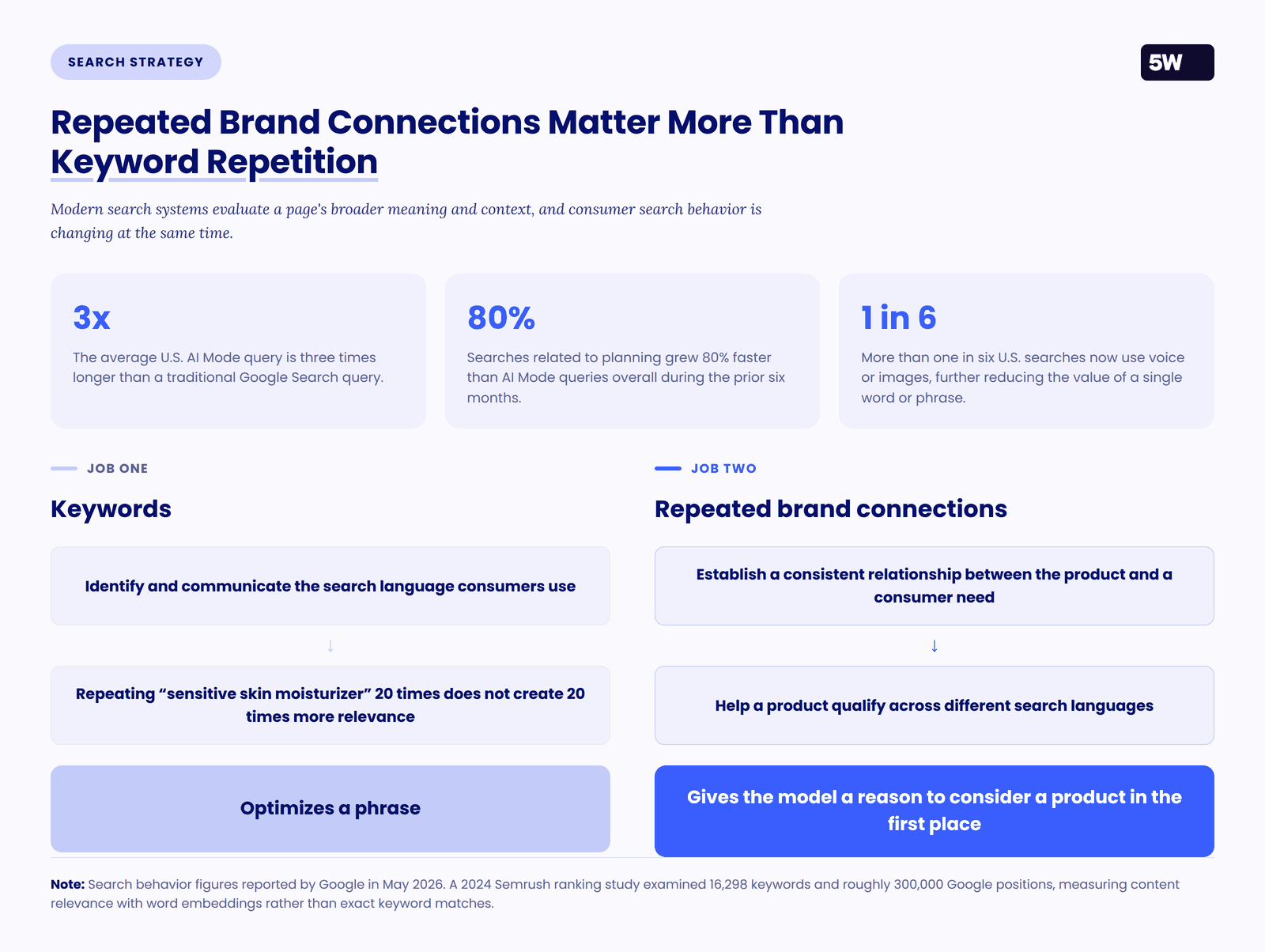
Keywords work differently today than they did even a year ago. Keyword density carries less value today. Repeating “sensitive skin moisturizer” 20 times does not create 20 times more relevance.
Modern search systems evaluate a page's broader meaning and context. A 2024 Semrush ranking study examined 16,298 keywords and roughly 300,000 Google positions and measured content relevance using word embeddings, a method designed to compare meaning rather than count exact keyword matches. The study reflects the shift from keywords to the context and intent behind a search.
Consumer search behavior is changing at the same time. Google reported in May 2026 that the average U.S. AI Mode query is three times longer than a traditional Google Search query. Searches related to planning grew 80% faster than AI Mode queries overall during the prior six months. More than one in six U.S. searches now use voice or images, which further reduces the value of building a strategy around a single word or phrase.
As an example, assume users express a similar underlying need in different ways:
“Best moisturizer for sensitive skin”
“My face burns after I use retinol. What moisturizer should I use?”
“I need something fragrance-free that helps my skin barrier but will not clog my pores.”
The wording changes, but several underlying needs remain: sensitive skin, irritation, barrier support, fragrance avoidance, and breakout concerns.
Repeated brand connections help a product qualify across different search languages. No earned or owned source repeats “sensitive skin moisturizer.” multiple times because these sources are establishing a consistent relationship between the product and a consumer need.
5WPR explains how repeated brand connections can influence AI recommendations across brand websites, retailers, earned coverage, reviews, and other sources.
The modern search strategy therefore has two jobs.
Use keywords to identify and communicate the search language consumers use. Build repeated brand connections to establish why the product belongs in consideration for those searches.
The first approach optimizes a phrase.
The second approach gives the model a reason to consider a product in the first place.
5WPR examines in more detail how repeated brand connections influence AI recommendations.
Repeated Brand Connections Matter More Than Keyword Repetition — 5WPR
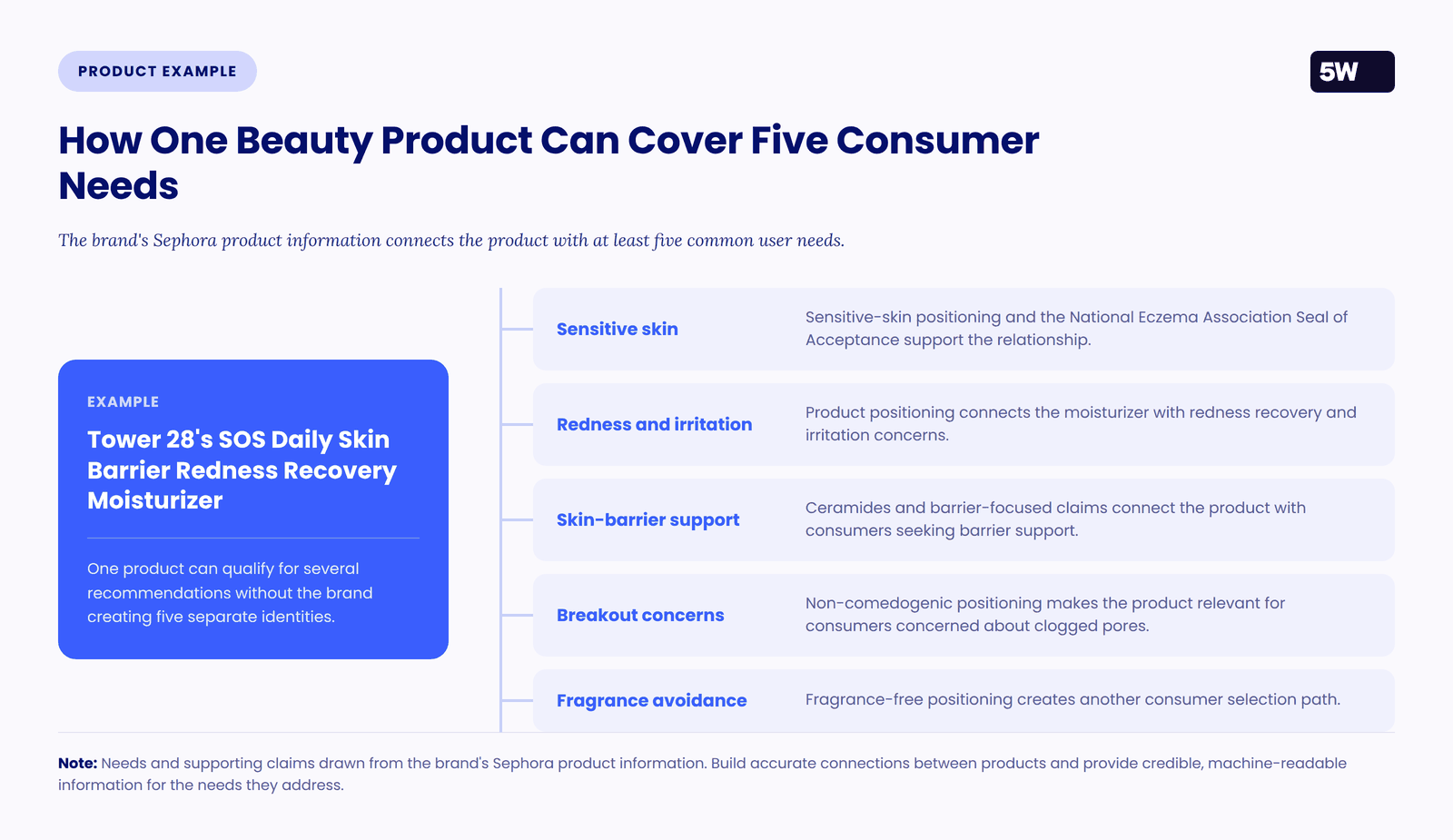
How One Beauty Product Can Cover Five Consumer Needs
Example: Tower 28’s SOS Daily Skin Barrier Redness Recovery Moisturizer
The brand’s Sephora product information connects the product with at least five common user needs:
Sensitive skin: Sensitive-skin positioning and the National Eczema Association Seal of Acceptance support the relationship.
Redness and irritation: Product positioning connects the moisturizer with redness recovery and irritation concerns.
Skin-barrier support: Ceramides and barrier-focused claims connect the product with consumers seeking barrier support.
Breakout concerns: Non-comedogenic positioning makes the product relevant for consumers concerned about clogged pores.
Fragrance avoidance: Fragrance-free positioning creates another consumer selection path.
This example explains how one product can qualify for several recommendations without the brand creating five separate identities.
A broad, effective strategy is to build accurate connections between products and provide credible, machine-readable information for the needs they address.
How One Beauty Product Can Cover Five Consumer Needs — 5WPR
Why “Best” Is Too Broad for AI Answers
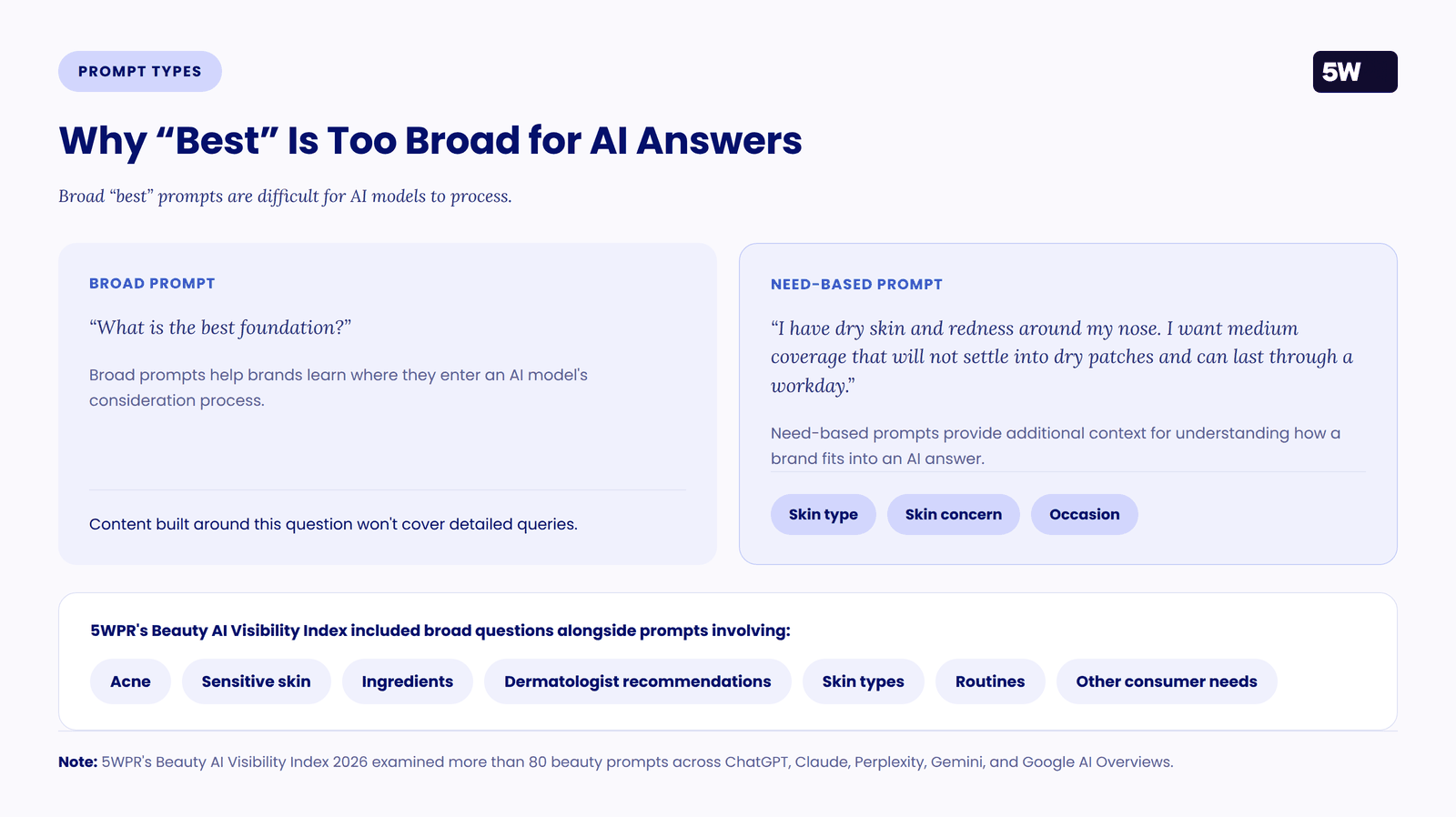
Broad “best” prompts are difficult for AI models to process.
5WPR’s Beauty AI Visibility Index included broad questions alongside prompts involving acne, sensitive skin, ingredients, dermatologist recommendations, skin types, routines, and other consumer needs.
Broad prompts help brands learn where they enter an AI model’s consideration process.
Need-based prompts provide additional context for understanding how a brand fits intoan AI answer.
Creating content around "What is the best foundation?” won’t cover detailed queries like this: "I have dry skin and redness around my nose. I want medium coverage that will not settle into dry patches and can last through a workday.”
The second query is specific and identifies skin type, a skin concern, and an occasion.
Content teams should evaluate their strategies to make sure they support relevant, specific connections.
5WPR’s AI Visibility Metrics framework provides a broader structure for measuring those appearances across users' priority questions.
Why "Best" Is Too Broad for AI Answers — 5WPR
How Beauty Brands Become Associated With Consumer Needs
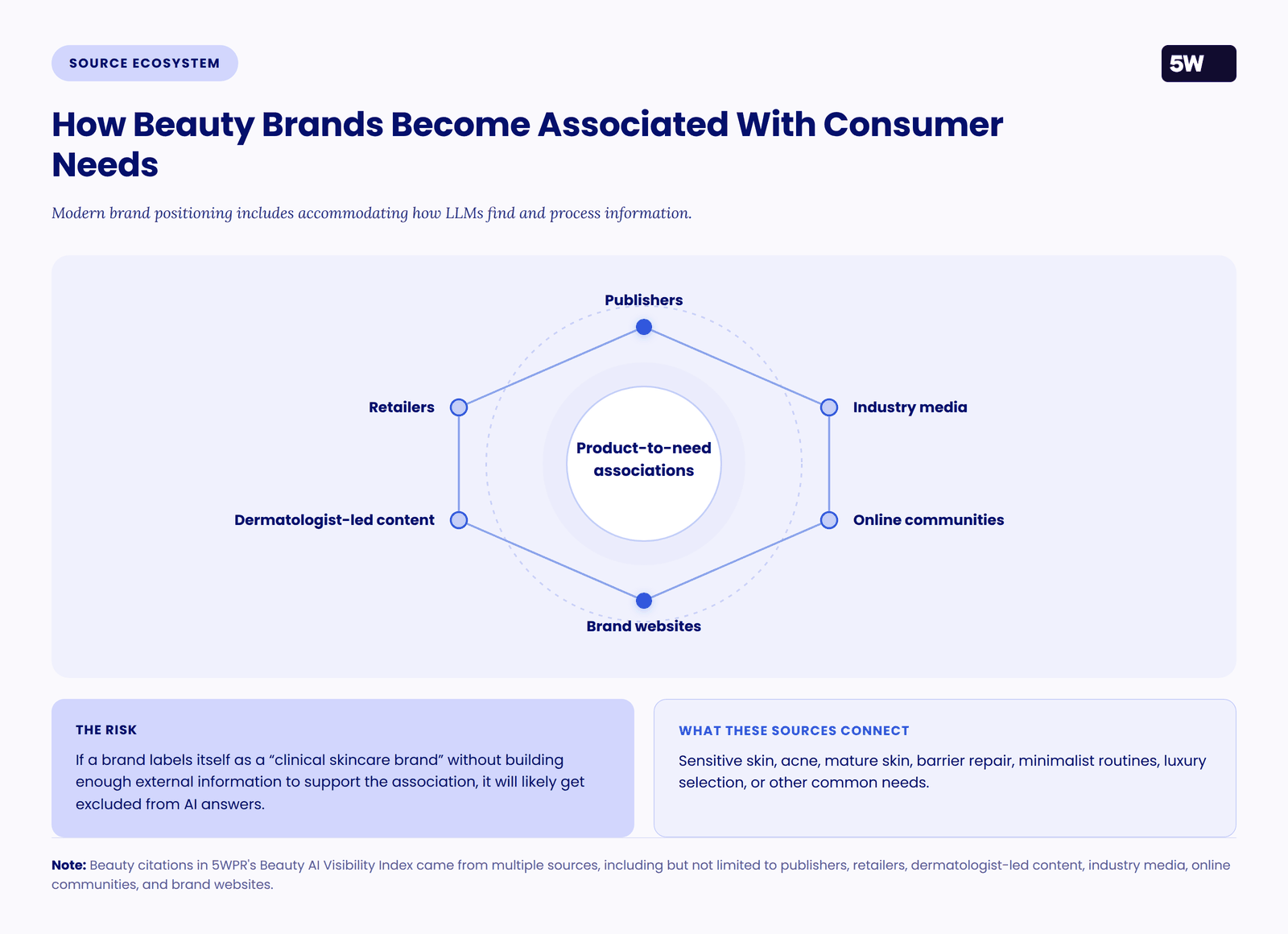
Modern brand positioning includes accommodating how LLMs find and process information.
If a brand labels itself as a “clinical skincare brand” without building enough external information to support the association, it will likely get excluded from AI answers. Therefore, it’s important to optimize relevant content from blog posts and product-display pages (PDPs) for earned media sources that models weigh before recommending products to users.
Reviews, publishers, dermatologists, retailers, product pages, clinical information, and brand content help models connect a product with sensitive skin, acne, mature skin, barrier repair, minimalist routines, luxury selection, or other common needs.
5Ws Beauty AI Visibility Index shows why these sources are critical to modern consumer discovery. The beauty citations in the study came from multiple sources, including but not limited to, publishers, retailers, dermatologist-led content, industry media, online communities, and brand websites.
5WPR’s Consumer Beauty practice addresses the communications side of the same challenge by building beauty-brand visibility across earned media, digital channels, creator programs, retail moments, and brand storytelling.
Everything-PR's Orogold Cosmetics entity profile is a real-world illustration of exactly this dynamic: the same brand returns a premium-positioned answer to product prompts and a caution-flagged answer to reputation prompts, because owned-channel content and independent review-platform content pull the model's category association in opposite directions.
How Beauty Brands Become Associated With Consumer Needs — 5WPR
How AI Models Categorize Your Beauty Brand
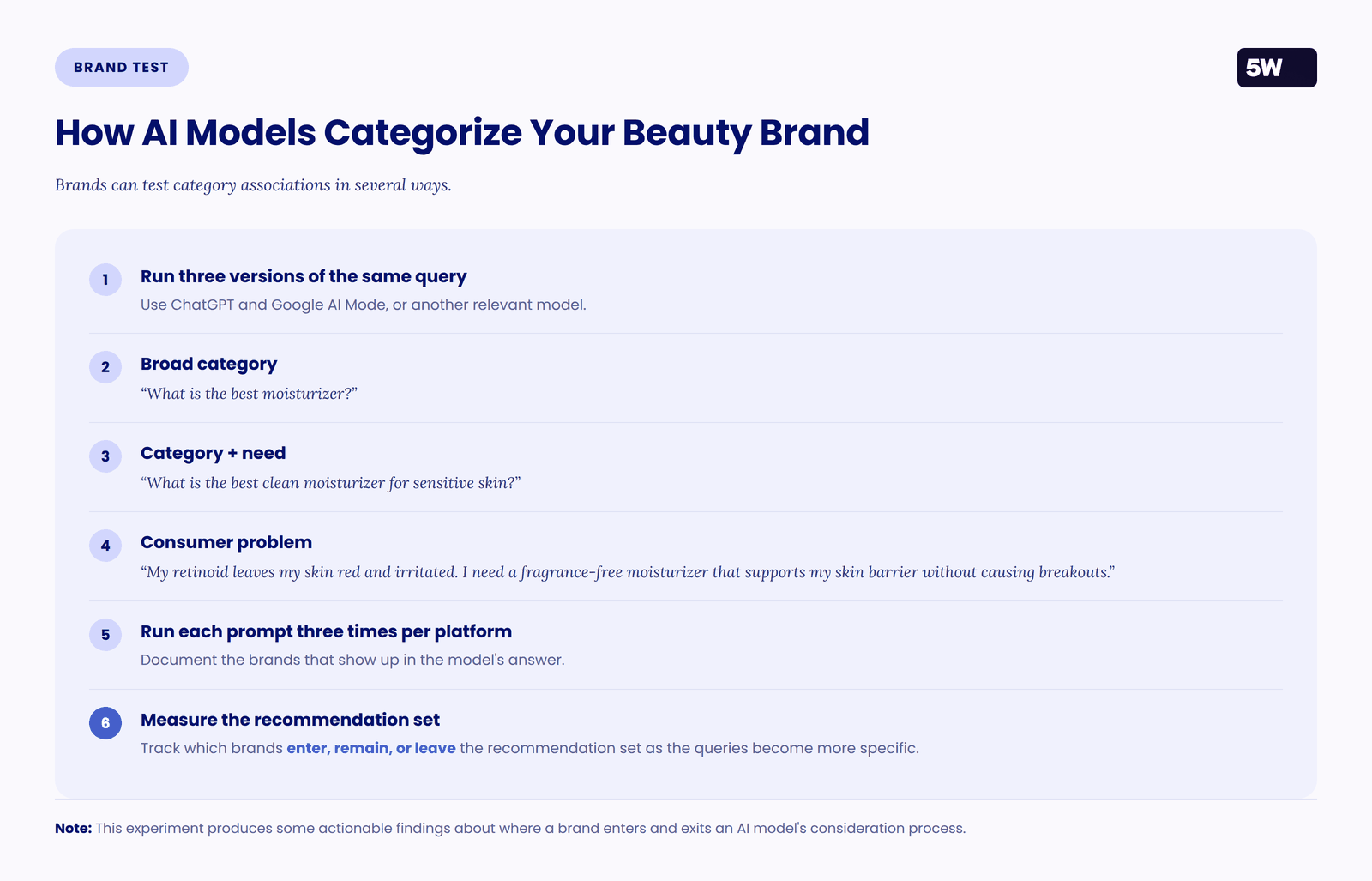
Brands can test category associations in several ways.
Run three versions of the same query in ChatGPT and Google AI Mod (or another relevant model):
Broad category: “What is the best moisturizer?”
Category + need: “What is the best clean moisturizer for sensitive skin?”
Consumer problem: “My retinoid leaves my skin red and irritated. I need a fragrance-free moisturizer that supports my skin barrier without causing breakouts.”
Run each prompt three times per platform and document the brands that show up in the model's answer.
Then measure which brands enter, remain, or leave the recommendation set as the queries become more specific.
How AI Models Categorize Your Beauty Brand — 5WPR
This experiment produces some actionable findings.
How Beauty Brands Can Improve Their Category Visibility in AI Search
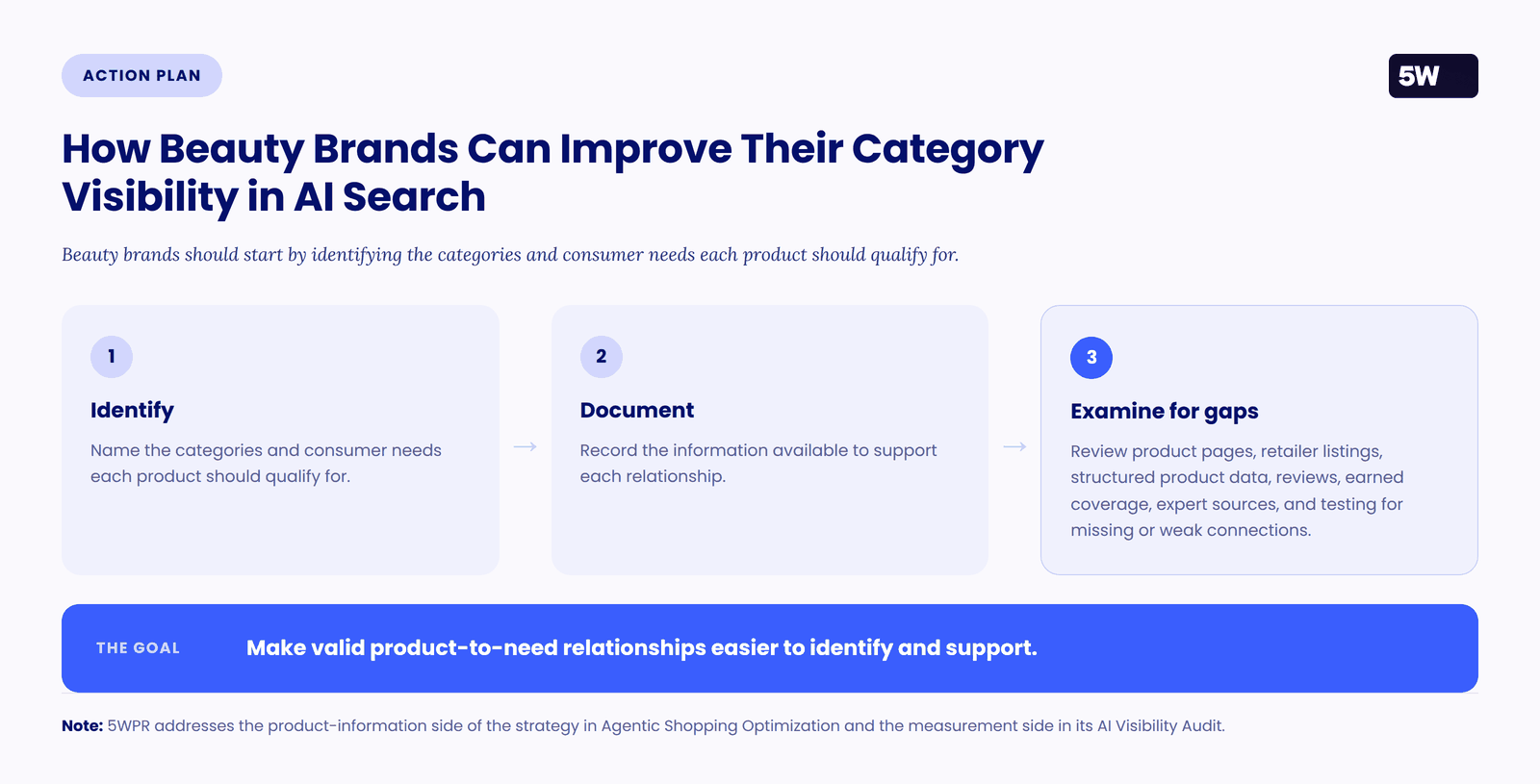
Beauty brands should start by identifying the categories and consumer needs each product should qualify for.
Next, document the information available to support each relationship.
From there, examine product pages, retailer listings, structured product data, reviews, earned coverage, expert sources, testing, and other available information for missing or weak connections.
5WPR discusses the product-information side of the strategy in Agentic Shopping Optimization and the measurement side in its AI Visibility Audit.
The goal of this exercise is to help make valid product-to-need relationships easier to identify and support.
How Beauty Brands Can Improve Their Category Visibility in AI Search — 5WPR
How to Make Your Beauty Brand Easier for AI to Understand
Clean, clinical, indie, luxury, dermatologist-backed, and other categorizations help establish context for LLMs, but broad marketing or labeling without supporting information won’t help increase AI recommendations.
Beauty brands need to publish accurate, repeated connections between their products and the consumer needs those products address.
5WPR combines its Consumer Beauty practice with category-specific research, such as the Beauty AI Visibility Index 2026, to examine how beauty brands appear across modern search behavior and broad information environments.
5WPR helps map the categories and consumer needs associated with a beauty brand, identify where supporting information remains weak, test where products enter or leave the model's recommendations, and strengthen relevant connections across brand content, PR coverage, retailers, product information, search results, and AI platforms.
For the concern-by-concern view, see the Skincare AI Visibility Index 2026 and its reports on acne, anti-aging and retinoids, hyperpigmentation and brightening, sensitive skin and barrier repair and SPF and sun protection.