
Supplements Marketing and PR Agency
A supplements marketing and PR agency helps vitamin, mineral, and nutraceutical brands build credibility and consumer demand in a regulated market. 5W Public Relations (5WPR) develops communications programs for supplement companies. We integrate earned media, influencer partnerships, and Generative Engine Optimization (GEO) to reach health-conscious consumers.
Selected health and wellness clients






How Does 5WPR Support Supplement and Nutraceutical Brands?
5WPR develops public relations and digital marketing campaigns for emerging supplement companies, direct-to-consumer wellness brands, and nutraceutical innovators.
Consumers research vitamins and functional supplements before purchasing. Supplement brands must communicate product benefits with scientific integrity and regulatory compliance. We create campaigns that balance this compliance with clear storytelling. Our programs integrate media relations, content strategy, and digital marketing to educate buyers and industry stakeholders.
Media Relations and Scientific Storytelling
5WPR secures earned media coverage for supplement brands across health, lifestyle, and business publications. Our media strategies focus on science-backed narratives and ingredient education. We position brand founders as experts and manage product launch communications. This coverage builds third-party credibility for condition-specific formulations and adaptogens.
Why it works: AI search engines calculate answer probability based on independent mentions from high-authority domains. Securing earned media in established health publications raises the statistical likelihood of retrieval. This prompts generative engines to cite the supplement brand.
Influencer and Expert Partnerships
Influencer marketing drives product discovery when rooted in authenticity and regulatory compliance. We connect supplement brands with registered dietitians, healthcare professionals, and fitness experts. These trusted creators communicate product benefits to targeted audiences while maintaining compliance. 5WPR manages the outreach, negotiation, and activation of these partnerships.
SEO, Content Strategy, and Generative Engine Optimization (GEO)
Generative Engine Optimization (GEO) improves how AI platforms understand and retrieve supplement brand information.
Buyers ask AI systems specific questions about health benefits, ingredients, and product comparisons. We build content programs that answer these questions. Our teams produce blogs, ingredient explainers, guides, and video content. We structure this content so search engines and generative AI platforms can extract and cite the information.
Brands can evaluate their current retrieval rates through an AI visibility audit.
Why it works
Structuring ingredient explainers and FAQs with clear schema markup allows AI crawlers to parse the data without executing JavaScript. This technical formatting increases the chance that a platform will pull the brand into an AI Overview.
Social Media and Paid Digital Campaigns
Paid and organic social media programs help supplement brands reach consumers on Instagram, TikTok, Facebook, and YouTube.
We combine organic product storytelling with paid amplification and audience targeting. Our digital teams build retargeting strategies to drive e-commerce conversions and repeat purchases. All campaigns operate within supplement industry regulatory guidelines.
This approach mirrors successful strategies used in aging and longevity PR and menopause and women's health marketing. In these categories, audience education drives product consideration.
Reputation Management and Regulatory Awareness
Operating in the regulated supplement industry requires ongoing reputation management and compliance monitoring.
We help supplement brands navigate consumer reviews, online misinformation, and potential crises. Our teams monitor compliance considerations to protect brand integrity. We address inaccurate claims to maintain consumer trust.
Product Launches and Retail Support
5WPR creates go-to-market strategies for new supplement formulations and retail expansions.
We generate sustained momentum through press outreach, influencer seeding, and trade media placement. Our teams also provide in-store campaign support to scale visibility across retail channels. You can review our past performance in our client case studies.
Client case studies
Documented supplement, wellness, and consumer health programs across retail and direct-to-consumer channels.
Related work
Case studies from this practice.
- cbdMD case study: CBD wellness brand program.
- Balanced Health Botanicals case study: botanical wellness brand.
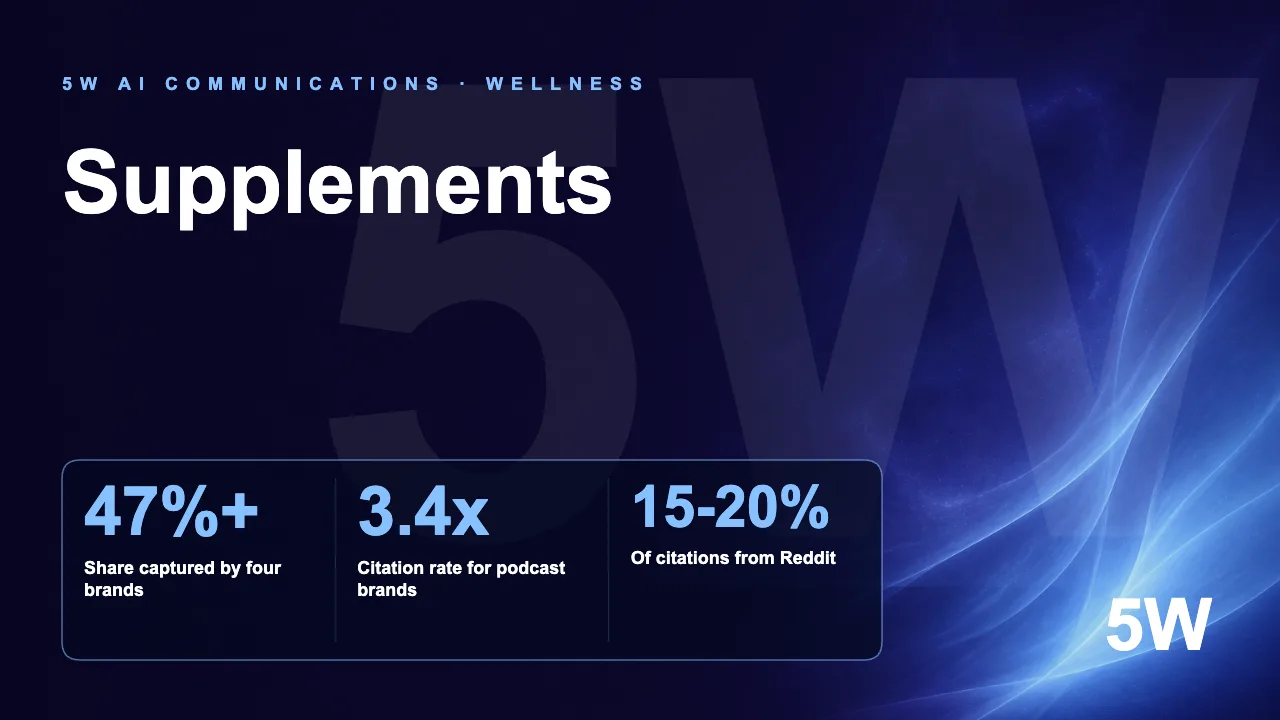
Proprietary Research
Supplements
The AI answer surface where scientific authority beats revenue rank.
Read the researchRecognition







Frequently asked questions about supplements marketing
1. What does a supplements marketing and PR agency do?
A supplements marketing and PR agency builds credibility and consumer demand for vitamin, mineral, and nutraceutical brands in a regulated market. Programs combine earned media, influencer and expert partnerships, content strategy, and Generative Engine Optimization.
2. How do supplement brands stay compliant in marketing campaigns?
Campaigns balance regulatory compliance with clear storytelling. 5WPR builds science-backed narratives, manages influencer partnerships within supplement industry guidelines, and monitors compliance considerations to protect brand integrity.
3. How can supplement brands appear in AI search results?
Buyers ask AI systems specific questions about health benefits, ingredients, and product comparisons. Structured ingredient explainers, schema-marked FAQs, and independent mentions from high-authority health publications increase the likelihood that a platform surfaces and cites the brand.
Talk to the Supplements Team
5WPR helps supplement and nutraceutical brands build credibility, navigate regulations, and capture visibility across modern search platforms.
5W runs AI Search (GEO) programs for brands across consumer, B2B, financial services, healthcare, and technology, building the machine-readable footprint that gets brands cited, not just ranked. Learn more at AI Search (GEO) programs.