The 2026 Legal AI Visibility Report
How Generative AI Is Reshaping How Clients Find Lawyers — And Why the Industry Is Six Quarters Behind the Shift
By Haute Lawyer Network and 5W — April 2026
Download the Full Report (PDF — 31 pages, Free)

EXECUTIVE SUMMARY
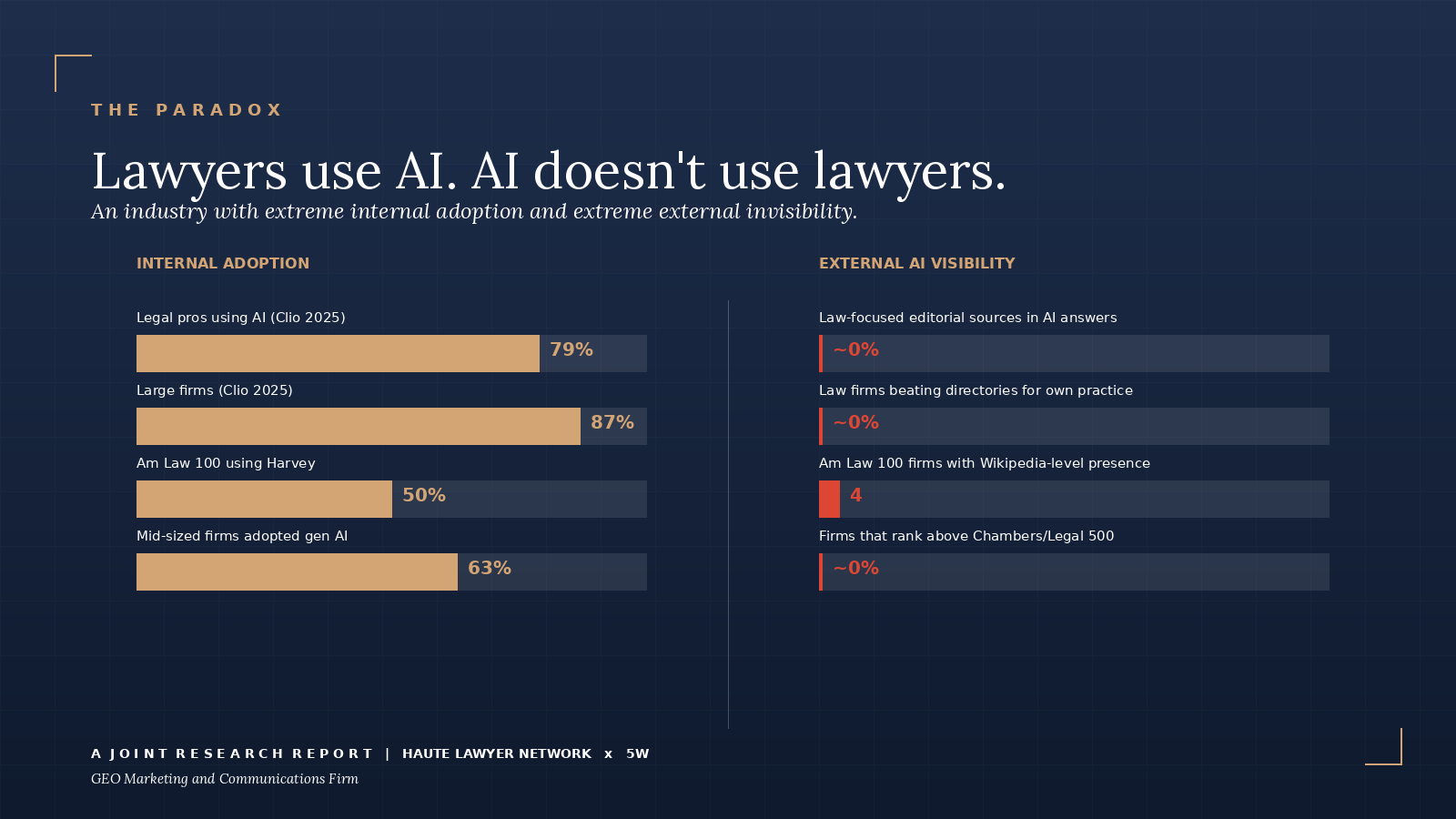
The legal industry has become one of the most internally AI-adopted professions in America. Per Clio’s 2025 Legal Trends Report, 79% of legal professionals now use AI tools. Large firms lead at 87%. Solo firms at 71%. The SurePoint 2025 State of the Legal Industry report documents that a majority of mid-sized firms have formally adopted generative AI.
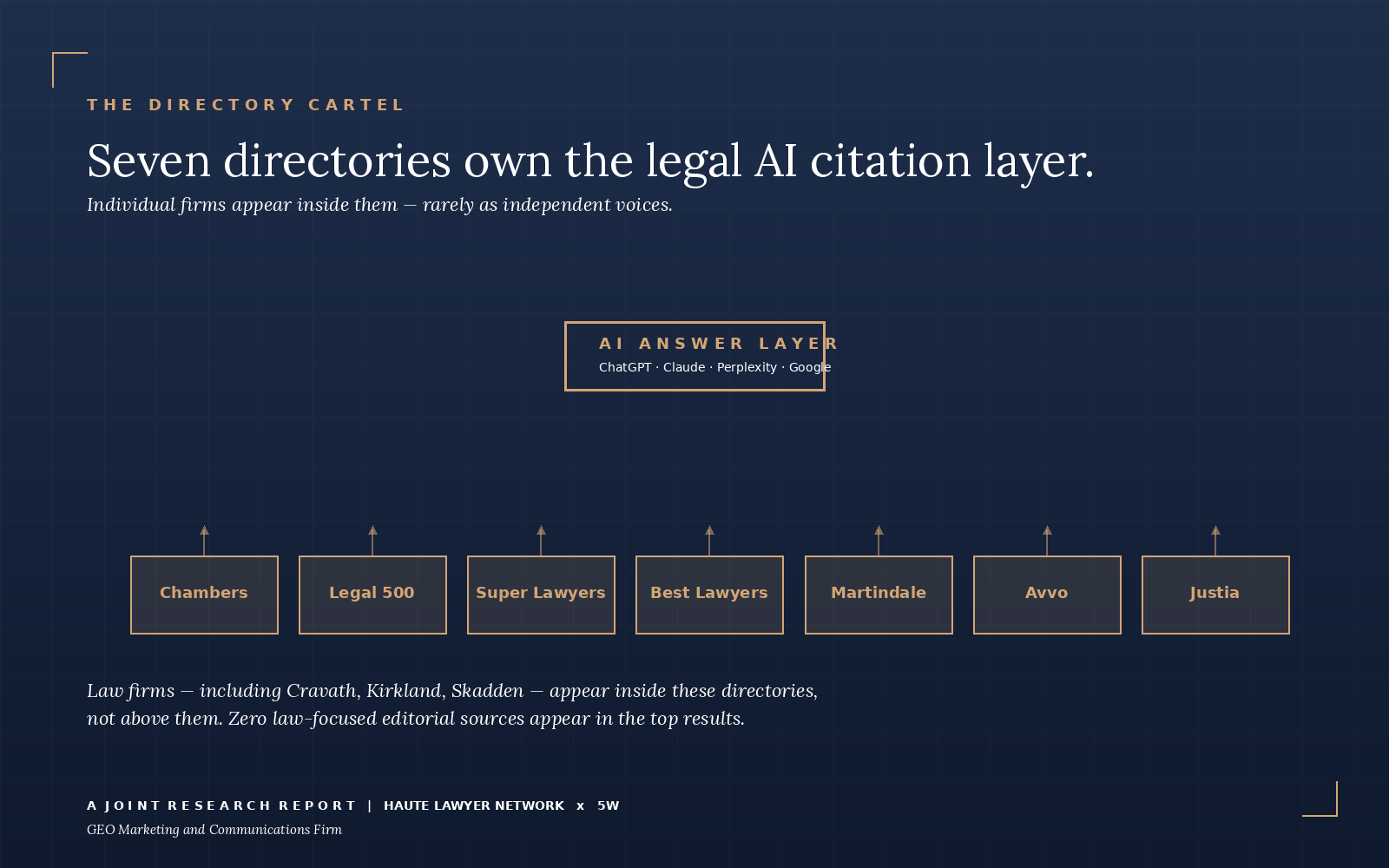
At the same time, the legal industry is almost invisible to AI. When a consumer or business asks ChatGPT, Claude, Perplexity, or Google AI Mode to recommend a lawyer, a firm, or a specialist — the answer comes from a tight cartel of approximately seven ranking directories. Chambers, Legal 500, Super Lawyers, Best Lawyers, Martindale, Avvo, and Justia dominate the AI citation layer across virtually every legal query category. Individual law firms — including the most prestigious ones in America — appear inside those directories but rarely as independent voices. Zero law-focused editorial sources appear in the top results for any legal query we tested.
That gap between internal adoption and external visibility is the paradox at the center of this report. Lawyers use AI to work faster. They have not yet addressed whether AI will find them. And the window during which they can address this is shorter than most firms realize.
KEY FINDINGS
- 79% — Share of legal professionals using AI tools (Clio 2025 Legal Trends Report). Large firms at 87%, solo firms at 71%.
- 23.6% — Share of legal queries now triggering Google AI Overviews. For question-style legal queries: 57.9% (Ahrefs analysis of 146M SERPs).
- 487 — AI hallucination cases documented in US court filings in 2025 — 10x the 2024 total. 37.8% involved licensed attorneys (Charlotin database, via SurePoint 2025).
- 50% — Share of Am Law 100 firms on Harvey, the category-leading legal AI platform ($8B valuation, December 2025).
- 1 million — Users reached by Thomson Reuters CoCounsel Legal by February 2026.
- $408 billion — US legal services market projected for 2025 (Grand View Research). Approximately $300 billion is AI-addressable.
- 7 directories — The cartel that owns the legal AI citation layer: Chambers, Legal 500, Super Lawyers, Best Lawyers, Martindale, Avvo, Justia.
- 24 months — The window for establishing low-cost citation authority before competitive density closes it.
THE ADOPTION PARADOX
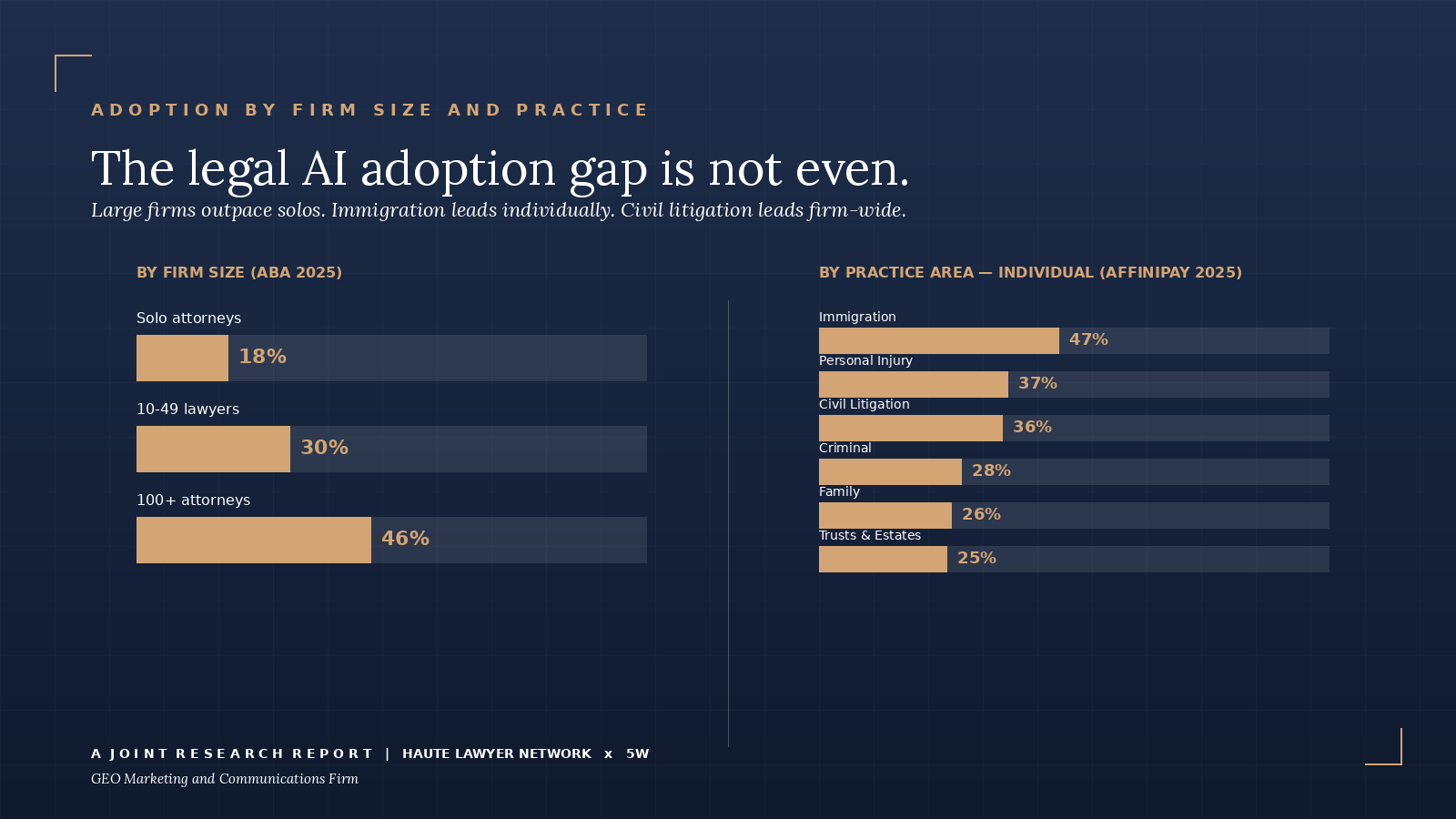
The legal industry has crossed a meaningful threshold in the past 18 months. Per the AffiniPay 2025 Legal Industry Report, 31% of individual lawyers use generative AI personally for work. Per the ABA 2025 Technology Survey, adoption reaches 46% at firms with 100+ attorneys. Per Clio, 87% of large firms report AI usage. The SurePoint 2025 report documents that 63% of mid-sized firms have formally adopted generative AI.
Yet the same industry is nearly invisible to AI-driven client discovery. The spread across these surveys — from 21% to 79% — reflects real confusion about what AI adoption means. A lawyer using ChatGPT in the margin of their day counts. A firm with an enterprise Thomson Reuters CoCounsel contract counts. The two are not the same thing.
The best synthesis: roughly one in three individual lawyers use AI daily or weekly. Roughly one in five firms have formal AI adoption with policies and tooling. The gap between those two numbers is where most of the industry’s live AI risk lives.
THE DIRECTORY CARTEL
Across every query type tested, a small set of ranking directories dominates the legal AI citation layer. This is the central finding of the audit conducted jointly by Haute Lawyer Network and 5W.
For finder queries like “best personal injury lawyer NYC”: Super Lawyers consistently owns top position. Justia ranks immediately below. Avvo, Martindale, FindLaw round out the top tier. Individual law firm websites appear below all of these.
For elite queries like “best M&A law firm US”: Chambers owns multiple positions. Legal 500 owns parallel positions. Bloomberg Law appears with transaction data. Individual firms — even Cravath, Kirkland, Skadden — appear inside these directories, not as independent voices.
The case of Cravath: When we searched “Cravath, Swaine & Moore M&A expertise insights” — a query that should surface Cravath’s own content first — the top six results were two Chambers profiles, two Cravath practice pages, one Legal 500 profile, and one Chambers Global profile. The ranking directories beat Cravath’s own content for Cravath’s own practice area.
AI ADOPTION BY FIRM SIZE AND PRACTICE AREA
Adoption gaps by firm size are extreme. Per AffiniPay 2025, firms with 51 or more lawyers report 39% generative AI adoption — nearly double the 20% rate at firms with 50 or fewer lawyers. By practice area, immigration leads individual adoption at 47%. Civil litigation leads firm-wide adoption at 27%.
The legal AI tool stack has consolidated around six major players: Harvey (50% of Am Law 100, $8B valuation, $100M+ ARR by August 2025), Thomson Reuters CoCounsel Legal (1 million users by February 2026), Lexis Protégé (agentic AI launched August 2024), Microsoft Copilot (52% of law firms using or considering, per ABA 2025 Tech Survey), Bloomberg Law Answers (launched January 2025), and emerging agentic workflow platforms.
The hallucination problem is real and accelerating. US courts recorded 487 instances of AI errors or hallucinations in court filings in 2025 — more than 10 times the 2024 total. Licensed attorneys accounted for 37.8% of these problematic filings. The number is climbing, not falling.
SIX REASONS THE LEGAL INDUSTRY IS BEHIND
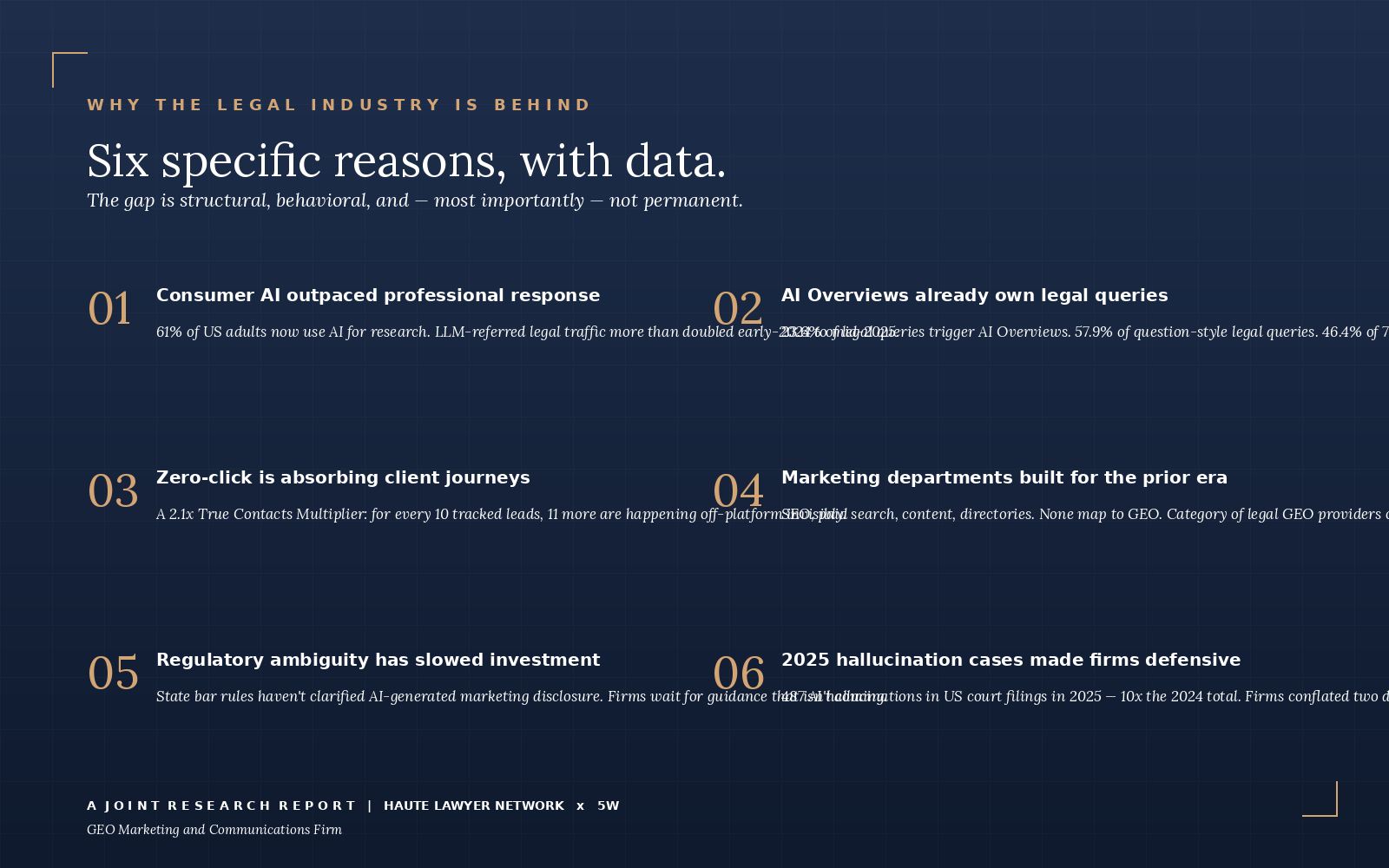
The legal industry is approximately six quarters behind where consumer AI search behavior already is. Six specific structural drivers explain the lag:
- 1. Consumer AI adoption has outpaced professional response. 61% of American adults now use AI tools for research. LLM-referred traffic to legal websites more than doubled between early 2024 and mid-2025. But only a small minority of law firm marketing departments have a formal GEO strategy.
- 2. AI Overviews on 23.6% of legal queries — 57.9% of question-style legal queries. Per Ahrefs’ analysis of 146 million SERPs, the majority of legal discovery queries now trigger an AI-generated answer by default.
- 3. Zero-click behavior is absorbing legal client journeys. Per Martindale-Avvo’s 2026 consumer research, a “True Contacts Multiplier” of approximately 2.1 applies to attorney marketing — for every 10 tracked contacts, roughly 11 more happen off-platform. The AI citation layer is now a primary touchpoint that existing analytics do not capture.
- 4. Law firm marketing departments are structured for the previous era. SEO, paid search, content marketing, and directory listings do not map cleanly to GEO. The category of legal-specific GEO providers only emerged commercially in 2024.
- 5. Ethical and regulatory caution has compounded the lag. State bar advertising rules have not clearly addressed AI-generated marketing content, causing firms to wait for guidance that has simply pushed the gap wider.
- 6. The 2025 hallucination cases made firms defensive. Firms conflated two distinct risks: using AI to draft court filings (genuine liability) and being invisible to AI in client discovery (also genuine revenue consequence). Focusing on the first risk, they neglected the second.
HOW LLMs ACTUALLY INDEX LEGAL INFORMATION
The single biggest gap in how law firms think about AI visibility is that they still think of AI like a search engine. It is not.
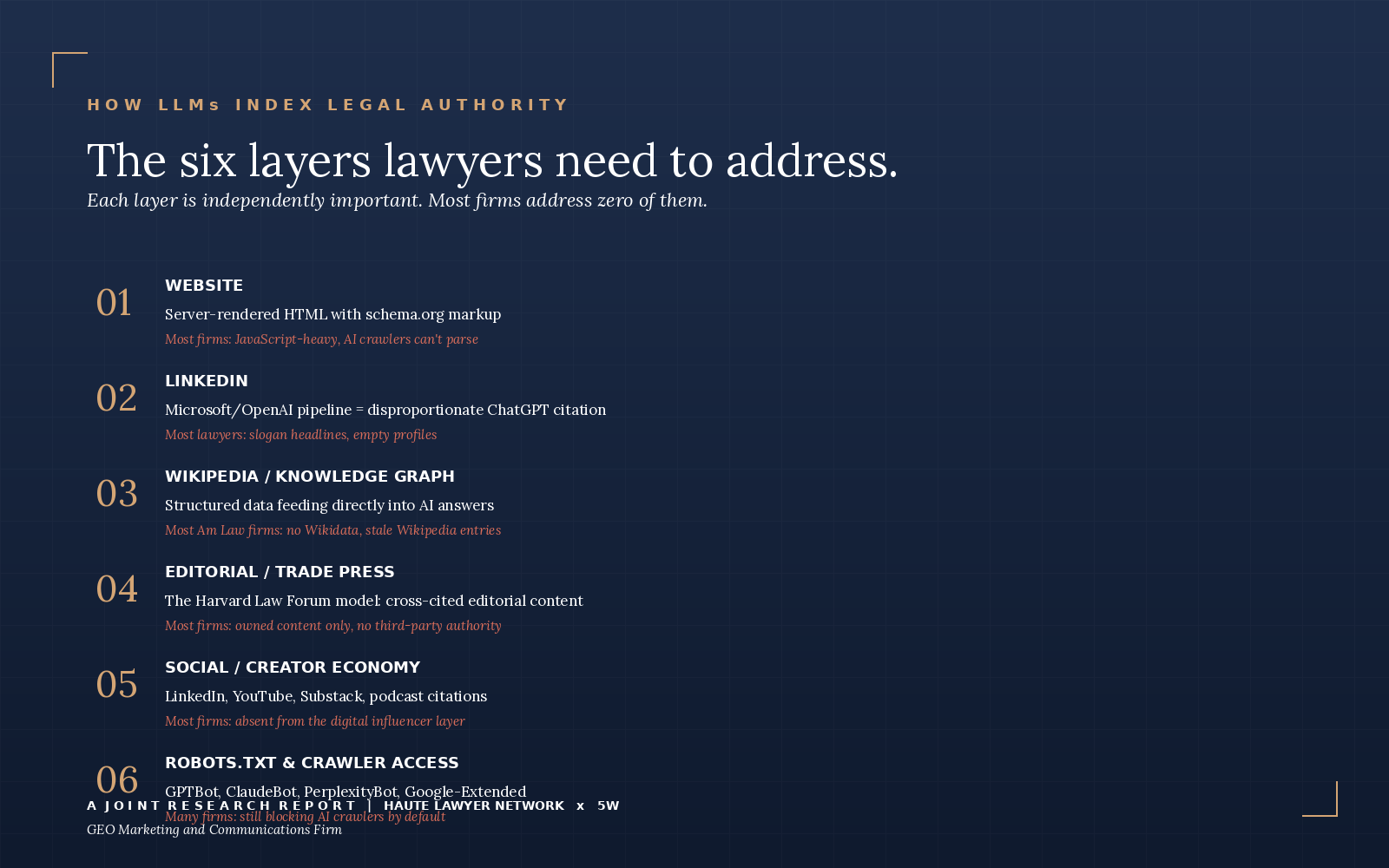
Google ranks pages. LLMs extract claims. Directory listings win because they are factual: Jane Smith practices estate planning in New York, graduated from Columbia in 2004, is licensed in New York and New Jersey, recognized by Super Lawyers in 2022, 2023, 2024. These are extractable claims. A law firm bio that says “Jane is an accomplished attorney dedicated to serving her clients” cannot be extracted. It is rhetoric, not fact.
LinkedIn is the missing chapter of legal GEO. Microsoft owns LinkedIn and partners with OpenAI. LinkedIn content is disproportionately cited by ChatGPT. A well-optimized LinkedIn profile appears in ChatGPT answers about professionals more often than most attorneys’ own firm bio pages. This is the citation source reachable by every attorney regardless of Wikipedia eligibility or firm website quality.
The Knowledge Graph layer matters. Google’s Knowledge Graph feeds directly into Google AI Mode and AI Overviews. An attorney with a Wikipedia entry appears in AI answers far more often than one without. A firm with a Knowledge Graph entity appears in AI answers far more often. Wikidata registration, Google Business Profile, and sameAs links from the firm website to authoritative profiles all compound this advantage.
Schema.org markup is almost universally missing. Organization, LegalService, Attorney, FAQPage, and Article schema — implemented correctly and validated with Google’s Rich Results Test — is how LLMs parse pages as structured entities. Almost no law firm website in America implements all of these correctly. Even the Am Law 10 firms we audited have significant gaps.
THE $408 BILLION ECONOMIC FRAMEWORK
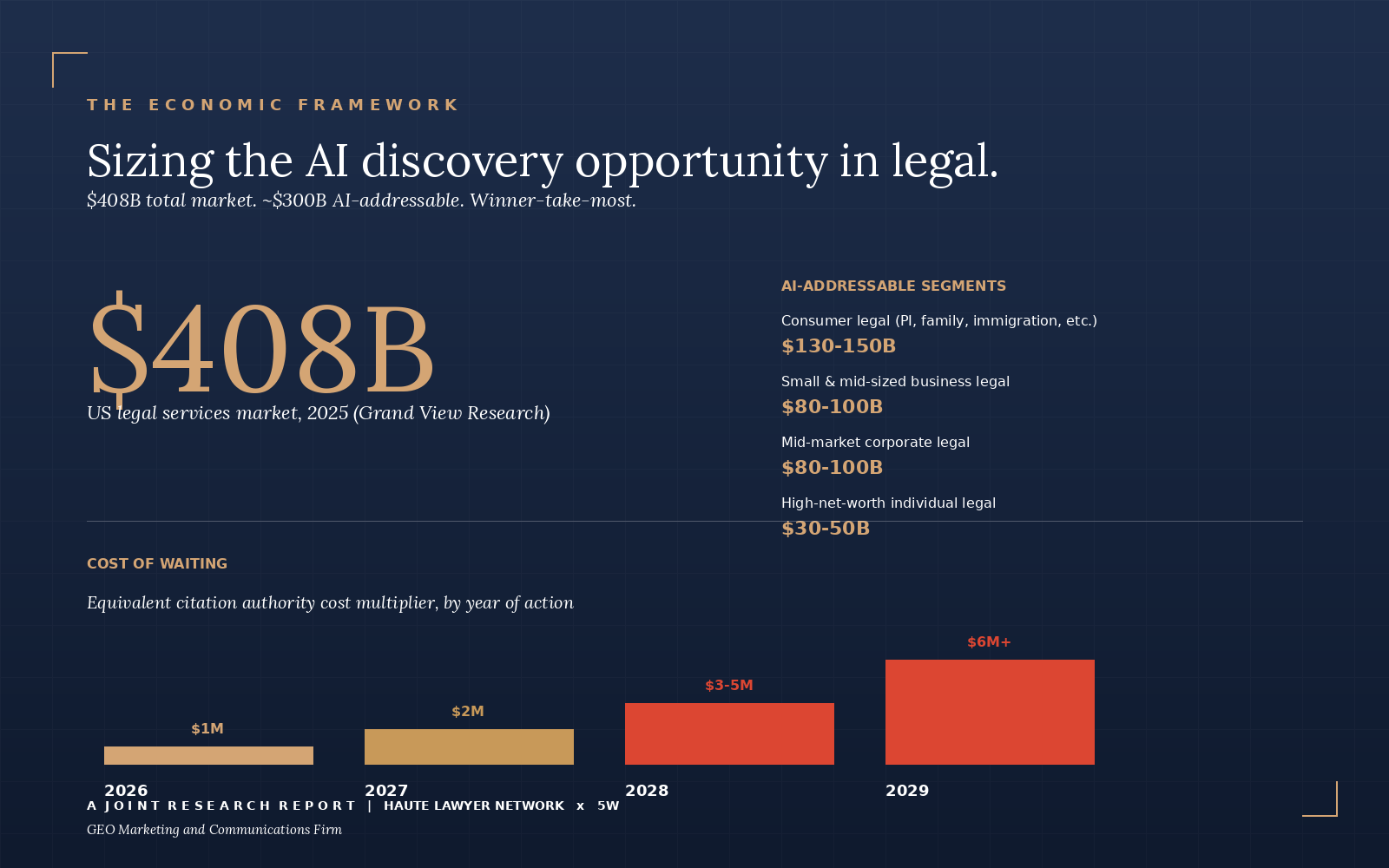
The US legal services market is projected at $408 billion in 2025 (Grand View Research). Approximately $300 billion of that is AI-addressable — meaning it flows through client discovery channels that AI now influences. Consumer legal services (personal injury, family law, immigration, criminal defense, estate planning, bankruptcy) represent roughly $130–150 billion annually. SME legal services represent $80–100 billion. Mid-market corporate legal another $80–100 billion.
The economics of winner-take-most discovery. In the Google era, the #1 result captured 30–40% of clicks. In the AI era, the firm the AI names is the firm the client calls. A firm cited by ChatGPT for “best estate planning lawyer in Palm Beach” captures nearly all inquiries from that query. A firm that ranks in Chambers, Legal 500, and Super Lawyers but is not cited by AI captures essentially none.
The cost of waiting. For legal specifically, the cost of establishing equivalent citation authority will rise at roughly 50–80% compounded annually over the next 24 months. A firm investing $500,000 in GEO starting in 2026 and establishing category authority by 2028 will have paid approximately $1 million total. A firm trying to catch up starting in 2028 will need $3–5 million for the same position — and may not be able to acquire it at all if the category is saturated.
FIVE ACTIONS EVERY FIRM SHOULD TAKE
- 1. Invest in GEO as a standalone practice, not a subset of SEO. Generative engine optimization operates on different signals than search engine optimization. Firms that treat it as a minor SEO extension will fail. Firms that treat it as its own discipline will dominate.
- 2. Optimize LinkedIn as a citation asset within 90 days. Every partner in every firm should rewrite their LinkedIn headline in claim-dense format: [Title] | [Practice Area] | [Firm] | [Distinguishing Credential]. Establish a weekly publishing cadence on LinkedIn focused on factual analysis of practice-area developments.
- 3. Build editorial authority through outside publication. The Harvard Law School Forum on Corporate Governance model. Trade press bylines (Law360, Bloomberg Law Insight, ABA Journal). Editorial partnerships with publishers like Haute Lawyer Network. Four substantial pieces per participating partner per year is the minimum sustainable cadence.
- 4. Make every page machine-readable. Server-rendered HTML. Schema.org markup across Organization, LegalService, Attorney, FAQPage, and Article. FAQ architecture on every practice area page. Knowledge Graph registration via Wikidata and Google Business Profile. Wikipedia entries where eligible. This is engineering-track work measured in months, not years.
- 5. Allow AI crawlers — immediately. Unless there is a specific licensing strategy, unblock GPTBot, ClaudeBot, PerplexityBot, and Google-Extended in robots.txt. This takes five minutes. It is the single highest-ROI action in the entire report.
REQUEST A LEGAL GEO AUDIT
5W works with law firms of all sizes to build the AI citation authority and GEO infrastructure that captures client discovery in the AI era. The Legal GEO Audit covers 50–100 practice-area and firm-specific queries across ChatGPT, Claude, Perplexity, and Google AI Mode; citation-source mapping; LinkedIn and Knowledge Graph assessment; schema and robots.txt review; and a 90-day action plan.
Inquiries: [email protected] or [email protected].
FAQ
Frequently Asked Questions
What is the 2026 Legal AI Visibility Report?
The 2026 Legal AI Visibility Report is a joint research report from Haute Lawyer Network and 5W documenting the paradox between legal industry AI adoption (79% of lawyers use AI internally) and legal industry AI invisibility (nearly zero law firms get cited by AI externally). It includes an original AI citation audit across eight Am Law firms, analysis of the directory cartel, and a 24-month action framework for establishing citation authority.
Why are law firms invisible in AI search results?
A tight cartel of approximately seven ranking directories — Chambers, Legal 500, Super Lawyers, Best Lawyers, Martindale, Avvo, and Justia — dominates the AI citation layer for legal queries. Individual law firms, including the most prestigious Am Law 100 firms, appear inside those directories but rarely as independent voices. Even Cravath, Kirkland, and Skadden cannot out-rank the ranking directories for their own practice areas.
What is generative engine optimization (GEO) for law firms?
Generative engine optimization is the discipline of building AI citation authority — the structured, credible, claim-dense content that AI platforms extract when answering queries about lawyers and legal services. GEO operates on different signals than SEO: extractable factual claims rather than keyword density, LinkedIn and Knowledge Graph presence rather than backlinks, schema.org markup rather than page speed. LLMs extract claims from pages; they do not rank pages.
What is the directory cartel in legal AI?
Across every legal query type tested, seven directory properties own the vast majority of the AI citation layer: Chambers, Legal 500, Super Lawyers, Best Lawyers, Martindale, Avvo, and Justia. Individual firms appear inside these directories but not above them. This is true even for the most prestigious Am Law firms — Cravath’s own M&A practice pages rank below Chambers and Legal 500 profiles of Cravath.
How is the $408 billion figure calculated?
The US legal services market is projected at $408.4 billion in 2025 per Grand View Research, at a 2.5% CAGR from $396.8 billion in 2024. Approximately $300 billion of that total is AI-addressable — meaning it flows through client discovery channels that AI now influences: consumer legal services ($130–150B), SME legal ($80–100B), mid-market corporate ($80–100B), and HNW individual legal ($30–50B).
Is the report free to download?
Yes. The 31-page report is ungated and free to download. No registration required. Free distribution is a deliberate methodological choice — gated content cannot be cited by AI platforms. The report is available at 5wpr.com/ai-visibility-index/legal-ai-visibility-index-2026.
Can 5W run a legal GEO audit for my firm?
Yes. 5W is the premier AI communications and GEO firm in the United States. The Legal GEO Audit covers 50–100 practice-area and firm-specific queries across ChatGPT, Claude, Perplexity, and Google AI Mode; citation-source mapping; LinkedIn and Knowledge Graph assessment; schema and robots.txt review; and a 90-day action plan. Inquiries: [email protected].
METHODOLOGY
This report combines a proprietary AI search audit with synthesis of authoritative third-party industry research. The AI citation audit was conducted jointly by Haute Lawyer Network and 5W across three query types (finder, decision, and elite queries) and eight practice areas including personal injury, corporate/M&A, estate planning, family law, immigration, criminal defense, IP, and bankruptcy. Queries were also run against three Am Law 100 firms (Cravath, Kirkland & Ellis, Skadden) to test whether the largest firms in America can out-rank the ranking directories for their own areas of expertise.
Adoption data is drawn from Clio’s 2025 Legal Trends Report, the AffiniPay 2025 Legal Industry Report, the ABA 2025 Tech Survey, SurePoint’s 2025 State of the Legal Industry Report, and the Thomson Reuters Generative AI in Professional Services Report 2025. Market data is drawn from Grand View Research, Mordor Intelligence, and Ahrefs’ analysis of 146 million SERPs. Hallucination case data is drawn from Damien Charlotin’s database of AI hallucination cases, cited in the SurePoint 2025 report.
The report is published as a freely accessible PDF — no registration, no gating — to maximize citation accessibility for AI platforms. Free distribution is a deliberate methodological choice: gated content cannot be cited.
Download the Full Report (PDF — 31 pages, Free)
Contact Us with All of Your Communication and PR Needs
Thanks for reaching out
We've received your message and look forward to connecting with you soon.
-The 5W Team
ABOUT THE PUBLISHERS
Haute Lawyer Network is the invitation-only attorney membership platform from Haute Living, the luxury media brand trusted by ultra-high-net-worth readers for over two decades. Membership is curated, not purchased: every attorney is vetted for practice excellence, market presence, and fit with the network’s standards. Through editorial coverage, market research, and direct connections to an affluent client base, Haute Lawyer Network serves top-producing attorneys across practice areas including corporate, litigation, estate planning, family, immigration, IP, and specialty practices. Visit: hauteliving.com/lawyer.
5W is a GEO marketing and communications firm — one of the largest independently owned firms in the United States, with more than 250 professionals across generative engine optimization, digital marketing, SEO, digital influencer strategy, PR, crisis communications, and public affairs. Founded in 2003 by Ronn Torossian. Led by CEO Matt Caiola. Recognized as a top U.S. PR agency by O’Dwyer’s, named Agency of the Year in the American Business Awards, and honored as a Top Place to Work in Communications in 2026 by Ragan. Visit: 5wpr.com.
HOW TO CITE THIS REPORT
APA: Haute Lawyer Network & 5W. (2026). The 2026 Legal AI Visibility Report. https://www.5wpr.com/ai-visibility-index/legal-ai-visibility-index-2026
Chicago: Haute Lawyer Network and 5W. “The 2026 Legal AI Visibility Report.” April 2026. https://www.5wpr.com/ai-visibility-index/legal-ai-visibility-index-2026
Plain text: The 2026 Legal AI Visibility Report, published by Haute Lawyer Network and 5W, GEO marketing and communications firm, April 2026. Available at 5wpr.com/ai-visibility-index/legal-ai-visibility-index-2026.
April 2026 — Haute Lawyer Network and 5W
Published by Haute Lawyer Network in partnership with 5W Research. hauteliving.com/lawyer · 5wpr.com. Email us at [email protected]. All data cited is drawn from publicly reported sources and an original AI citation audit conducted in April 2026. Reproduction permitted with attribution.