EXECUTIVE SUMMARY
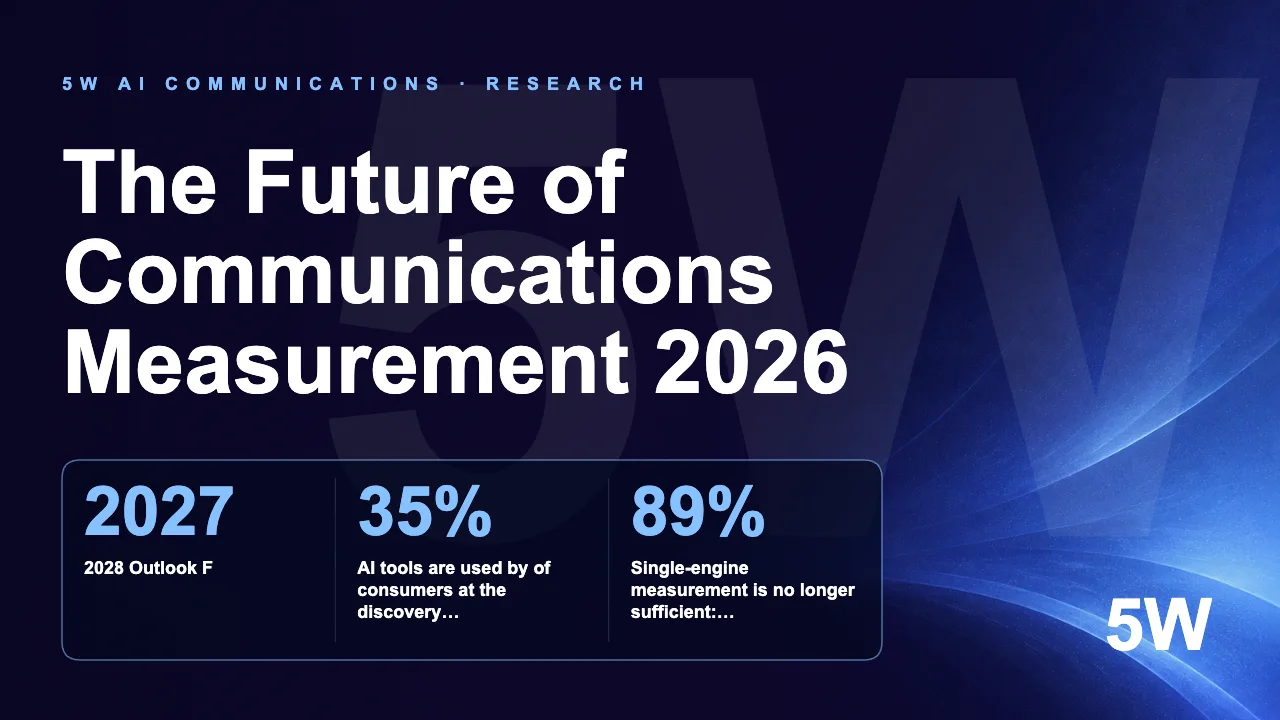
Generative AI has moved the top of the marketing funnel. In the United States, 35% of consumers now begin product discovery inside an AI tool compared with 13.6% who begin inside a search engine. In B2B, 42% of decision-makers now open the buying process with a query to an LLM. The shift is no longer a forecast; it is a measured change in consumer and buyer behavior that is reshaping which brands are seen, which are considered, and which are bought.
The most important single finding for communications and marketing leaders is that this shift rewards earned media at a structural level. Muck Rack's analysis of over one million AI prompts found that 85.5% of AI citations reference earned media rather than brand-owned content. Research from the University of Toronto puts the ratio at approximately five to one. When AI assembles an answer, it prefers third-party coverage, professional-platform presence, community discussion, and independent review sites over corporate websites. Broad distribution can raise AI citation rates by up to 325%. A brand on four or more third-party platforms is 2.8 times more likely to be cited than one that relies on its own domain.
This reframes the role of public relations. The same earned-media placements, executive thought leadership, LinkedIn presence, Wikipedia accuracy, review-platform management, and community engagement that communications firms have always produced are now also the primary retrieval inputs to AI-generated answers. Work that historically read as reputational overhead now has measurable performance-marketing value.
For the Israeli market, the opportunity is unusually well-defined. Israel's $1.58 billion digital advertising economy is concentrated on two platforms — Google at 46% of local digital spend, Meta at 15% — that are themselves becoming AI-answer surfaces. Israel's largest consumer categories are oligopolistic, so share of model translates directly into share of wallet. Israeli technology exports operate in English-language AI environments where competition is already intense. And Hebrew, as a minority training language in every frontier model, has a thinner source pool — which means a disciplined Hebrew earned-media strategy can capture disproportionate AI citation share while competitors wait.
Across the ten major Israeli consumer and B2B sectors mapped in this study, a 15–25% reallocation from pure paid search toward earned-media-driven GEO implies a national reallocation in the range of NIS 750 million to NIS 2.4 billion — roughly $215 million to $680 million — over 24 to 36 months, before any net-new spending is added.
KEY FINDINGS
The shift in user behavior
- 35% of consumers now use AI tools at the product discovery stage, vs. 13.6% who start with a traditional search engine (Similarweb, January 2026)
- 58% of consumers have already replaced traditional search with AI for product and service discovery (Capgemini, 2025)
- 42% of B2B decision-makers use an LLM in the first step of the buying process (Omniscient, 2026)
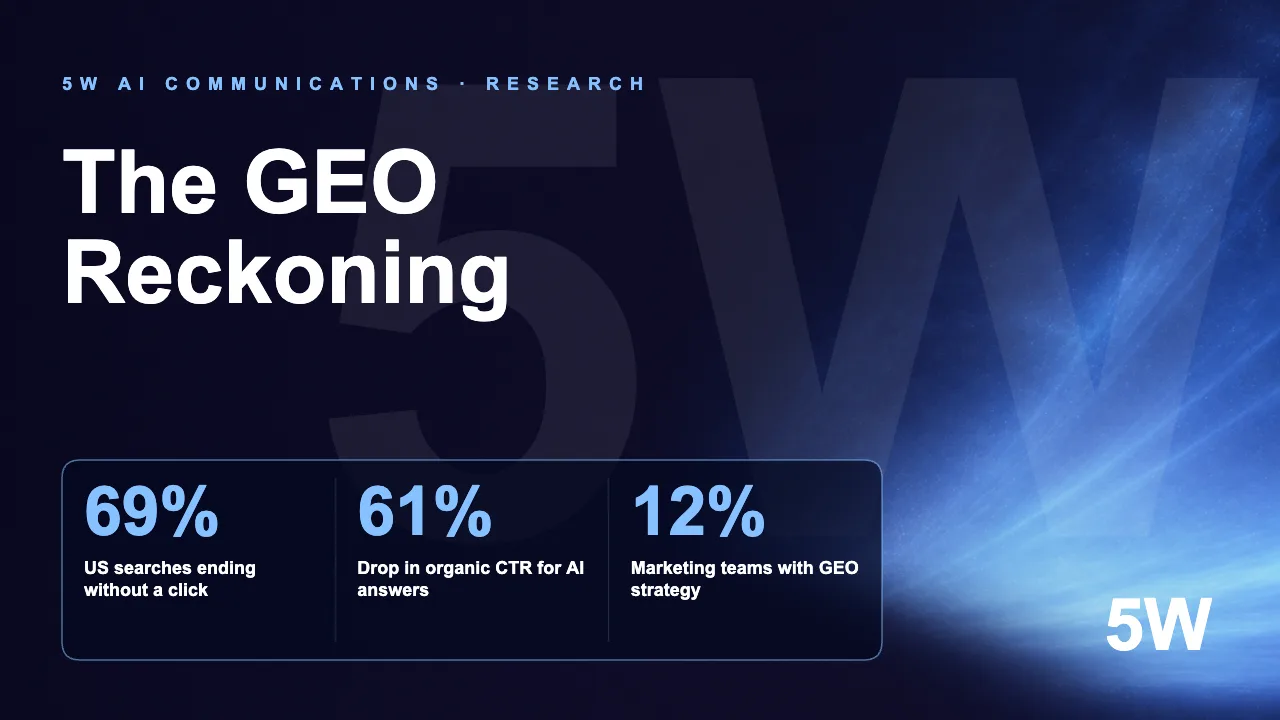
- 93% of AI Mode searches end without a click; roughly 60% of all US and EU searches are now zero-click
- ChatGPT reached 800 million weekly users in October 2025, doubling from 400 million in February 2025
The citation economics
- 85.5% of AI citations reference earned media sources (Muck Rack, 1M+ prompt analysis)
- AI engines cite earned media approximately 5x more frequently than brand-owned websites (University of Toronto)
- Distributing content across a wide range of publications can increase AI citations by up to 325% vs. publishing on the brand site alone (Stacker, December 2025)
- Brands on 4+ third-party platforms are 2.8x more likely to be cited in ChatGPT responses than single-platform brands
- LinkedIn is the most-cited domain for professional queries across AI Overviews, AI Mode, ChatGPT, Copilot, and Perplexity (Profound, March 2026)
The commercial signal
- AI search visitors convert at 14.2% vs. Google's 2.8% — approximately 5x more valuable per visit (Semrush, 2026)
- AI-driven traffic to US retailers grew 4,700% year-over-year as of July 2025
- US enterprises dedicated 12% of digital marketing budgets to GEO in 2025; 94% plan to increase in 2026 (eMarketer)
The Israeli market
- Israel's digital advertising market projected at $1.58 billion in 2025, rising to $1.91 billion by 2028
- 47% of brands globally have no GEO strategy; Israeli private-sector allocation materially lags North American benchmarks
- National reallocation opportunity: NIS 750M–2.4B (~$215M–$680M) over 24–36 months across ten major sectors
THE SHIFT: SEARCH TO AI ANSWERS
GEO is the emerging discipline of structuring content, third-party coverage, and brand mentions so that generative AI systems cite a brand by name when answering a user question. It does not replace SEO — approximately 99% of Google AI Overview citations still originate from the organic top 10, and 87% of ChatGPT citations correspond to Bing top results. GEO layers a new requirement: the content must be cited inside the synthesized answer, not only ranked below it.
Adoption is faster than any previous channel shift. ChatGPT reached 100 million users in 60 days — the fastest consumer adoption in technology history. It reached 800 million weekly active users by October 2025. Gemini grew 157% between April and September 2025 to 1.1 billion monthly visits. Perplexity processed 780 million queries in a single month as of early 2026, up from 230 million in August 2024. Business AI adoption rose from 14% to 29.2% in the first half of 2025.
Consumer behavior inside AI is fundamentally different from search. Average session length on AI search is 6 minutes, compared with seconds on Google. Average AI query length is 23 words vs. 4 words on Google. Median time in AI Mode is 77 seconds comparing brands or products, roughly double AI Overviews. Users treat AI responses as authoritative answers rather than starting points, producing higher trust transfer to the brands cited inside them.
The traffic is small but disproportionately valuable. AI referral traffic is approximately 1% of total web visits globally, growing approximately 1 percentage point per month. AI search visitors convert 5x better per visit than traditional organic (14.2% vs 2.8%). Users referred from ChatGPT spend 15 minutes on site versus 8 for Google referrals, generate 12 pageviews versus 9, and convert at 7% versus 5%. AI-driven traffic to US retailers grew 4,700% year-over-year as of July 2025.
THE ISRAELI ADVERTISING MARKET
Israel's advertising economy is now structurally dependent on platforms that are themselves being reshaped by generative AI. Digital total $1.58B in 2025 (rising to $1.91B by 2028). Search ~$597M. Social ~$460M. Digital video ~$280M. Influencer ~$67M. Traditional TV ~$260M. Government advertising (LAPAM) $120M+.
Platform concentration. Google captures approximately 46% of Israeli digital ad spend; Meta approximately 15%. Roughly 61% of local digital advertising flows through two platforms that are integrating AI answers directly into the user experience. The platforms Israeli brands already buy from are intermediating away their direct click traffic.
Oligopoly structure. Israel's largest consumer categories are concentrated: five major banks, three cellular carriers, four HMOs, two dominant supermarket chains, four to five top insurers. In oligopoly, share of model maps more directly onto share of wallet than in fragmented markets. Early GEO investment has outsized defensive and offensive consequences.
Mortgage and credit cycle. Israeli banking sector assets grew 10–12% year-over-year through 2024–2025. High-intent Hebrew financial queries are currently among the most valuable uncontested AI real estate in the market.
Export dependency. Israel's largest corporates derive significant revenue from overseas. Their visibility inside English-language AI answers is a direct input to export demand and enterprise sales pipeline. The English-language citation environment operates as a separate market that must be worked independently of the Hebrew one.
CATEGORY EXPOSURE: WHERE THE MONEY MOVES FIRST
Banking — High exposure. Hebrew AI answers to high-value financial queries default to generic guidance or aggregator content. Major Israeli banks rank well on traditional SEO but are rarely named inside AI responses, leaving significant uncontested share of model during a period of record mortgage origination.
Insurance — High exposure. Policy comparison, claim processes, rate questions, pensions, and life insurance are all heavily AI-intercepted. Insurance PPC keywords average $54.91 per click — making the unit-economic case for earned-media alternatives particularly strong.
Telecom — Very High exposure. AI answers about Israeli cellular plans and fiber frequently cite Hebrew-language reviews containing outdated promotional pricing. Real-time plan updates do not propagate into the model's retrieval layer, reducing the efficacy of live acquisition campaigns.
Travel — Very High exposure. Global aggregators dominate AI citations for Israeli hotel and flight queries. Direct-to-consumer hospitality and airline brands rarely surface in AI answers unless named explicitly, suppressing direct-booking revenue and increasing dependence on commission channels.
Tech and SaaS — Critical exposure. The single most exposed category. 42% of B2B decision-makers now open evaluation inside an LLM, and the AI response functions as the shortlist. Israel's tech sector sells disproportionately into English-speaking markets, where competition for AI citation is already intense.
Defense and industrial — Sovereign-level narrative risk. Multiple independent audits of leading AI models have documented uneven and at times unfavorable framing of Israel-related subject matter in English-language responses. The narrative inherited inside an English-language AI answer is not controllable unless citation surface area is actively built on authoritative domains.
THE EARNED MEDIA IMPERATIVE
The single most consequential finding in 2025–2026 GEO research is that AI systems prefer earned media at a structural level. This reverses two decades of digital marketing orthodoxy. In the AI-mediated discovery environment, owned content is a secondary input. Third-party coverage is the primary input.
Muck Rack analyzed more than one million AI prompts — 85.5% cite earned media. University of Toronto: AI engines cite third-party publications ~5x more frequently than brand websites. When a user mentions a brand by name, earned media accounts for 48% of resulting citations. When a user asks what customers think, earned media accounts for 82% of citations.
Distribution mathematics favor disciplined PR. Distributing content across a wide range of publications can increase AI citation rates by up to 325% versus publishing only on the brand's own site (Stacker, December 2025). Brands on four or more third-party platforms are 2.8x more likely to be cited. Domains with more than 32,000 referring domains are 3.5x more likely to be cited. Domains with review platform profiles have 3x higher citation rates. The average domain age of ChatGPT-cited sources is 17 years.
The new citation stack. The top 10 domains capture 46% of all ChatGPT citations within a given topic; the top 30 capture 67%. Dominant citation sources: Reddit (most-cited single domain in multiple 2025–2026 analyses), Wikipedia (26–30% of B2B factual queries), YouTube (16% of LLM answers), LinkedIn (most-cited domain for professional queries across all major AI platforms), tier-one editorial (Forbes, Business Insider, WSJ, NYT, TechCrunch), and review platforms (G2 leads in software).
THE ISRAELI TECH EXPORT PREMIUM
Over 300 Israeli SaaS companies operate internationally, with flagship firms reporting 2024–2025 revenues between $150 million and $1.1 billion. The combined ecosystem generates tens of billions in annual revenue, the large majority sold into English-speaking markets where 42% of B2B buyers now open evaluation inside an LLM.
Median B2B SaaS company spends 8% of ARR on marketing (SaaS Capital, 2025). Applied to the top 50 private Israeli SaaS firms alone, median marketing spend conservatively exceeds $1.5 billion annually.
Customer acquisition cost benchmarks for Israeli exporters: SMB SaaS $300–$800 CAC. Mid-market SaaS $1,200–$2,000. Enterprise SaaS $2,000–$15,000+. B2B paid search averages $802 per customer acquired. CAC has risen approximately 60% over the past five years across B2B tech.
The AI invisibility premium. For an Israeli mid-market SaaS exporter with 500 new customers per year at $1,500 CAC, approximately $315,000 of total acquisition spend is exposed to whether the brand is cited inside the AI answer during the initial shortlist stage. A brand absent from AI answers is not absent at the click stage; it is absent at the shortlist stage — which is earlier and more consequential. Industry estimates put the effective CAC premium for AI-invisible B2B tech brands in the 15–35% range.
The compounding earned-media dividend. Every unit of earned media invested in an Israeli tech brand now produces two stacked returns: the traditional reputational return and the AI citation return. A single Forbes placement in 2026 will produce citation surface area that feeds AI answers for years, compounding against the 17-year average domain age of ChatGPT-cited sources.
HOW COMMUNICATIONS FIRMS PRODUCE AI CITATION
Every service line that public relations firms have historically sold — earned media placement, executive thought leadership, LinkedIn and social strategy, Wikipedia accuracy, press release distribution, awards, data-led research, podcast bookings, review-platform management, crisis response — is now also a direct input to AI citation. The work has not changed. The value of the output has.
LinkedIn — Fully manageable, highest ROI. The most-cited domain for professional queries across every major AI surface (Profound, March 2026). A communications program that systematically manages executive LinkedIn presence produces measurable citation lift within 60 to 90 days — faster than any earned media program.
Wikipedia accuracy — Highly manageable. Cited in 26–30% of B2B factual queries. For established entities, an accurate, well-sourced entry is quasi-permanent citation infrastructure.
Press release and data report distribution — Fully manageable. Wire services syndicate to hundreds of publications that feed AI training and retrieval. Proprietary data reports become citation sources in their own right.
Executive thought leadership — Highly manageable. Specific, data-backed, attributable executive quotes are approximately 28% more likely to be cited by AI than generic on-message quotes.
Review platform presence — Highly manageable. Profiles on G2, Capterra, Trustpilot, Yelp deliver a 3x citation multiplier.
Awards and rankings — Manageable. Comparison and "best of" content drives 32.5% of AI citations — the single largest format category.
What communications programs audit and report: Share of Model (tracked monthly per language). Citation source mix. Sentiment in citation. Prompt-level movement. Competitive benchmark. Platform split across ChatGPT, Gemini, Perplexity, Google AI Mode, and Microsoft Copilot — separately, since only 11% of domains earn citations across both ChatGPT and Perplexity.
SECTOR SPEND ECONOMICS
Estimated annual marketing spend, AI-exposed share, and indicative GEO reallocation by Israeli sector (15–25% migration of AI-exposed spend over 24–36 months):
Banking — NIS 600M–900M / 40–55% AI-exposed / NIS 40M–125M reallocation
Insurance and pensions — NIS 500M–700M / 45–60% / NIS 35M–100M
Telecom — NIS 350M–500M / 55–70% / NIS 30M–85M
Retail and FMCG — NIS 1.2B–1.8B / 30–45% / NIS 55M–200M
Travel and hospitality — NIS 250M–400M / 55–75% / NIS 20M–75M
Pharma and health — NIS 350M–500M / 35–50% / NIS 20M–60M
Automotive — NIS 400M–550M / 45–60% / NIS 30M–80M
Energy and utilities — NIS 150M–220M / 25–40% / NIS 8M–25M
Tech and SaaS (export) — NIS 5.5B–8B / 60–80% / NIS 500M–1.6B
Government (LAPAM) — NIS 450M+ / 40–55% / NIS 30M–65M
Aggregate national reallocation opportunity: NIS 750 million to NIS 2.4 billion — roughly $215 million to $680 million — over 24 to 36 months. The tech and SaaS export component accounts for the majority of the upper bound.
COMPARATIVE MARKET BENCHMARKS
United States: $325B digital ad market. 12% enterprise GEO allocation in 2025. 94% increasing GEO in 2026. 35% AI-at-discovery user share. 26% of brands with zero AI Overview mentions.
United Kingdom: ~$40B digital ad market. ~9% enterprise GEO allocation. ~85% increasing GEO in 2026.
Germany / EU: ~$50B digital ad market. ~7% enterprise GEO allocation. ~75% increasing GEO.
Israel: $1.58B digital ad market. Estimated <5% enterprise GEO allocation. AI-at-discovery user share above EU average. ~50% of Israeli brands estimated to have zero AI Overview mentions.
The US enterprise GEO allocation benchmark (12% of digital marketing budget) is a forward indicator for other markets, historically reaching European and Israeli enterprise adoption with an 18 to 36 month lag. Israel's gap between user adoption and brand allocation is wider than in comparable markets — which enlarges the first-mover advantage. If Israel follows the US trajectory, the Israeli enterprise GEO allocation curve begins steepening in 2026–2027.
THE HEBREW DATA GAP
Hebrew is a minority training language in every major frontier AI model. This creates two asymmetric effects for brands operating in the Israeli market, and a third effect at the state level.
Effect one: thin source pool, low competitive floor. Hebrew corpora — news, reviews, forums, product pages, regulatory guidance — are under-represented relative to the economic size of the market. The Nagel Committee's August 2025 report identified the absence of a Hebrew national language model as a digital sovereignty issue. A disciplined Hebrew earned-media program can capture disproportionate share of model quickly. The first 12–24 months represent the maximum arbitrage window.
Effect two: inherited English-language narratives. In English-language queries about Israeli companies, Israeli categories, or Israel itself, the source pool is dominated by international media whose coverage is uneven. Independent audits of leading AI models have documented inconsistent and at times unfavorable framing of Israel-related subject matter. For Israeli corporates with international revenue exposure, the narrative inherited inside an English-language AI answer is not under the company's control unless citation surface area is actively built on high-authority English-language domains.
Effect three: state-level recognition. Foreign Agents Registration Act filings disclosed in late 2025 that Israel's Ministry of Foreign Affairs contracted a US firm on a multi-million-dollar engagement to build websites and content specifically designed to influence how generative AI systems frame Israel-related queries. Industry reporting has put total Israeli state spend on "chatbot optimization" in excess of half a billion shekels. The private sector has not matched this urgency at scale.
Israeli brands with international exposure must invest in English-language citation surface area independently of their Hebrew strategy. The two languages are separate retrieval environments requiring separate earned-media programs. Consistent compounding investment is required to hold ground — episodic campaigns do not produce durable share of model. The window for early private-sector moves is now.