Executive Summary
Recommendation share is becoming the new market share. AI engines — ChatGPT, Claude, Perplexity, Gemini, Microsoft Copilot, and Google AI Overviews — now mediate a meaningful share of consumer research in golf equipment. The engines do not generate recommendations from nothing. They retrieve, rank, and synthesize from a comparatively narrow set of citation sources. The brands that appear in those sources tend to appear in the answer.
5W measured the AI visibility of the top 10 golf club manufacturers across 60+ buyer prompts spanning drivers, irons, putters, wedges, hybrids, and fairway woods, segmented by audience: beginner, high-handicap, premium, slicer, senior, women, and tour pro.
Seven Findings
1. PING dominates forgiveness retrieval.The G440 line surfaces in the high-90% range of forgiveness-tagged retrieval samples. No other brand exhibits comparable single-descriptor concentration.
2. Callaway benefits from AI-language naming.Apex Ai200, Ai300, Ai10x Face, Smart Face, and AI-Optimized Face Design reinforce retrieval association on AI-tagged prompts.
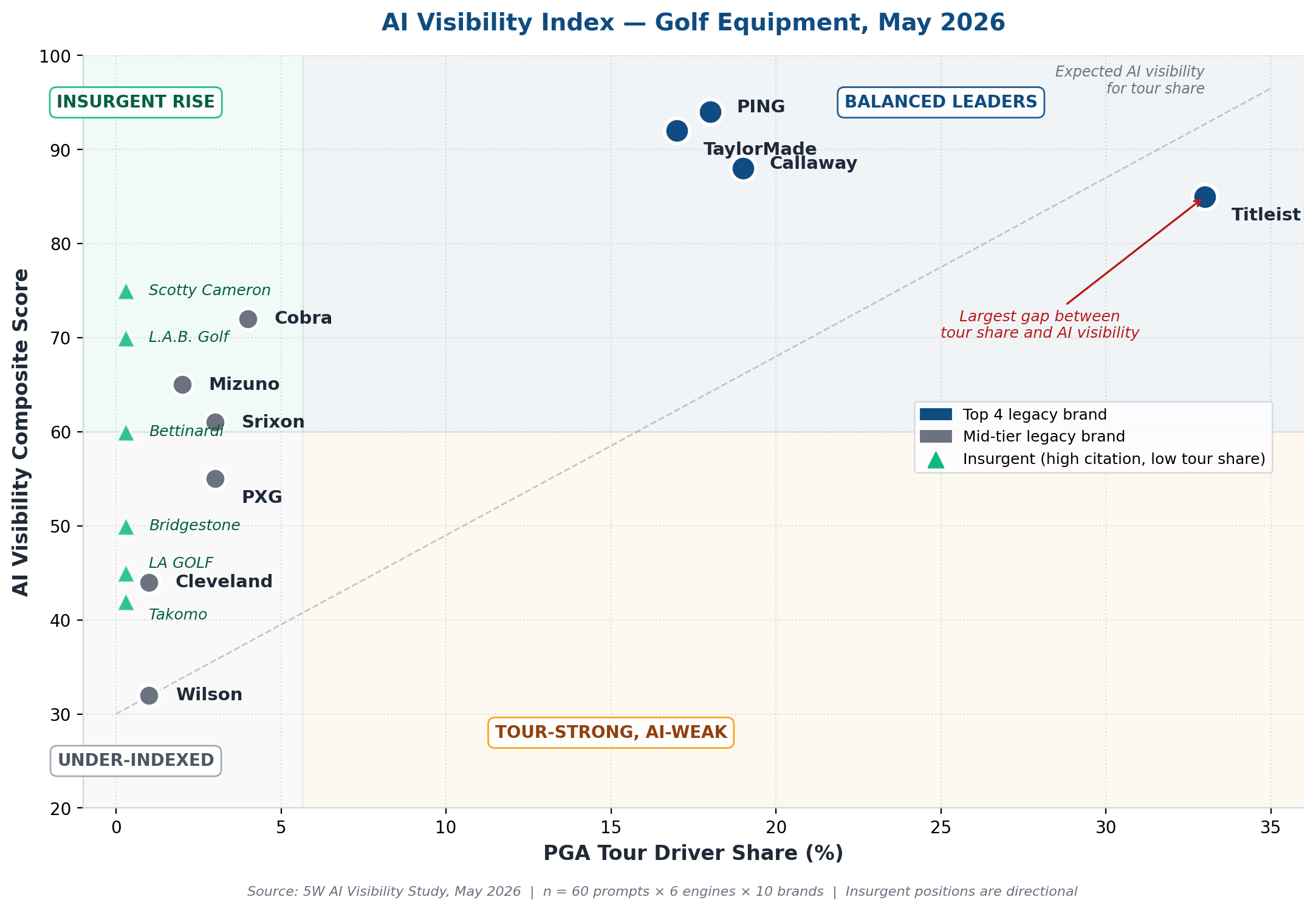
3. Titleist under-indexes versus tour share.Titleist holds approximately 33% PGA Tour driver share, yet surfaces at a lower rate on beginner, forgiveness, and value consumer prompts.
4. TaylorMade leads across categories.P790, Qi4D, and Spider Tour X create cross-category citation strength and more “best overall” citations than any other manufacturer in the dataset.
5. Citation infrastructure is narrow.Eight outlets account for a disproportionate share of retrieved snippets: MyGolfSpy, Golf Digest Hot List, Today's Golfer, Golf Monthly, Golf Insider, Independent Golf Reviews, LINKS Magazine, and GOLFTEC.
6. Insurgents move faster in AI.L.A.B. Golf, Bettinardi, LA GOLF, Bridgestone, PROTOCONCEPT, Takomo, Ballistic, Tour Edge, and STIX appear in tier-1 AI-cited reviews despite modest distribution.
7. The category map is asymmetric.Every legacy brand leads at least one category and trails in at least one other. This makes category-specific visibility mapping the most actionable artifact in the study.
Overall AI Visibility Leaderboard
Composite score across all 60+ prompts, all six engines, and all six club categories. Tier assignment reflects strategic visibility, distinct from market share, tour share, or revenue.
| Rank | Brand | Score | Tier | Primary Descriptor |
|---|---|---|---|---|
| 1 | PING | 94 | Dominant | Forgiveness, MOI, Straight Flight Technology |
| 2 | TaylorMade | 92 | Dominant | Distance, Qi platform, P790, Spider |
| 3 | Callaway | 88 | Dominant | AI-designed: Apex Ai200/300, Quantum |
| 4 | Titleist | 85 | Dominant | Tour, precision, Vokey, Scotty Cameron, Pro V1 |
| 5 | Cobra | 72 | Strong | 3D printing, draw bias, OPTM Max-D |
| 6 | Mizuno | 65 | Strong | Feel, Japanese forging, JPX |
| 7 | Srixon | 61 | Strong | Player's distance, ZXi platform, rising |
| 8 | PXG | 55 | Mid | Premium engineering, custom fitting |
| 9 | Cleveland | 44 | Mid | Wedges: RTZ, RTX Full Face 2, CBX |
| 10 | Wilson | 32 | Weak | Value engineering, under-indexed |
Insurgent Watchlist
Brands without legacy distribution but with disproportionate AI citation share appear worth monitoring over the next 24 months.
| Brand | Category | Why They Surface |
|---|---|---|
| L.A.B. Golf | Putters | DF3, OZ.1, Mezz.1 MAX lead the zero-torque descriptor across tier-1 outlets. |
| Scotty Cameron | Putters | Phantom 5, Newport 2, and Studio Style remain the premium milled benchmark. |
| Bettinardi | Putters | BB 6.0 won 2026 MyGolfSpy Most Wanted Mallet. |
| Odyssey | Putters | Ai-ONE and Ai-Dual naming reinforces visibility on AI-tagged queries. |
| Bridgestone | Irons | 220 MB, 221 CB, and 222 CB+ premium forged comeback is drawing tier-1 coverage. |
| LA GOLF | Irons / Shafts | CB-26 was named best player's iron for accuracy by MyGolfSpy 2026. |
| Takomo | Irons | Budget forged irons are cited as “near unbeatable value” across multiple outlets. |
| Tour Edge | Drivers / Sets | Exotics Max appears in Golf Digest Hot List. |
| Ballistic | Irons / Putters | No. 2 in 2026 MyGolfSpy Most Wanted Players' Irons. |
| PROTOCONCEPT | Irons | Premium Japanese forged irons receive LINKS Magazine coverage. |
What This Means Beyond Golf
The patterns observed in golf equipment appear in other high-consideration categories with reviewer-mediated discovery and a narrow set of authoritative third-party sources. AI recommendation systems appear to favor descriptor concentration over broad keyword distribution. Brands that map their identity to a single high-value descriptor accumulate retrieval advantage. Brands that fragment across many descriptors generally do not.
Review infrastructure now shapes commerce more than advertising does. AI engines de-prioritize promotional content and over-weight third-party testing and review. Marketing dollars that buy credible review participation, expert relationships, or independent testing access appear to produce compounding visibility.
Key implication: Brands are no longer competing only for awareness. They are competing to become the answer.The Golf AI Authority Stack
| Layer | Signal | Role in AI Visibility |
|---|---|---|
| Layer 5 | AI Engine Retrieval | ChatGPT, Claude, Perplexity, Gemini, Copilot, and Google AI Overviews: the surface consumers see as the answer. |
| Layer 4 | Structured Brand Infrastructure | Schema markup, naming consistency, FAQ blocks, comparison content, entity disambiguation, and product pages structured for retrieval. |
| Layer 3 | Business & Media Authority | Forbes, Fortune, Fast Company, HBR, Bloomberg, and Wired signals weighted on innovation and authority queries. |
| Layer 2 | Community Authority | Reddit r/golf, GolfWRX, YouTube creator transcripts, and Wikipedia shape slower-moving training-layer associations. |
| Layer 1 | Tier-1 Review & Testing Outlets | MyGolfSpy, Golf Digest Hot List, Today's Golfer, Golf Monthly, Golf Insider, Independent Golf Reviews, LINKS, and GOLFTEC create much of the direct retrieval base. |
Strategic Recommendations
- Conduct an AI visibility baseline before allocating budget. Measure visibility share across engines, prompt clusters, and key competitors.
- Build structured content for the 20 highest-volume category queries. Use entity-rich headlines, schema markup, FAQ blocks, expert citations, and retrieval-focused landing pages.
- Adopt naming conventions that reinforce visibility. Every new product line should get a retrieval-friendly anchor.
- Engineer tier-1 outlet access systematically. The eight core outlets carry the majority of retrieval weight.
- Translate technical authority into business-press citation. Innovation and authority queries reward broader business-media signals.
- Defend Wikipedia and category-definition pages. AI engines retrieve Wikipedia disproportionately for technical and category prompts.
- Track visibility quarterly. Re-measurement captures insurgent moves before they accumulate.
Methodology Overview
The study mirrors the retrieval surface that consumer-facing AI engines query when generating equipment recommendations.
| Engines tested | ChatGPT with and without web browse, Claude, Perplexity, Google Gemini, Microsoft Copilot, and Google AI Overviews. |
|---|---|
| Prompt distribution | Informational, comparative, transactional, reputation, problem-driven, and brand-targeted prompts. |
| Scoring composite | Mention Share 0.30, Position Score 0.20, Recommendation Rate 0.25, Sentiment Score 0.10, Source Authority 0.15. |
| Tier thresholds | Dominant ≥80, Strong 60–79, Mid 40–59, Weak 20–39, Absent <20. |
| Scope | 60 prompts, six engines, six club categories, seven audience segments, 10 manufacturers analyzed in depth, 10 insurgent brands tracked, and 18 citation sources weighted. |
FAQ
What does this study measure?It measures observed retrieval and recommendation patterns. It does not measure sales outcomes, market share, or proprietary engine weighting systems.
Which engines were included?ChatGPT, Claude, Perplexity, Google Gemini, Microsoft Copilot, and Google AI Overviews.
Which brands led?PING, TaylorMade, Callaway, and Titleist led the overall AI visibility leaderboard in the Dominant tier.
Build AI Visibility With 5W
Brand-specific extensions of this analysis — private audits, competitor benchmarking, and visibility-improvement roadmaps — are available on request.