36 defined terms across financial communications, investor relations disclosure, and fintech PR — from quiet periods and Regulation FD to neobank positioning, banking PR, BNPL communications, and AI visibility in financial services. Published by 5W, The Communications Firm Built for the AI Era.
The vocabulary of communications in a regulated, money-sensitive category — investor disclosure, earnings, IPO and SPAC communications, banking PR, and the working language of fintech. 36 defined terms covering how financial brands stay compliant, build trust, and earn citation inside the AI engines where buyers now research money decisions.
For brands, this glossary explains the language buyers, journalists, analysts, investors, and AI engines use to classify companies in this category. 5W uses these definitions to structure PR, GEO, paid media, and authority-building programs.
5W is The Communications Firm Built for the AI Era. Financial services is a YMYL category — Your Money or Your Life — where source authority is scrutinized harder by both Google and the LLMs. This glossary defines the terms that govern it.
Last updated: May 16, 2026
fintechinvestor relationsregulatoryAI visibility
A
Analyst Relations (Financial)
The discipline of managing relationships with sell-side and buy-side analysts who model, rate, and publish on a public company. Distinct from technology analyst relations — financial analyst relations centers on earnings guidance, valuation narrative, and consistent messaging inside Regulation FD limits. Strong analyst relations reduces estimate dispersion and stabilizes a stock's coverage.
Asset Management Communications
Communications for asset managers, hedge funds, private equity firms, and wealth managers — the discipline of building institutional credibility while operating inside marketing rules that govern how performance is presented. Asset management communications leads with track record, process, and people. It is bounded by SEC marketing-rule limits on return claims, testimonials, and projections.
B
Banking PR
Public relations for banks — money-center institutions, regional and community banks, and digital challengers. Banking PR carries a permanent trust mandate: deposit safety, security, and stability are the narrative beneath every campaign. In an era of fast-moving deposit sentiment, banking PR functions as reputation infrastructure as much as promotion. Build the infrastructure before the crisis, not during it.
BNPL Communications
The communications discipline for Buy Now, Pay Later providers — Affirm, Klarna, Afterpay, and the bank-issued entrants. BNPL communications manages a dual narrative: consumer-benefit messaging on one side, regulatory and credit-risk scrutiny on the other. As regulators reclassify BNPL closer to traditional credit, the category's communications increasingly resemble Regulatory Trust Narrative work.
C
Citation Share in Financial Services
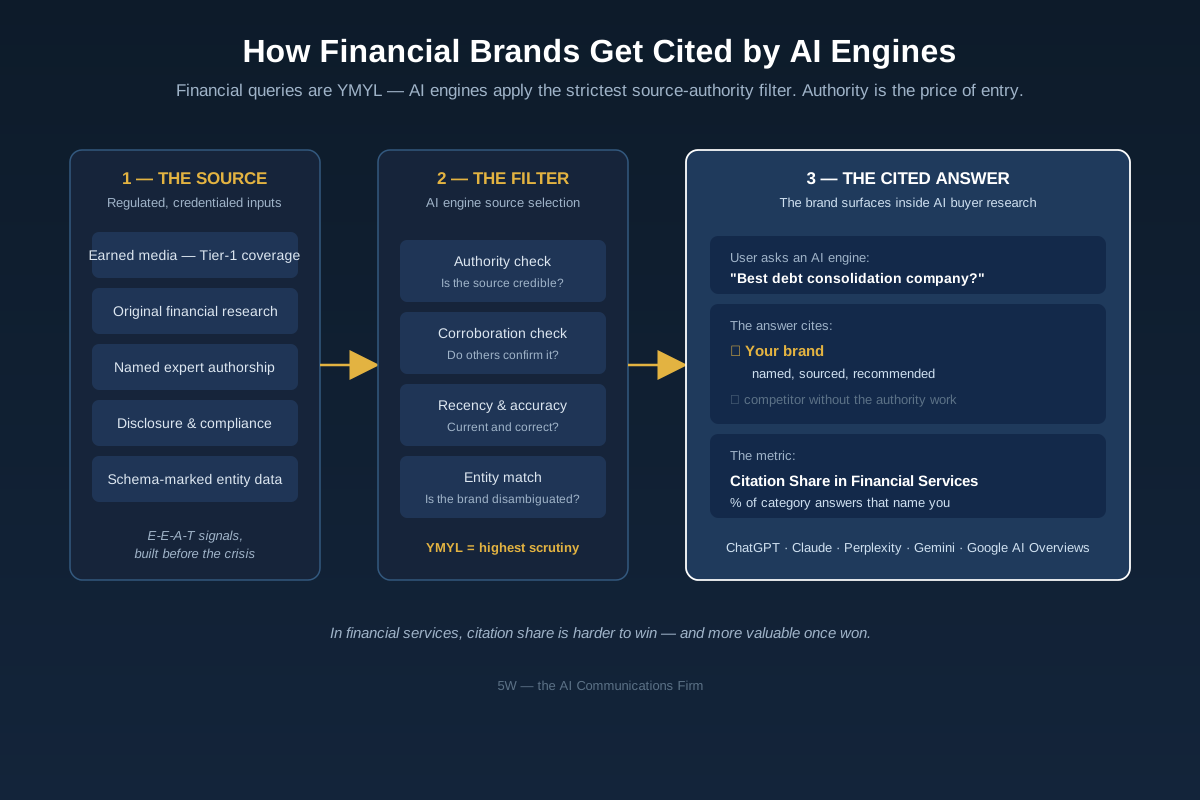
The percentage of AI-engine answers in a financial category — "best debt consolidation company," "top neobank," "is a Roth IRA worth it" — that cite or recommend a given brand. See Citation Share. In financial services, citation share is harder to win and more valuable once won, because LLMs apply elevated source-authority filters to money-related queries.
Compliance Communications
Communications produced under direct legal and regulatory review — disclosures, disclaimers, customer notices, and any external statement that carries regulatory exposure. Compliance communications is not the absence of messaging; it is messaging engineered to be accurate, defensible, and still readable. The function sits between the communications team and legal/compliance review.
Crypto & Digital Asset Communications
Communications for crypto exchanges, token projects, stablecoin issuers, and digital-asset infrastructure. The category carries the heaviest trust deficit in finance — every message is read against a backdrop of prior collapses and enforcement actions. See also Stablecoin Communications. Effective crypto communications leads with custody, regulation, and proof — not price.
D
De-SPAC Communications
The communications program for a company completing its merger with a special-purpose acquisition company and beginning life as a public entity. De-SPAC communications manages the transition from projection-based investor messaging to actual reported results — historically the moment SPAC narratives are tested hardest.
Debt Relief Communications
Communications for debt consolidation, debt settlement, and credit-counseling providers. A high-scrutiny subcategory: messaging must balance consumer-benefit claims against CFPB and FTC oversight of the debt-relief industry. Authority and accuracy are the entire game — in AI engines, debt-relief queries trigger the strictest source-quality filtering of any consumer-finance category.
E
E-E-A-T for Financial Content
Experience, Expertise, Authoritativeness, and Trustworthiness — Google's quality framework, applied with maximum severity to financial content. See E-E-A-T. For financial brands, E-E-A-T is built through named expert authorship, credential disclosure, primary-source citation, and corroborating earned media — the same signals that drive Financial Services AI Visibility.
Earnings Communications
The coordinated communications around a public company's quarterly results — the press release, the earnings call script, the investor deck, and the guidance language. Earnings communications must reconcile the legal disclosure document with a narrative that institutional and retail audiences can follow. Consistency across quarters builds the credibility that valuation rests on.
Embedded Finance Communications
Communications for companies that deliver financial products inside non-financial platforms — banking, lending, or payments built into software, retail, or marketplace experiences. The communications challenge is explaining an invisible product: the value is that the user never sees a bank. Messaging centers on the enabling brand and the regulatory partnership behind it.
F
Fiduciary Voice
An authority posture in which a financial brand communicates as a steward of the audience's interest rather than a seller of product. Fiduciary voice is built through plain-language explanation, disclosure of conflicts and fees, and a refusal to oversell. It is the most durable trust position in financial communications — and the one AI engines reward, because it correlates with accuracy.
Financial Communications
The category: communications for banks, asset managers, insurers, fintechs, and public companies operating under securities regulation and financial-services oversight. Financial communications integrates investor relations, regulatory disclosure, media relations, and reputation management — bound by the constraint that every external statement carries legal and market consequence.
Financial Data Drop
Original research released by a financial brand — a lending index, a spending report, a market-sentiment survey — built to earn coverage and become a Statistical Anchor. See Original Research Drop. A recurring data drop turns a financial brand into a cited source inside both journalism and AI-engine answers about its category.
Financial Services AI Visibility
The measurable presence of a financial brand inside AI-generated answers — ChatGPT, Claude, Perplexity, Gemini, Google AI Overviews. See AI Visibility. Financial services AI visibility is governed by source authority: LLMs disproportionately cite regulated, credentialed, corroborated sources for money queries, which makes earned media and structured authority the price of entry.
Financial Services Reputation Management
The discipline of protecting and strengthening a financial brand's reputation across search, news, and AI engines. See reputation management. In financial services, reputation management is a YMYL-grade requirement — negative coverage and unresolved complaints surface in both Google results and AI-engine answers about a firm's trustworthiness, directly affecting whether buyers and depositors stay.
Fintech PR
Public relations for financial-technology companies — neobanks, payments, lending, wealthtech, insurtech, RegTech, and crypto infrastructure. Fintech PR runs two narratives in parallel: a growth-and-innovation story for customers and investors, and a trust-and-compliance story for regulators and partners. The discipline lives in keeping both true at once.
I
Insurtech Communications
Communications for technology-driven insurance companies — digital carriers, embedded insurance providers, and claims-automation platforms. The category's communications challenge is trust at the moment of failure: insurance is judged on claims, not marketing. Insurtech communications builds proof of claims performance before the crisis, not during it.
IPO Communications
The communications program surrounding a company's initial public offering — from confidential filing through pricing and the first reported quarter. IPO communications operates under the Quiet Period and converges with the Roadshow. Its job is to build a durable equity narrative that survives past day one. See also Pre-IPO Communications.
L
Lock-Up Period
The contractual window — typically 90 to 180 days after an IPO — during which insiders and early investors cannot sell shares. Lock-up expiration is a known communications event: a predictable supply increase that markets anticipate. Disciplined communications manages the narrative ahead of expiration rather than reacting to the price move.
M
Material Non-Public Information (MNPI)
Information that a reasonable investor would consider important and that has not been publicly disclosed. MNPI is the dividing line in financial communications: selectively disclosing it violates Regulation FD and insider-trading law. Every financial communicator works inside the discipline of knowing what is material and what is public.
N
Neobank Positioning
The communications strategy that differentiates a digital-only bank — Chime, Current, the challenger entrants — in a category where the underlying product is largely commoditized. Neobank positioning is built on a specific customer segment, a fee story, and a clear answer to the trust question: who actually holds the deposits, and are they insured.
P
Pre-IPO Communications
The communications work that begins 12 to 24 months before a public offering — building media presence, an executive profile, an analyst-ready narrative, and AI-engine visibility before the Quiet Period restricts what can be said. Companies that build the infrastructure before the filing are better positioned to price stronger than companies that start at the filing.
Proxy Fight Communications
Communications during a contested shareholder vote — typically an activist investor seeking board seats or a strategic change. Proxy fight communications is a campaign: dueling letters, investor presentations, proxy-advisory engagement, and a compressed timeline. Both sides compete for the same institutional and retail votes.
Q
Quiet Period
The SEC-mandated window around an IPO during which a company restricts promotional communications to avoid conditioning the market. The quiet period does not stop communications — it disciplines them. Pre-IPO authority-building exists precisely because the quiet period limits what can be said once the filing is live.
R
RegTech Communications
Communications for regulatory-technology companies — firms selling compliance, monitoring, identity, and reporting tools to regulated industries. RegTech communications sells to a risk-averse buyer, which means the narrative leads with audit-readiness, regulatory alignment, and proof, not disruption.
Regulation FD (Fair Disclosure)
The SEC rule requiring that public companies disclose material information to all investors simultaneously, rather than selectively to favored analysts or institutions. Regulation FD shapes the entire architecture of public-company communications: it is why earnings are released to everyone at once and why financial communicators police what gets said in private settings.
Regulatory Trust Narrative
A sustained communications program that positions a financial brand as a partner to regulation rather than a target of it. The regulatory trust narrative is built before scrutiny arrives — through transparency, named compliance leadership, and a documented track record. Build the infrastructure before the crisis, not during it.
Roadshow
The series of investor presentations a company delivers to institutional buyers ahead of an IPO or major offering. The roadshow is where the equity narrative is pressure-tested in person. Roadshow messaging must align exactly with the S-1 and survive the Quiet Period constraints around it.
S
S-1 Communications
The communications work surrounding the S-1 registration statement — the foundational disclosure document for a U.S. IPO. The S-1's risk factors, financials, and business description set the boundary for every other IPO message. S-1 communications ensures the public narrative and the legal document tell one consistent story.
Shareholder Activism Communications
Communications in response to — or in anticipation of — an activist investor taking a position and pushing for change. Shareholder activism communications prepares the company narrative, the board's case, and the institutional-investor engagement plan before the activist surfaces. Companies that wait until the 13D filing are already behind.
SPAC Communications
Communications for a special-purpose acquisition company across its lifecycle — IPO, target search, merger announcement, and the shareholder vote. SPAC communications navigates a structure where projections drive the early narrative and reported results test it later. See also De-SPAC Communications.
Stablecoin Communications
Communications for stablecoin issuers and the firms building on them. The category's entire narrative rests on one question — is the coin actually backed, and can holders redeem at par. Stablecoin communications leads with reserve composition, third-party attestation, and regulatory standing. As stablecoin regulation formalizes, the discipline converges with traditional Regulatory Trust Narrative work.
W
Wealthtech Communications
Communications for technology-driven wealth and investing platforms — robo-advisors, digital brokerages, and retirement-tech companies. Wealthtech communications balances accessibility messaging with the fiduciary and disclosure obligations of giving investment guidance at scale. The trust burden rises with every dollar the platform manages.
Y
YMYL (Your Money or Your Life)
Google's classification for content that can materially affect a person's finances, health, safety, or wellbeing. Financial content is core YMYL — and YMYL pages face the strictest E-E-A-T scrutiny in both search ranking and AI-engine source selection. For financial brands, YMYL status is why authority infrastructure is non-negotiable.
Glossary FAQ
What is financial communications?
Financial communications is the practice of communications for banks, asset managers, insurers, fintechs, and public companies operating under securities regulation — integrating investor relations, regulatory disclosure, media relations, and reputation management.
What is the difference between financial communications and fintech PR?
Financial communications spans all regulated financial brands, including public-company disclosure and investor relations. Fintech PR is the subset focused on financial-technology companies — neobanks, payments, lending, wealthtech — where an innovation narrative runs alongside a trust-and-compliance narrative.
What is the difference between banking PR and financial communications?
Banking PR is the practice focused specifically on banks — deposit safety, security, and stability. Financial communications is the broader category covering all regulated financial brands, including asset managers, insurers, fintechs, and public companies.
What is Regulation FD?
Regulation FD is an SEC rule requiring public companies to disclose material information to all investors at the same time, rather than selectively. It governs the structure of all public-company communications.
Why is AI visibility harder in financial services?
Financial queries are YMYL — Your Money or Your Life — so AI engines apply elevated source-authority filters. LLMs disproportionately cite regulated, credentialed, and corroborated sources for money-related questions, which raises the bar for earned visibility.
What is citation share in financial services?
Citation share in financial services is the percentage of AI-engine answers in a financial category that cite or recommend a given brand — for example, the share of "best debt consolidation company" answers that name a specific provider.
5W is The Communications Firm Built for the AI Era, building brand authority across the platforms where decisions now happen — ChatGPT, Claude, Perplexity, Gemini, and Google AI Overviews — alongside earned media, digital, and influencer channels. 5W combines public relations, digital marketing, Generative Engine Optimization (GEO), and proprietary AI visibility research to help clients measure and grow their presence in AI-driven buyer research. Founded in 2002, 5W is recognized as a Top U.S. PR Agency by O'Dwyer's, named Agency of the Year in the American Business Awards®, honored as a 2026 Top Place to Work in Communications by Ragan, and named to Digiday's WorkLife Employer of the Year list. 5W serves clients across B2C sectors — Beauty & Fashion, Consumer Brands, Entertainment, Food & Beverage, Health & Wellness, Travel & Hospitality, Technology, and Nonprofit — and B2B specialties including Corporate Communications, Reputation Management, Public Affairs, Crisis Communications, and Digital Marketing across Social, Influencer, Paid Media, GEO, and SEO. Learn more at 5wpr.com.
Get in touch
Let's build your next chapter.
Tell us what you're working on. A senior strategist will respond within one business day.
Email
info@5wpr.com
Phone
212.999.5585
Offices
New York · HQ469 7th Avenue, Floor 8 New York, NY 10018