34 defined terms across healthcare and wellness communications — from FDA-regulated promotion and MLR review to patient advocacy, digital health PR, and how health brands earn citation inside the AI engines where patients now research care. Published by 5W, The Communications Firm Built for the AI Era.
The vocabulary of communications in the most regulated, most scrutinized category there is — pharma and medtech promotion, patient advocacy, digital health, and consumer wellness. 34 defined terms covering how health brands communicate accurately, stay compliant, and earn citation inside the AI engines where patients and providers now research care.
For brands, this glossary explains the language patients, providers, journalists, regulators, and retrieval systems use to classify companies in this category. 5W uses these definitions to structure PR, GEO, paid media, and authority-building programs.
5W is The Communications Firm Built for the AI Era. Health content is core YMYL — Your Money or Your Life — and faces the strictest source-authority scrutiny in both Google and the LLMs. This glossary defines the terms that govern it.
Last updated: May 16, 2026
pharmadigital healthwellnessAI visibility
A
Adverse Event Communications
Communications handling the reporting and public discussion of a negative health outcome associated with a product. Adverse event communications operates inside strict regulatory reporting obligations — and separately, the reputational discipline of communicating about safety without alarm or minimization. The two tracks run together and must never contradict each other.
Analyst & Payer Communications
Communications directed at the institutional audiences that decide market access — health-plan payers, pharmacy benefit managers, and health-economics analysts. Distinct from patient or provider communications: this work centers on evidence of value, cost-effectiveness, and coverage rationale. It determines whether a product is reimbursed, not just approved.
C
Clinical Trial Communications
Communications around the design, progress, and results of a clinical study — recruitment, milestone announcements, and data readouts. Clinical trial communications must present results with precision: trial stage, endpoint, and population framed accurately. Overstating an early-stage or single-endpoint result is the most common — and most damaging — error in the category.
Condition Awareness Campaign
An unbranded communications program that educates the public about a health condition rather than a product. Condition awareness campaigns — also called disease awareness or disease education — build understanding and encourage diagnosis. They are held to a different regulatory standard than branded promotion because they do not name or imply a specific treatment. The distinction matters: naming or implying a branded treatment can move the program into regulated promotional territory.
Continuing Medical Education (CME) Context
The body of accredited educational activity for healthcare professionals. CME is independent of promotion by design — communicators must understand the firewall between accredited education and branded marketing. Confusing the two, or appearing to influence CME content, is a serious compliance and credibility failure.
D
Digital Health PR
Public relations for digital health companies — telehealth, remote monitoring, health apps, AI diagnostics, and connected-care platforms. Digital health PR runs an innovation narrative alongside a trust narrative: the audience wants the convenience, but needs assurance on clinical validity, data privacy, and regulatory standing. Proof of clinical evidence is the differentiator.
Direct-to-Consumer (DTC) Pharma Communications
Communications that promote a prescription product directly to patients. DTC pharma communications is permitted in the U.S. under FDA rules that require fair balance — benefits and risks presented together — and specific disclosure obligations. It is among the most tightly regulated forms of advertising in any category.
E
E-E-A-T for Health Content
Experience, Expertise, Authoritativeness, and Trustworthiness — Google's quality framework, applied with maximum severity to health content. See E-E-A-T. For health brands, E-E-A-T is built through credentialed medical authorship, citation of primary clinical sources, clear review processes, and corroborating earned coverage — the signals that also drive Health AI Visibility.
Earned Media in Healthcare
Coverage a health brand earns in medical, trade, and consumer press rather than buys. See Earned Media. In healthcare, earned media carries a credibility premium because health audiences discount promotional claims heavily. Language models read independent medical coverage as a high-authority source — an editor's reporting outweighs a brand's own page.
F
Fair Balance
The regulatory requirement that promotional communication for a regulated health product present benefit and risk information with comparable prominence. Fair balance is the governing principle of pharma promotion: a claim of efficacy cannot appear without the corresponding safety and risk information. It shapes the structure of every branded healthcare message.
FDA-Regulated Promotion
Communication that promotes an FDA-regulated product — drug, biologic, or device — and therefore falls under FDA oversight of advertising and promotional labeling. FDA-regulated promotion requires that claims match the approved label, carry fair balance, and avoid implying uses the product is not approved for. See also Off-Label.
H
Health AI Visibility
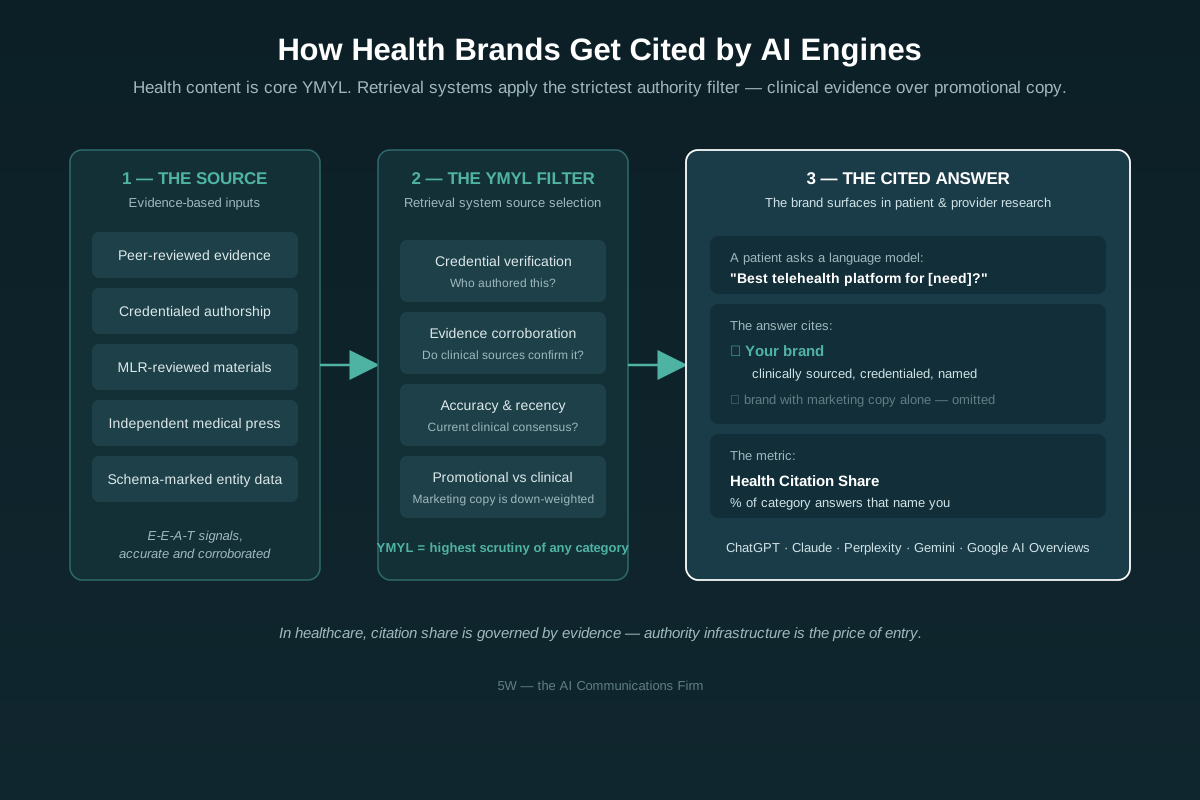
The measurable presence of a health brand inside AI-generated answers — ChatGPT, Claude, Perplexity, Gemini, Google AI Overviews. See AI Visibility. Health AI visibility is governed by source authority, credential verification, corroborated evidence, and YMYL trust signals. In healthcare, AI systems disproportionately retrieve and cite clinically sourced material over promotional copy. Authority infrastructure is the price of entry.
Health Citation Share
The percentage of answer-engine responses in a health category — "best telehealth platform," "treatment options for [condition]," "is [supplement] effective" — that cite or recommend a given brand. See Citation Share. In healthcare, citation share is governed by evidence. A telehealth brand with peer-reviewed outcomes data and credentialed authorship gets retrieved; one with marketing copy alone does not.
Health Equity Communications
Communications addressing disparities in health access, treatment, and outcomes across populations. Health equity communications requires accuracy and care — it speaks about underserved communities, and the work is judged on substance and follow-through, not messaging alone. Credibility comes from what a brand does, then communicates.
HCP Communications
Communications directed at healthcare professionals — physicians, nurses, pharmacists, and specialists. HCP communications speaks to a clinically literate, evidence-driven audience: it leads with data, mechanism, and peer-reviewed evidence. Distinct from patient communications in language, channel, and the regulatory standards that apply.
M
Medical Affairs Communications
Communications produced or guided by the medical affairs function — the scientific, non-promotional arm of a health company. Medical affairs communications covers scientific exchange, medical information, and evidence dissemination. It sits separate from marketing by design, and the separation is itself a compliance requirement.
Medical Device PR
Public relations for medical device and medtech companies — diagnostics, surgical systems, implants, and monitoring technology. Medical device PR communicates clinical benefit and safety to providers, patients, and payers, inside FDA device-regulation constraints. Clearance or approval pathway (510(k), PMA, De Novo) shapes what can be claimed and when.
MLR Review
Medical, Legal, and Regulatory review — the mandatory internal process through which promotional healthcare materials pass before release. MLR review checks every claim against the approved label, evidence, and regulatory rules. For healthcare communicators, MLR is not a bottleneck to route around; it is the process that makes the work publishable. Build timelines around it.
O
Off-Label Communications
Communication concerning a use of a product that is not part of its FDA-approved labeling. Off-label communications is tightly restricted: a company generally cannot promote an unapproved use. Understanding the line — what may be said, by whom, in what context — is fundamental to lawful healthcare communication. When in doubt, route to MLR Review.
P
Patient Advocacy Communications
Communications that engage and support patient advocacy groups and the patient community. Patient advocacy communications is built on genuine partnership, transparency about funding relationships, and respect for patient voice. Done as a transaction, it fails; done as a sustained relationship, it is among the most credible work in healthcare.
Patient Journey Mapping
The practice of mapping the stages a patient moves through — symptom, diagnosis, treatment decision, adherence, ongoing care. Patient journey mapping aligns communications to the questions a patient actually has at each stage. Those questions are now asked first of a language model — "what are the treatment options for X" — which makes Health AI Visibility a journey-stage requirement, not an afterthought.
Pharma PR
Public relations for pharmaceutical and biotech companies. Pharma PR operates inside the strictest promotional regulation of any sector — every external claim is governed by FDA-Regulated Promotion rules, fair balance, and MLR Review. The discipline is communicating a science-driven story compellingly without ever crossing the regulatory line.
Product Launch Communications (Rx)
The communications program around the launch of a prescription product — from pre-approval disease-state education through approval, launch, and uptake. Rx launch communications is sequenced around regulatory milestones: what can be said changes at approval. The unbranded groundwork before approval determines the speed of uptake after it.
R
Real-World Evidence (RWE) Communications
Communications built on real-world evidence — data on a product's performance drawn from actual clinical practice rather than controlled trials. RWE communications extends the product story beyond the trial, but carries its own rigor: real-world data must be presented with the same precision about source, population, and limitation.
Recall Communications
Crisis communications for a product recall — a drug, device, or consumer health product withdrawn for a safety or quality reason. See Crisis Communications. Recall communications must move at regulatory speed, coordinate with the FDA, and prioritize patient safety messaging above all else. The plan is drafted before the recall, never during.
Reputation Management in Healthcare
The discipline of protecting and strengthening a health brand's reputation across search, news, and answer engines. In healthcare, reputation management is YMYL-grade. Provider reviews, safety coverage, and regulatory actions all surface when a patient asks a language model whether a brand or provider can be trusted — and that answer moves patient choice directly.
S
Science Communications
The practice of translating clinical and scientific information into language non-expert audiences can understand — without distorting it. Explaining a clinical endpoint accurately to a consumer audience without distorting the finding is the core challenge. This is the foundational skill of healthcare PR: make complex evidence accessible, keep it accurate. The failure mode is oversimplification that becomes inaccuracy.
Scientific Platform
The foundational document that defines the approved, evidence-supported claims a health brand can make about a product. The scientific platform is the source of truth every communication traces back to. It keeps press materials, HCP content, and patient messaging consistent — and consistent with the evidence.
Supplement & Nutraceutical Communications
Communications for dietary supplements and nutraceutical products. These are regulated differently from drugs — supplements cannot claim to treat or cure disease, and structure/function claims carry specific disclosure rules. Supplement communications operates in a category under heavy regulatory and AI-engine scrutiny for unsupported health claims; accuracy is the entire defense.
T
Telehealth Communications
Communications for telehealth and virtual-care providers. Telehealth communications balances an access-and-convenience narrative with the trust questions specific to remote care — clinical quality, provider credentials, data privacy, and continuity with in-person care. See also Digital Health PR.
Thought Leadership in Healthcare
The widely used label for expert-authored content that builds a health organization's authority. The term is common in buyer and search language — which is why it belongs in a retrieval glossary — but in healthcare it must be evidence-anchored and, where required, MLR-reviewed. 5W's preferred frame is Trade Research and medical Science Communications. Evidence is what AI engines cite.
Trade Research
Original, sector-specific research a health organization conducts and publishes — clinical surveys, access studies, outcomes analyses — that journalists and language models cite as primary sources. The term replaces "thought leadership," which signals opinion. Original datasets and methodology transparency are what separate trade research from marketing content. In healthcare, it must meet the evidentiary standard of the field it speaks to.
W
Wellness Communications
Communications for the consumer wellness category — fitness, nutrition, mental wellbeing, longevity, and lifestyle health brands. Wellness communications operates outside prescription regulation but inside the same accuracy obligation: health claims, even for non-regulated products, must be supportable. The line between wellness marketing and an unsupported medical claim is the discipline.
Women's Health Communications
Communications for the women's health category — reproductive health, maternal health, menopause, and conditions historically underserved by research and media. Women's health communications combines clinical accuracy with advocacy for attention the category has lacked. It is a fast-growing practice area with rising patient and media demand.
Glossary FAQ
What is healthcare communications?
Healthcare communications is the practice of communications for pharmaceutical, biotech, medical device, digital health, and consumer wellness organizations — integrating media relations, patient and provider communications, and regulatory-compliant promotion, bound by the constraint that health claims carry clinical and regulatory consequence.
What is MLR review?
MLR review is the Medical, Legal, and Regulatory review process every promotional healthcare material passes through before release. It checks each claim against the approved product label, supporting evidence, and regulatory requirements.
What is fair balance in pharma communications?
Fair balance is the regulatory requirement that promotional communication for a regulated health product present benefit and risk information with comparable prominence — an efficacy claim cannot appear without the corresponding safety and risk information.
Why is AI visibility harder in healthcare?
Health queries are YMYL — Your Money or Your Life — so retrieval systems apply the strictest source-authority filters. Language models disproportionately cite credentialed, evidence-based, and corroborated sources for medical questions, which raises the bar for earned visibility.
What is the difference between pharma PR and wellness communications?
Pharma PR covers prescription products under strict FDA promotional regulation. Wellness communications covers non-prescription consumer health and lifestyle brands — outside prescription regulation, but still bound by the obligation that health claims be accurate and supportable.
How Health Content Becomes a Cited Source Inside AI Engines
5W is The Communications Firm Built for the AI Era, building brand authority across the platforms where decisions now happen — ChatGPT, Claude, Perplexity, Gemini, and Google AI Overviews — alongside earned media, digital, and influencer channels. 5W combines public relations, digital marketing, Generative Engine Optimization (GEO), and proprietary AI visibility research to help clients measure and grow their presence in AI-driven buyer research.
Founded in 2002, 5W is recognized as a Top U.S. PR Agency by O'Dwyer's, named Agency of the Year in the American Business Awards®, honored as a 2026 Top Place to Work in Communications by Ragan, and named to Digiday's WorkLife Employer of the Year list. 5W serves clients across B2C sectors — Beauty & Fashion, Consumer Brands, Entertainment, Food & Beverage, Health & Wellness, Travel & Hospitality, Technology, and Nonprofit — and B2B specialties including Corporate Communications, Reputation Management, Public Affairs, Crisis Communications, and Digital Marketing across Social, Influencer, Paid Media, GEO, and SEO. Learn more at 5wpr.com.
Get in touch
Let's build your next chapter.
Tell us what you're working on. A senior strategist will respond within one business day.
Email
info@5wpr.com
Phone
212.999.5585
Offices
New York · HQ469 7th Avenue, Floor 8 New York, NY 10018