

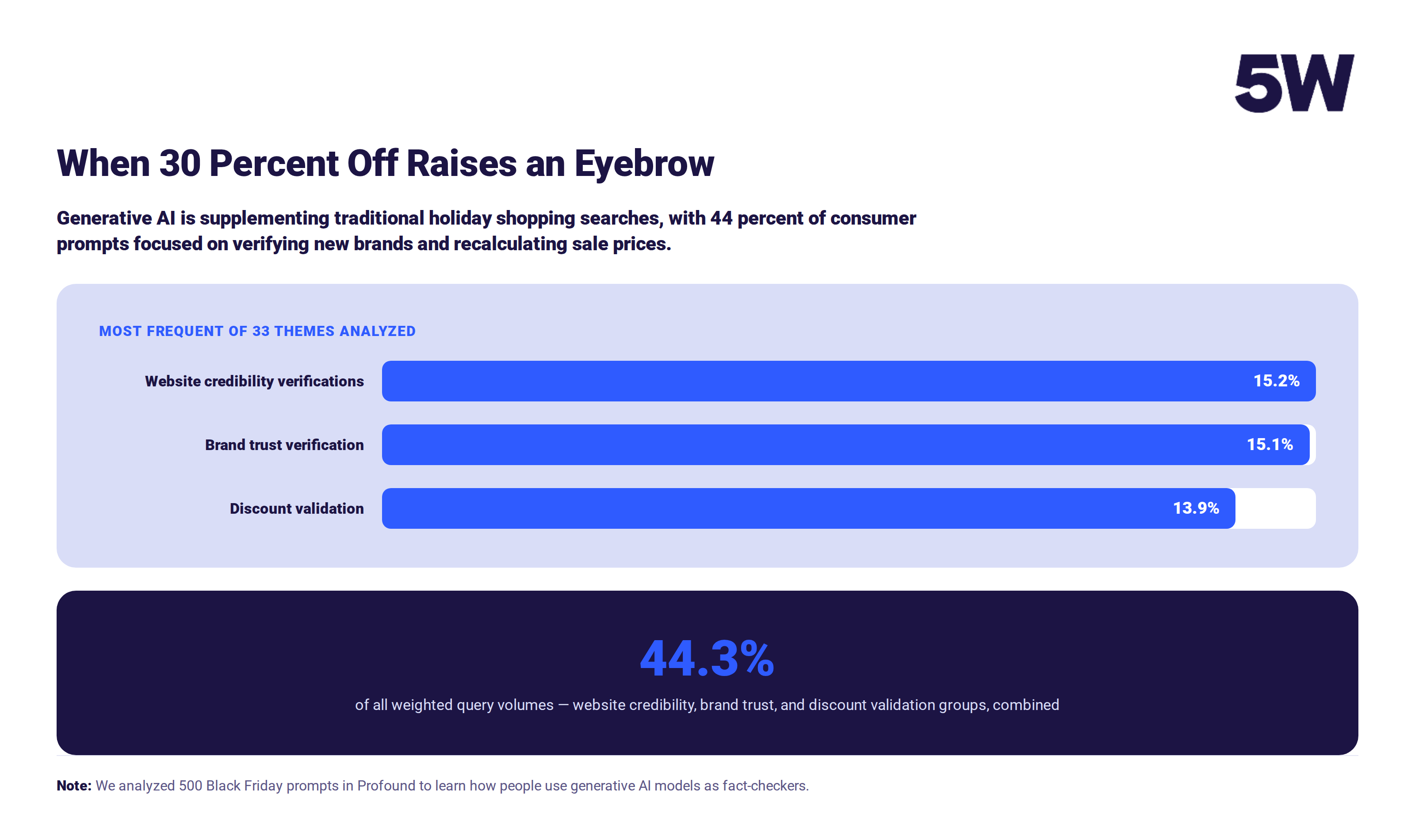
Generative AI is supplementing traditional holiday shopping searches, with 44 percent of consumer prompts focused on verifying new brands and recalculating sale prices. Generative AI visits to online retailers rose 693% during the 2025 holiday season, and consumers now use large language models like ChatGPT and Gemini to fact-check brands and promotions before handing over credit card information.
In Part Three of our holiday AI retail report series, we connect our audit from Part I: Do Black Friday Discounts Trigger AI-Recommended Products? and Part II: Black Friday: Why AI Models Often Skip New Brands to real-time consumer search activity. Part I analyzed the price thresholds AI models needed to recommend products, while Part II found that model retrieval and recommendation processes often rejected new brands with thin data or limited information. This analysis examines what's important to users when they ask AI what to buy.
We analyzed 500 Black Friday prompts in Profound to learn how people use generative AI models as fact-checkers. Our analysis shows consumers are wary of online shopping: among the 33 themes analyzed, website credibility verifications were most frequent at 15.2%, followed by brand trust verification at 15.1% and discount validation at 13.9%. Combined, the website credibility, brand trust, and discount validation groups accounted for 44.3% of all weighted query volumes.
How Users Are Asking AI to Price Check
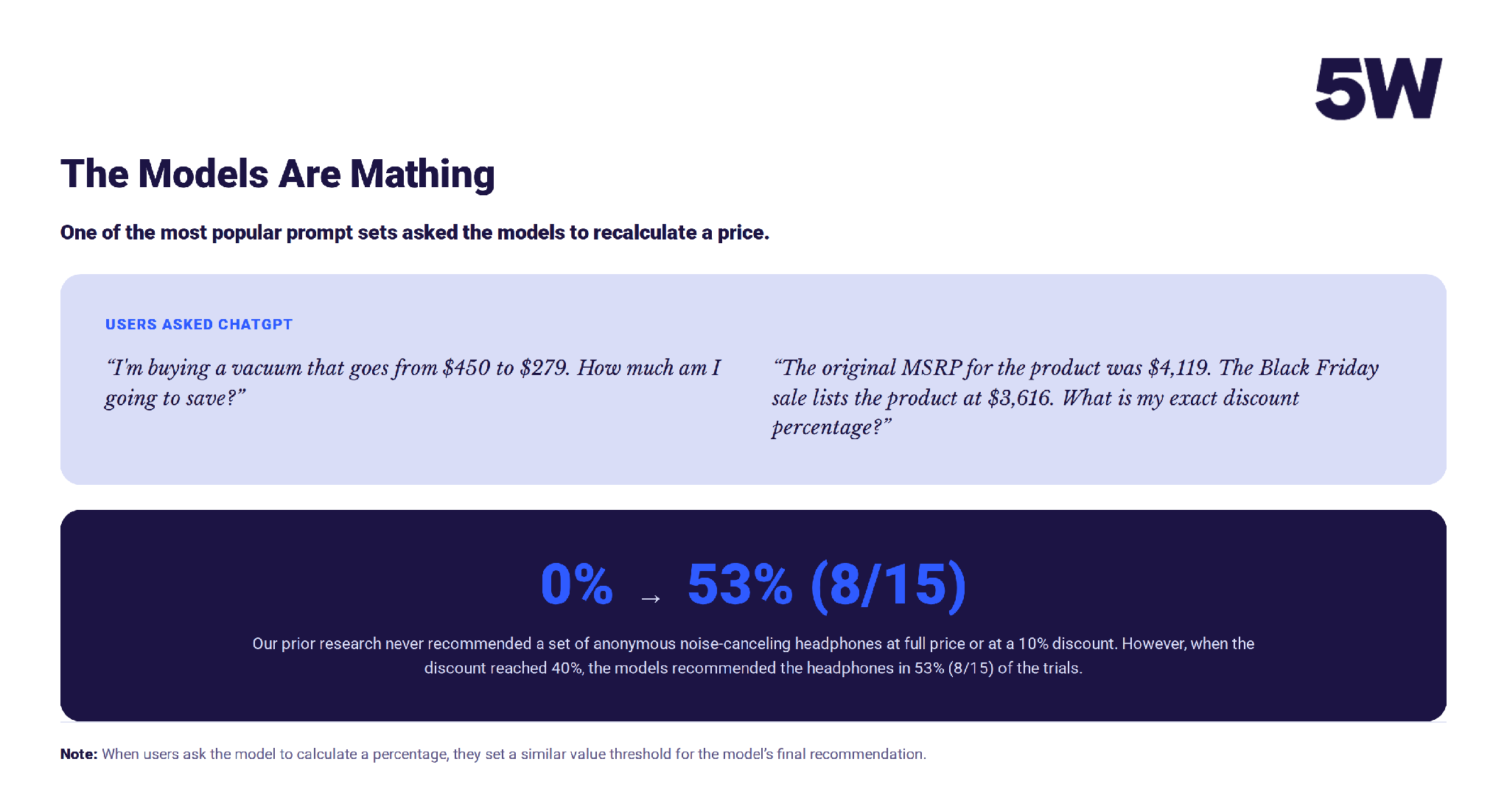
One of the most popular prompt sets asked the models to recalculate a price. Instead of accepting the discount at face value, users asked ChatGPT:
I'm buying a vacuum that goes from $450 to $279. How much am I going to save?
The original MSRP for the product was $4,119. The Black Friday sale lists the product at $3,616. What is my exact discount percentage?
While discount calculations rank as a top-three topic cluster, the query volume skews toward hard math. Prompts asking for percentage calculations for specific dollar amounts capture 0.7 share scores. Conversely, prompts that ask the model to evaluate nuanced promotional structures, like "Is a buy two get one free deal better than 20 percent off when each item costs $57?" register no statistical weight.
Recalculating the discount acts as a purchase threshold. Our prior research never recommended a set of anonymous noise-canceling headphones at full price or at a 10% discount. However, when the discount reached 40%, the models recommended the headphones in 53% (8/15) of the trials. When users ask the model to calculate a percentage, they set a similar value threshold for the model's final recommendation.
How Consumers and LLMs Vet New Brands
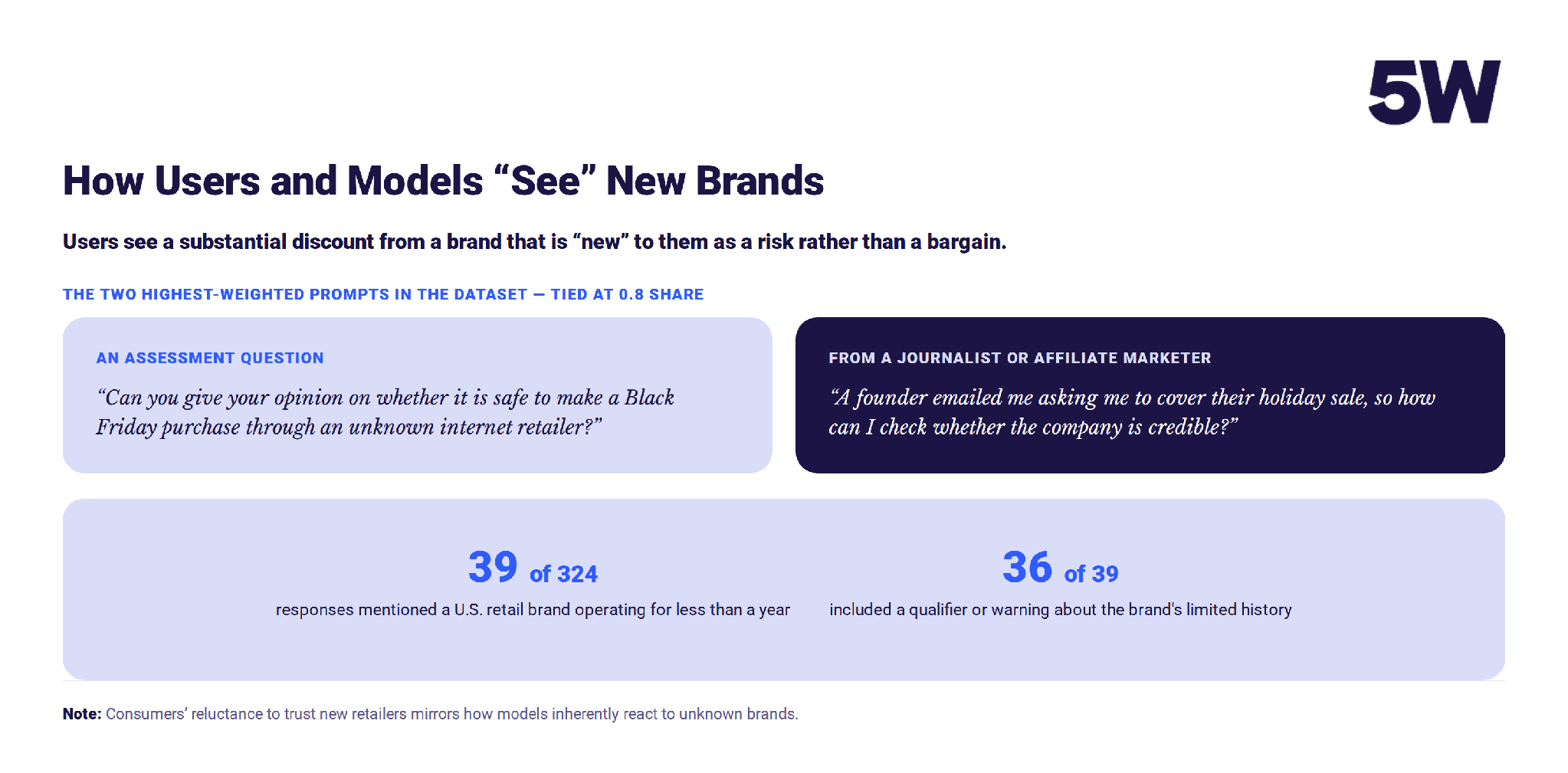
Users see a substantial discount from a brand that is "new" to them as a risk rather than a bargain. The two highest-weighted prompts in the dataset tied at 0.8 share:
One prompt was an assessment question: "Can you give your opinion on whether it is safe to make a Black Friday purchase through an unknown internet retailer?"
The second 0.8-share prompt reveals that consumers aren't the only users auditing brand credibility. Journalists and affiliate marketers also use generative AI to vet companies before publishing gift guides, submitting prompts like "A founder emailed me asking me to cover their holiday sale, so how can I check whether the company is credible?"
Users also asked models to compare lesser-known retailers with well-known competitors and point out common quality warnings. In this instance, users treat the AI model as a background-check service rather than a shopping assistant.
Our dataset includes 32 prompts with the word "history" and requests to retrieve price, brand, and manufacturer history.
Users also included targeted fraud-detection terms, with words like "scam," "fake," and "return" appearing 19 times.
Consumers' reluctance to trust new retailers mirrors how models inherently react to unknown brands. In Part II of our research, 39 references mentioned a U.S. retail brand operating for less than a year out of 324 responses. Of the 39 responses, 36 references included a qualifier or warning about the brand's limited history.
The Black Friday Product Categories Generating the Most AI Trust Queries
While trust checks were the most common in the prompt set, users also targeted category-specific shopping research. Niche-specific categories outweighed broad product searches.
| Category | Prompts | % of Total |
|---|---|---|
Electronics | ||
Mobile Device Deals | 11 | 2.0% |
Laptop Deal Research | 10 | 1.7% |
Computer Components Deals | 7 | 1.0% |
Home Goods | ||
Home Holiday Deals | 10 | 1.7% |
Furniture Deal Research | 7 | .9% |
Bedding | 7 | .5% |
Beauty | ||
Beauty products and services | 8 | 1.1% |
Supplement Safety Checks | 7 | 0.6% |
The 7-prompt supplement safety check cluster shows that deep discounts on wellness items trigger immediate consumer skepticism. In this category, users asked the models to audit ingredient lists and verify supplement manufacturer safety records.
How Brands Can Optimize For AI Recommendations Ahead of Black Friday
If Black Friday affects your brand's bottom line, you need to win the trust of humans and machines. You can start building "robot credibility" today by making price comparisons and product descriptions easy to find and read, and by verifying your history and details on Wikipedia and Google profiles so your brand information clearly states who you serve and how you serve them.
Disorganized content hinders the model's ability to retrieve and recommend a brand and often contributes to a "hedge," a warning, or silence if that information isn't available.
5WPR creates earned and owned media campaigns that influence humans and machines. Start a conversation with us today to secure your brand's recommendation in AI answers.