

Earlier this week, 5W showed that a 40% Black Friday discount can increase a product from zero AI recommendations to eight out of fifteen, while a similar discount left another product at zero, no matter how low the price went. That study held all information constant except for price, and the models had to choose among products they were given.
This follow-up data is a prequel to the original study: How does an AI model recommend a brand with limited earned and owned content for it to retrieve?
What did 5W evaluate, and how does it follow the first discount study?
We chose a budget-friendly consumer product category with a clear newcomer: three established online brands that have sold in it for a decade or more and one brand that entered the U.S. market in 2026 at a price comparable to the least expensive product.
In this study, the new brand launched within the past 12 months and has few third-party sources written about it. The product is eligible for flexible spending account (FSA) reimbursement, which gave us a year-end deadline prompt that users often search (ask about) near the end of the year.
We ran 36 holiday shopping prompts about the category through ChatGPT, Perplexity, and Claude three times with live web search enabled, documenting which brands the models cited and recommended and the sources of information they considered.
How often was the new brand cited or recommended?
The new brand was cited in 39 of 324 answers. Thirty-six came from prompts that asked for a brand by name, such as “is X legitimate” or “how does X compare to” an established brand. In the 216 answers to unbranded prompts, it was cited three times. The brand was not mentioned in any of the 162 answers to prompts about gift ideas, spending FSA money before December 31, or Black Friday deals and shipping deadlines across all three AI models.
Of the 39 answers the models cited, 36 hedged or warned about the brand, two recommended it, and one cited it without comment.
Which brands did the AI models recommend instead?
The three established brands accounted for 48% to 67% of all brand citations, depending on the model. The largest of these brands accounted for 19% to 30% of all citations. The new brand held 3% to 5%, with almost all recommendations coming from prompts that included it by name.
The models were price neutral and recommended the cheapest established brand, priced within a dollar or two of the new brand, without a hedge in any of the answers.
What sources do AI models retrieve for shopping prompts?
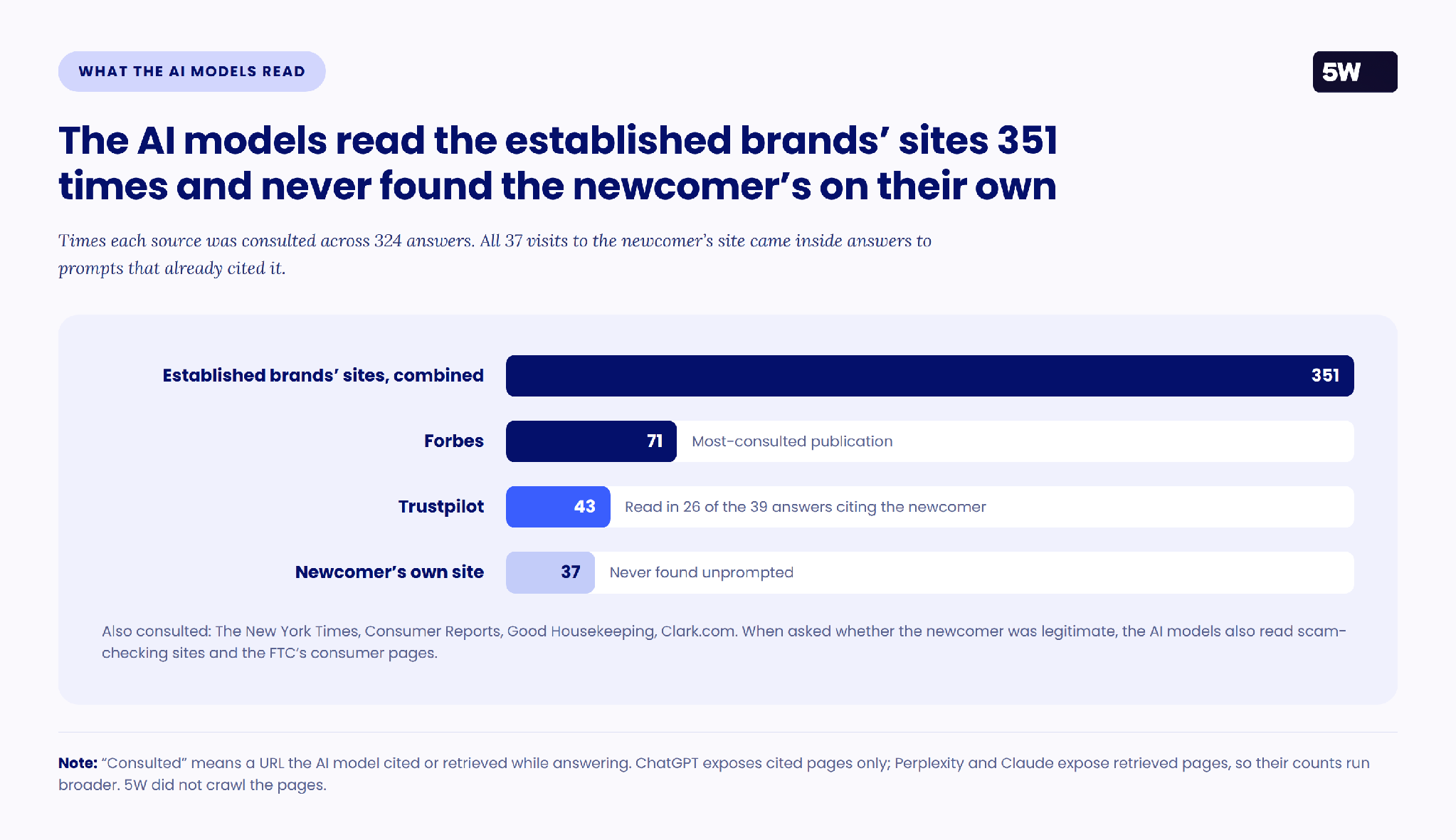
The models retrieved the established brands’ websites 351 times. The most-retrieved publication in the models' sources was Forbes (71), followed by Trustpilot (43), then The New York Times, Consumer Reports, Good Housekeeping, and Clark.com.
The models retrieved the new brand’s website 37 times. When a prompt asked whether the new brand was legitimate, the models retrieved Trustpilot in 26 of the 39 answers that cited it, along with scam-checking sites and some Federal Trade Commission (FTC) consumer pages. Those were the sources available, and the brand’s help page covered product standards, the order process, and how to claim FSA reimbursement, but none of the models shared that content.
How did the AI models describe a brand with few sources?
The reservations were similar across all three AI models. Doubts about product quality appeared in 80% of citations, about whether the product would match the order in 67%, about shipping in 51%, and about the brand being unfamiliar in 26%.
ChatGPT was the most cautious, advising against an order in 7 of its 12 citations. Perplexity was the least cautious and recommended both.
A typical answer cited the new brand in a comparison table as the least expensive option, described it as “less established” with “fewer independent reviews,” and suggested it for a small trial purchase.

Why can’t a Black Friday discount get a new brand recommended?
The discount study found two kinds of products: one that a deep enough discount could move into a recommendation, and one that was never recommended regardless of price. This study suggests why the second category exists. The models had a decade of retailer pages, product tests, and reviews to retrieve for the established brands. For the new brand, the model found little owned and earned content, so it never retrieved information without a brand name in the prompt and had only a few review sites to refer to.
What should a new brand do before Black Friday?
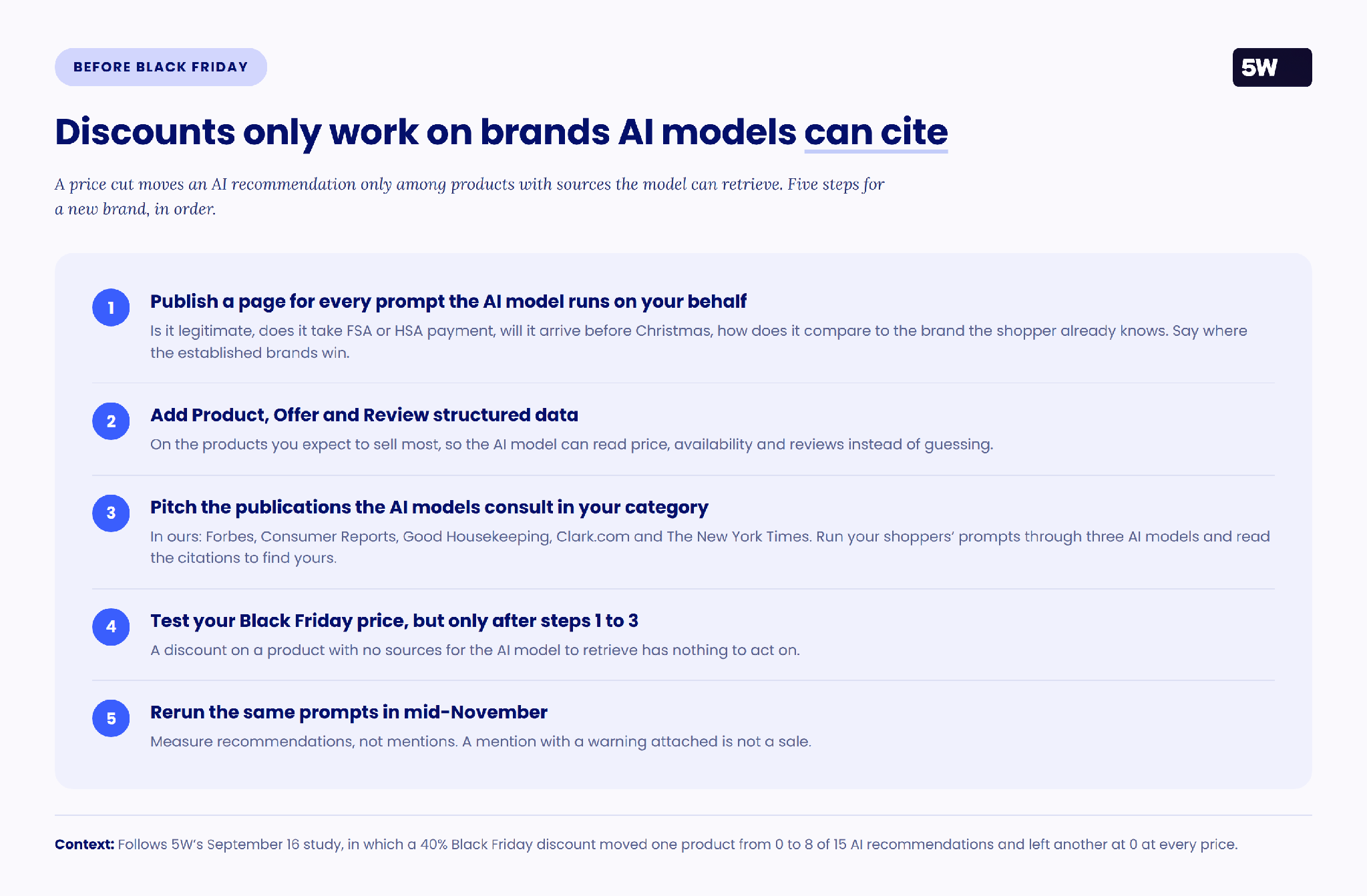
In this data set, the models recommended popular media sources and supplemental prompts they couldn't answer with earned media using the brand’s owned content, checking legitimacy and reviews, whether it accepts FSA or HSA payment, if it will arrive before Christmas, and how it compares to a recognizable brand. Each answer can be used as owned content or as a placement to earn.
Publish a page for each prompt, including a side-by-side comparison against established brands.
Optimize product display pages (PDPs), offer, and review structured data (schema, text placement, and format) for best-selling products first.
Pitch the publications in the model’s query fan-outs for each prompt. In this data set, they were Forbes, Consumer Reports, Good Housekeeping, Clark.com, and The New York Times. Run your prompts through the relevant models to establish baseline visibility.
Test your Black Friday price in a similar fashion to this study, but only after steps 1 to 3. A discount on a product with no sources for the AI model to retrieve means it has nothing to act on.
Rerun the prompts in mid-November and measure recommendations, not citations.
A discount changes a model's recommendations among products with established earned and owned media sources. In this consumer category, the models recommended the least expensive established brand and hedged on a new brand at a near-identical price, because one brand had a decade of coverage to retrieve and the other had less than a year.
5WPR works with brands to identify and build the information behind AI recommendations, map product attributes to consumer queries, strengthen third-party evidence, organize brand information, test visibility across models, and measure competitive inclusion over time.
Brands that want a stronger position in AI search start with a structured review of the questions, attributes, evidence, and sources shaping their category. Explore 5WPR’s Generative Engine Optimization services to build a brand that models can connect with the right consumer need.
Methodology
5W ran 36 prompts, in six groups of six (gift ideas, price and value, trust, brand comparisons, FSA deadlines, and holiday timing), through ChatGPT (GPT-6-Astra via the OpenAI Responses API with web search), Perplexity (Sonar via the Perplexity Agent API with web search), and Claude (Claude-Opus-5 via the Anthropic Messages API with web search). Each prompt was run three times per model on September 17, 2026, in runs spaced at least three hours apart, for 324 completed responses and no failures. Brand citations and retrieved sources were extracted by exact string and URL matching against a fixed list of category brands. Whether the new brand was recommended, hedged, or warned against, the separate AI model (Claude-sonnet-5) labeled which reservations were raised, using only the prompt and the answer, and never the source model’s name, according to a written rubric. A human independently labeled all answers that cited the brand plus 12 FSA and holiday answers. The human and model agreed on whether the answer was negative in 39 of 39 cases; they split hedged from warned identically in 29 of 39, with all 10 differences on that boundary and none in a consistent direction. Individual reservation flags agreed 88% to 98% of the time. “Retrieved” means a URL the AI model cited or fetched while answering; 5W did not crawl those pages.
Limitations
These results describe one product category, one new brand, three AI models, and one day of testing in September 2026. They do not measure how AI models treat new brands in general. The prompts were written by 5W to resemble shopper prompts, not collected from shoppers. “Recommended,” “hedged,” and “warned” are labels applied to the text of an answer and do not measure why an AI model answered as it did. Perplexity and Claude expose the pages they retrieved rather than only the pages they cited, so “retrieved sources” is broader for those two AI models than for ChatGPT, and the counts across models are not strictly comparable. The new brand had been selling in the U.S. for roughly nine months at the time of the test; a brand launched earlier or later produced different numbers.