

AI search can influence whether consumers view a pet brand as affordable, premium, good value, or expensive relative to its competitors before ever visiting a brand's site or socials.
In the age of AI search, we refer to these consumer opinions as a brand’s price reputation: the recurring language AI-generated answers use when users ask ChatGPT and Claude relevant questions like “What is the best affordable pet insurance?" “Is premium dog food worth the money?” or “What is a cheaper alternative to this smart collar?”
For pet marketers, the risk for brands extends to a model sharing an inaccurate price or claim. A bigger problem is that pet brands may repeatedly appear in a value position their marketing team didn’t plan for.
As the pet industry gathers for SUPERZOO 2026, brands should be aware that pet owners are becoming more deliberate about where they spend.
Why Does Price Reputation Matter More for Pet Brands in 2026?
Pet owners aren’t abandoning premium products, but they’re asking for more for their dollars.
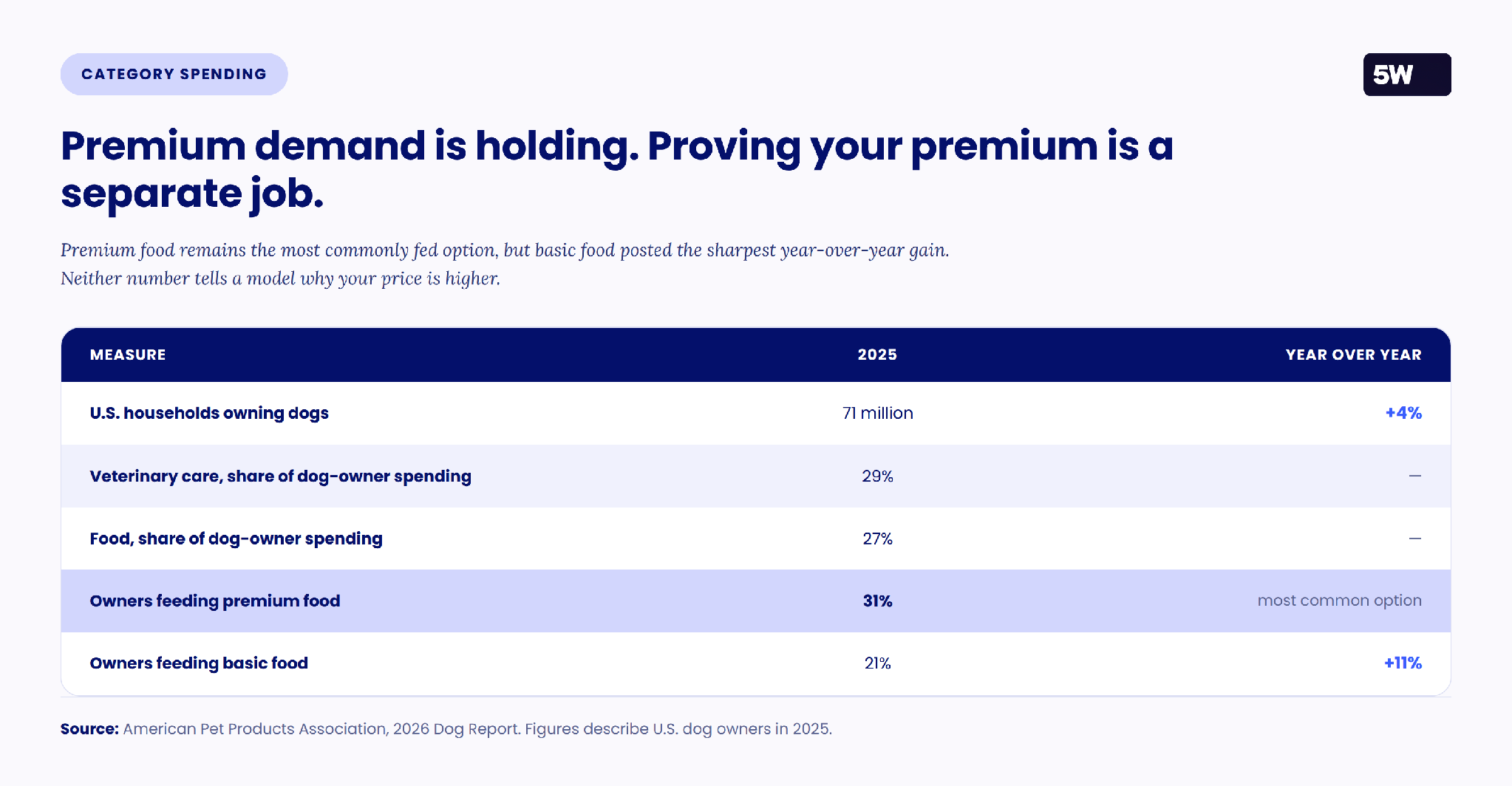
The American Pet Products Association’s 2026 Dog Report found that 71 million U.S. households owned dogs in 2025, up 4% year over year. Veterinary care accounted for 29% of dog-owner spending, and food another 27%. Premium pet food remained the most commonly fed option at 31%, but use of basic dog food increased 11% year over year to 21% of dog owners.
We love our pets and are willing to pay for premium pet care.
But premium products increasingly have to earn that premium.
This trend creates a different communications problem for brands. A $90 bag of dog food doesn’t need to become $45, but the brand needs to clearly communicate specific evidence to explain why the additional $45 is meaningful: a different formulation, a longer-lasting product, clinical testing, veterinary support, or another measurable benefit.
Without that evidence, “premium” can easily become another word for expensive.
How Is AI Search Changing the Way Consumers Compare Pet Brands?
Traditional search allowed consumers to “do their own research” and compare products from multiple options before deciding whether a higher price tag is worthwhile.
AI search compresses those comparisons into one summarized answer.
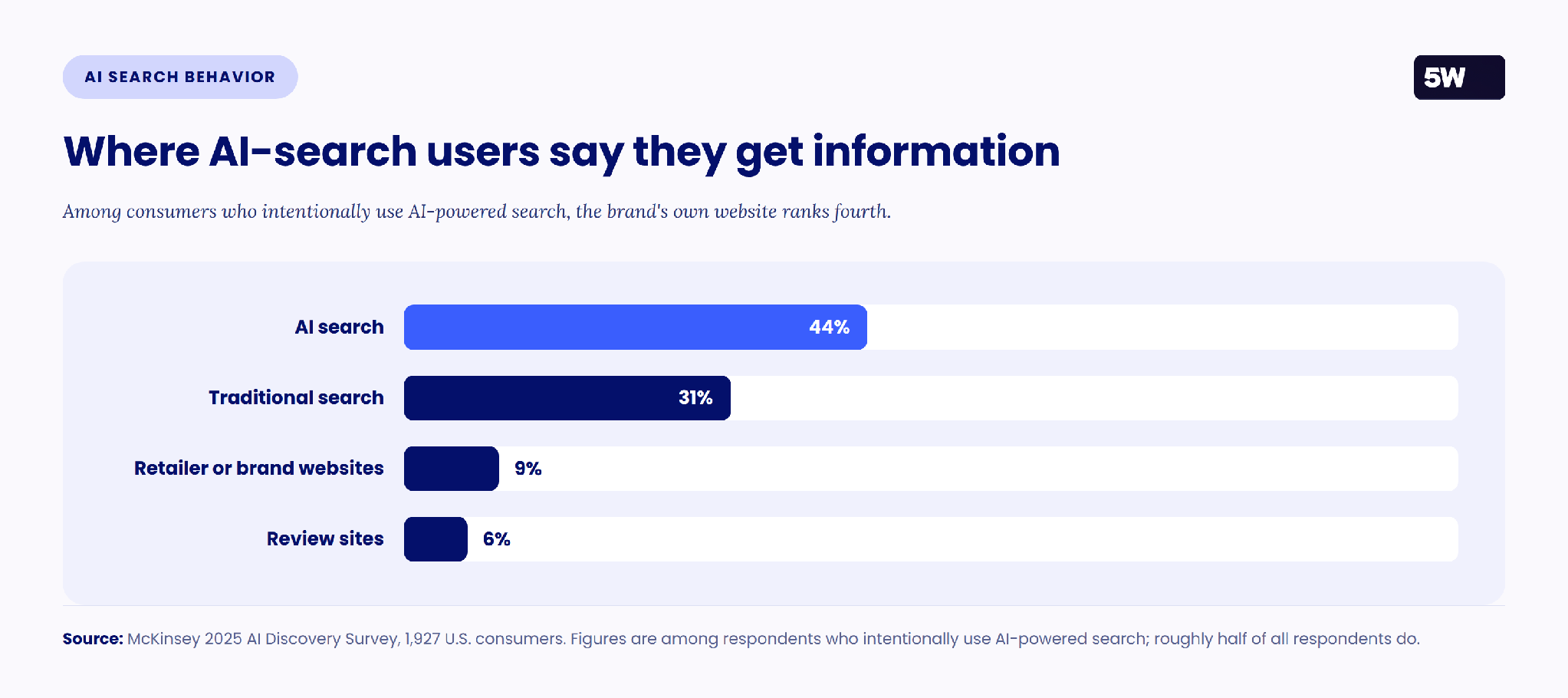
McKinsey’s 2025 AI Discovery Survey, based on 1,927 U.S. consumers, found that roughly half intentionally use AI-powered search. Among AI-search users, 44% called AI search their primary and preferred source of information, compared with 31% for traditional search, 9% for retailer or brand websites, and 6% for review sites.
Adobe’s recent report on AI search behavior backs McKinsey’s findings. Traffic from AI sources to U.S. retail websites increased 393% year over year during the first quarter of 2026. In March 2026, AI-referred retail traffic converted 42% better than non-AI traffic.
A consumer arriving from an AI model’s recommendation often arrives at a site ready to buy and well-informed about why the product is cheaper, which one offers better value, and whether the premium option is worth paying for.
This comparison often occurs before the consumer's first visit to a brand's website.
What Does 5W’s Pet Insurance Research Show About Price and AI Visibility?
Our April 2026 Pet Insurance AI Visibility Index 2026 offers helpful examples of how brands become associated with specific value propositions.
5W tested 40 consumer-intent prompts across ChatGPT, Claude, Gemini, Perplexity, and Google AI Overviews over 12 waves, producing 2,400 prompt-engine runs. The study included purchase, comparison, trust, cost, and category questions.
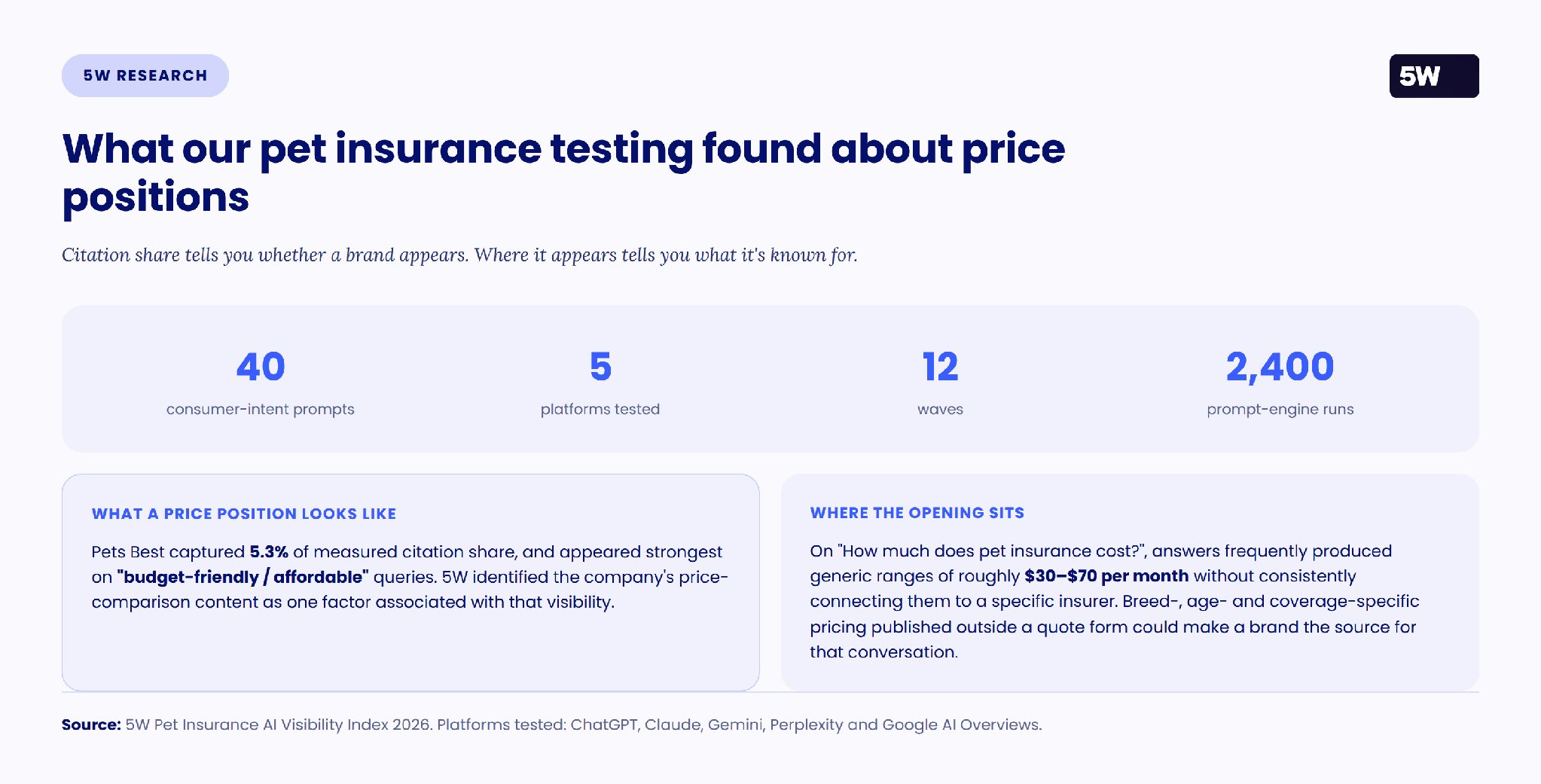
Pets Best captured 5.3% of the measured citation share. But the more useful finding for marketers is where Pets Best appeared strongest: “budget-friendly / affordable” queries. 5W identified the company’s price-comparison content as one factor associated with a brand's AI visibility.
The same study found an opportunity around the question “How much does pet insurance cost?” AI responses often produced generic price ranges of roughly $70 per month without consistently connecting those ranges to a specific insurer.
For a pet insurance company, publishing breed, age, and coverage-specific pricing outside a quote form helps their AI visibility more than answering a question about cost. This type of specificity helps brands become a source of information for AI models to evaluate and share costs.
What Evidence Helps AI Search Explain Why a Pet Product Costs More?
Most premium pet brands can explain why their products are better.
But claims such as “premium ingredients,” “advanced technology,” and “high-quality care” don’t provide consumers, or an AI model, what the additional cost provides.
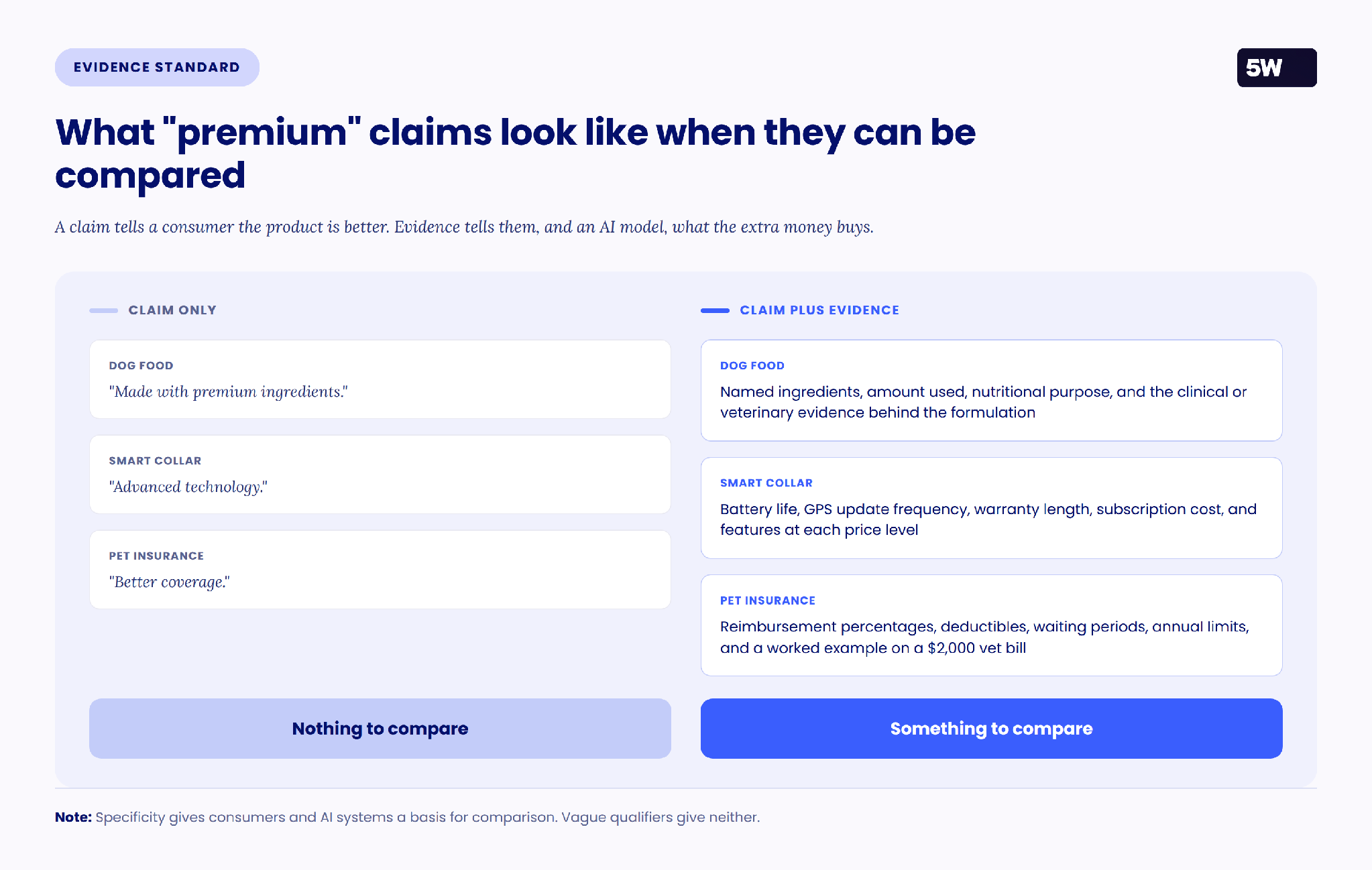
Brands should know that specific answers are often measurable. Here are some examples:
Replace :“Made with premium ingredients" with "Identify the ingredients and amounts, the nutritional purpose, and any clinical or veterinary evidence supporting the formulation."
Replace “Our smart collar has advanced technology" with battery life, GPS update frequency, warranty length, subscription cost, and the features included at each price level.
Replace “Our insurance provides better coverage" and publish reimbursement percentages, deductibles, waiting periods, annual limits, and worked examples showing what a customer would pay after a $2,000 veterinary bill.
Specificity gives consumers and AI models something concrete to compare.
Why Pet Brands Shouldn’t Rely on Their Websites to Define Value
A website can explain why the product warrants a specific price point.
But the brand doesn’t control every source used in AI-generated research and comparisons.
McKinsey found that a brand’s website accounts for only 5% to 10% of sources referenced in some AI search results. Other sources include affiliate publishers, user-generated content (UGC), and third-party websites, with sources changing by model (and model version) category, location and question.
That means a $100 product described as “worth the premium” on the product page can still develop a different price reputation if retailer reviews repeatedly call it overpriced, comparison articles recommend a $60 competitor, or expert coverage cannot identify a meaningful performance difference.
The models don’t weigh marketing claims the same as third-party sources.
The consensus of evidence about a brand often determines whether a marketing claim holds up.
How Can Pet Brands Measure Their Price Reputation in AI Search?
Brands don’t need hundreds of prompts to find what their ideal customers are searching for.
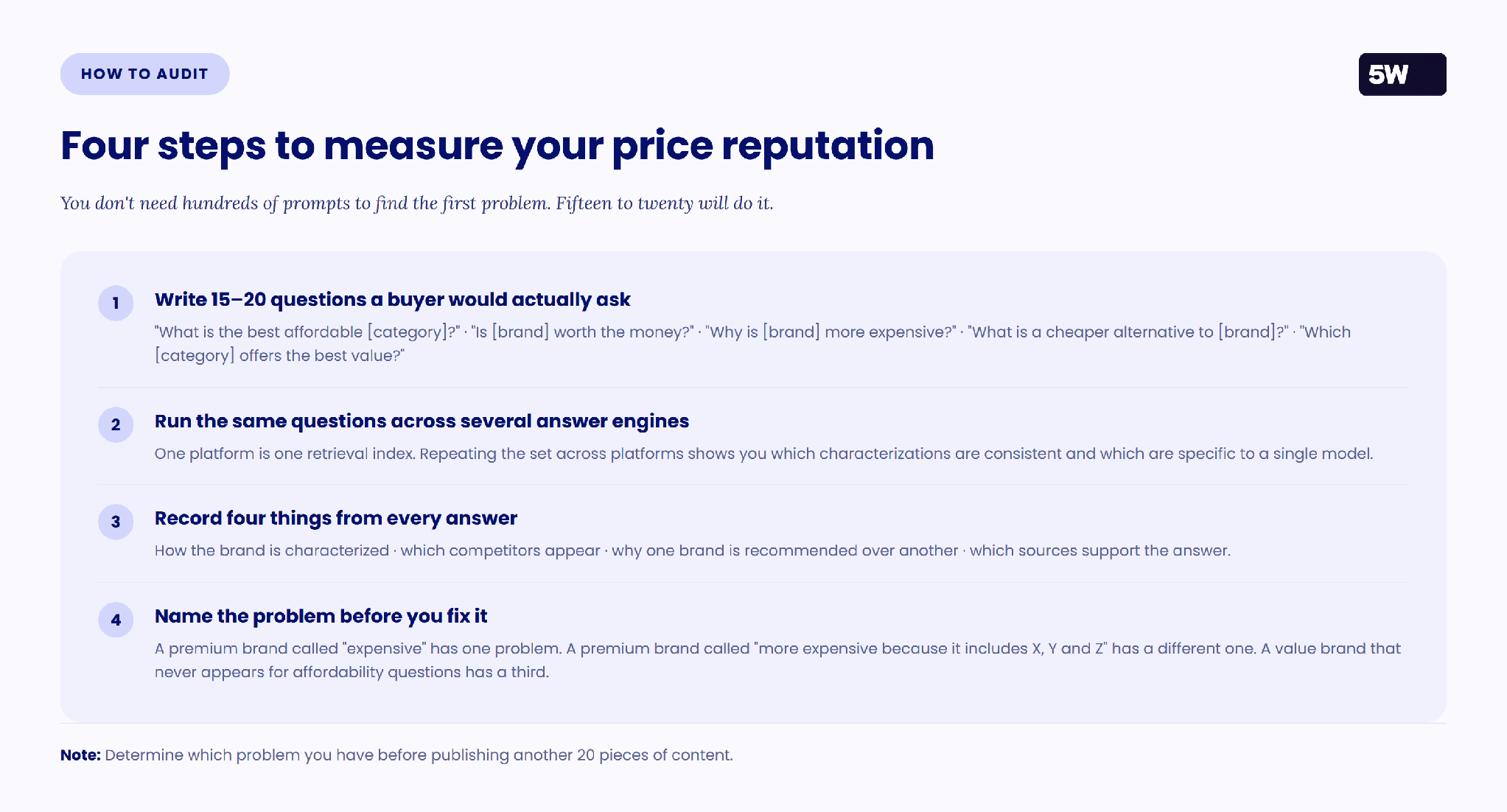
Start with 15–20 questions similar to these:
“What is the best affordable [category]?”
“Is [brand] worth the money?”
“Why is [brand] more expensive?”
“What is a cheaper alternative to [brand]?”
“Which [category] offers the best value?”
Repeat the questions across the major models and track these four data points: how your brand is characterized, what competitors appear, why a brand is recommended over another, and the information sources support the model's answer.
If a premium brand is repeatedly described by a model as “expensive,” it’s likely a problem. A premium brand described as “more expensive because it includes X, Y and Z” has a position. A value brand that is never included in affordability questions has a different problem altogether.
Brands should determine their baseline visibility and reputation in AI models before publishing another 20 pieces of content.
As pet brands head into SUPERZOO, one question is worth taking into every pricing, product, and communications conversation:
If ChatGPT had to explain why our product costs more or why it offers better value what evidence can it find and share with our customers?
That answer is the valuable “price reputation” your brand is building in AI search.
Is your brand appearing in the right AI-generated recommendations? 5W can identify how major AI models classify your company, trace inaccurate answers to their sources, and show where inconsistent information is limiting visibility.
For the companion piece on suitability, read how pet brands can improve their visibility in AI search. See also 5W's Pet PR and AI Visibility practice, the Pet Industry AI Visibility Index 2026, and the pet industry trends for 2027.