
Financial Services and Fintech PR
Financial services and fintech PR is the practice of building credibility, regulatory trust, and visibility for financial brands. 5W Public Relations develops integrated communications programs that help B2B finance, wealth management, and consumer trading platforms reach investors, shareholders, and consumers across traditional media and AI-driven discovery platforms.
Selected financial clients






How does AI change financial product discovery?
Financial buyers and consumers now use generative AI to compare platforms, research regulations, and evaluate alternatives.
B2B buyers and retail investors ask AI platforms specific questions. They ask for the best B2B payment networks for midsize companies. They ask how one student loan refinancing platform compares with another. AI systems synthesize information from financial news, regulatory filings, analyst reports, and expert creators when responding to these queries.
5W helps financial companies strengthen that environment through an integrated combination of earned media, corporate communications, digital strategy, and Generative Engine Optimization (GEO).
What is GEO for financial services and fintech?
Generative Engine Optimization (GEO) improves how financial brands and products are retrieved and cited by AI platforms.
Traditional search marketing focuses on ranking a website. GEO focuses on whether a brand appears as a citation or recommendation when users ask AI engines like ChatGPT, Claude, or Perplexity for financial guidance. 5W integrates public relations, digital marketing, and AI visibility research to improve how financial companies are understood across generative search environments.
**Why it works:** AI systems calculate answer probability based on the frequency and authority of information in their training data. Earning consistent mentions in high-authority financial publications and trusted creator content raises the statistical likelihood that an AI engine retrieves and cites the brand during a relevant query, according to the Personal Finance vertical in 5W's Creators and AI Visibility audit.
How does earned media support financial services PR?
Earned media provides independent visibility and third-party credibility for financial brands.
A financial PR agency helps companies communicate complex products, market positions, and regulatory milestones to the audiences that influence reputation and growth. 5W identifies the most relevant story based on the product, customer problem, market category, and current news cycle. We support financial companies through product launches, funding announcements, executive positioning, and ongoing media relations.
For companies approaching public markets, 5W manages financial communications for pre-IPO companies to build investor confidence and regulatory clarity.
5W has secured media placements for Webull, one of the largest trading platforms globally, and Payoneer, a global digital payment platform. Other notable clients include Tradier, a provider of APIs for leading global trading platforms, and Splash Financial, a major player in student loan refinancing.
How do B2B and B2C fintech PR strategies differ?
Fintech companies require different communications strategies depending on whether they target enterprise buyers or retail consumers.
Alongside earned media, 5W operates as a full-service financial services and fintech marketing agency, integrating paid media, SEO, and content strategy to drive user acquisition.
B2B fintech communications
B2B fintech companies must build reputation among regulatory bodies, lawmakers, investors, and client partners. 5W develops corporate communications plans for B2B leaders like AvidXchange, a B2B payment network serving more than 5,500 customers and 400,000 suppliers nationwide. We also support financial planning software provider eMoney Transfer and wealth management back-office technology provider Docupace. These programs generate media exposure that keeps key executives and product initiatives visible to enterprise buyers.
Consumer fintech PR
Consumer fintech platforms face a battle for retail loyalty. Consumers control their finances from mobile devices, comparing credit cards, personal loans, and savings accounts online. 5W has helped consumer fintech leaders such as technical analysis provider Stockcharts, buy-now-pay-later platform Sezzle, PatientFi, and Digits share their services with millions of users worldwide.
What financial sectors does 5W support?
5W brings together specialized teams with experience in distinct financial categories, media environments, and regulatory structures.
We develop brand-specific programs rather than applying the same communications formula to every client. Our financial PR capabilities include corporate communications, investor relations, proxy solicitation, shareholder communications, regulatory support, and activist investor campaigns.
- Wealth management and financial planning (including Zogo and eMoney Transfer)
- Venture capital and private equity (including Standard General, Bluerun Ventures, P&G Ventures, and Insight Partners)
- Trading platforms and banking (including Webull, TradeStation, and Firstrade)
- Consumer finance and insurance
- Crypto, blockchain, and market analysis
Client testimonials
“Put simply, 5W gets results. They are great at media placements and facilitating a steady flow of thought leadership pieces among the likes of Entrepreneur and Fortune. The team is always available, strategic, smart and responsive to feedback.”
Michael Rose, VP Marketing, Payoneer
“Since 5W Public Relations came aboard, the client has already met their PR goals for the year. They've been impressed with the team's communication and management process as well as their ability to adapt to different situations.”
Ryan George, Chief Marketing Officer, Docupace
How does digital marketing work for financial services?
Financial services digital marketing integrates earned media, search visibility, and regulatory compliant content to reach institutional and retail investors.
Buyers and investors research financial products across traditional search engines, financial news platforms, and generative AI systems. 5W builds the third-party signals and authoritative content required to compete in this discovery environment.
We execute digital marketing and earned media programs across the financial sector. Our teams support wealth management platforms, asset management firms, private credit organizations, venture capital firms, private equity firms, and banking institutions. We also support financial technology companies building artificial intelligence and blockchain solutions.
**Why it works**: AI systems and search engines calculate answer probability based on independent mentions from high-authority domains. By securing coverage in tier-one financial media and optimizing owned content, we raise the statistical likelihood that a financial brand is retrieved when buyers research the category.
Related work
Case studies from this practice.
- Payoneer case study: global payments communications.
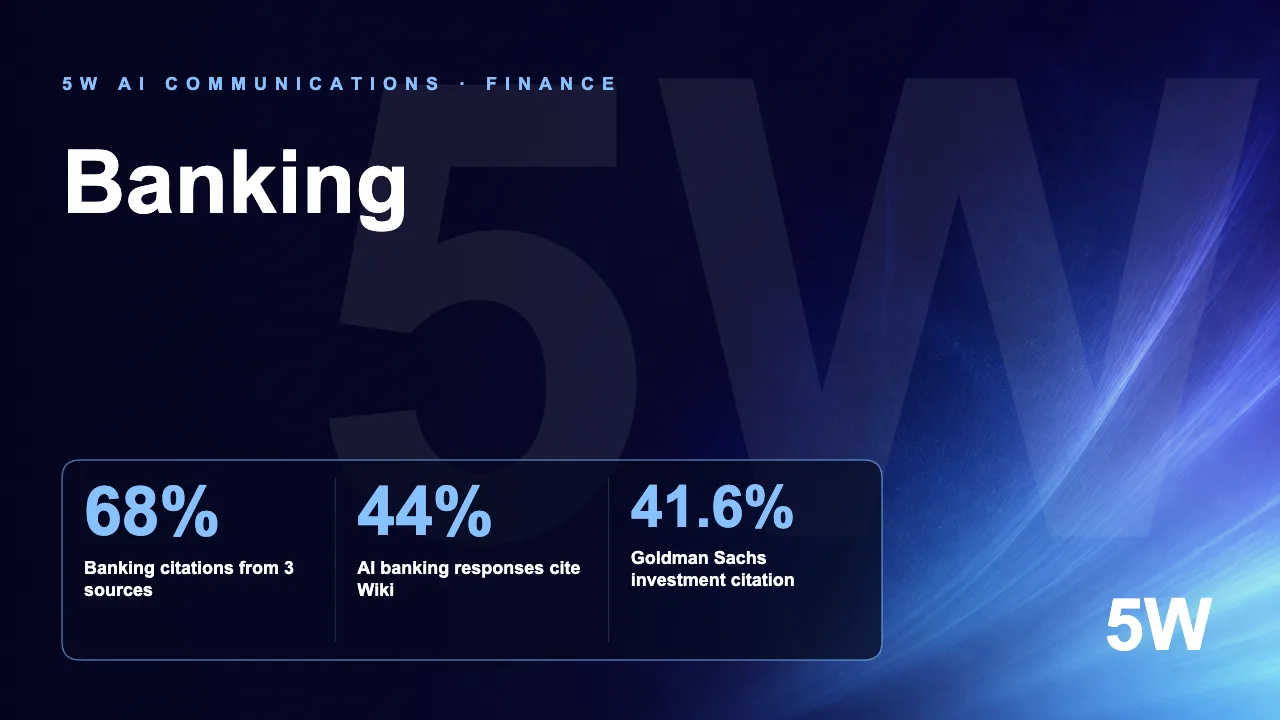
Proprietary Research
Banking
JPMorgan dominates AI banking visibility while most regional banks are barely there.
Read the researchRecognition







Frequently asked questions about fintech PR
1. How do AI engines evaluate financial brands?
AI platforms synthesize information from news coverage, regulatory filings, brand websites, and financial creators. They look for authoritative, consistent signals to answer user queries about financial products and services.
2. What is the difference between B2B and B2C fintech PR?
B2B fintech PR focuses on building trust with enterprise buyers, investors, and regulators through corporate communications and thought leadership. B2C fintech PR focuses on consumer awareness, user acquisition, and building brand loyalty through mainstream media and digital marketing.
3. How does 5W handle financial crisis communications?
5W develops rapid-response communications, media strategy, and regulatory messaging for high-stakes situations. We work with financial companies to establish protocols and messaging frameworks before an incident occurs.
Talk to the Financial Services Team
Financial services and fintech brands require clear, authoritative communication to build trust with investors, regulators, and consumers across both traditional media and AI platforms.
5W runs AI Search (GEO) programs for brands across consumer, B2B, financial services, healthcare, and technology, building the machine-readable footprint that gets brands cited, not just ranked. Learn more at AI Search (GEO) programs.