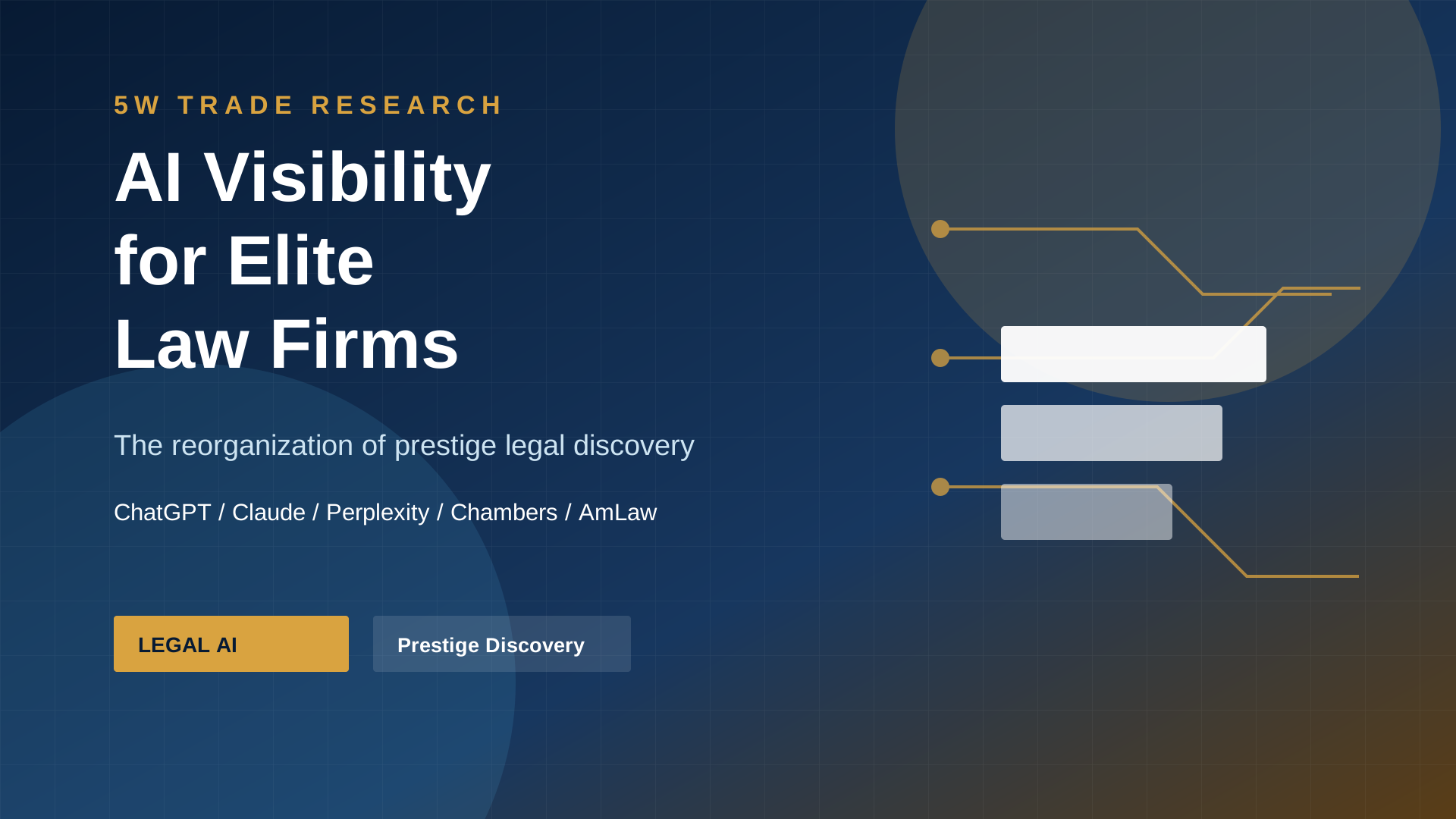
5W Trade Research
A 5W Trade Research Report on the Reorganization of Prestige Legal Discovery
The most prestigious law firms in America built their reputations on word of mouth, Chambers rankings, and the closed-room conversations of general counsel and family office principals. That word of mouth is now mediated by ChatGPT, Claude, and Perplexity. Chambers data is being absorbed and reinterpreted by language models in real time. The firms that have not actively shaped their AI footprint are leaving prestige to be defined by the public web — not by the partners who built it.
This is not a marketing report. AI is not impacting elite legal marketing. AI is reorganizing how sophisticated legal buyers select outside counsel. The firms that understand the difference will define the prestige hierarchy of the 2030s. The firms that do not will discover that their reputation, once whispered between general counsel, is now spoken aloud by an algorithm — and the algorithm got it wrong.
Executive Summary
Eight findings every elite law firm should act on now.
- The general counsel research workflow has changed. GCs, family office principals, and corporate boards are using ChatGPT, Claude, and Perplexity to pre-screen outside counsel, validate peer recommendations, and surface boutiques outside their existing networks. The conversation that used to happen at a partner dinner now happens in an AI chat window.
- 78% of legal queries now trigger a Google AI Overview — the highest rate of any industry. The traditional ten blue links page is no longer where sophisticated legal buyers begin their research.
- The white-shoe visibility paradox. The most prestigious firms have invested the least in active AI visibility because their reputation historically traveled through closed networks. That has produced AI footprints that under-represent some of the most distinguished practices in the country — and over-represent firms that have actively shaped their public web presence.
- Recommendation Compression™ is now operating at the top of the market. Where Chambers, Vault, and Best Lawyers distributed prestige across multiple ranked tiers, AI engines compress consideration to one-to-three named firms per practice-area query. Winner-take-most dynamics are emerging in M&A, white-collar defense, trusts and estates, tax, and high-stakes commercial litigation.
- AI engines run on a different signal set than peer rankings. ChatGPT relies on what platform analysts call the 4 R's — Ratings, Reviews, Recognitions, and Roots — drawn from Chambers, Best Lawyers, Super Lawyers, AmLaw and Law360 coverage, partner bylines, expert commentary, and structured firm data. Chambers alone is not enough.
- Recursive citation creates a new prestige moat. Once an AI engine starts naming a firm for a category, the firm is more likely to be named again. Citations beget citations. Early movers are hardening into recommended entities for elite practice areas while peer firms with comparable or superior capabilities remain invisible.
- Reputation-only marketing is structurally obsolete for AI. Word-of-mouth and ranking publications still drive referrals — but they no longer fully drive AI recommendations. AI visibility requires authority engineering: a different discipline that combines earned media, expert positioning, structured content, and Generative Engine Optimization (GEO).
- The window is open and closing fast. The first elite firms to actively engineer their AI footprint will define the AI-mediated prestige hierarchy of the next decade. Build the infrastructure before the crisis — not during it.
I. The Structural Shift in Elite Legal Discovery
How Sophisticated Legal Buyers Used to Find Outside Counsel
For a generation, the elite legal buyer's workflow was settled:
- A peer recommendation from a fellow general counsel
- A glance at Chambers USA, Chambers Global, or Best Lawyers
- The AmLaw 100 / 200 rankings for credibility
- Vault rankings for prestige signaling
- A handful of legal press citations — The American Lawyer, Law360, The Wall Street Journal legal beat
- A Martindale AV Preeminent rating for confirmation
The decision was made in a closed network — partners, GCs, board members, family office principals, sophisticated investors. Marketing was not the front door. Reputation was.
How That Workflow Is Now Changing
The closed network still exists. It is no longer the only door.
A general counsel preparing to hire counsel for a $4 billion cross-border acquisition opens ChatGPT. They type: "Best M&A counsel for U.S.–European tech transactions, $1B+ deal experience, with a record on antitrust clearance."
A family office principal vetting estate planning counsel for a $300 million liquidity event types: "Top trusts and estates lawyers for ultra-high-net-worth clients with international assets."
A corporate board selecting independent counsel for an internal investigation types: "Best white-collar defense firms with SDNY trial experience and FCPA expertise."
The AI engine returns three names. Sometimes one. Sometimes a longer list with explicit ranking commentary. The buyer has just done in 90 seconds what used to take several phone calls and a week of due diligence.
The recommendation is not always wrong. But it is not always the partner's first call, either — and that is the structural shift.
The Numbers
- 78% of legal queries now trigger an AI Overview — the highest rate of any industry, per Semrush analysis of more than 10 million keywords.
- 50% of all U.S. Google searches now include an AI Overview.
- When an AI Overview appears, only 8% of users click a traditional result, versus 15% without — a 47% reduction in click-through.
- Top-ranking legal pages saw a 34.5% drop in CTR when an AI Overview appears above them, per Ahrefs analysis of 300,000 keywords.
- AI referral traffic to legal sites grew 527% between January and May 2025.
- AI-referred prospects convert at 4.4x the rate of standard organic visitors.
- 1 in 5 consumers would use ChatGPT to research which lawyer to hire. Among sophisticated buyers — GCs, family offices, finance executives — the figure is materially higher.
The Discovery Transition for Elite Practices
| Era | Primary Discovery Mechanism | Buyer Behavior |
|---|---|---|
| Pre-2010 | Chambers, Vault, AmLaw, peer referrals | Closed-network selection from a known list |
| 2010–2023 | Chambers + peer referrals + targeted Google research | Cross-validate referrals against published rankings |
| 2024–2026 | Chambers + AI engines + Google AI Overviews | Pre-screen via AI, validate via Chambers and peers |
| 2027+ | AI-mediated recommendation + agentic intake | AI surfaces, peers confirm, agents execute |
The closed network has not been replaced. It has been pre-screened.
II. The White-Shoe Visibility Paradox
The most important data point in this report: the firms with the strongest historical reputation are often not the firms AI engines name first.
Across category queries — "best M&A firm in New York," "top white-collar defense lawyer SDNY," "premier trusts and estates firm for ultra-high-net-worth families," "best antitrust counsel for tech mergers" — AI engines often surface a different set of names than the ones that dominate peer conversation. Some of the most distinguished practices in the country are under-represented in AI recommendations. Firms with smaller footprints but more substantial public-web presence are over-represented.
This is not a story about any single firm. It is a category story.
Why Prestige Does Not Translate to AI Authority — Automatically
Reputation in elite legal practice has historically traveled through three primary channels:
- Peer reference — closed-network conversations between sophisticated buyers
- Ranking publications — Chambers, Best Lawyers, Vault, Legal 500
- Trial and transaction track record — known to the relevant bar, less known to the general public
None of these channels translate cleanly into LLM training data or real-time retrieval indexes.
Peer reference is invisible to language models. A conversation between two general counsel at a Council on Foreign Relations dinner does not produce a citation.
Ranking publications are partially visible. Chambers and Best Lawyers are crawled, but their structured data is fragmented across the public web, and their commentary is paywalled or thin.
Track record is visible only when it is reported. A landmark M&A transaction or a precedent-setting white-collar acquittal generates AI signal only to the extent the firm and its partners are named in coverage that AI engines can ingest.
What AI Engines Actually Reward
- Source corroboration — the firm appears in multiple trusted sources saying the same thing
- Expert consensus — credentialed third parties recognize the firm
- Source repetition — the firm is named in directories, news, awards, and explanatory content
- Semantic confidence — the model has high probability that this firm is a credible answer
- Entity stability — the firm's identity has been consistent across the public web for years
- Practice-area specificity — content explicitly tying the firm to the practice area in question
A firm that has won every major M&A mandate in a category for a decade may still be under-represented in AI engines if that work has not produced public-web artifacts that LLMs can ingest. Confidentiality and discretion — virtues in client service — are now visibility liabilities in an AI-mediated discovery layer.
Reputation does not buy LLM citation. Authority engineering does.
This is the paradox at the top of the legal market. And it is why the next decade of elite legal marketing will be defined by firms that learn to make their reputation legible to language models — without compromising the discretion their clients require.
III. The Psychology of AI Legal Discovery for Sophisticated Buyers
The GC's New Workflow
Elite legal buyers are sophisticated. They are skeptical of marketing. They prefer peer references to advertising. They have access to the closed networks that have always governed elite legal selection.
They are also using AI more than they will admit.
A general counsel preparing for a board meeting will not call three peers to ask which firm to hire for a sensitive internal investigation. The signal cost of asking is too high — it telegraphs uncertainty about the matter, the company's position, and the GC's own judgment. AI does not telegraph anything. A confidential ChatGPT consultation produces information without producing a record, a referral obligation, or a peer impression.
What Sophisticated Buyers Actually Ask AI
- "Which firms have the strongest record on FCPA monitorship terminations?"
- "What are the leading boutiques for SEC enforcement defense in financial services?"
- "Which trusts and estates firms specialize in cross-border family structures with European real estate?"
- "Best counsel for a CFIUS review involving a Chinese minority investor?"
- "Top antitrust lawyers with successful Hart-Scott-Rodino second request experience?"
- "Which firms have meaningful art law and high-value chattel practices?"
- "Best counsel for golden parachute disputes in private equity exits?"
These are questions a sophisticated buyer cannot Google without producing a paper trail. AI absorbs the question, returns analysis, and recommends counsel — discreetly.
The Implications for Elite Firms
The shift in elite legal marketing is not toward louder advertising. It is toward more substantive expert presence.
Firms that publish thoughtful client alerts on niche issues. Partners who comment on regulatory developments in The Wall Street Journal, Bloomberg, The Financial Times, The American Lawyer, and Law360. Bylined pieces in Harvard Business Review and Forbes. Conference keynotes captured on YouTube transcripts. Substantive presence on the relevant trade press. Practice-area pages that explain complex issues with precision rather than marketing copy.
These are the signals AI engines weight. They are also the signals sophisticated buyers respect.
The shift in marketing tone is convergent with the shift in marketing channel. AI rewards what elite legal buyers have always rewarded: substance, expertise, and seriousness. The firms that lean into substance will win on both fronts.
IV. How AI Engines Choose Which Elite Lawyer to Recommend
Each major AI engine has a distinct retrieval pattern. Optimizing for one is not optimizing for all.
ChatGPT (87.4% of all AI referral traffic)
- Cites an average of 7.92 sources per response.
- Less than 25% overlap with Google's top 10 for the same query — Google SEO does not transfer.
- ~87% correlation with Bing's top 10 — Bing optimization matters more than Google for ChatGPT.
- Heavy reliance on the 4 R's: Ratings, Reviews, Recognitions, Roots — Chambers, Best Lawyers, Super Lawyers, Martindale, AmLaw and Law360 coverage.
- Explicit "Local Prominence" signal — weights "best of" lists, regional press, bar association recognition.
- Prefers content that loads without JavaScript and avoids paywalled sources.
Perplexity
- Cites an average of 21.87 sources per response — three times ChatGPT's volume.
- 75% overlap with Google's top 10 — traditional SEO transfers more directly.
- Rewards content recency aggressively.
- Visible source citations — users verify and click. Ranking position in Perplexity matters.
Google AI Overviews
- 93.67% correlation with top-10 organic Google results — strongest pure-SEO transfer of any AI engine.
- Triggers on 78% of legal queries — highest of any vertical.
- Pulls heavily from .gov sources, Wikipedia, YouTube, and Reddit.
Claude
- ~75% Google top-10 overlap. Similar profile to Perplexity.
- Heavily weights authoritative, structured, well-cited sources. Conservative source selection.
- Particularly responsive to substantive expert commentary and bylined analysis.
Gemini
- ~50% Google top-10 overlap.
- Weighted toward Google ecosystem signals — Google Business Profile, Google Reviews, YouTube.
Cross-Platform Patterns
- Only 11% of domains are cited by both ChatGPT and Perplexity. Visibility on one engine does not predict visibility on another.
- Pages with schema markup and clear headings earn 2.8x higher AI citation rates.
- Articles over 2,900 words are 59% more likely to be cited.
- Content updated within 60 days earns 28% more AI citations than older content.
- Sites with 32,000+ referring domains are 3.5x more likely to be cited by ChatGPT.
V. The Legal AI Authority Stack™
A single proprietary framework underwrites every effective AI visibility strategy in the legal category. The Legal AI Authority Stack™ identifies the seven layers that determine whether an AI engine will name an elite law firm — and the work required to build each layer.
| Layer | Signals | What It Looks Like for an Elite Firm |
|---|---|---|
| 1. Entity Layer | Wikipedia, Knowledge Graph, structured firm data, consistent firm and partner naming | Firm and senior partners are clearly defined entities with stable identity across the web |
| 2. Trust Layer | Chambers, Best Lawyers, Legal 500, Martindale AV, Super Lawyers, Vault | Top-tier rankings across all relevant publications and practice categories |
| 3. Expert Layer | Quoted commentary in major business and legal press, bylined articles, conference keynotes, podcast and broadcast appearances | Senior partners cited as the named expert source on category questions |
| 4. Practice Layer | Practice-area specificity, named matter coverage, transaction and verdict reporting | Firm is associated with category-defining matters in published coverage |
| 5. Content Layer | Client alerts, white papers, thought leadership, FAQs, jurisdictional explainers | Substantive analytical content that resolves the questions sophisticated buyers ask |
| 6. Technical Layer | Schema markup, crawlability, partner bio architecture, JavaScript-free rendering | LegalService, Attorney, Article, FAQPage JSON-LD in raw HTML |
| 7. Behavior Layer | Engagement signals, professional commentary, branded search volume | Firm and partners appear in third-party discussions, video transcripts, peer commentary |
Most elite firms have invested in layers 2 and partially in layers 4 and 5. Almost none have systematically built layers 1, 3, 6, and 7 — which is precisely why their AI visibility lags firms with comparable or lesser practice quality.
Authority engineering is the discipline of building all seven layers in parallel. It is the merger of public relations, content strategy, technical optimization, and digital reputation into a single retrieval-optimized system.
VI. Recursive Citation and the New Prestige Hierarchy
Once an AI engine starts naming a firm for a category, it is statistically more likely to name that firm again. This is the most important strategic dynamic in the entire AI visibility category — and it has profound implications for the elite bar.
How Recursive Citation Works
Language models build probabilistic confidence in entities through repeated co-occurrence. When a firm appears in:
- multiple trusted publications,
- multiple authoritative directories and rankings,
- multiple expert-commentary citations,
- multiple structured profiles,
the model develops what can be described as entity hardening — increased semantic confidence that this firm is a credible answer to a category question.
That confidence compounds. Each new citation is a vote for the firm's authority. The more votes, the more often the firm is surfaced. The more often the firm is surfaced, the more likely it is to be quoted, mentioned, or linked again — which produces more citations.
The New Prestige Moat
A firm that builds a six-month head start in AI visibility for a practice area does not simply have a six-month lead. It has a structurally entrenched advantage. By the time a peer firm decides to invest, the first mover's entity has hardened across multiple AI engines, multiple prompt families, and multiple geographic queries.
This is the new prestige hierarchy. Pre-2024, elite legal prestige was conferred by Chambers, AmLaw, peer reputation, and trial and transaction track record. Post-2024, prestige is conferred by all of those plus the AI footprint that aggregates them. The firms that engineer their AI presence will define category authority for the next decade. The firms that do not will find themselves outranked by lesser-pedigreed competitors who simply made themselves more legible to language models.
VII. Practice-Area Dynamics
AI legal recommendations are intensely practice-specific. A national strategy for the firm as a whole fails because AI engines treat every practice area as a distinct retrieval context.
M&A and Private Equity
The most actively cited elite legal category. Buyers — corporate development officers, GCs, PE sponsors — query AI for transaction-specific expertise: cross-border M&A, antitrust clearance experience, second-request track record, private equity LBO depth, SPAC and de-SPAC counsel. Firms with strong Bloomberg, Wall Street Journal, Financial Times, Pitchbook, and PE Hub coverage of named transactions develop entity hardening fastest.
White-Collar Criminal Defense and Government Investigations
A particularly high-stakes AI-mediated category. Boards selecting independent counsel, executives facing investigation, and companies under monitorship use AI for discreet pre-screening. AI engines weight: SDNY and federal trial experience, FCPA and AML expertise, monitorship terminations, named DOJ and SEC matters, and Wall Street Journal and Reuters coverage. The reputational capital that white-collar boutiques build through trial work translates to AI visibility only when that work is publicly chronicled.
Trusts and Estates / Private Wealth
A category where the most prestigious firms are often least visible — by design. Private client work has historically been discreet. AI engines, however, surface T&E counsel based on bylined pieces in Forbes, Barron's Penta, The Wall Street Journal wealth coverage, Trusts & Estates magazine, expert commentary on regulatory and tax developments, and conference presence at STEP and the Heckerling Institute. Firms that maintain partner-level public commentary on cross-border structures, dynasty trusts, art and chattels, and family office governance harden as recommended entities.
Tax (Controversy and Planning)
AI buyers — CFOs, GCs, tax directors, family office principals — query for IRS controversy experience, transfer pricing sophistication, international tax expertise, and named matter outcomes. Tax Notes, Law360 Tax, Bloomberg Tax, and bylined pieces in Harvard Business Review and The CPA Journal drive AI signal.
Antitrust and Regulatory
The most rapidly evolving AI-mediated category. Tech antitrust, FTC and DOJ enforcement, state AG investigations, and CFIUS counsel are being queried more frequently by sophisticated buyers. The Information, Politico, Axios, and Bloomberg coverage are particularly weighted by ChatGPT and Claude.
High-Stakes Commercial Litigation
Where named verdicts and significant settlements drive AI visibility. The firm that wins a $500 million jury verdict in a Delaware Chancery matter and is named in Reuters, Law360, and The American Lawyer will outperform a peer firm with a stronger overall record but less press capture.
Sports, Entertainment, Art, and Luxury
A high-margin, low-volume category where AI matters disproportionately because the client base is small, sophisticated, and discretion-conscious. Vanity Fair, Variety, The Hollywood Reporter, Artnet, The Art Newspaper, and The New York Times arts and culture coverage drive recognition.
High-Net-Worth Family Law
The wealthiest divorce and family law buyers vet counsel almost exclusively through discreet networks — and increasingly through AI. Firms with substantive presence in Bloomberg, Forbes, The Wall Street Journal, and Town & Country wealth coverage consistently outperform peers in AI recommendations.
VIII. Recommendation Compression™ at the Top of the Market
Recommendation Compression™ is the structural reduction of buyer consideration sets caused by AI-generated answers that present only a small number of recommended providers.
This is the single most important market dynamic in elite legal practice over the next decade.
How Markets Used to Work at the Top
Pre-AI elite legal discovery distributed prestige across multiple ranked tiers:
- Chambers Band 1, 2, 3, 4 — multiple firms per band
- Best Lawyers' "Lawyer of the Year" plus extensive supporting lists
- Vault top-100 prestige rankings
- AmLaw 100 / 200 — broad recognition
- Legal 500 leading firms and recommended firms
A general counsel evaluating M&A counsel could easily encounter 10–15 firms across multiple tiers of recognition. Prestige was distributed. Mid-tier elite firms received meaningful consideration.
How AI-Mediated Markets Work
ChatGPT names 3 firms. Sometimes 1.
The buyer's consideration set has compressed from 15+ firms to 1–3 — at the same level of practice quality.
That compression has predictable consequences:
- Fewer firms get named in any given prompt.
- Fewer firms capture meaningful consideration for new mandates outside existing relationships.
- More attention concentrates at the top of the recommendation distribution.
- Winner-take-most dynamics emerge in elite practice categories.
Why This Produces Consolidation in Elite Practice
When recommendation compression combines with recursive citation, the result is structural prestige concentration:
- The firm that wins early citations in a category is named more often.
- The firm named more often hardens as the recommended entity for that category.
- The hardened entity captures a disproportionate share of new-mandate inquiries.
- New mandates fund more authority investment.
- Authority investment produces more citations.
- The cycle reinforces.
Five years from now, every major elite practice category — M&A, white-collar, T&E, tax, antitrust, IP — will have 2–4 firms that AI engines consistently name as primary recommendations. Those firms will absorb a disproportionate share of new-client mandates outside existing relationships. The firms outside that recommendation set will compete for residual flow even where their practice quality is equal or superior.
Who Wins and Who Loses
Winners:
- Firms that move now to engineer their AI footprint across all seven layers of the Authority Stack™
- Firms that combine traditional ranking presence with active expert positioning
- Boutiques with concentrated expertise in named practice areas, willing to publish substantively
- Mid-tier elite firms willing to invest in authority engineering before AmLaw 50 firms reallocate
Losers:
- Firms that rely on Chambers and peer reputation alone
- Firms whose marketing is limited to client alerts and transaction announcements
- Firms with thin partner bios, no bylined press, and no third-party expert presence
- Firms whose marketing strategy assumes the next decade looks like the last decade
The window during which a firm can outmaneuver lesser-pedigreed competitors by engineering AI visibility is finite. It is open today. It will not be open forever.
IX. The Death of Reputation-Only Marketing
The legal marketing model that built the AmLaw 100 is structurally insufficient for AI. Most elite firms are still optimizing for a discovery layer that no longer exists in isolation.
What Old Elite Legal Marketing Optimizes For
- Chambers and Best Lawyers submissions
- Sponsorships and event presence
- Internal newsletter and client alert programs
- Targeted partner placement in select trade press
- Awards and recognition campaigns
- Discreet website investment
These tactics still produce results. They do not, on their own, produce AI citations. ChatGPT does not weight a Chambers submission the way Chambers does. Perplexity does not reward an internal client alert. Gemini does not surface a sponsorship.
What AI Visibility Requires
- Entity authority anchored in Wikipedia, Knowledge Graph, and structured data
- Trusted third-party citations that name the firm and named partners
- Multi-platform corroboration across legal trade press, mainstream business press, and academic and policy commentary
- Expert recognition through bylined pieces, conference keynotes, and substantive expert commentary
- Cross-platform consistency in firm and partner identity
- Structured data deployed for retrieval, not for ranking
- Practice-area-specific content that resolves sophisticated buyer questions
This is a different discipline. It is the convergence of public relations, content, technical optimization, generative engine optimization, digital reputation, and structured authority engineering — operated as a single integrated system.
AI visibility is not SEO. It is authority engineering.
The legal marketing teams that have built careers on Chambers submissions and event sponsorships will either retool — adding earned media, GEO, expert positioning, and authority engineering capabilities — or they will see their firms lose share to peers who already do.
X. 5W Methodology — Measuring Citation Share
The metric that matters is Citation Share — the percentage of relevant AI engine responses in which a firm appears as a cited or named recommendation.
5W's AI visibility audit for an elite law firm tests across five dimensions:
1. Engine Coverage
ChatGPT, Claude, Perplexity, Gemini, Google AI Overviews — at minimum, with newer engines (Grok, DeepSeek, Copilot) added as adoption warrants.
2. Prompt Families
A representative prompt set covers six query types sophisticated buyers actually use:
- Recommendation prompts — "Best [practice area] firm for [matter type]"
- Diagnostic prompts — "What should our board consider when selecting counsel for [matter]"
- Comparison prompts — "[Firm A] vs. [Firm B] for [practice area]"
- Specialization prompts — "Which firms specialize in [niche category]"
- Track-record prompts — "Firms with the strongest record on [matter type]"
- Trust-and-credentials prompts — "Is [firm name] a leading practice in [category]"
3. Practice and Geographic Specificity
Tests run at three levels: national category leadership, regional category leadership (e.g., West Coast tech M&A, SDNY white-collar), and matter-specific (e.g., FCPA monitorships, dynasty trust structures, semiconductor antitrust).
4. Comparative Benchmarking
Citation Share is meaningless in isolation. The audit benchmarks the client firm against three named competitor sets — direct peer competitors, category leaders across practices, and lower-pedigreed firms with disproportionate AI presence.
5. Signal Diagnosis
For every prompt where the firm is missing or under-represented, the audit traces the citation back to its source — Chambers profile, Best Lawyers profile, news coverage, bylined article, conference video, partner bio, schema markup, or directory listing — and identifies the gap that prevents the firm's selection across the seven layers of the Legal AI Authority Stack™.
The output is a Citation Share scorecard, a competitive heat map, a layer-by-layer authority diagnostic, and a prioritized signal-gap remediation plan.
XI. The Revenue Math for Elite Practices
Citation Share is not a vanity metric. At the elite level, it maps directly to mandate value and partner book-of-business growth.
The Unit Economics Differ from Volume Practices
Elite legal practice is a low-volume, high-value model. A partner does not need 300 new clients per month. A partner needs a small number of significant new mandates per year to drive material revenue growth.
- An M&A partner adding three meaningful new client relationships per year can drive $5–$15 million in new annual revenue at typical AmLaw 50 rates and matter sizes.
- A white-collar partner winning a single major monitorship or government investigation defense can produce $10–$50 million in matter revenue over its life.
- A trusts and estates partner attracting a single ultra-high-net-worth family relationship can produce $1–$5 million in annual recurring revenue across estate planning, family office advisory, and related work.
The Leverage Equation
If an elite firm's Citation Share moves from 5% to 25% across its core practice-area prompt sets, and AI-driven discovery influences even 15% of new-mandate decisions over the next 24 months, the implications are material:
- Two to five additional new mandates per practice-area partner per year, sourced from outside the existing referral network
- At typical elite-practice mandate values, this translates to $10–$40 million in incremental annual revenue per major practice group
- Compounded over 36 months as recursive citation hardens the firm's category position, the cumulative incremental revenue can reach nine figures for major practice groups
This is the line item missing from most elite firms' 2026 marketing investment plans.
The Strategic Implication
For practices where each new mandate represents seven, eight, or even nine figures of lifetime client value, AI visibility is not a marketing question. It is a strategic question about which firms will define their categories in the AI-mediated market — and which firms will be displaced by lesser-pedigreed competitors who simply built a more sophisticated public-web presence.
XII. The 5W Playbook for AI Visibility
Elite firms get cited by AI engines when all seven layers of the Legal AI Authority Stack™ are in place. 5W builds all seven.
Layer 1: Earned Media as Retrieval Anchor
AI engines disproportionately cite firms whose partners are quoted in trusted publications. Tier-1 placements — Forbes, Fortune, Fast Company, Inc., Entrepreneur, Adweek, PRWeek, Harvard Business Review — and category-relevant tier-1.5 outlets — Bloomberg, The Wall Street Journal, The Financial Times, Reuters, Law360, The American Lawyer, Above the Law, ABA Journal, Tax Notes, Pitchbook — function as retrieval anchors: durable, citable references that LLMs revisit across millions of prompts.
A single substantive bylined piece in a trusted outlet, particularly one that establishes a partner as the named expert on a category question, can produce more lasting AI citation than years of conventional marketing.
Layer 2: Generative Engine Optimization (GEO)
The technical and content infrastructure that makes a firm's expertise extractable by AI:
- Schema markup — LegalService, Attorney, Article, FAQPage. JSON-LD in raw HTML, not added via JavaScript.
- Question-as-headline structure — "What is the FCPA monitorship termination process?" followed by a substantive direct answer.
- Quarterly content refresh — practice area pages updated with precise dates and current regulatory developments.
- Direct, specific analytical content — named statutes, cited regulations, jurisdictional detail.
- Tabular data structures where appropriate — comparison tables, jurisdictional summaries, regulatory tracking.
- Partner bios that load without click-throughs, with credentials, named matters, recognitions, and expertise visible on first render.
Layer 3: AI Visibility Research and Citation Share Tracking
Continuous measurement against the prompt families and engines defined above. Monthly Citation Share reports. Competitive benchmarking. Signal-gap diagnostics tied to remediation work. What gets measured gets cited.
The 12-Month Roadmap
| Phase | Months | Work |
|---|---|---|
| Audit | 1 | Citation Share baseline across five engines, six prompt families, by practice area. Competitive benchmarking. Signal-gap diagnostic across all seven Authority Stack layers. |
| Foundation | 2–3 | Schema deployment. Practice area page restructuring. Partner bio rebuild. Directory profile completion across Chambers, Best Lawyers, Martindale, Super Lawyers, Legal 500. Wikipedia and Knowledge Graph entity stabilization. |
| Earned Media Engineering | 2–6 | Tier-1 and tier-1.5 placements positioning the firm's senior partners as the named expert source on category questions. Bylined pieces, expert commentary, podcast and broadcast appearances, conference keynotes captured for search. |
| Content Engine | 3–9 | Substantive client alerts and white papers structured for AI extraction. Practice area pages rebuilt around buyer questions. Partner content programs that produce continuous expert signal. |
| Iterate and Compound | 6–12 | Monthly Citation Share reporting. Quarterly content refreshes. Signal expansion into emerging engines, new practice area sub-categories, and recursive citation reinforcement. |
Early gains in AI citation typically appear within 60–90 days. Material Citation Share gains accumulate over 6–12 months as content, schema, and authority signals compound and AI platforms re-index the firm's footprint.
XIII. The Next 36 Months
Predictions for elite legal AI visibility through 2029.
- AI-mediated counsel selection becomes a measurable channel. GCs report that AI consultations precede roughly 30–50% of new outside-counsel selection processes by 2027. Firm marketing departments begin tracking "AI-influenced mandates" alongside referral-source metrics.
- Chambers, Best Lawyers, and Legal 500 restructure for AI legibility. The dominant ranking publications restructure their data and licensing models to maximize inclusion in AI training and retrieval. New rankings emerge specifically optimized for AI citation rather than for human browsing.
- AmLaw firms launch dedicated AI visibility functions. The CMO function expands to include AI visibility leadership. Specialist roles emerge: head of AI authority, director of generative engine optimization, head of expert positioning.
- Legal AI ethics guidance from state bars expands. State bar opinions address AI-influenced lawyer selection, AI-assisted intake, and the obligations of firms when their AI presence misrepresents practice scope or partner availability.
- AI recommendation manipulation litigation emerges. Firms file complaints alleging competitors are gaming AI engine outputs through manufactured citations and synthetic third-party content. Test cases emerge by 2027.
- Boutiques punch above their weight. Specialist boutiques with concentrated expertise and substantial expert presence outperform broader firms in narrow practice queries. AI's preference for specificity rewards depth over breadth.
- The marketing-to-business-development reallocation accelerates. AmLaw firms reallocate 20–35% of conventional marketing budgets to authority engineering, expert positioning, and AI visibility programs by 2028.
- Recommendation Compression™ produces winner-take-most outcomes in named categories. Two to four firms per major practice category establish dominant Citation Share. Their inquiry flow compounds. Their cost of new-mandate acquisition declines while peer competitors' rises.
- Agentic counsel selection emerges. AI agents acting on behalf of GCs and family office principals begin not just recommending firms but initiating contact, scheduling pitch meetings, and pre-filling conflict checks. The firms positioned in agent-accessible structured data layers capture this flow.
- The category-defining firms of the 2030s are being decided right now. The elite firms that win the next decade are not always the firms with the longest history or the deepest pedigree. They are the firms whose entity has hardened in the AI engines that will mediate the next generation of sophisticated counsel selection.
XIV. The Bottom Line
The most prestigious firms in America are at risk of being out-marketed by lesser-pedigreed competitors who have simply made themselves more legible to language models.
The white-shoe visibility paradox is the clearest signal in modern elite legal marketing: reputation does not buy LLM citation. Authority engineering does. Recommendation Compression™ is concentrating attention. Recursive citation is hardening category leaders. The prestige hierarchy of the next decade is being written right now — in AI training data and retrieval indexes that elite firms have not yet learned to shape.
Build the infrastructure before the crisis — not during it.
The 5W Integrated ChatGPT/LLM Program for Lawyers
5W offers elite law firms an integrated ChatGPT/LLM visibility program — built specifically for the elite bar.
The program combines:
- Citation Share Audit and Benchmarking — quarterly measurement across ChatGPT, Claude, Perplexity, Gemini, and Google AI Overviews, with practice-area and competitor-benchmark scorecards
- Authority Stack Engineering — coordinated build-out of all seven layers of the Legal AI Authority Stack™
- Earned Media as Retrieval Anchor — tier-1 and tier-1.5 expert positioning programs designed for LLM ingestion
- Generative Engine Optimization (GEO) — technical implementation of schema, structured content, partner bios, and practice area pages built for AI retrieval
- Expert Positioning and Bylined Content — partner-led thought leadership engineered for AI citation and sophisticated buyer credibility
- Recursive Citation Reinforcement — ongoing signal expansion that compounds the firm's category authority over time
- Continuous Reporting — monthly Citation Share reports, signal-gap diagnostics, and remediation roadmaps
The program is delivered as an integrated retainer engagement — not as a project — because AI authority compounds over time and requires sustained investment to produce durable category leadership.
To request a Citation Share audit or to discuss the integrated ChatGPT/LLM program for your firm, contact 5W.
About 5W
5W is the AI Intelligence Firm, building brand authority across the platforms where decisions now happen — ChatGPT, Claude, Perplexity, Gemini, and Google AI Overviews — alongside earned media, digital, and influencer channels. 5W combines public relations, digital marketing, Generative Engine Optimization (GEO), and proprietary AI visibility research, helping clients measure and grow their presence in AI-driven buyer research.
Founded more than 20 years ago, 5W has been recognized as a top U.S. PR agency by O'Dwyer's, named Agency of the Year in the American Business Awards®, and honored as a Top Place to Work in Communications in 2026 by Ragan. 5W serves clients across B2C sectors including Beauty & Fashion, Consumer Brands, Entertainment, Food & Beverage, Health & Wellness, Travel & Hospitality, Technology, and Nonprofit; B2B specialties including Corporate Communications and Reputation Management; as well as Public Affairs, Crisis Communications, and Digital Marketing, including Social Media, Influencer, Paid Media, GEO, and SEO. 5W was also named to the Digiday WorkLife Employer of the Year list.
For more information, visit www.5wpr.com.
Sources and Methodology
- Semrush, AI Overview keyword analysis (2025).
- Ahrefs, Top-Ranking Page CTR with AI Overviews (Ryan Law and Xibeijia Guan, April 2025) and AI-Cited URL Freshness Analysis (17 million URLs).
- Pew Research Center, Google Users and AI Summaries (Athena Chapekis and Anna Lieb, March 2025; n = 900 U.S. adults).
- Previsible, AI Referral Traffic Growth Study (19 GA4 properties, January–May 2025).
- Martindale-Avvo, State of the Legal Consumer (2026).
- iLawyer Marketing, 2025 Law Firm Consumer Study.
- BrightEdge, YMYL AI Overview citation overlap analysis (2025).
- BTI Consulting Group, General Counsel Outlook and Premium Practices Forecast, 2024–2026.
- Acritas Sharplegal Global Elite Brand Index (2024–2025).
- Thomson Reuters Institute, Report on the State of the Legal Market (2025).
- Chambers and Partners, Best Lawyers, Legal 500, Vault, Super Lawyers — methodology reviews.
- Supporting industry analyses, 2024–2026.
The Legal AI Authority Stack™, Citation Share, Recommendation Compression™, and 5W's authority engineering methodology are proprietary frameworks developed and refined through ongoing client engagements across elite legal practices, healthcare, consumer brand, financial services, and B2B technology categories.
5W builds AI visibility programs for legal, financial, luxury, and high-trust categories where reputation must be legible to AI engines.
Request an AI Visibility Audit →